


logo
EverydayChaos
Everyday Chaos
Too Big to Know
Too Big to Know
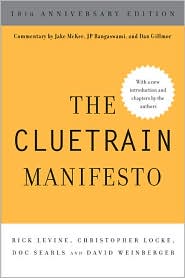
Cluetrain 10th Anniversary edition
Cluetrain 10th Anniversary
Everything Is Miscellaneous
Small Pieces cover
Small Pieces Loosely Joined
Cluetrain cover
Cluetrain Manifesto
My face
Speaker info
Who am I? (Blog Disclosure Form) Copy this link as RSS address Atom Feed

December 10, 2007

Global infrastructure, global ID

At the Cisco Public Services Summit in Stockholm, I’ve heard lots of great presentations about governments’ commitment to providing Internet connectedness across their populations, even — and especially — in the poorer regions. Some amazing projects are underway.


And yet, at the same time, there seems to be a near universal assumption that providing hard ID’s to the population is requisite and desirable. There are obvious reasons why governments want strong digital ID programs, but I’m hearing no discussion of any possible negative consequences of eliminating anonymity as the default on the Web. It seems to be a done deal, at least in the presentations I’ve heard. Not surprising, but to me distressing.

Tweet
Follow me

Categories: Uncategorized Tagged with: digital rights Date: December 10th, 2007 dw

3 Comments »

Making speech cost too much

Hoder is asking his social network to publicize the lawsuit that threatens to bankrupt him. Ethan Zuckerman has posted about this with his usual cogency and moral insight. You don’t have to agree with Hoder to see the suit against him as an attempt to shut out a voice and ideas. You don’t have to agree with Hoder to support him in this.

Tweet
Follow me

Categories: blogs Tagged with: blogs • bridgeblog • digital rights • peace • politics Date: December 10th, 2007 dw

1 Comment »

December 7, 2007

AT&T opens its network using the advanced technology known as “marketing”

According to TechDirt, AT&T’s announcement that it too is opening its network, just like Verizon, means it has in fact simply slapped the label “open” on its existing capabilities. Get yourself an appropriate GSM phone and an AT&T sim card, and you can use the AT&T network.

Yay! Go marketing!

Tweet
Follow me

Categories: Uncategorized Tagged with: digital culture • digital rights • marketing Date: December 7th, 2007 dw

Be the first to comment »

December 5, 2007

Nielsen joins the copyright vigilantes

According to a post by Wendy Davis at Just an Online Minute (citing the WSJ), the Nielsen company (not Jakob) is going to start fingerprinting content and reporting violators. Oh, yay. Yet another soulless company that prefers cash to freedom and control to art is going to protect us. [Tags: nielsen copyright copyleft drm google ]

Tweet
Follow me

Categories: Uncategorized Tagged with: digital culture • digital rights • media Date: December 5th, 2007 dw

Be the first to comment »

I was wrong about Facebook! Yay!

Despite my confident laying of odds, Mark Zuckerberg has announced in a blog post that Facebook now is enabling us to opt out of the Beacon advertising system entirely.

That’s not perfect. It’s still not opt in. And info about your activity on third party sites is still being passed around, unencrypted; if you opt out FB ignores the info, but it’s still sent to them. Nevertheless, the announced change is enough to collect on that 100:1 bet I made.

Fortunately, I neglected to mention any stakes. Whew!

[Tags: facebook privacy marketing ]

Tweet
Follow me

Categories: Uncategorized Tagged with: digital rights • marketing Date: December 5th, 2007 dw

6 Comments »

December 4, 2007

Erica George on LJ

Erica George of the Berkman Center writes about the sense of betrayal among Live Journal’s users about its sale to a Russian company:

I know this one site, it’s fantastic. It has all the features we’re used to and the guy who runs it is totally awesome and he says he will always protect his users’ speech and… it’s Livejournal, circa 2000, or really almost anytime before Brad sold LJ to Six Apart.

Erica’s a long-time LJ’er and has plenty more to say.[Tags: live_journal lj erica_george ]

Tweet
Follow me

Categories: Uncategorized Tagged with: digital rights Date: December 4th, 2007 dw

2 Comments »

The Future of Reading juxtaposed

Mark Pilgrim does some mighty provocative juxtapositioning of then and now quotes about books and reading.

The juxtapositions certainly make the case that things are different. They certainly point to things we’re all be sorry to give up, like being able to lend a friend a book. But, of course, they don’t tell the whole story, because the whole story is not only complex, and it’s not only unwritten, but it’s the story of the coming change in norms. And a change in norms rewrites all the stories leading up to it.

Anyway, it’s a terrific piece. Totally worth getting riled up about. [Tags: ebooks amazon kindle drm copyright copyleft everything_is_miscellaneous]

Tweet
Follow me

Categories: Uncategorized Tagged with: culture • digital culture • digital rights • education • everythingIsMiscellaneous Date: December 4th, 2007 dw

Be the first to comment »

December 3, 2007

The Top Five anti-tech groups in the US

Mark Sullivan in PC World lists and discusses at some length the top five anti-tech organizations in the US, starting with the RIAA.

[Tags: net_neutrality riaa ]

Tweet
Follow me

Categories: Uncategorized Tagged with: digital rights • net neutrality Date: December 3rd, 2007 dw

2 Comments »

November 29, 2007

EMI reducing its sue-our-customers budget

From the DigitalFreedom site:

EMI done paying to prosecute its customers

What happens when the people you pay to represent you, stop acting in your best interest? If you are EMI – one of the largest record labels in the world who has recently come under new ownership – you stop footing the bill. The RIAA has spent millions of dollars to alienate and even prosecute its customers and apparently at least one of its Big Four members is beginning to wonder why and at what cost.

It has been reported that British label EMI is considering a significant cut to the amount of money it provides the trade groups on an annual basis. “EMI, along with each of the Big Four record labels contributes approximately $132.3 million to fund the operations of the IFPI, RIAA, and other national recording industry trade groups. That money is used in part to fund the industry’s antipiracy efforts—including the close to 30,000 file-sharing lawsuits filed by the record labels in the US alone.”

Today’s announcement should come as no surprise to anyone, and certainly not the RIAA. EMI has been at the forefront of understanding their customer’s needs and wants – leading the way in the recent movement away from DRM locked music, and opening the door to customer choice and content flexibility for Amazon.com, Wal-Mart.com, and even Microsoft who now offers millions of DRM free songs.

The RIAA has publicly acknowledged that their strategy to ‘combat piracy’ is costing its members millions with no end in sight. Let’s hope the RIAA gets the message EMI is trying to send and puts their resources back into serving the best interest of its members instead of prosecuting their customers.

[Tags: drm copyright emi riaa marketing ]

Tweet
Follow me

Categories: Uncategorized Tagged with: digital rights • everythingIsMiscellaneous • marketing Date: November 29th, 2007 dw

1 Comment »

November 27, 2007

Berkman lunch: Michael Anti on Chinese blogging

Michael Anti was a NY Times correspondent in Beijing and was a well-known Chinese blogger until the government shut the blog down. He is now a Niemann Fellow at Harvard. He’s giving a Berkman lunchtime talk. (As always, I’m typing quickly, paraphrasing, and missing stuff. You can hear the entire talk at MediaBerkman.)

Michael speaks informally. What happens when decentralized, open blogging meets the centralized, closed Chinese society? From 2004-2005, most dissenting news of China came through blogs. After that, it comes through chat rooms. Chat rooms started in Chinese in around 1998. Now China has gone back to that — very Web 1.0, Michael says. Email and mailing lists are also important for sharing dissenting news about politics, religion, etc. “We don’t use Web 2.0. Why not?” Web 2.0 is democratizing and decentralizing. But blogs aren’t really decentralized because they need centralized servers, which make them easy for the government to control. It is much harder for the government to find chat rooms and shut them down.

Before the Internet, the media were propaganda. With the Internet, people can do the job of traditional media in providing another voice. Michael finds this a more useful way of thinking about the Internet than considering it to be new media.

Sina.com aggregates Chinese newspapers for free. In 2005, they set up their own blog service. The bloggers are VIPs: journalists, professors, celebrities. Blogging has become very mainstream. Like the HuffingtonPost, it’s invited and not really the voice of the people. Bloggers there are like traditional columnists. The bloggers don’t serve as a check on the media; the media are the bloggers.

Michael was a hotel receptionist. He began writing on the Net about the Net. He got hired in 1999 as a journalist on the basis of that. H Thousands of netizens were hired as journalists. Journalism therefore “has an Internet heart.” Journalists welcomed bloggers during the “golden years” of 2004-2005. After that, bloggers and journalists couldn’t post anything sensitive.

The Chinese blogosphere is about recruiting people into the old media, not about new media.

“The guy who censored my blog… we’re close friends.” They talk frequently. “Sorry I have to close down your blog.” “I understand. How about if this weekend we go kayaking?” It’s his job to shut down blogs, but inside he is very liberal.

If you want to find citizen journalism in China, turn to the geeks. And they have “copycats” of the services on the Web that are easier to censor. (Michael says that gmail is popular and very important to the Chinese. It’s too important to government and business to block it.)

There is a network of elite blogs and there are chat rooms. These are the two faces of the social Internet in China. The dark side is that the government has successfully controlled the Internet. Everything is free to talk about except politics.

He doesn’t see any immediate change. China is becoming Singapore, not the US. He hopes that social networking and chatrooms will eventually steer the country towards freedom.

Q: What percentage of the Chinese people are involved in social movements and social networking?
A: Only the middle class and those committed to social change. That’s why I say “elite networking.”

Q: Is most blogging urban or rural?
A: I think blogging happens only in the cities.

Q: What’s the government doing to try to monitor and control chat rooms?
A: Conservatives like chat rooms, as well as liberals do. (In 2005, the anti-Japanese movement spread via chat rooms.) Anonymity is easy in chat rooms.

Q: (doc) Is Red Flag a knockoff of RedHat?
A: Yes. The government doesn’t trust RedHat. It only uses Red Flag. Microsoft gave much of the Windows source code to the government so the government verify there are no back doors.

Q: (ethanz) What percent of Chinese people do you think are aware of the levels of restriction and censorship, and are inclined to find a way around them?
A:The personal life of Chinese is so free that the first time I came to Europe and America I found it so conservative. In China we have sex before marriage, are more tolerant of homosexuality, we have no conservative party, we have no God, it’s very easy to create new companies. The Chinese government allows the people to have so much freedom about sex and business so they’ll accept the political restrictions. The new generation accepts this exchange. Only very weird people care. At least 95% of people don’t care about censorship. I don’t see any hope to change this. In the US, the Internet is Che Guevara. In China, it’s an harmonic ship.

Q: What do you mean by making China into a “big Singapore”?
A: Happy citizens without any political ideas.

Q: (colin) What’s next?
A: Forget anything centralized. E.g., Twitter won’t work. The elites will get further networked. If the political situation changes, China will become liberal very quickly because the media is already liberal on the inside. And if there’s an organizational collapse, the social networks on the Internet will come to the fore. I’m very confident about the future of China because of the Internet.

Q: (me) If there were anonymous blogging, would more people do it?
A: No, because in China it’s all about the name. If you don’t have a recognized name, who cares what you say? Tom Freidman without that name would be no one.
Q: Pseudonyms that gain traction by getting links, etc.?
A: Sometimes a blogger will break news, but after the media picks it up, the blogger is out of the picture.

Q: (colin) Anything that international companies can do?
A: If Congress banned Google from doing business with China, what would happen to gmail? If Microsoft left China, what about Messenger? For Congress, it’s easy to be black and white. But the Chinese people depend on these tools to communicate about freedom and rights. The real cost is Chinese freedom. (Yahoo is different. It’s “a real bad thing.” It “didn’t do any good to China.”) The Chinese authorities want to embrace the Internet, to be part of the international community, not like North Korea. So we should encourage them to do more with the Internet and to continue to say that the Internet is good. The outside world should encourage as well as blame the Chinese government. The Chinese people don’t like blame and don’t like being told what to do. [Tags: michael_anti china blogs censorship berkman ]

Tweet
Follow me

Categories: blogs Tagged with: blogs • culture • digital rights • politics Date: November 27th, 2007 dw

6 Comments »

« Previous Page | Next Page »


Creative Commons License
This work is licensed under a Creative Commons Attribution-NonCommercial-ShareAlike 3.0 Unported License.
TL;DR: Share this post freely, but attribute it to me (name (David Weinberger) and link to it), and don't use it commercially without my permission.

Joho the Blog uses WordPress blogging software.
Thank you, WordPress!