


logo
EverydayChaos
Everyday Chaos
Too Big to Know
Too Big to Know
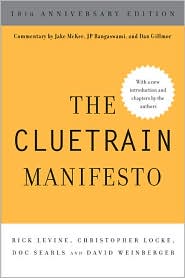
Cluetrain 10th Anniversary edition
Cluetrain 10th Anniversary
Everything Is Miscellaneous
Small Pieces cover
Small Pieces Loosely Joined
Cluetrain cover
Cluetrain Manifesto
My face
Speaker info
Who am I? (Blog Disclosure Form) Copy this link as RSS address Atom Feed

November 26, 2007

Will Facebook end its ad program? Nah.

Alan Patrick of the Broadstuff blog wagers 3:2 that now that the “A List” has weighed in against Facebook’s new ad program, Facebook will drop it.

I’d like to think so (see my post here), but I’d wager 100:1 that Facebook will continue. Of course, I’m neither a bettor nor much of a predictor (remember the glorious eight years of the President Howard Dean administration?), but here’s my thinking:

1. The A-List ain’t what once people thought it was. The folks Alan mentions are influential within the tech community, but they are not the head of the long tail and thus don’t have much direct influence over the broad base of Facebook users. (Alan has me on the list, which makes little sense in terms of readership or influence. But, what the heck. I’m just happy to be on a list.)

2. There has been no great uporoar from Facebook users.

3. Facebook has justifications — rationalizations, in my view — for their decisions. For example, Facebook says if you don’t click on any buttons on the popup that invites you to share news of your purchase, it defaults to “yes” because Facebook wants to encourage users to try the program. Besides, Facebook says with some justice, you have to explicitly click on a “yes” button once you log into Facebook before the news is shared. (Sorry this is confusing. See Ethanz for a clear explanation.) True enough. Nevertheless, this strikes me as an anti-user decision that Facebook wouldn’t have made if it weren’t going to make a gazillion dollars from their ad program.

4. Facebook will make a gazillion dollars from their ad program. [Tags: facebook privacy advertising marketing alan_patrick ]

Tweet
Follow me

Categories: Uncategorized Tagged with: digital rights • privacy Date: November 26th, 2007 dw

5 Comments »

November 25, 2007

RIAA rejects Harvard

Slashdot quotes New York Country Lawyer:

“According to a report on p2pnet.net, the RIAA’s latest anti-college round of “early settlement” letters targets 7 out of 8 Ivy League schools, but continues to give Harvard University a wide berth. This is perhaps the most astonishing display of cowardice exhibited to date by the multinational cartel of SONY BMG, Warner Bros. Records, EMI, and Vivendi/Universal (the “Big Four” record companies, which are rapidly become less “big”). The lesson to be drawn by other colleges and universities: “All bullies are cowards. Appeasement of bullies doesn’t work. Standing up to bullies and fighting back has a much higher success rate.””

While it’s true that Berkman founder Charles Nesson has called on Harvard to fight the RIAA (yay, Charlie!), I don’t find Fear of Harvard Law sufficient explanation. There are some other pretty good (!) law schools around, and the RIAA is happily suing those universities. I don’t get it.

(See NY Country Lawyer’s comment at Slashdot for some useful links.) [Tags: riaa harvard copyright]

Tweet
Follow me

Categories: Uncategorized Tagged with: digital rights • everythingIsMiscellaneous Date: November 25th, 2007 dw

3 Comments »

November 22, 2007

When the law is code

Gene Koo of the Berkman Center blogs about a paper by Danielle Citron titled Technological Due Process, a topic Gene has been studying for a while. Writes Gene:

Professor Citron describes how software code increasingly executes our public laws. Decision support systems, she convincingly argues, quickly become decision making systems. And invariably, the vagaries of the legislative and administrative processes leave large gaps in the specifics of how a given law should be executed. Without firmer guidance from proper governmental bodies, the programmers charged with translating legal code into software code essentially wind up creating law to fill the gaps. (I describe this as “shoving analog pegs into digital slots”). From a procedural – even a Constitutional – perspective, this is a grievously inappropriate delegation of governmental functions to the private sector, not unlike the hiring of Blackwater mercenaries to achieve military objectives. Professor Citron finds, therefore, the need for “technological due process”: safeguards to ensure that software is literally up to code.

Gene adds his own example of how letting software administer law can go wrong: the distribution of food stamps.

This is a big deal…all part of the squeezing out of human judgment and the leeway it enables in the name of efficiency.

[Tags: gene_koo danielle_citron law lawrence_lessig ]

Tweet
Follow me

Categories: Uncategorized Tagged with: culture • digital rights • politics Date: November 22nd, 2007 dw

4 Comments »

November 15, 2007

More on Facebook

My Berkman colleagues Ethan Zuckerman and Wendy Seltzer both have great posts up about the Facebook ad infrastructure that I blogged about yesterday. [Tags: facebook berkman wendy_seltzer ethan_zuckerman privacy advertising ]

Tweet
Follow me

Categories: Uncategorized Tagged with: digital rights • marketing Date: November 15th, 2007 dw

Be the first to comment »

November 14, 2007

Facebook’s Privacy Default

[This post is also running at HuffingtonPost.]

With its new advertising infrastructure, Facebook is being careful
to protect privacy of information. But they are bucking — and
perhaps helping to transform — the norms of privacy. At
its most basic, Facebook is getting the defaults wrong.

The new ad infrastructure enables Facebook to extend their reach onto
other companies’ sites. For example, if you rent a copy of “Biodome”
from Blockbuster.com, Blockbuster will look for a Facebook cookie on
your computer. If it finds one, it will send a ping to Facebook. The
Blockbuster site will pop up a “toast” (= popup) asking if you want to
let your friends at Facebook know that you rented “Biodome.” If you say yes, next time you
log into Facebook, Facebook will ask you to confirm that you want to
let your friends know of your recent rental. If you say yes, that
becomes an event that’s propagated in the news feed going to your
friends.

Facebook has also created a new type of entity to allow non-people
to have a presence in the system. So, a company or a character can
now get a “page,” but not a profile. It can have “fans” but not
“friends.” And the fact that you decided to become a fan of Cap’n
Crunch is yet more information advertisers can use against you.

Facebook makes an astounding array of information available to its
advertisers so that they can precisely “target” likely suspects. This
is great for advertisers, and — given that the ad space is going
to be filled up one way or another — it’s arguably better for
users to see ads that are relevant than are irrelevant. (The
counter-argument is that targeting makes ads more successfully
manipulative, not just more relevant.) Facebook is scrupulous,
however, about not letting advertisers know the identity of those to
whom it’s advertising. So, Blockbuster might buy ads for all men aged
18-24 who have joined the Pauly Shore fan club, but Blockbuster
doesn’t know who those people are.

When Facebook talks about preserving user privacy, that’s what they
have in mind: They do not let advertisers tie the information
about you in a profile (your age, interests, etc.) to the
information that identifies you in your profile (your name,
email address, etc.). That is the informational view of privacy, and
Facebook is likely to continue to get that right, if only because so
many governmental agencies are watching them. I also think that the
Facebook folks understand and support the value of maintaining privacy
in this sense.

Yet, I find myself creeped out by this system because Facebook gets
the defaults wrong in two very significant areas.

When Blockbuster gives you the popup asking if you want to let your
Facebook friends know about your rental, if you do not respond in
fifteen seconds, the popup goes away … and a “yes” is sent to
Facebook. Wow, is that not what should happen! Not responding far
more likely indicates confusion or dismissal-through-inaction than
someone thinking “I’ll save myself the click.”

Further, we are not allowed to opt out of the system. At your Facebook
profile, you can review a list of all the sites you’ve been to that
have presented you with the Facebook spam-your-friends option, and you
can opt out of the sites one at a time. But you cannot press a big red
button that will take you out of the system entirely. So, if you’ve
deselected Blockbuster and the Manly Sexual Inadequacy Clinic from the
list, if you go to a new site that’s done the deal with Facebook,
you’ll get the popup again there. We should be allowed to Just Say No,
once and for all.

Why? Because privacy is not just about information. It’s all about
the defaults.

If a couple is walking down the street, engaged in deep and quiet
conversation, it certainly would violate their privacy to focus
listening devices on them, record their conversation, and post it on
the Internet. The couple wold feel violated not only because their
“information” — their conversation — was published but
because they had the expectation that even though their sound waves
were physically available to anyone walking on the street who cared to
listen, norms prevent us from doing so. These norms are social
defaults, and they are carefully calibrated to our social
circumstances: The default for sidewalks is that you are not allowed
to intercede in private conversations except in special circumstances.
The default for showing up at a wedding party is that they can ask
whether you’re with the bride or groom’s party, but they can’t ask you
to show a drivers license. The default at some schools is that your
grades will be posted on a public bulletin board and at others that
they will not. When we violate these norms, various forms of social
opprobrium ensue. We even have special words for different types of
violations: eavesdropping, being nosy, being a blabbermouth, etc.

Facebook is getting privacy right where privacy is taken as a matter
of information transfer. But it is getting privacy wrong as a norm. Our expectation is that our
transactions at one site are neither to be made known to other sites
nor made known to our friends. We may well want to let our friends
know what we’ve bought, but the norm and expectation is that we will
not. Software defaults generally ought to reflect the social defaults. And
when you’re as important as Facebook — two billion page views a
day — your software’s defaults can nudge the social defaults.

Our privacy norms are changing rapidly. They have to because we’ve now
invented so many new ways to be in public. That’s why Facebook’s move
is especially disappointing. Although they are rigorously supporting
informational privacy, they are setting the defaults based not on
what’s best for their users but on what’s best for them. It’s clearly
and inarguably better for users to be able to opt out of the entire
third-party system, but it’s clearly more lucrative for Facebook to
make it hard to opt out (not to mention making it an opt in system).

Businesses always choose sides, implicitly or explicitly. Facebook has
been notable for being on its users’ side. Not in this case. In fact,
because this new ad plan invokes Facebook on other companies’ sites,
it feels like we’re being ganged up on. Even worse, in this case the
gang is so strong, it could reshape privacy’s norms.

[Tags: facebook social_networking_sites privacy advertising marketing ]

Tweet
Follow me

Categories: Uncategorized Tagged with: digital culture • digital rights • privacy Date: November 14th, 2007 dw

14 Comments »

October 18, 2007

Copyright kidnappers, Google, and the prior restraint of Fair Use

The copyright cartel has decided how they want us to play. According to Reuters:

The companies agreed to use technology to eliminate copyright-infringing content uploaded by Web users and to block any pirated material before it is publicly accessible.

Yeah, well that sucks. Will their fingerprinting technology be able to tell that I’m posting 15 seconds of Bill O’Reilly as part of a mock news report to make fun of him? That’s Fair Use. Technology can’t tell Fair Use from infringement. The copyright cartel’s idea would squeeze the leeway out of the system that allows culture to advance.

Google’s idea with YouTube is a lot better. Copyright holders would register their stuff so that Google can fingerprint it. If I then post the fingerprinted clip of O’Reilly, the copyright holder is notified (actually, Google says they’ll have a tool to identify infringers, so I don’t know if they get actively notified) and is given the option of asking Google to remove the clip or keep it up and get ad revenues from it. If the copyright holder has Google take my clip down, I’m notified and can counter-notify. (This is much like the DMCA, but it’s not the DMCA.) Google’s lawyers will then adjudicate the claim. If it’s not covered by Fair Use, the clip comes down. If they think it is, it stays up.

This beats the cartel’s plan by a mile. Actually, by three miles:

Mile 1: Material is not preemptively blocked from being published. Google thus allows for the possibility of Fair Use.

Mile 2: I have a right of appeal, so to speak, to Google’s lawyers.

Mile 3: Google has provided copyright holders with a damn good reason to allow people to post copyrighted material — the holder not only gets the mind share that comes from letting your material be spread, they also get cold hard cash via ad revenues.

Note, please, that IANAL. If I’m misunderstanding how either the cartel or Google plan works, lets me know. But, as I understand it, Google’s plan is far more aligned with our Founders’ intentions than the piratical cartel’s plan is. [Tags: copyright google copyleft ]

Tweet
Follow me

Categories: Uncategorized Tagged with: digital culture • digital rights Date: October 18th, 2007 dw

5 Comments »

October 13, 2007

Why I wish I could get MythTV to work

David Pogue has a piece about TiVo’s support of the National Hockey League’s use of DRM. I don’t care about hockey (unless that’s the sport the Red Sox play, since residents of Boston are apparently legally required to insert “Go Sox!!!!!” into everything they write), but I do care about handing over to my machines the power to override Fair Use and fair use.

So, after about two years of trying, I sure wish I could get my open source MythTV to work :( [Tags: drm tivo nhl mythtv copyright ]

Tweet
Follow me

Categories: Uncategorized Tagged with: digital rights Date: October 13th, 2007 dw

5 Comments »

October 11, 2007

Explain cookies, win $5,000

Berkman and StopBadware.org, sponsored by Google, are having a contest. Create a YouTube that explains cookies and win yourself $5,000. And before you waste your time getting out the flour and the cookie cutters, be sure to read the rules. [Tags: cookies videos contests youtubes berkman stopbadware.org ]

Tweet
Follow me

Categories: Uncategorized Tagged with: digital rights • web Date: October 11th, 2007 dw

Be the first to comment »

October 9, 2007

Berkman lunch: Drew Clark , Media Tracker

Drew Clark of the Center for Public Integrity is giving a Berkman lunch about the Media Tracker project. [As always, I’m paraphrasing, missing things, getting things wrong. You can always hear the entire talk at Media Berkman.]

In 1934, the Fed Communications Act was passed and the FCC was created. It got authority over radio and the Bell system. “So, for many years you had effectively two sides of the FCC: The wireless side and the wired side.” The past couple of decades has made that much messier. Drew’s group watches the FCC.

He shows the Media Tracker. Type in a zip code and it searches 5 million records and it shows the which media are available there, including TV radio, cable, broadband and newspapers. IT shows that for 94306, Clear Channel has 13 stations. Media Tracker provides three different views and lots and lots of detail, including type of license and parent company. And, of course, you can slice by media company as well, seeing not only how many outlets they own, but also how much they’ve donated to each political rep. Then you can click on a member of Congress to see all the contributions she’s received from individuals and companies in the media sector. (Here’s Google. Here’s Comcast.)

The Media Tracker is part of the Well Connected project which also includes blogs, investigative reports, and the telecom portal at Congresspedia.

Drew also talks about FCC Watch, still in beta. But the work they’ve done on the 700MHz auction gives a taste of what’s to come. They scrape the ex parte summaries every hour to see who’s lobbying which commissioners. (Frontline is the most active lobbyist on this issue, followed by the CTIA .) You can click all the way through to see the summary of a particular lobbyist’s phone calls to a commissioner. You can easily see who, say, Chairman Martin is meeting with.

Q: You’re familiar with Connect Kentucky…?
A: Connect Kentucky has gained a lot of traction in the past year, for some good reasons. It’s a state-led initiative, housed in a non-profit. It started out to get tech deployed in deprived communities. They connect data about broadband availability. It’d be good to also know about competitors, speeds, and prices. Drew would like to build a system for tracking all of this nationally.

Q: (ethanz) I’m dumbstruck to find out that companies are required to register every telephone call their lobbyists make. But what are the data sets that you can’t get? What are the crown jewels that should be available and aren’t?
A: 1. Broadband competition, speed, and price. 2. More detailed reporting about the Congressional lobbying. 3. Do that for the states as well . 4. Likewise for lobbying disclosure for international.

Q: (jpalfrey) We’ve been interested in a distributed app that you download onto your PC. The ONI is interested in this as a way of gathering data about which sites are being filtered, but you could do this for speed tests as well. It’d have three checkboxes: Check for malware, check for filtered sites, and check speeds.
A: eCorridors has a distributed speed test (using NDT, an open source network diagnostic tool) that does something similar.

Q: (doc) How about harnessing the power of the crowd?
A: We want to do that.

Q: (me) Has the ONI thought about having say, Google Tools include its reporting sw as an opt-in? It could also gather Dave’s data.
A: ONI has so far only aimed at “gold standard” data. But we have a project for developing this distributed software, which would provide useful data but not totally trustworthy.

Q: [missed it]
A: This is both a journalism effort and a citizen data effort.

A: Newspapers will be gone in 20 years. It’s time to play taps and move on. We have to think creatively and work collaboratively in some new ways. It has a bright future but a very different future.

Q: (jp) What difference is this info making?
A: It’s always hard to tell. The openness of the Internet is of the same value as the traditional values enshrined in our Constitution. [Tags: center_for_public_integrity media_tracker fcc mashups web2.0 fcc_watch connect_kentucky broadband 700MHz everything_is_miscellaneous net_neutrality ]

Tweet
Follow me

Categories: Uncategorized Tagged with: digital rights • net neutrality • politics Date: October 9th, 2007 dw

1 Comment »

October 8, 2007

Isenberg on the history of Net neutrality

David Isenberg lays out a history of common carriage as part of an argument for Net Neutrality.

You should also note his quoting of Jim Hoffa on AT&T’s decision to censor messages it considers critical of AT&T. [Tags: david_isenberg net_neutrality at&t jim_hoffa free_speech ]

Tweet
Follow me

Categories: Uncategorized Tagged with: business • digital rights • net neutrality • politics Date: October 8th, 2007 dw

11 Comments »

« Previous Page | Next Page »


Creative Commons License
This work is licensed under a Creative Commons Attribution-NonCommercial-ShareAlike 3.0 Unported License.
TL;DR: Share this post freely, but attribute it to me (name (David Weinberger) and link to it), and don't use it commercially without my permission.

Joho the Blog uses WordPress blogging software.
Thank you, WordPress!