


logo
EverydayChaos
Everyday Chaos
Too Big to Know
Too Big to Know
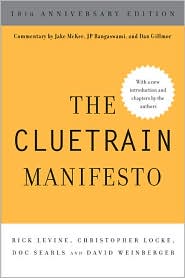
Cluetrain 10th Anniversary edition
Cluetrain 10th Anniversary
Everything Is Miscellaneous
Small Pieces cover
Small Pieces Loosely Joined
Cluetrain cover
Cluetrain Manifesto
My face
Speaker info
Who am I? (Blog Disclosure Form) Copy this link as RSS address Atom Feed

April 11, 2009

World music

I know I’m late to the PlayForChange.com party, but this is a pretty impressive video, on several grounds. Don’t be misled by the opening; it’s not really just about a street musician.


In a semi-related story, the YouTube orchestra is getting ready to play Carnegie hall. To join, you had to post an audition video on YouTube…

[Tags: music worldmusic globalvoices ]

Tweet
Follow me

Categories: Uncategorized Tagged with: bridgeblog • culture • digital culture • globalvoices • music • peace • worldmusic Date: April 11th, 2009 dw

1 Comment »

April 10, 2009

T-Mobile’s structured, commercial spontaneity

I have not unmixed feelings about T-Mobile’s “spontaneous” dance fest in London’s Liverpool Station. (You can see it here. You can see the making of it here.) On the one hand, it’s a very cool event, and people seemed to like it. On the other, I think I’d feel a bit betrayed if I found out that my joyous dancing was actually part of a commercial.

So, overall, thumbs up, and kudos for creativity. But just a bit of pucker of distaste for commercializing the flash mob vision. Not that anyone asked me.

[Tags: flash_mob t-mobile marketing cluetrain ]

Tweet
Follow me

Categories: Uncategorized Tagged with: cluetrain • culture • digital culture • marketing • t-mobile Date: April 10th, 2009 dw

3 Comments »

April 6, 2009

Ethanz at his best

Ethan Zuckerman has a fantastic post about Paul Simon’s South African collaboration. It’s a long, complex story that Ethan tells with his usual clarity and gusto, but it’s not about Paul Simon so much as about the nature of paths between cultures. The simple is complex because cultures emerge from (and shape) history, and history is everything there is plus some more on top of that.

Few can combine his simultaneous grasp of details, his breadth, and his ability to synthesize context. There’s also his vast heart. Read the post. Only Ethan could have written it.

[Tags: ethan_zuckerman paul_simon bridgeblogs blogs south_africa culture ]

Tweet
Follow me

Categories: blogs Tagged with: bridgeblog • bridgeblogs • culture • digital culture • globalvoices • peace Date: April 6th, 2009 dw

Be the first to comment »

April 5, 2009

Songs of Liberation

As I clean my home office for Passover, ere’s a quick refresher on the holiday’s symbols:

The pointer came from my brother Andy, who, in a non-unrelated-email also pointed me to an ACLU petition to get a special prosecutor to look into W’s torture policy.

[Tags: passover pesach liberation torture ]

Tweet
Follow me

Categories: Uncategorized Tagged with: culture • liberation • passover • pesach • politics • torture Date: April 5th, 2009 dw

2 Comments »

April 3, 2009

Gay Iowa

So,now Iowa has decided that marriage is between two people who love each other. I’m shocked and delighted, and just a little disappointed that New England didn’t get to be the first multi-state Republic of Love.

I watch the kids in our local high school, gay and straight together, and I am floored that this change has occurred so quickly. When I was brought up, not only were we deeply homophobic, but we had an entire psychological theory to back us up: Men were afraid of homosexuals because of their own latent homosexuality; we all carried a little gay man inside of us. The prejudice, the fear, and the theory have all drained faster — unevenly distributed, of course — than I could ever have hoped.

Hope.

[Tags: gay_marriage ]

Tweet
Follow me

Categories: Uncategorized Tagged with: culture Date: April 3rd, 2009 dw

1 Comment »

April 1, 2009

When the tubes were tubes

The always insight/delight/ful Molly Wright Steenson describes 19th century pneumatic tube cylinder delivery systems. Quite astounding…and all in 5 minutes and 20 slides. From the O’Reilly Ignite series.

[Tags: tubes pneumatic_tubes packet_switch_networks networks molly_wright_steenson ]

Tweet
Follow me

Categories: misc Tagged with: culture • infohistory • misc • networks • tubes Date: April 1st, 2009 dw

1 Comment »

March 27, 2009

Long-tail museum

Jeff Gates posts about how the Smithsonian American Art Museum is facing the fact that it’s a long-tail phenomenon:

Our Web statistics showed that the number of visitors to our top ten sections paled when compared with the total number of visitors for all other pages, even though only a few people viewed each page. The challenge: how could we make it easier for our online visitors to find things of interest even if that information is buried deep in our site?

He continues:

Museums are changing. Like many other organizations, our hierarchical structure has historically disseminated information from our experts to our visitors. The envisioned twenty-first-century model, however, is more level. Instead of a one-way presentation, our online visitors are often interested in having a conversation with our curators and content providers. In response, many of us at American Art have been looking for ways to engage our public by designing applications that promote dialogue. By encouraging user-generated content and by distributing our assets beyond our own Web site and out across the Internet, we hope to make our content easier to find. In doing so, we are trying to fulfill our long tail strategy. In order to succeed we will need to approach our jobs differently.

And that’s just the introduction.

Meanwhile, the Library of Congress has expanded on its successful 15.7M views Flickr experiment and is now posting material at iTunes and YouTube.

Among the items Web surfers can expect on iTunes and YouTube are 100-year-old films from Thomas Edison’s studio, book talks with contemporary authors, early industrial films from Westinghouse factories, first-person audio accounts of life in slavery, and inside looks into the library’s holdings, including the rough draft of the Declaration of Independence and the contents of President Abraham Lincoln’s pockets on the night of his assassination.

This is all getting just too cool. Time to put the toys back on shelves behind glass

Nah.

[Tags: smithsonian museums libraries library_of_congress everything_is_miscellaneous long_tail ]

Tweet
Follow me

Categories: Uncategorized Tagged with: culture • digital culture • everythingIsMiscellaneous • libraries • museums • smithsonian Date: March 27th, 2009 dw

2 Comments »

March 21, 2009

The wisdom of snake mobs

Amboseli baboons engage in what’s called “snake mobbing”: Rather than fleeing from a predatory snake, they approach it and sound the alarm or even, at times, attack it. (“The Information Continuum,” Barbara J. King, p.43)

Surely this must be a metaphor for something.

[Tags: baboons snakes metaphors ]

Tweet
Follow me

Categories: misc Tagged with: baboons • culture • metaphors • misc • snakes Date: March 21st, 2009 dw

1 Comment »

March 17, 2009

[berkman] David Post on scaling governance

David Post is giving a talk at the Berkman Center about his book In Search of Jefferson’s Moose. I haven’t read the book yet, but it looks fascinating. It looks at cyberspace through Thomas Jefferson’s eyes. [NOTE: I’m live blogging, with all the weaknesses and inaccuracies thereupon. Be warned. And I’ve done a particularly poor job of capturing the details of David’s talk.]

David says the Net is all about scaling. “The Internet isn’t big because it’s the Internet. It’s the Internet because it’s big.” It’s the inter-network that got big. Jefferson figured out how to scale a democratic republic, which works at the town level but hadn’t worked at the national level. Likewise, he says, we need to be thinking about how scale law and governance for this new territory.

He gives the example of copyright. Even if you wanted to clear the copyrights for a YouTube, it’d probably take you 10 hours. Copyright doesn’t scale. “Copyright is supposed to be incentivizing creators” but these works only get created if people ignore copyright. Jefferson scaled a republic to continental scale, we need to do the same for the Net, he says. David says he doesn’t know how to do it. Not through the UN. “We need collectively to begin working on this.” He sees his book as the start of that conversation.

He says we should buy his book because “the omens are with me.” The day he sent off the final draft of his manuscript, a male moose was standing in front of his house in Vermont. The moose stands there for a day and a half. It’s the first one he saw in twenty years. Then, a week after the book was published, they found a complete fossilized skeleton of a mammoth under the new Thomas Jefferson law school, and under that was a whale, and under that there was a giant ground sloth of the same genus as the one Jefferson wrote a scientific paper about. His book is about scale and they find a mammoth, a whale, and a giant sloth under the Jefferson law school.

Q: [zittrain] You’ve vindicated a strand of thinking about the future of the Net. Just as Jefferson was living in a privileged time to think about frontiers, is cyberspace undergoing a similar transformation from frontiered to settled and suburbanized?
A: No. Not if we can keep it growing and, um, generative. There’s a self-fulfilling aspect to our discussions of this. It continues to be a frontier.

Q: [benkler] Why did you mention the UN? Are you suggesting we turn to it? What made the republic scalable was its loosely coupled architecture. That’s what made the Net grow. What is the shape of this international that’s not UN that’s presumably more grownup than cyber-jurisdictions, that retains this loosely coupled…
A: I really don’t know. It’s not too farfetched to think about small groups joining together into larger and larger organizations and coming to the table and saying they deserve respect as a law-making body. It might happen via real world courts that might say that they respect the local laws of this community on the Net.
Q: [benkler] What’s not sustainable about muddling through?
A: It’s totally sustainable, although there are scaling problems that will need to be addressed in some form or another. But then we’ll miss the opportunity to build something even more extraordinary.

Q: You say in the intro that this isn’t a scholarly work, but at the end you do take on the unexceptionalists [i.e., those who think the Net isn’t an exceptional case]. How do you get from your discussion of scale at the routing level to the application layer.
A: Take Wikipedia as an application. I’m not sure that it can continue to scale.

Q: I’m interested in the interaction between copyright law and publishers. We no longer need publishers for the dissemination of scholarly information…
A: I don’t know what the future of copyright looks like. A subtext of the book is to try to have people start fresh, at least as a thought experiment. How might we design copyright law? I don’t know what that looks like or how we get there from here, but it’s worth thinking about … The Jeffersonian insight is that there are two types of people: Those are instrumentalists who only want copyright law if it helps people to create. Others think it’s a moral or natural right. These two views are irreconcilable.

Q [zittrain] Do we need a constitutional convention for the Net? The Clean Slate project at Stanford, David Clark at MIT…What do you think about those projects? If you were at a Clean Slate meeting, what would your charge to them be?
A: They may be premature. I’d like to see a call to netizenship, i.e., citizenship in this space. Taking seriously this as a place where important things happen. At Clean Slate, I’d start with copyright because you could get a consensus among netizens that the system is profoundly broken and needs a new paradigm…maybe a hybrid of law and tech.

Q: [me] Do you worry that if there were a founding constitutional moment for the Net, it might provide an opportunity for, say, the Taliban to object to the very protocols of the Net (as well as the rest of the stack) because the protocols don’t permit the control of content? Might we end up with something far from what you and I want?
A: I worried about this when ICANN was founded. I don’t know, but I have Jeffersonian faith that more discussion is better than less. You have to shine your light and take the chances that you will lose those battles.

Q: [lewis hyde] The Google Books settlement is a constitutinal moment. Isn’t this an example of an ad hoc agreement: Two parties show up in court and the court settles it. If you could change one thing in the settlement, what would it be?
A: I don’t want to shoot my mouth off about that. The Google Books settlement illustrates a point about scaling. There are 40M people who have written books who aren’t represented.

Q: [ethanz] Why doesn’t the conversation start earlier than consitutional moments, i.e., with revolutions that give you the constitutional moment. When and how do we reach the point where we say we can’t just muddle along. We rebel against Facebook but we only get a new fiat from FB. When do we stand up and say that we need to govern ourselves?
A: That’s why I say constitutional moments may be premature. We’re in early days. When people live more of their lives in cyberspace, then I think they care more about the rules under which they live. [Tags: copyleft copyright thomas_jefferson david_post policy ]

Tweet
Follow me

Categories: Uncategorized Tagged with: copyleft • copyright • culture • digital culture • digital rights • policy Date: March 17th, 2009 dw

2 Comments »

March 14, 2009

Shirky’s classic post on the fate of newspapers

This post by Clay Shirky will be at the center of future discussions about the newspaper revolution. It is itself a pivot point. And it’s beautifully written, with a pause-worthy insight in every paragraph.

[Tags: newspapers journalism media clay_shirky everything_is_miscellaneous ]

Tweet
Follow me

Categories: Uncategorized Tagged with: culture • digital culture • everythingIsMiscellaneous • journalism • media • newspapers Date: March 14th, 2009 dw

4 Comments »

« Previous Page | Next Page »


Creative Commons License
This work is licensed under a Creative Commons Attribution-NonCommercial-ShareAlike 3.0 Unported License.
TL;DR: Share this post freely, but attribute it to me (name (David Weinberger) and link to it), and don't use it commercially without my permission.

Joho the Blog uses WordPress blogging software.
Thank you, WordPress!