


logo
EverydayChaos
Everyday Chaos
Too Big to Know
Too Big to Know
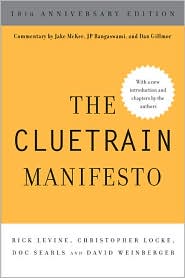
Cluetrain 10th Anniversary edition
Cluetrain 10th Anniversary
Everything Is Miscellaneous
Small Pieces cover
Small Pieces Loosely Joined
Cluetrain cover
Cluetrain Manifesto
My face
Speaker info
Who am I? (Blog Disclosure Form) Copy this link as RSS address Atom Feed

March 13, 2009

Jon Stewart: Squirmatastic righteousness

I thought Jon Stewart’s interview with Jim Cramer last night was a righteous misfire. Stewart was on his high horse, but Cramer was on his little Shetland pony. The result: It was hard to watch.

Stewart was making an important, broad point: Mainstream financial journalism as embodied by CNBC fails the most basic tests of journalism overall. These folks knew better, but give us bread and circuses. Right on, Jon

But feisty, cocky Cramer came onto the show as a Stewart fan, and just kept agreeing and apologizing. I thought ultimately that was pretty disingenuous of Cramer, but it left Stewart looking like a bully. We wanted to see Stewart tear into William Randolph Hearst, but Hearst sent Dear Abby in his place. Except — to mess up the metaphor — Cramer does epitomize CNBC’s tabloiding of financial news, Cramer is a financial insider who knows better, and Dear Abby would have put up more of a fight.

[Tags: jon_stewart jim_cramer cnbc media journalism financial_news ]


You can see the entire, unedited interview here.


The Daily Show runs an anagram contest. The phrase to be anagrammed at the moment is: “Envoys to Afghanistan and Iraq Are Named”

Here’s my best attempt: “On the QT, Iran damns any gain of area saved”

And yours?

Tweet
Follow me

Categories: Uncategorized Tagged with: business • cnbc • culture • entertainment • expertise • journalism • media Date: March 13th, 2009 dw

5 Comments »

February 27, 2009

Beware the Military-Halitosis Complex

Cold war, the cult of expertise, the broadcast metaphor, scientism, chaste kissing…why this one’s got it all!

[Tags: certs advertising expertise ]

Tweet
Follow me

Categories: Uncategorized Tagged with: advertising • certs • culture • expertise • marketing • science Date: February 27th, 2009 dw

5 Comments »

February 24, 2009

[berkman] Pippa Norris on cultural convergence

Pippa Norris of the Harvard Kennedy School is giving a lunchtime Berkman talk titled “Cultural Convergence: The Impact on National Identities and Trust in Outsiders.” [Note: I’m live-blogging, hence making mistakes, missing stuff, misunderstanding other stuff, typing badly. This is an inaccurate, incomplete record of her talk.]

What might be the impact of cosmopolitan communications, she asks? Her thesis is that there are many firewalls that block global information flows. She will argue that the news media has an impact through cosmopolitan communications, and will look at the implications for public policies. It makes people slightly less nationalistic. [Note: She talks fast. Bad for live bloggers, but good for listeners.] (This is from her book, available free on her Web site.)

Globalization is the starting part. It’s about more than trade; it’s also social and political. Cosmopolitan communications = “the way we learn about, and interact with, people and places beyond the borders of our nation-state.” Cosmocomms have been expanding. But, so what, she asks. In the 1970s, this was seen as cultural imperialism. In the 1990s, it was thought of as Coca-colonization. In the 2000s, we’re still seeing cultural protectionism.

Pippa will focus on audio-visual publishing. Western countries remain dominant. In fact, the gap has widened. There are four views in the literature: 1. There’s a convergence around US exports. 2. There’s a polarization of national cultures. 3. There’s a fusion of national cultures. 4. Pippa’s firewall model.

The firewall model says that there are barriers: 1. Trade barriers; 2. Internal barriers to free press; 3. Poverty; 4. Learning barriers that make it harder to acquire values and attitudes.

She discusses three levels: individual, national, and cross-level. For the national, she talks about the “cosmopolitanism index” she’s devised. She’s surveyed 90 countries using a set of survey questions. At the bottom are the poorest countries with the poorest press freedom. At the top, Luxembourg, Switzerland, Norway, Denmark. It goes from 1972-2004.

That’s the framework. She confines her discussion of the results to effects on national identity and trust. Roughly, the more cosmpolitan, the less national identity and higher trust in outsiders. In terms of trusting outsiders, Norway takes the cake. US and Sweden are also high. (The Netherlands are high on the cosmo scale but only in the middle on the trust scale. Also, Germany and Spain.) But because there’s no control group — maybe trust maps to education? — you have to do multilevel regression. She uses age, gender, income, education, and news media use, and finds that trust correlates with news media use.

Her conclusions: Use of the news media “is positively related to more trust in outsiders” (different countries and religions) and “is related to weaker feelings of nationalism.” “I regard that as positive results.” But there are some qualifications: 1. Many other factors create trust in outsiders. 2. This study looks at the impact of news media, but not the impact of entertainment media. 3. There may be self-selection bias or interaction effects.

Policy implications? Is the globalization of news media a threat to national diversity? See www.pippanorris.com …

She concludes by asking what we know about how we measure flows of info from one country to another, over time, say from 1995?

Q: [ethanz] There are some familiar data sets. E.g., Alexa, although because it’s opt-in, it’s not perfect. There’s also Google Search Insights that tracks searches. In most countries, “news” is almost always one of the very top searches. A question: How might your analysis integrate with national-level studies. E.g., a study that showed that as cable TV was introduced to communities in India, you got an increase in empowerment equivalent to 4 years of education. [I probably got this substantially wrong.]

Q: There are categories of trust…
A: We use the World Values survey that includes over a quarter million people. Is trust in Nigeria and Sweden the same? There are many categories indeed. But when you see a strong pattern emerge, as we have, then we should assume something is happening in the data.

Q: A speaker from Microsoft was at Berkman recently, talking about the issues importing and exporting data on the Net across national boundaries. What sorts of measures have you been using?
A: The obvious ones. Internet access. Location of hosts. And some articles that have looked at search terms.

Q: I’m from Poland: High cosmo, low trust. In the US, we rent movies instead of watching TV. But rental stores don’t know about a particular movie highly famous in Europe. My question is about the global dimension of local issues.
A: Poland and much of Central Europe have suddenly become much more open and have found greater value change than in countries open for a long time. You should see greater variation within such countries, e.g., by age.

Q: [smacleod] Pippa asked for ideas about media flows, with some positivist assumptions about the ability of globalization and media studies to be objective. Has she read Appadurai’s “Modernity at Large: Cultural Dimensions of Globalization,” which emphasizes the mutability of flows. I wonder how Pippa might engage on-the-ground research and how such ethnographic research might recast her methodological assumptions. Extensive anthropological field work has been done in all the countries she’s mentioned, which engages and historicizes the legacy of colonialism.
A: I am a positivist. But I also like dealing with cases. There’s rich work being done in communications and other fields, but there’s also good division of labor. You need both. Some people like to fly over a country and others like to walk through it, and you get value from both.

Q: The US has more cultural exports than imports, while most seem to have about equal amounts. How does this play into cosmo?
A: America also imports a lot. America doesn’t have to import a lot because it’s got so much.

Q: Tribal populations in America have a tight tie to geography. Where’s UNESCO is generating the data to look at other regions than nation states?
A: The data generally depend on national statistical offices. UNESCO depends on those; it has no data generation capability itself.

Q: [hal] Google Ad-Planner lets you download a list of the 500 most visited sites for many countries. It has unique visitor numbers.
A: So I could see how many people go into Norway and how many go out.

This gives us a way to focus on globalization of media by focusing on the people, not on the media, Pippa concludes, reminding us that the chapters are up on her site. [Tags: norris_pippa globalization media trust ]

Tweet
Follow me

Categories: Uncategorized Tagged with: culture • digital culture • globalization • media • trust Date: February 24th, 2009 dw

1 Comment »

February 18, 2009

[podcast] Seeing the network – Its traffic, obstructions, and its social effect

The latest Radio Berkman podcast talks with Jonathan Zittrain about Herdict, a service that lets us together discover which sites are being blocked by whom. Then there’s an interview with Judith Donath about her MIT Museum installation that lets us experience what it means to live in a world supersaturated with information.

[Tags: berkman herdict judith_donath jonathan_zittrain art museum network_tools filtering censorship digital_rights ]

Tweet
Follow me

Categories: Uncategorized Tagged with: art • berkman • censorship • culture • digital culture • filtering • herdict • museum Date: February 18th, 2009 dw

Be the first to comment »

February 15, 2009

Marcus Brown’s tweet exegesiseses

Marcus Brown parodies twitter, social software and literary criticism rather savagely and very funnily, picking on some of the leading twitterers. (And the fact that his first video shows him pondering Cluetrain is not exactly an endorsement of Cluetrain.) Sure, it’s unfair to pick a handful of tweets out of context, and twitterers don’t claim to be writing deathless literature. Nevertheless … well, make up your own mind. (Thanks for the link, RageBoy!)

[Tags: twitter humor parody ]

Tweet
Follow me

Categories: Uncategorized Tagged with: culture • humor • parody • twitter Date: February 15th, 2009 dw

1 Comment »

February 13, 2009

SpokenWord.org aggregates spoken words

Douglas Kaye, founder of IT Conversations and the Conversations Network, has launched SpokenWord.org. Here’s part of the announcement:

There are perhaps millions of audio and video spoken-word
recordings on the Internet. Think of all those lectures,
interviews, speeches, conferences, meetings, radio and TV
programs and podcasts. No matter how obscure the topic,
someone has recorded and published it on line.

But how do you find it?

SpokenWord.org is a new free on-line service that helps you
find, manage and share audio and video spoken-word
recordings, regardless of who produced them or where
they’re published. All of the recordings in the
SpokenWord.org database are discovered on the Internet and
submitted to our database by members like you.

This is another public-spirited work from a public-spirited guy who has assembled and inspired a public-spirited collective. [Disclosure: I’m on the board of advisers.]

[Tags: spokenword aggregators collaboration doug_kaye douglas_kaye ]

Tweet
Follow me

Categories: Uncategorized Tagged with: aggregators • collaboration • culture • digital culture • everythingIsMiscellaneous • libraries • metadata • podcasts • spokenword Date: February 13th, 2009 dw

5 Comments »

[open access] Dan Bricklin podcasts a couse on Passover

Dan Bricklin has posted a recording of a reduced version (only five hours!) of a course he took with Rabbi Reuven Cohn about the Passover Haggadah. The Haggadah is the book Jews read aloud before the Pasover meal, recounting one of the religion’s founding events. Because it is a story of liberation, it has resonances all over the place. Dan writes about the class:

The book, mainly in Hebrew, seems to be a random mishmash of different readings and blessings. With the help of the class I learned about its origins 2000 years ago by studying the ancient books of the Talmud, especially the parts called the Mishnah. Through the class I saw this book that I had been reading carefully for my whole life (and the ceremony it describes) in an entirely new light. I got to see it’s important place in the evolution of the Jewish religion after the destruction of the Second Temple in 70 C.E. It also helped give me some insight into the parallel development of Christianity at the same time.

I talked Reuven into giving a short version of the course (only about 5 hours) to some of my friends while I recorded it for sharing on the Internet (under a Creative Commons attribution, non-commercial, no-derivative works license). With the help of a few microphones and a PDF of the handouts, you should be able to feel as if you were there. The participants had a wide range of Jewish backgrounds, from very little Jewish education to extensive. The class was conducted in English.

Reuven is a very gifted teacher, with an interesting background. He received a law degree from Yale and once was a lawyer at a well-known Boston firm. He also received ordination from Yeshiva University and teaches at Hebrew College in Newton and Maimonides School in Brookline.

I have not listened to the podcasts yet, but trust Dan’s judgment implicitly. I find the Jewish method of exegesis to be fascinating, and quite admirable, even while I am unconvinced of the divinity of the work being explained.

It would be interesting to find a similar project explaining some aspect of Islam. [Tags: judaism haggadah pesah passover ]

Tweet
Follow me

Categories: Uncategorized Tagged with: culture • haggadah • judaism • passover • pesah Date: February 13th, 2009 dw

Be the first to comment »

February 11, 2009

How’s Your News?

I really enjoyed the first episode of How’s Your News?, a new series on MTV (Sundays at 10:30 pm EST/PST).

It’s tough to describe. (Tom Shales does a good job.) It documents the travels of a roving bus of “reporters” who are developmentally disabled. The reporters do person-in-the-street interviews and interviews with MTV-ish stars. It’s deeply funny, and bounces around through multiple levels all at the same time.

The obvious criticism is that the show exploits these folks. I don’t think it does even for a minute, although there are undoubtedly people who view it meanly. But, what are you going to do? There are idiots and bullies everywhere. The show in fact takes these folks for what they are. It doesn’t turn them into saints and it doesn’t condescend. The show is created by a guy who works closely with the developmentally disabled.

Now, the truth is that I know this group pretty well. I have a relative who goes to the same summer camp from which this project sprung, and I have spent enough time with them to know that the reporters are participating voluntarily, happily, enthusiastically, aware of their limitations but also of their special strengths and vantage points.

There’s nothing like it on TV.[Tags: hows_your_news jabberwocky developmentally_disabled ]

Tweet
Follow me

Categories: Uncategorized Tagged with: culture • entertainment • jabberwocky Date: February 11th, 2009 dw

Be the first to comment »

February 9, 2009

Sopranos condensed

This video consists of nothing but every curse word in every episode of The Sopranos. It takes 27 minutes.

[Tags: sopranos remix ]

Tweet
Follow me

Categories: Uncategorized Tagged with: culture • entertainment • remix • sopranos Date: February 9th, 2009 dw

Be the first to comment »

February 7, 2009

Here’s how much I care that Michael Phelps smokes pot:

Tweet
Follow me

Categories: Uncategorized Tagged with: culture Date: February 7th, 2009 dw

5 Comments »

« Previous Page | Next Page »


Creative Commons License
This work is licensed under a Creative Commons Attribution-NonCommercial-ShareAlike 3.0 Unported License.
TL;DR: Share this post freely, but attribute it to me (name (David Weinberger) and link to it), and don't use it commercially without my permission.

Joho the Blog uses WordPress blogging software.
Thank you, WordPress!