


logo
EverydayChaos
Everyday Chaos
Too Big to Know
Too Big to Know
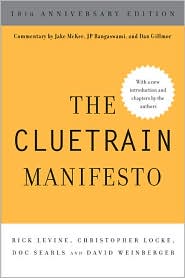
Cluetrain 10th Anniversary edition
Cluetrain 10th Anniversary
Everything Is Miscellaneous
Small Pieces cover
Small Pieces Loosely Joined
Cluetrain cover
Cluetrain Manifesto
My face
Speaker info
Who am I? (Blog Disclosure Form) Copy this link as RSS address Atom Feed

August 15, 2008

Whose advice would you take on the future of the Internet, McCain’s or Craig’s?

Craig Newmark weighs in on McCain’s scary Net agenda. (Craig says something very nice about me, but I’m linking to him anyway.) Craig’s written about this before. For example: Why a president needs to know tech.

And the cuticle on Harold Feld’s pinky knows more about the Net than all of McCain’s personal IM list does (because McCain doesn’t have one). Harold is, um, not impressed with McCain’s policy statement. To put it mildly. [Later: Part 2 of Harold’s post is more substantive but not as funny.]

And that ol’ AT&T veteran and certified visionary — he was right and AT&T was wrong — David Isenberg is equally aghast.

Matt Stoller runs just the subheads of McCain’s policy statement. Hilarious. As Matt says, “Seriously, this is approaching Chuck Norris-level aggrandizement.”

[Later] Susan Crawford, professor of law and ICANN rep, and one of the most clear-headed policy people arounds thinks McCain’s policy is “wistful.”

It’s not just that McCain’s policy is ludicrously wrong about the source and nature of the Internet’s value. It’s that McCain might win, in which case, the Internet is going to get a whole lot worse for us in the US … and, given that high on McCain’s agenda is exporting US copyright totalitarianism, it’s bad news for the rest of the world, too.

(My take, along with some more links, is here It’s also up at HuffingtonPost.) [Tags: ]


More links at Sascha Meinroth’s place, including his own analysis.

Tweet
Follow me

Categories: Uncategorized Tagged with: conference coverage • digital rights • net neutrality • policy • politics Date: August 15th, 2008 dw

6 Comments »

June 28, 2008

Ethanz on PDF and GV

Conference coverage like this and this makes me sorry that Ethan Zuckerman is chairing the Global Voices meeting instead of live blogging it. We need an “and,” not an “or” here. Clearly it’s time that Ethan cloned himself.

[Tags: ethan_zuckerman global_voices pdf ]

Tweet
Follow me

Categories: Uncategorized Tagged with: conference coverage • ethan_zuckerman • globalvoices • global_voices • pdf Date: June 28th, 2008 dw

1 Comment »

June 26, 2008

[reboot08] David Isenberg on the end of bandwidth limitations

David Isenberg shows a fiber optic cable with 864 fibers. Each can carry 155 frequencies that each can carry 10 gigabits. That means three of the fibers can carry the entire busy hour traffic of the USA. If everyone on the planet had a phone and was making a call at the same time, that one cable could carry it, and 100 of the fibers would still be dark. [I’m sure I screwed up some of the numbers, perhaps seriously. Sorry. I’m multitasking because I decided this afternoon that my after dinner talk — entirely new — needs slides.] “The answer to the question ‘How many angels can dance on the head of a pin?’, the answer is ‘How many do you want to dance on the head of a pin?’.”

[Tags: reboot08 broadband david_isenberg ]

Tweet
Follow me

Categories: Uncategorized Tagged with: broadband • conference coverage • david_isenberg • reboot08 Date: June 26th, 2008 dw

4 Comments »

June 19, 2008

Governance discussion at Supernova

Berkman sponsored a discussion at Supernova on governance, the topic of the Publius project. Here are Ross Mayfield’s notes. Sounds like it was a terrific session, with great people on the panel and joining in from the audience. [Tags: berkman publius governance supernova ]

Tweet
Follow me

Categories: Uncategorized Tagged with: berkman • conference coverage • digital culture • governance • publius • supernova Date: June 19th, 2008 dw

Be the first to comment »

June 5, 2008

Dream Ticket a Trois

President: Barack Obama

Vice President: Hillary Clinton

Special ambassador to the Middle East: Bill Clinton

[Tags: politics ]

Tweet
Follow me

Categories: Uncategorized Tagged with: conference coverage • politics Date: June 5th, 2008 dw

6 Comments »

May 27, 2008

ROFLcon post-post-mortem

Christina Xu, one of the founders of ROFLcon, has posted her post-mortem of the event. In fact, she posted this to a mailing list we’re on. Here’s what I posted to that list in reply:

I was there. I thought it was, well, epic.

From the very first sentence of the conference — a call and response
from Leeroy — it was clear that the audience members knew the same
jokes and held the same values, and thus was something more than a
mere audience. The enthusiasm of the attendees was instant,
unbridled and sustained. Given that this was a celebration of a
culture constructed by its own audience, this was appropriate. It felt
more like a movement than a conference.

But, since I am just about three times older than the average
attendee, my reaction is tainted. Oh, sure, I enjoy a funny LOLcats
now and then, but Time magazine covered that meme a year ago. I had to
have a young friend explain the complex history of Anonymous, and the importance of
Leslie Hall only slowly sank in. As for Leeroy, well, I had to look
him up in Wikipedia to get the entire backstory. (This was far more a
WoW than Wikipedia crowd.) It was a revelation to me how far outside
the Net mainstream I’ve become.

So, it’s hard for me to judge how important ROFLcon was. It might have
been a watershed event in which the culture assembled itself into one
physical place long enough to sense its own heft. Woodstock, anyone?
Or it might have been
“merely” a place in which bonds formed and themes coalesced that will
affect the future. I do suspect that it was, in any event, more than
just a good time.

(I might add that, Christina’s modesty aside, the degree of looseness
the event achieved came as a result of especially meticulous,
transparent, organizing by Christina, Tim, and a large, loose cadre). [Tags: roflcon christina_xu internet_culture ]

Tweet
Follow me

Categories: Uncategorized Tagged with: conference coverage • digital culture • roflcon Date: May 27th, 2008 dw

6 Comments »

May 16, 2008

[b@10] Unconf

This morning, we’ve had two unconference sessions, here at the Berkman tenth anniversary conference. And I have to say, as far as I can tell, it’s going really well. The participants (formerly known as attendees) filled in the grid of times and places with a set of great topics, ranging pretty far and quite wide. The people I’ve talked with so far have been enthusiastic about the sessions they went to.

I participated in one on reframing the Net. The discussion was interesting, with some particular insights. The next one was smaller, more like eight people sitting around the table, except four of the people were Charlie Nesson, David Reed, and Jordan Pollack, and Stuart Shieber. The topic had something to do with entropy in information theory and thermodynamics; complexity; the ontological status of math; and the beauty of numbers. It was, well, something. Fantastic. My brow may never unfurrow as I try to understand the implications of that discussion.

Now Josh Marshall is addressing the lunch about how the Net is bringing about the crumbling of the paper news empire. “These things tend to work out well over the fifty year timeline, but in the short term the human cost — and the journalistic cost — is awful.”

[Tags: berkman berkmanat10 ]

Tweet
Follow me

Categories: Uncategorized Tagged with: berkman • berkmanat10 • conference coverage Date: May 16th, 2008 dw

Be the first to comment »

May 15, 2008

[b@10] John Palfrey: Poilitics and the Future of Democracy

John begins by pointing to Publius, a set of essays and discussions about the Net’s many “constitutional moments.” But his overall topic is, as Yochai Benkler frames it, whether the networked sphere expands democracy. E.g., photos and videos of the monks’ protest in Burma were spread through the Internet. [Live blogging. Sloppy. Incomplete. Inaccurate. Wildly incomplete. ]


Argument 1: “The Internet allows more speech from more people than ever before.” JP hands it to Ethan Zuckerman to talk about Global Voices. There are probably more than 100M outside of the US creating content on line, says ethanz. Global Voices tries to surface those voices. International news has gone from a supply problem to a demand problem. How do you find those voices? How do you understand (= translate, contextualize) them? How is your attention held? Ethan says that although he was initially skeptical of blogging, Salam Pax convinced him. But, it’s not perfect. E.g., governments (and sometimes corporations) try to cut down access to the tools. More worrisome, people don’t pay attention to much outside of what the mainstream media tell them to. “We haven’t found the way to shape the news agenda through social media.”

JP puts up the map of the Farsi blogosphere. In response to question about Cass Sunstein’s hypothesis, John Kelly (who made the map) that even though blogs cluster by political stance, they are still densely interlinked.

Argument #2: Although the Net lets more people tell the story, “states are finding more and more ways to restrict online speech and to practice surveillance.” JP points to the OpenNet Initiative, which tracks state blockage of speech.

Esther Dyson: To get Internet to help democracy, we need to fix the people. The Net is just a tool. We need profiles of courage. Also, there’s virality of protest.

Audience: We cannot rely on people doing the right thing. Many think that control and censorship are good things.

Audience: It’s not just a digital divide, but a media literacy gap.

Argument 3: “The Internet facilitates the formation of online groups, which in turn has great impact on democracy and governance.” Ellen Miller of the Sunlight Foundation talks about Public Markup, which enables people to comment on bills, etc. JP asks if there are downsides to this increased transparency. E.g., the star wars kids who didn’t want the exposure. Can people be harmed by transparency and the power of collective action without recourse? Ellen replies, “Not yet.”

JP calls on Yochai Benkler. What questions should we be asking in the next ten years? Benkler responds: “I’m sorry, prof., I didn’t do the reading.” His serious reply is that we are moving from imagining and fearing, to actually gathering data and doing detailed analysis.

David Reed: While the Net is great at group-forming, there is an upper limit. Each group demands attention. There’s an attention economy that limits this. In the political space, you can starve out attention. [Tags: berkman democracy john_palfrey berkmanat10 ]

Tweet
Follow me

Categories: Uncategorized Tagged with: berkman • berkmanat10 • conference coverage • democracy • digital rights Date: May 15th, 2008 dw

2 Comments »

[b@10] Jonathan Zittrain

[

After Dean Kagan (correctly) identifies JZ with the Berkman Center, JZ begins by talking about the importance of the fact that the Net at its start was unconstrained by a need to make money. They therefore didn’t have to count how many people were on it or how much they were using it. So, they made it so anyone could get on just be hooking in. Anyone can build on it. It explains the hourglass shape of the Net: Diverse media, diverse tasks, all going through Internet protocol. [Live blogging: JZ is a great speaker, and my scribbled notes don’t come close to capturing the flow, much less the texture, of his talk.][Note: I’m posting this without re-reading or spellechecking so I can go join the hallway chat.]

IP reflects the constraint and lack of constraint. Ethernet, for example, relies on social conventions to keep the hardware following the protocol. Same with email. The natural way to create email would have been to set up an authenticated database. Instead, email assumes a distributed email address and assumes people won’t spoof addresses. Solutions to problems generally are postponed until the problems arise. He points to the informal, unpretentiousness of the IETF as typical of the founding attitude of the Net.

JZ points to the “generative” power of having programmable computers attached to an open network.

The heart of his argument: The social conventions may not be enough to prevent the “turning of the barge” of the Net. We are losing the fight. Our PC’s assume that codes running there are good and desired, whereas PC’s (and Macs) frequently run programs we don’t understand or want. Vint Cerf has said that perhaps 250M machines around the world are running code waiting for commands to do something evil, e.g., botnets. “This is an absurd situation. We would not allow our cars to be used for joyriding.”

E.g., Pakistan YouTube by exploiting a network weakness: An ISP altered its routing tables so that other routers thought it was one hop from YouTube, so YouTube traffic went that way.

“The Internet is a collective hallucination that works so long as we don’t stare at it too carefully.”

He puts up a 2×2: hierarchy <> polyarchy, and bottom-up<>top-down. (Polyarchy means lots of people can try out lots of things.) JZ says bottom-up = generative and top-down = sterile. He puts the Internet in the bottom-up, polyarchy quadrant. “This area works great until it doesn’t.”

So, then what do you about it? Have the government fix it? A Patriot Act for cyberspace, as Lessig fears? Sometimes the government does intervene, JZ says. E.g., it adjudicates domain name disputes. But he shows the ITU’s architecture for fixing the Internet: an enormously complex chart that is the opposite of the simple Internet hourglass. The changes is to quality of service (not best effort) and fully compliant with all regulatory requirements. That’s the future Internet being designed for us. Likewise, PCs are being locked down. He points to the Mac that says Macs are better because all the pieces come from a single vendor. Even with the coming of the iPhone SDK, all apps have to go through the Apple Store, subject to Apple’s regulations, as announced by Jobs: Nothing illegal, malicious, privacy violative, porn, bandwidth hog or “unforeseen.” JZ thinks that this type of lockdown, which is coming, is the worst of both worlds. Locked down appliances and gated communities.

He points to FaceBook being used as an alternative email, but with pretty hideous terms.

So what do we do? Perhaps the lower left quadrant: bottom-up hierarchy: Bottom up solutions with enough adherents that it has the heft of a hierarchy. We need social buy-in. E.g., Wikipedia has technology that makes the price of mistakes not to high and that lets people talk and come to agreement. That’s the kind of buy-in we want for stopbadware.com at the Berkman Center. But this also requires that we import some practices from the regulatory sphere, e.g., an appeals process to get people off the stopbadware list. We need ways of expressing our social preferences with the condience that they will be respected. But, he says, some of these social techniques can be subverted. And we don’t always agree on norms. When we don’t find solutions in that quadrant, we find ourselves turning to government.


Q: Scottt Bradnor: JZ is sort of right, but hyperbolic.

Q: David Reed: I sort of agree. There were a lot of skeptics when the American democracy was founded. The problems we’re suffering through are not the iconic ones. They’re more subtle. They’re about power shifts and whether commercial entities are really helping us. I’m not convinced the problems are insurmountable. [Tags: ]

Tweet
Follow me

Categories: Uncategorized Tagged with: conference coverage Date: May 15th, 2008 dw

2 Comments »

[b@10] Intros

Terry Fisher talks about the Berkman’s scope. He initiates a cheering section to try induce Jonathan Zittrain to accept Harvard Law’s offer of a professorship. [JZ! JZ! Z!]

Charlie Nesson talks about the values of the Center: “Open code, open acJcess, open talk, open education.” He asks us to build “the university” across all distances. “We are the future of the Internet,” he says.

[Tags: berkman terry_fisher charlie_nesson jonathan zittrain ]

Tweet
Follow me

Categories: Uncategorized Tagged with: berkman • conference coverage Date: May 15th, 2008 dw

Be the first to comment »

« Previous Page | Next Page »


Creative Commons License
This work is licensed under a Creative Commons Attribution-NonCommercial-ShareAlike 3.0 Unported License.
TL;DR: Share this post freely, but attribute it to me (name (David Weinberger) and link to it), and don't use it commercially without my permission.

Joho the Blog uses WordPress blogging software.
Thank you, WordPress!