
logo
EverydayChaos
Everyday Chaos
Too Big to Know
Too Big to Know
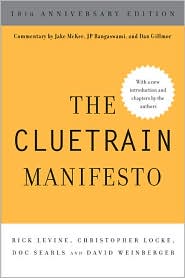
Cluetrain 10th Anniversary edition
Cluetrain 10th Anniversary
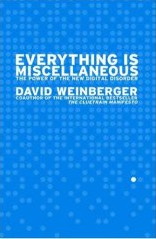
Everything Is Miscellaneous
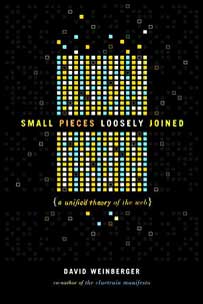
Small Pieces cover
Small Pieces Loosely Joined
Cluetrain cover
Cluetrain Manifesto
My face
Speaker info
Who am I? (Blog Disclosure Form) Copy this link as RSS address Atom Feed

May 15, 2008

[b@10] Berkman@10

The tenth anniversary celebration of the Berkman Center is starting. It’s a two day conference about the future of the Internet. It’s sold out.

The backchannel is at irc://irc.freenode.net/berkman. I assume it’s being webcast but I don’t know where. (I came into the conf room without a program.) The tag is “berkmanat10.” For more, check here. Also, STeve Garfield is streaming it live here.

[Tags: b@10 berkmanat10 ]

Tweet
Follow me

Categories: Uncategorized Tagged with: berkmanat10 • conference coverage Date: May 15th, 2008 dw

Be the first to comment »

April 28, 2008

ROFLcon talk on Web fame

Mary Joyce did a nice job live-blogging my ROFLcon talk. Thanks, Mary! [Tags: roflcon2008 ]

Tweet
Follow me

Categories: Uncategorized Tagged with: conference coverage • roflcon2008 Date: April 28th, 2008 dw

1 Comment »

April 4, 2008

[topicmaps] Change the name?

During the end session, the moderator asked the panel why topic maps have not been catching on as quickly as they should. I suggested that one reason was that people think they’re graphical representations, when in fact they’re a data representation that can be displayed any way that makes sense.

I hit some resistance among the panelists, however. Some maintained that maps themselves are abstractions. Sure, but when you say you’re going to give someone a subway map, they expect a piece of paper with colored lines on it, not an abstract representation of the relationships among the stations.

If I were in the business of selling software that implements topic maps, I’d come up with another name, and at some point mention that underneath is an ISO standard called “topic maps.” Some people at the conference talk about “subject-centric computing,” which is still pretty techie but I find much less confusing than “topic maps.” [Tags: topic_maps marketing ]

Tweet
Follow me

Categories: Uncategorized Tagged with: conference coverage • marketing Date: April 4th, 2008 dw

7 Comments »

[topicmaps] Steve Pepper: Everything is a subject

Steve Pepper begins by talking about Vannevar Bush, whose influence on the Web has been profound. Bush was concerned with finding info, says Steve. His aim was to model how we find info on how the human mind works, i.e., by association. But, says Steve, Bush’s memex revolved entirely around documents, which is not how we think. [Caution: Live-blogging!]

Documents are about subjects. Subjects exist as concepts in our brains. They’re connected by a network of associations. Docs are how we happen to capture and communicate ideas. “Hypertext has been barking up the wrong tree” ever since the memex. (Steve then couches this more softly, acknowledging how much he loves the Web, etc.) We should be organizing information around topics/subjects, not around documents.

Why? Because topic maps reflect how we think. That’s why topic maps are ideal fo web sites. They’re subject-based associative. See topicmaps.com.

Steve counters the impression that topic maps are a portal technology. They were invented in 1991, before the Web. They “just turned out to be ideal for the purpose.” Until recently, they were mainly used for portals, but now they’re used increasingly to represent domains of knowledge. TMs are bigger than Topics, Associations, and Occurrences (TAO), for knowledge has a context. The concept of scope enables the rexpression of contextual validity, enabling multiple viewpoints. This makes topic maps more than a simple semantic tech. Semantics are decontextualized meaning, whereas pragmatics is contextuaiized meaning. See www.hoyre.no

Merging “is the single most powerful feature of topic maps.” Merging was the original motivation for topic maps, merging multiple indexes. It enables a “global knowledge federation.” You can arbitrarily merge any two topic maps. That can’t be done with relational databases or XML documents. But how to make it useful? It vcan’t be done by relying on names since every subject has multiple names, says Steve. The only solution for computers is identifiers. A topic in a topic map is a symbol that represents something in the real world, says Steve. He quotes the ISO definition: “A subject is any ‘thing’ whatsoever, whether or not it exists or has any other specific characteristics, about which anything whatsoever may be asserted by any means whatsoever.”

Meaning is expressed through the relationship between the representation and that to which it refers. Subject identifiers are central to topic maps. For example, which Steve Pepper wrote the letter of protest to the ISO committee? There’s a Steve Pepper in NJ who has a CD called “The Information Age.” But if you look at the metadata on the PDF of Steve’s letter, there’s a URI that describes Steve. This allows humans to disambiguate. At the moment there’s no good way to register such identities. “PSIs [Published Subject Identifiers] are perhaps not the final answer, but they’re a pretty good stopgap” and can easily be remapped if something else turns out to be the answer.

Steve ends by asking Microsoft to become more subject-centric. Windows is highly document-centric he says. He wants a desktop that shows him the subjects and topics he cares about, rather than folders and apps. Although there are some Semantic Web people working on a semantic desktop, Steve thinks Topic Maps is better for human-facing representations of knowledge. Why not have an entire subject-centric operating system, he asks: NLP for categorizing docukents, p2p, facilities for merges, etc.

Topic maps started out as a way to merge indexes, Steve says. It turned into a knowledge representation formalism. Now it’s the flag-bearer for subject-centric computing. Subject-centric computing is a paradigm shift, Steve says, comparing it to object-oriented programming, and then to the Copernican revolution. [Tags: topic_maps steve_pepper ]

Tweet
Follow me

Categories: Uncategorized Tagged with: conference coverage • everythingIsMiscellaneous • knowledge • metadata Date: April 4th, 2008 dw

6 Comments »

[topicmaps] The ontology of Duckberg

Birte Fallet, Kjersti Haukaas and Asbjørn Risan present a topic map of Donald Duck’s world. It cameou t of a master course at Oslo University, with Steve Pepper as tutor.

They show the surprisingly full Duck family tree and the topic map of the relationships. Quackmore is the father of Donald and Della. [See? We learn stuff every day! They made special relationships for cousin, uncle, etc. [Why not infer this from the tree? Possibly because they decided to exclude known members who do not participate in stories.] Some relationships are symmetric, and some are asymmetric. They have a special association type for “unrequited love.” And some characters switch occupations. In fact, Donald seems to have a different job in juist about every episode: museum guard, factory worker, dog catcher… They attached the occuptations to the stories. They’ve captured a lot of detail. [But not a taxonomy of Entertainers Without Pants]

They found topic maps to provide “associative richness,” flexible, easy to learn and “Quite fun actually.” The map is here

[Tags: topic_maps donald_duck ]

Tweet
Follow me

Categories: Uncategorized Tagged with: conference coverage • culture • donald_duck • metadata • topic_maps Date: April 4th, 2008 dw

2 Comments »

[topicmaps] RAMline – a musical timeline

Three musicians from the Royal Academcy of Music — Antony Pitts, Hannah Riddell, and John Drinkwater — talk about using topic maps to organize music. They begin with a snippet of Bach’s “A Musical Offering,” which always strikes me as extraordinarily modern, as well as of course exquisitely beautiful. [Caution: I’m live-blogging and thus only capturing a little of what’s being said, plus making mistakes, writing poorly, etc.]

Anthony talks about one day in the life of the Academy. He zooms in on more and more detail, eventually showing a messy sketch of a small stretch of time, including the works and musicians being discussed and performed, with “A Musical Offering” at the center. It’s a mess. Now he shows a cleaner version that sorts by scores, sounds, ideas and opinions. But the musical work doesn’t exist in any one of those boxes, he says. The music moves from inspiration to notation to interpretation to reception. There are distinct boundaries between them. Anthony treats those as rows and adds columns for creating, capturing, connecting and communicating.

Ultimately, they show a timeline — RAMline — divided into seven rows: idea, composer, score, performer, sound, audience and history. It is fed from a topic map, allowing multiple visualizations.

Anthony shows the ontology. [Pardon me if I don’t try to capture it :)]

Hannah teaches a course on assessing the way music is documented. Students create their own RAMlines, like a CV. “The logic of the topic map has transcended language barriers,” and led them to unexpected conclusions. One student (Laurie) did a map of Bach’s cello suites, tracking versions, arrangements, and publications. Another student has a RAMline of Chopin Scherzo #4, tracking the recordings, etc.

The project is at the end of Phs 1: an internal working model. In phase 3, it goes open access. [Yay!] They hope it will be largest online music knowledge base.

Steve Pepper adds that topic maps started out as a way to capture musical information

Tweet
Follow me

Categories: Uncategorized Tagged with: conference coverage • culture • metadata Date: April 4th, 2008 dw

7 Comments »

April 3, 2008

[topicmaps] Alexander Johannesen on digital libraries

Alexander Johannesen talks about digital libraries. [Caveat: Live-blogging ahead.]

Libraries traditional have had ideals: To secure a significant record, meeting needs of users, access to collections, etc. He states “the bleeding obvious,” beginning with “Oonly the library can save us all.” Libraries are in a unique position. Libraries are trusted, they are the keepers of knowledge and order, librarians care about truth. Librarians are “nice but firm.” And it’s a global institution: Librarians from different cultures understand one another

But what will happen when we have digital books, he asks. The vendors are “small potatoes,” he says, which means they don’t have a lot of time or resource to refashion libraries and save the library world. The infrastructure is aging. There’s fear about the future. MARC is not the right format for the future. For one thing, it’s untyped and it’s unvalidated. And there’s no model except for the cataloging rules.

Topic maps are a perfect match, he says. They’re all about metadata, enable merging and sharing, provide a model, and a global identity.

What should libraries do? Jump in! Get past “not invented here.” Prototype big solutions. Grow “balls of steel.” [And ovaries of Formica? Jeez I hate the “balls” trope. d]

[Tags: topicmaps libraries marc everything_is_miscellaneous ]

Tweet
Follow me

Categories: Uncategorized Tagged with: conference coverage • everything_is_miscellaneous • libraries • marc • topicmaps Date: April 3rd, 2008 dw

3 Comments »

[topicmaps] Sam Oh on FRBR

Sam Oh teaches at Sungkyunkwan U in Korea and heads the ISO committee responsible for Topic Maps (among other things). (I had the pleasure and honor of having dinner with him last night.) [Caution: Live-Blogging]

FRBR tries to capture the various levels of abstraction of our works. Group 1 consists of: work, expression, manifestation, and item. “A work is realized through an expression” that is “embodied in” a manifestation and “is exemplified by an item.” E.g., Othello is a work which may be expressed in English or in Korean. A particular edition of a book is a manifestation, while a particular copy is an item.

Group 2 consists of people and corporate bodies responsible for creating Group 1.

Group 3 are the subject entities that “serve as the subjects of intellectual or artistic endeavor” Concept (topical subject heading), object (name for an object), even (name for an event), place (name for a place). Sam says that FRBR adopted these from topic maps.

There are some defined relationships among these three grups: A work is by a person, a manifestation may be produced by a corporate bdy, etc. Ad there are work to work relationships such as successor, supplement, complement, translation, etc.

Currently, everything is focused on the manifestation level. That’s at the center of the map, so to speak. A future direction for library systems: Applying FRBR in services to present search results, to streamline cataloging, and to express new insights into works. FRBR can “naturally” be rendered in topic maps, he says.

Sam talks about mapping MARC (standard bibliographic records) to FRBR. The OCLC has an algorithm for converting these.

He shows some examples of pages and maps. He also notes that FRBR’s terms for talking about these levels of expression aren’t clear to a general public. E.g., most people don’t talk about “manifestations.” He’d like to see better terms, especially as FRBR gets exposed more widely. He also thinks the library community should come to know topic maps better.

[Tags: sam_oh frbr libraries topicmaps topic_maps oclc everything_is_miscellaneous ]

Tweet
Follow me

Categories: Uncategorized Tagged with: conference coverage • everythingIsMiscellaneous • frbr • libraries • metadata • oclc • taxonomy • topicmaps • topic_maps Date: April 3rd, 2008 dw

5 Comments »

topicmaps] e-government

Petter Thorsrud is a senior advisor to the Norwegian government and responsible for the government’s Web site. He’s going to talk about the “State of the Nation” with regard to semantic interoperability. There was a forum last fall with many governmental groups participating, including education, municipal services, parliament, tax services, etc. Things are moving along.


Marit Lofnes Mellingen [maybe — that’s who’s listed in the program, but they didn’t introduce her by name] gives some examples of semantic interoperability. Semantics is about agreeing on names, she says. The agreement should be minimal so you don’t have to agree on the entire universe.

She points to examples in the health sector. In one case, there are 400 subjects organized into two levels of categories, with synonyms, as well as document type, date, organizational relation (= facet). It uses Dublin Core for documents. “MyPage” is a personalized info portal for citizens. It uses the LOS ontology.

Challenges: Extending the adoption of the common ontologies, merging them with others, driving the categories down to the right level of granularity (so users don’t get too much info). To do this, she thinks we should identify “semantic glue” on a lower level. Also, she’d like to see the ontologies published and made free to use, to enable mashups.

Robert Keil (ex of Razor Fish) says behavior is shifting: People now enter pages through searches, not only through the home page. And the number of portals is increasing. Users want info from the government, but there are many portals to the government.

He shows the Parliament portal” Stortinget.no. It tries to create semantic interoperability around topics. They try to make sure all the retrieved documents are relevant to the query. They use topic maps for this. The status of a matter is presented graphically, with the relevant documents arranged via the info in a topic map. They want to be able to show every parliamentary question with all the relevant info.

Altinn is an Internet portal for “public reporting.” You can get your forms and services there for 20 Norwegian government agencies. The information portal is based on topic maps. It’s smart about the dependency of forms on one another.

Status: Robert quotes Petter: “Before sustems can exchange data, the people behind the systems need to echange information.” Robert says there’s a lot of enthusiasm in the government for semanticizing its information. “We are past the tipping point.” [Tags: topic_maps semantic_web norway ontologies everything_is_miscellaneous ]

Tweet
Follow me

Categories: Uncategorized Tagged with: conference coverage • everythingIsMiscellaneous • norway • ontologies • taxonomy Date: April 3rd, 2008 dw

1 Comment »

[topicmaps] Lars Helgeland on Topic Map-driven Web sites

Lars Helgeland says that Ted Nelson called Web sites “decorated directories.” The Web has failed the expectations of the Web’s visionaries, Lars says. Topic Maps can help.[Caution: Live-blogging]

Web sites have become reflections of their technical structure, which is usually hierarchical. Knowledge is not natively hierarchical. Knowledge works through people associating ideas.

Lars shows examples of sites redesigned using topic maps; they use the knowledge representation of topics maps without using the familiar circles-and-lines display. “We need to see portals as layered architecture, where content is independent of both presentation and the underlying technology structures.”

[Tags: topicmaps lars_helgeland ]

Tweet
Follow me

Categories: Uncategorized Tagged with: conference coverage • everythingIsMiscellaneous • folksonomy • lars_helgeland • taxonomy • topicmaps Date: April 3rd, 2008 dw

Be the first to comment »

« Previous Page | Next Page »


Creative Commons License
This work is licensed under a Creative Commons Attribution-NonCommercial-ShareAlike 3.0 Unported License.
TL;DR: Share this post freely, but attribute it to me (name (David Weinberger) and link to it), and don't use it commercially without my permission.

Joho the Blog uses WordPress blogging software.
Thank you, WordPress!