



logo
EverydayChaos
Everyday Chaos
Too Big to Know
Too Big to Know
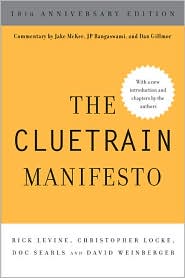
Cluetrain 10th Anniversary edition
Cluetrain 10th Anniversary
Everything Is Miscellaneous
Small Pieces cover
Small Pieces Loosely Joined
Cluetrain cover
Cluetrain Manifesto
My face
Speaker info
Who am I? (Blog Disclosure Form) Copy this link as RSS address Atom Feed

December 21, 2008

Dead Chumby

Here’s what my Chumby looked like last Channukah when I got it:

new chumby

It was sort of fun, but priced about three times higher than its worth, at least to me. And, amazingly, the single most obvious widget — the one that might make it price competitive — doesn’t exist: Plug in a USB drive and have it show the photos that are on it. (It does show photos from your Flickr account.)

Anyway, my Chumby died yesterday, almost a year to the day I got it. I performed a Chumbectomy but was unable to resuscitate it. Here are its innards, for those of you who’ve wondered:


chumby insides

chumby insides

[Tags: chumby ]

Tweet
Follow me

Categories: Uncategorized Tagged with: chumby • tech Date: December 21st, 2008 dw

2 Comments »

December 4, 2008

TinEye’s reverse image search

I’m very proud that a photo that I snapped with my cellphone on a London sidewalk (and that I posted in this blog) is the fourth hit you get when you do a Google image search for “comb over”.

amazing comb over

Now TinEye lets me feed in the photo’s URL and see the other places where it’s been used. You can even give upload the photo itself. TinEye spiders the Web, creating a hash for the images it finds, and then compares the search “term” to the hash. Of course this can be used to track down Violators, but it could also be useful to get more information about an image. The site’s “cool searches” page has some examples of searches that are, well, somewhat cool and that give a sense of the search engine’s tolerance for variations. (Thanks to Michael O’Conner Clarke for the link.)

[Tags: search images combovers ]

Tweet
Follow me

Categories: Uncategorized Tagged with: combovers • everythingIsMiscellaneous • images • search • tech Date: December 4th, 2008 dw

4 Comments »

November 29, 2008

Beginner to Beginner: Splitting strings into arrays in Javascript

I mentioned to my nephew Joel Weinberger, a CS grad student at UC Berkeley, that I wished the Javascript “split” method took multiple delimiters, and within minutes, he wrote one for me. If you know what I’m talking about, you can click here to get a zip file with the code (including a function as well as a method) and a sample. If you don’t …

[Note: all explanations are approximate.] Javascript comes with a built-in method for converting a string (that is, what normally consists of letters and characters in quotes) into an array (that is, a data structure of numbered elements). So, if you have a string that’s really a list of elements, such as “monday, tuesday, wednesday” or “12-345-6,” the split method will automatically chop it up into an array, using a delimiter of your choice (a comma or a dash in the two examples given). This is very useful.

But suppose you have a string such as this: “beef OR chicken AND duck” You want to be able to chop it up at the ORs and the ANDs, but the split method only lets you specify one delimiter.

Enter Joel. His multiSplit method lets you specify an array of delimiters. It chops up the string and records the phrases and their delimiters. Very handy.

Thanks, Joel!

[Tags: javascript_split javascript joel_weinberger ]

Tweet
Follow me

Categories: Uncategorized Tagged with: javascript • tech Date: November 29th, 2008 dw

4 Comments »

November 11, 2008

[berkman] Open Source at Microsoft

Bryan Kirschner (Dir of Open Source Strategy) and Mario Madden (Open Source Licensing Counsel) at Microsoft are giving a Berkman Tuesday lunch talk on Open Source and Microsoft. [NOTE: I am live-blogging, typing too fast, missing things, getting things wrong, etc.]

They start with three framing positions: 1. Open source has changed the info-communications landscape. It’s “neither a fad nor a magic bullet” [missed the attribution] 2. It brings an opportunity for Microsoft, open source developers, and ICT customers. 3. It’s not any harder or easier to realize this potential, compared to other opportunities (e.g., cloud computing).

In 2004, Msft submitted two licenses to the Open Source Initiative. Now there are 500. There are at least 80,000 Open Source apps that run on Windows. Microsoft is virtualizing Linux on Windows and vice versa, and Silverlight is becoming Moonlight (= a Linux version).

Why is Msft doing this?

1. Motivation. What motivates OS developers? (From Karim Lakhani, who is in the room.) They’re motivated by creativity and learning, economic opportunity, and solving a problem.

2. Commercialization. Some of OS is money-driven, while some is community-driven. “At the end of the day, it’s about value-for-cost and solving a customer’s problem.”

There’s a “world of choice” these days. You use the best tool for the job. Mix and match. E.g., they want Windows to be a great platform for OS apps, including for PHP. So, Windows is working with Zen (commercial PHP company) and the PHP community. If your company wants single-sign-on; Msft has Active Directory that does that, including for php aps. Then, if you want to use cloud computing (Windows Azure), you can use it and it works with Active Directory. Then you could have OpenID and Ruby apps running on Linux. Then you might want to use virtualization to rapidly move apps across hardware, and you could then use OpenPegasus to do cross-platform systems management, contributing back to the Pegasus project. “At the application layer, it really makes sense to strive for openness.”

There’s a human relationship and emotions in the OS community, Bryan says. It’s inspirational. Microsoft wants to comingle, cooperate and co-exist.

Q: You touted collaboration with Novell. Many are not happy with that deal. Some people at Novell quit. The Linux kernel community would be a tougher community. They haven’t been happy about joining forces with you. Do you have any plans to bury the hatchet? E.g., Linus Torvalds is unhappy with Msft’s stance on patents…
A: I wouldn’t hold up Novell as a great example. Our customers, especially our large customers, like it a lot, though. It makes commercial sense, although it doesn’t necessarily make everyone feel happy.
A: [mario] The legal team’s job is to help the team navigate the shoals. We did the best we could in the Novell deal.
A: [bryan] We have an active partnership with Samba. Both sides are happy about this.

Q: I’m a European lawyer. Microsoft’s reaction to the European Court’s decision showed no sign of openness? How do you address the abuse that was found and the open attitude you’re expressing today?
A: [bryan] I’m not a lawyer. The question for me is how do you meet the needs of your customers? The overwhelming body of evidence leads you to openness. We will continue to develop .Net. But it’s not zero sum. We also have support php. The Windows media team wrote a plugin so Windows Media Player would work on Firefox. There have been 6 million downloads, so that’s great.
A: [karim] There’s a lag between court decisions and how the company thinks about it.
Q: My point was that you might have saved 500M euros if you had been more open…

Q: Once sw is fully developed, you’re half done. It still needs quality assurance. How do you assure open source software is of high quality? And how do you know it wasn’t stolen from an open source app?
A: [mario] When code is brought in, it’s up to the engineering groups to do the QA. Legally, OS software is just third party code. We brought in 500M lines of code last year. We scan it. A lot of it was Open Source.
A: [karim] Two studies have compared the quality of code from Open Source vs. commercial and found no difference, except perhaps OS is slightly higher quality because the QA is continuous.
A: [bryan] We’re a platinum sponsor of the Apache Foundation. They have overhead. It makes it easier to deal with them if they’re not under terrible financial stress.
A: [mario] When it comes to OS, we’re driven by business purposes. Can we decrease development costs?

Q: [me] What’s the business case that you see for contributing to OS, as well as enabling Windows to work well with OS? How much are you contributing?
A: [bryan] We contribute in three ways. 1. Product strategy. E.g., contribute to php to make it work better with SQL Server. 2. Does it actually make sense for your product to take an OS or hybrid strategy? E.g., Class server is curriculum management system. It competes with OS. It didn’t make sense to compete, so now it’s an OS product. 3. Having more developers creating more code is a good thing. It’s pie-expanding. E.g., we have XNA libraries for developing games. There are hundreds of XNA projects that are open source now.
Q: [me] Are 500 contributions a lot? Compared to the number of patents? Products?
A: We’ll measure success when every product group considers open source.
Q: [karim] IBM says they have 1,000 developers working on Linux, etc. Do you have any number you can point to that’s similar?
A: No.

Q: Has OS affected how stuff gets done inside?
A: Inside the company, we are not the Borg. Every product group has a lot of autonomy. Agile groups. You also have some 3-year-product-plan projects. Increasingly you’ll see a more blended model.
A: [mario] We have 30,000 developers. It’s hard to know, on the IP, what everyone is doing.
A: [bryan] You’ll see a company-wide statement from the company that we understand the world is heterogeneous, we respect the contributions open source has made, and we’re committed to greater openness. I’ll quote Heidegger: Fear is not knowing what to do. The Windows-Linux oppositional framework in 1998 took the public imagination. We formally responded with a site in 2007, so no one will accuse us of acting precipitously :)

Q: When will Steve Ballmer start putting out the OS msg? He has a reputation for being confrontational.
A: [bryan] He’s a strong, opinionated leader. But you’ve already seen Steve talk about the benefits of supporting open source. Inside Msft, the open source group always talks in terms of what makes sense for business.

Q: This has implications for DC policy positions. I.e., very strict IP enforcement.
A: [mario] We may disagree about strict IP; we support patent reform, for example. But we see our business as about IP. We’ll always support IP and IP rights.

Q: Chances are we’ll find out that the new Redmond Congressperson will be a former Microsoft manager. Since Msft employees have funded about a third of her campaign, when your lobbyists are calling her up, will you be asking to support Open Source?
A: [mario] Fascinating question, and I’m sure not going to comment :)
A: [bryan] We don’t want anyone fighting Open Source. We don’t think it makes business sense.

Q: [karim] If we’re back to big iron — Google is a server farm company — how do we think about the role of open source?
A: [bryan] It changes the dynamics. Clouds and server farms open up a lot more space.

[me[ What about OOXML vs. ODF? Why did you push OOXML as a doc format after we already had adopted ODF? Is that typical of what you mean by openness?
A: [bryan] Open doc formats are really important. I don’t see doc standards as a zero sum game. So being able to understand the doc through a published set of docs doesn’t seem exclusive to me.

Karim concludes the session by pointing out how contentious this topic would have been just five years. “The presence of Mario and Bryan here is a sign of success.” [Tags: berkman microsoft open_source ]

Tweet
Follow me

Categories: Uncategorized Tagged with: berkman • digital culture • digital rights • everythingIsMiscellaneous • microsoft • tech Date: November 11th, 2008 dw

5 Comments »

October 23, 2008

Where Puzzle Quest saves games on the Mac

I recently had to reinstall Puzzle Quest on my Mac, and it took me way longer than it should to find where it stashes saved games. So, to save you the trouble:

Puzzle Quest in porting from Windows seems to have taken the shortcut of replicating on the Mac the Windows folder structure. So, you’ll find the saved games here:

/Users/{your_username}/Library/Preferences/Puzzle Quest Preferences/p_drive/My Documents/Puzzle Quest/Saves

Tweet
Follow me

Categories: Uncategorized Tagged with: entertainment • tech Date: October 23rd, 2008 dw

Be the first to comment »

October 16, 2008

Mac Apps folder crash log

Just to follow up on my completely reproducible crash when I access (what is now my old) Applications folder, here are the relevant lines from the system.log:

Oct 16 08:43:49 davidmac2-red-MacBook2 kernel[0]: disk0s2: I/O error.
Oct 16 08:43:49 davidmac2-red-MacBook2 kernel[0]:
Oct 16 08:44:00: — last message repeated 1 time —
Oct 16 08:44:00 davidmac2-red-MacBook2 ReportCrash[9201]: Formulating crash report for process Finder[6298]
Oct 16 08:44:01 davidmac2-red-MacBook2 com.apple.launchd[145] ([0x0-0x152152].com.apple.finder[6298]): Exited abnormally: Bus error
Oct 16 08:44:03 davidmac2-red-MacBook2 /System/Library/CoreServices/coreservicesd[83]: SFLSharePointsEntry::CreateDSRecord: dsCreateRecordAndOpen(Documents) returned -14135
Oct 16 08:44:03 davidmac2-red-MacBook2 /System/Library/CoreServices/coreservicesd[83]: SFLSharePointsEntry::CreateDSRecord: dsCreateRecordAndOpen(davidmac2’s Public Folder) returned -14135
Oct 16 08:44:03 davidmac2-red-MacBook2 /System/Library/CoreServices/coreservicesd[83]: SFLSharePointsEntry::CreateDSRecord: dsCreateRecordAndOpen(_misc) returned -14135
v
Oct 16 08:44:07 davidmac2-red-MacBook2 ReportCrash[9201]: Saved crashreport to /Users/davidmac2/Library/Logs/CrashReporter/Finder_2008-10-16-084349_davidmac2-red-MacBook2.crash using uid: 501 gid: 20, euid: 501 egid: 20

I ran Drive Genius 2 and it found no problems with the drive. (See my previous entry for all else I tried.) Anyone know what this log entry tells me?

[Tags: mac support ]

Tweet
Follow me

Categories: Uncategorized Tagged with: mac • support • tech Date: October 16th, 2008 dw

1 Comment »

October 12, 2008

Applications folder crashes Finder. Re-installed OS X.

Clicking on my Applications folder crashes Finder every time. I have: Nuked the finder plist. Nuked Library/Caches. Nuked the folder’s .DS_Store. Repaired permissions. Used Drive Magician to check the hard drive. Did a fsck. Entered single-user mode and watched it hang as I tried to access that folder via the command line. Nothing worked. So I reinstalled OS X, using the “archive” option, which put my old installation into a folder. The Application folder within the archive still crashes Finder. This is a pain in the butt because it means I can’t transfer my old apps into my new Applications folder.

Plus, I’m really curious about what’s going on. Any ideas?

[Tags: mac os_x ]

[LATER: System.log here.]

Tweet
Follow me

Categories: Uncategorized Tagged with: mac • tech • whines Date: October 12th, 2008 dw

15 Comments »

September 7, 2008

Hacking the Trivial: Governor of Poker game

During the nine-hour plane ride from Amsterdam (after the 1.5 hr flight from Vienna) to Dallas, I figured out how to increase the amount of money you have in the game the Governor of Poker by flipping a bit in the save game file.

I did this because I’ve had a little trouble with the game. It’s a cute Texas hold’em game in which you progress through Texas based on your winnings. Quite possibly because of the oddities of my system, the game several times acted as if it had lost the save file. So, now I copy the save file after every game. But I also was annoyed at having lost the three or four days of “work” acquiring a lump o’ cash. (Please note that in this game, you play against the computer for purely fictitious money. Also, it’s a Windows game I’m running under VMware on my Mac.) So, I spent time on the plane figuring out which bytes in the save file encode the amount of money you have in the game.

So, here are some rough instructions on how to do this. Or, quite likely, totally screw up the game.

The save file is “GovernorOfPoker.sol,” which will be in something like: C:\Documents and Settings\[username]\Desktop\E4VWWMXNC:\Documents and Settings\{username}\Application Data\Macromedia\Flash Player\#SharedObjects\TS2J3QVB\localhost. Make a copy of it and put it somewhere safe.

Did you remember to make a copy? You’re about to edit the save file, and a single wrong byte can trash it.

Get yourself a hex editor. PSPad is free and works well. Open up the save file in it. (Did you remember to make a copy first?)

Look for the word “money” towards the end of the file. The byte you want is 3 bytes after the end of that word. In the version I have, the key byte is #7959.[LATER: The file size changes as you play the game, so there’s no predicting which byte is at issue. Instead, go to the end of the file and look backwards for “money” or “m.o.n.e.y”, depending on how your hex editor displays it.] Change it to “A” and you’ll have something like $3,000 available. Change it to “F” and you’ll have over $100,000. But I haven’t experimented enough to know exactly what the rules are. There’s clearly another byte or two involved in recording the amount. So, you have have to do some experimenting.

Also, did you make a copy?

By the way, on the plane I also watched “Vantage Point,” which just gets more convoluted and less believable with each iteration, plus an hilarious episode of “Frasier” in which Daphne asks Niles to pretend to be her husband to discourage an old flame. [Tags: games governor_of_poker make_a_copy ]

Tweet
Follow me

Categories: Uncategorized Tagged with: entertainment • games • tech Date: September 7th, 2008 dw

77 Comments »

July 29, 2008

Reason #12,563 I love the Web

I’m a-lovin’ Marijn Haverbeke’s Eloquent Javascript, an interactive javascript tutorial. It’s clear, nicely written, nice looking, handy (what with its embedded console for trying scripts out), free, and Creative Commons licensed. It’s easily downloadable so you can run/read it even when you don’t have any of that newfangled “broadband” the kids are so excited about.

Thank you, Marijn. [Tags: javascript javascript_tutorial marijn_haverbeke ]

Tweet
Follow me

Categories: Uncategorized Tagged with: digital culture • javascript • media • tech Date: July 29th, 2008 dw

Be the first to comment »

July 10, 2008

Wanna play Fix My Code?

LATER THAT DAY: I took Wray Cummings’ advice in the comments below, which worked. So, now all the examples of uncentered HR statements in this post are in fact examples of centered HR statements, which makes the post rather mysterious. Imagine, if you will, then, that all of the little horizontal rules are left-justified. And, thanks, Wray!


I know I’m going to be embarrassed about this, but for months, if not for years, I’ve been unable to bend the simple <hr> element to my will. I can adjust its length, but I can’t get the little !@#$% to center itself.

I’ve tried everything I can think of to make it work:

<hr width=’100pt’ >:


<hr width=’100pt’ align=center />:


<hr width=’100pt’ align=’center’ />:


<hr width=’100pt’ style=’text-align:center’ />:


None of these work in Firefox or Safari. I have not intentionally redefined hr in any of my many CSS style sheets, but wouldn’t the local, inline setting take precedence anyway?

What incredibly obvious, embarrassing thing am I missing? Go ahead, make me look bad. And I’ll thank you for it. [Tags: html hr ]

Tweet
Follow me

Categories: Uncategorized Tagged with: hr • html • tech Date: July 10th, 2008 dw

14 Comments »

« Previous Page | Next Page »


Creative Commons License
This work is licensed under a Creative Commons Attribution-NonCommercial-ShareAlike 3.0 Unported License.
TL;DR: Share this post freely, but attribute it to me (name (David Weinberger) and link to it), and don't use it commercially without my permission.

Joho the Blog uses WordPress blogging software.
Thank you, WordPress!