



logo
EverydayChaos
Everyday Chaos
Too Big to Know
Too Big to Know
Cluetrain 10th Anniversary edition
Cluetrain 10th Anniversary
Everything Is Miscellaneous
Small Pieces cover
Small Pieces Loosely Joined
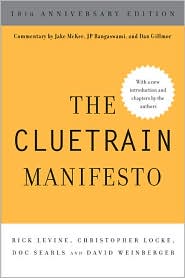
Cluetrain cover
Cluetrain Manifesto
My face
Speaker info
Who am I? (Blog Disclosure Form) Copy this link as RSS address Atom Feed

August 26, 2008

DNC chat again tonight

Last night’s IRC chat party was fun. I’m going to set up a room again tonight, starting at 8pm EDT, so we can watch the Democratic convention together: irc://irc.freenode.net/#democonvo. (If that link doesn’t work for you, you’ll have to download an IRC client. I use Chatzilla, an add-on to Firefox. Once you’ve installed it, plugging the URL into Firefox’s address bar should launch Chatzilla automatically.) (Dave Winer also had a chat going, at #dnc08.)

See you then!

[Tags: dnc campaign chat irc obama dnc08 ]

Tweet
Follow me

Categories: Uncategorized Tagged with: campaign • chat • dnc • dnc08 • irc • obama • politics • social networks Date: August 26th, 2008 dw

1 Comment »

July 6, 2008

RMack on the GV Summit

Great reflective post about the Global Voices Summit from Rebecca MacKinnon…

[Tags: berkman gv globalvoices rebecca_mackinnon ]

Tweet
Follow me

Categories: Uncategorized Tagged with: berkman • globalvoices • gv • peace • social networks Date: July 6th, 2008 dw

Be the first to comment »

June 27, 2008

[reboot] Jyri Engestrom on “Nodal Points”

Jyri Engestrom, whose company, Jaiku, was bought by Google, is talking about “Nodal Points: The emerging real-time social Web.” About four years ago, I heard Jyri talk about “social objects:” at Reboot, a talk that really stuck with me. Now Jyri works on social tools at Google.

Nodal Points is an homage to William Gibson, he says, and especially to a character who can predict the future by seeing patterns in human amounts of data.

Jyri says that social networks don’t explain why people are connected socially. He talks about the importance of social objects — objects that connect people in a social network. “Good web services allow people to create social objects that add value.” Mobile devices can help because they provide sensors that let us capture more data. This will be increasingly true.

Then we need to think about the verbs that people perform on objects. E.g., Flickr’s aggregation of what people have done with your photos. We should be surfacing the available actions.

“Social peripheral vision” lets you see what’s next. If you are unaware of other people’s intentions, you can’t make plans. “Imagine a physical world where we have as much peripheral information at our disposal as in WoW.” Not just “boring update feeds.” Innovate, especially on mobiles. We will see this stuff in the next 24 months. Some examples: Maps: Where my friends are. Phonebook: what are people up to. Email: prioritized. Photos: Face recognition.

Structurally, there are “object lockers” and on top of that a set of “activity aggregators.” “What’s key is filtering out what’s irrelevant.” Pattern recognition matters … hence, nodal points. “It’s not that different from Web search,” except the query is constant and consists of contextual parameters, e.g., who is copresent in the space, what’s in the calendar. “Imagine it’s all funneled into one big query” that runs constantly.

Detecting nodal points: “What should I be aware of that’s happening around me? Was what just happened significant to someone on the network.” And then deliver it to people at just the right time, perhaps via push. “Discovery is becoming social.” “It is the end of the era of search,” i.e., of querying for stuff. From browser to search to share (citing former ceo of paypal). From pagerank to “facerank” where what counts is friends in common, physical proximity, shared taste, shared objects.

He points to OpenID (identity), OAuth (authorization), and OpenSocial (interoperability).


Whe you develop a social service, your questions shoudl be: What is your object? Whare are your verbs? What are your nodal points?

Are we creating echo chambes?
An empirical question. Still open. In my own experience, no. We can build into the software the ability to prompt you with what would be interesting to you even though you would never have thought so. [heavily paraphrased]


[Great talk. And undoubtedly giving insight into Google’s plans for socializing its software.] [Tags: reboot10 reboot jyri_engstrom social_networks google ]

Tweet
Follow me

Categories: Uncategorized Tagged with: digital culture • google • reboot • reboot10 • social networks Date: June 27th, 2008 dw

14 Comments »

June 23, 2008

Traffic regulation by paying attention

From Martin Oetting comes a link to an article in Der Spiegel (in German), which he summarizes:

A small German municipality joined a Euro project in which road signs and all types of visible regulation of the inner-city traffic are abandoned in seven towns across Europe. Instead, all drivers, cyclists and pedestrians are asked (or expected) to more consciously pay attention to everyone else and negotiate the right of way and how and where to park “on the go” – for a more fluid and less rule-driven approach to traffic.

[Tags: everything_is_miscellaneous regulation ]

Tweet
Follow me

Categories: Uncategorized Tagged with: everythingIsMiscellaneous • everything_is_miscellaneous • regulation • social networks Date: June 23rd, 2008 dw

3 Comments »

June 9, 2008

AllVoices

AllVoices is a new site that lets anyone upload an “event,” which in other circumstances might be called a “news story.” The site enables the clustering of bloggage and msm coverage of the event in what looks like a useful way.

I like a lot about it. I just hope it doesn’t become the preserve of yet another homogeneous group, which is exactly what the site doesn’t want to happen.

(It could use tags. [LATER that day: A helpful person from AllVoices tells me that there are tags for user-contributed items but not for ones that the system susses out.] And, at the moment the registration process is broken.)

Tags: allvoices global_voices media news social_tools everything_is_miscellaneous

Tweet
Follow me

Categories: Uncategorized Tagged with: allvoices • digital culture • everythingIsMiscellaneous • everything_is_miscellaneous • global_voices • media • news • social networks • social_tools Date: June 9th, 2008 dw

Be the first to comment »

May 14, 2008

Zenzuu: The social network with a one-track mind

So, I was chatting with the driver of the limo my hosts in Las Vegas kindly supplied for me. When I said that I write about technology, he told me about his startup. It’s a social network that he’s confident will knock FaceBook and MySpace off the map. So, when I got back home tonight, I took a look. The Zenzuu explanatory page consists of a 6-minute video right off of late-night cable.

The pitch is that if you check into Zenzuu 30 times per month, they’ll give you 80% of the ad revs. And if you sign other people up, you’ll get a cut of their ad revs. All of which is fine, and reminds us of the absurd amounts of money we users generate for the social networks we use. But Zenzuu is so focused on the revenues that the video doesn’t mention a single feature of the site.

The fact that all the ads on the site are for Zenzuu itself pushes it over the edge into self-parody.

By the way, would you surprised to learn that Zenzuu’s privacy policy seems to suck, although I’m not sure because it’s in a font designed by and for squirrels.[Tags: social_networking_sites facebook myspace zenzuu ]

Tweet
Follow me

Categories: Uncategorized Tagged with: facebook • marketing • myspace • social networks • social_networking_sites • zenzuu Date: May 14th, 2008 dw

96 Comments »

April 26, 2008

And another thing about fame…

I was talking with Kate Raynes-Goldie of the CBC at the end of the first day of ROFLcon yesterday [live-streamed here] and had a small realization about another difference between broadcast fame and Web fame. A little connection that immediately seemed too obvious to blog about. Nevertheless, here goes….

I said in my talk at the conference yesterday that we are making fame our own, rather than an alienating effect of the broadcast regime, because we make people famous on the Web by passing around links, and that — especially when you watch people watching YouTubes together — it’s a lot like how people tell jokes together: one video reminds someone of another, and there can be a type of pleasant one-upmanship as people try to top the current video with one that’s even better.

Not until I was talking with Kate did the further obviousness occur to me: One of the differences between broadcast and Web fame is that in making someone famous on the Web, we are putting a little bit of our social standing at risk. We’ve got a stake in it.

For example, during the wonderful, impromptu videofest blogged by (and, to a large degree, led by) the wonderful and impromptu Ethan Zuckerman, during Fellows Hour at the Berkman Center last week, everyone was pointing to the next great video to play. In the midst of this, I lost the thread and pointed to a video that, when projected to the group, was out of place and not even very interesting. People shuffled uncomfortably, trying to figure out why I would suggest such a clunker. I was embarrassed. (At least the video was short.)

That we have something at stake in what we recommend is, of course, well understood and completely obvious. But for me, only last night did I recognize that that’s one of the reasons the Web famous feel more like ours than the broadcast famous usually do. Not only do we make them famous, but we do so at some risk to ourselves.

It’s a type of sweat equity, or, in my case during video night at the Berkman, it was more like a type of flop sweat equity. [Tags: roflcon2008 fame ]

Tweet
Follow me

Categories: Uncategorized Tagged with: culture • digital culture • fame • roflcon2008 • social networks Date: April 26th, 2008 dw

1 Comment »

April 1, 2008

Thoughtcloud scrapes neurons

The Media Re:Public group at Berkmanhas announced a breakthrough technology that promises to take the “conference” out of “un-conference.”

Tweet
Follow me

Categories: blogs Tagged with: blogs • business • conference coverage • culture • digital culture • digital rights • folksonomy • humor • science • social networks • taxonomy • tech • uncat • web 2.0 • wifi Date: April 1st, 2008 dw

Be the first to comment »

February 28, 2008

Clay Shirky’s book talk

Clay Shirky is giving his book talk. Here Comes Everybody was released today. It’s immediately necome #1 at two Amazon lists. [Note: I’m typing quickly, getting things wrong, paraphrasing, etc. For an accurate report of what Clay’s book is about, please read Clay’s book.]

The Internet isn’t a decoration on society. It is a challenge. It is important on the order of print and broadcast. Previous media either were two way or they didn’t create groups. Now we have a network that is natively good at group forming. And this medium contains the contents of the others. In a single bullet point his book says: “Group action just got easier.”

Humans are great at forming groups. But they get complicated faster as they get large. A workgroup of 10 has four times more connections than a group of five. There are native disabilities once a group passes a certain size. The typical answer has been to install a hierarchy. Now we’re seeing a set of tools that make it easier to create large groups: Ridiculously easy group forming. E.g., email unexpectedly became the dominant service used on the original Internet. That was because of the “reply all” button, a social feature.

But there’s been an enormous social lag. This tech has not transformed society as rapidly as it might. That’s because groups are innately conservative. No one wants a protocol that shuts out group members. It needed to become ubiquitous and boring. That’s when the social effects become interesting. Clay tells the story of his parents’ first date, a story that is not about internal combustion engines but that depends on the presence of them. We needed the Net to be always present and invisible for it to have its social effect.

Sharing, conversation, collaboration, collective action are rungs on a ladder: How much does an individual have to work to coordinate with the group?

Sharing. E.g., Delicious.com has urls, users and tags. It lowers the difficulty of sharing, so the social effects are practically unintended. It’s “me-first” collaboration (cf. Stowe Boyd).

Tagging systems let you share and then aggregate, reversing the traditional order. E.g., the mermaid parade in Coney Island. Since Flickr added tagging in 2005, you can click mermaidparade and get all the photos. The photographers weren’t coordinated ahead of time. Sharing has become a platform for coordination, rather than vice versa.

The next rung up the ladder is conversation, i.e., people actually synchronizing with one another. Clay shows a “communty of practice” at Flickr: High Dynamic Range photography at Flickr. Pre-Web, it would have taken 5-7 yrs from a pro photographer figuring it out to people in the street doing it. At Flickr, it took 3 months because when a photo went up, people could talk and ask how it was done. People post photos, etc. The medium becomes the platform for a community practice where people help one another get better. No commercial incentive.

That’s an example of “every url is a link to a community.” The discussion can turn into a group sharing resources. Clay points to bronzebeta.com, a Buffy site. It came after the Bronze bulletin board shut down. The fans raised money for new software to create their own bronze. They told the designers not to give it any features: no ratings, no identity mgt. They just wanted the system they used to have, a very basic discussion board.

He also points to Aegisub, a project that required a division of labor. It was a huge collaborative effort without a commercial motivation, or an anti-commercial motivation. Their success resulted in making themselves unnecessary.

The fourth rung is collective action. That’s coming. Three stories:

In Jan, 1999, a Northwest flight was stuck on the tarmac fo 7.5 hours. NW signs a toothless bill of passenger rights. Same thing happened last year and it resulted in legislation. What happened? Kate Hanni was on the second plane. She googled for articles about the flight. She comments on all of them, in detail. At the end of each comment, she asked others on the flight to contact her. She’s coopted the media and turned them into sites for coordination. She goes around to legislators’ offices. William James, the philosopher, once said “Thinking is for doing.” We have brains because we’re deciding between courses of action. Now publishing is for acting.

Second, flash mobs started as a critique of hipster culture. The guy who started them said he could get people to do anything at all if you tell them that it’s a protest against the bourgeoisie. It spread to Belarus: They’d go to a square in Minsk eating ice cream in January. Cops arrested them. It was illegal to form groups in October Sq. The kids turned the joke on hippies into a genuine form of dissident action. They provoked the government into reacting, and documented it. Media led to collective action, and the action led to more media. They thought publicity would make a difference, but the West turned out not to care much about Eastern European dictatorships. The tools are very different when deployed in high or low freedom environments. (They’d also done a flash mob where people walked around October Sq smiling.)

Third, a group ran around Palermo putting up stickers protesting the prominence of the Mafia. It was a big story. Now they’re reversing it. They put up a Web site at which businesses can agree to refuse to pay the protection money. If an individual business were to do this, the Mafia would act. They also let citizens search the site for businesses who’d signed.

So, ridiculously easy group forming improves sharing, convesation, collaboration and collective action. Clay is watching now and in the future to see how collective action evolves, for that is the hardest but could be the most important.

Q: Privacy?
A: Privacy cuts across all of this. The higher up the ladder you go, the more important it matters. For sharing, privacy doesn’t matter much, but if we’re going to converse, I at least need a handle. To collaborate, I need to know more. But if we’re going to bind ourselves in collective action, then identity becomes really important. [Hmm. That last point seems wrong. In some collective action, we don’t need to know much about others. E.g., a flash mob of kids eating ice cream.] Privacy isn’t all or nothing. Under what circumstances do we want people in a collective action to know one another, but not be known by others. The big change in privacy is not in opt-in or opt-out; it’s that we’ve lost “don’t ask.”

Q: Yochai Benkler is working on whether you can explain this other than by enlightened self-interest?
A: There’s a growing literature on explaining behavior via social motivations. Behavioral economics is unambiguous about the ultimatum game: People will refuse deals that seem unfair, even if they’re in their interest.
Q: But social cohesion is to my benefit …
A: What you’d really like to be in a group that produces public goods but not have to contribute. But the willingness of people to spend resources to keep social cohesion going cannot be rolled up just to individual enlightened self-interest. [Missed some of that. Sorry.]

Q: What are the downsides you see?
A: I used to be a cyber-utopian. That view broke for me. I was teaching a class at NYU on social software. One of my students was a community manager for a magazine for teenage girls. They were shutting down the health and beauty boards because we can’t get the pro-anorexia girls to shut up with tips about how to avoid eating. I was thinking this isn’t a side effect of the Net. It was an effect. Ridiculously easy group forming for anorexics. Now, we have to move to a publish-then-filter world. That pattern suggests we’re moving the media world from decision to reaction. We can’t stop the pro-anorexia groups from forming. All we can do is watch and act.

A: My nightmare is that the advertising budget for print shrinks and we lose newspapers in mid-size American cities. We lose investigative journalism. Every city under a million goes back to endemic civic corruption. The newspaper industry is not ready now to talk about how to save investigative journalism as we lost print.

Q: [couldn’t hear it]
A: The social media being used in the presidential campaign is less social than before. Obama excels at fund raising, and public-created media. But no one has proposed a policy wiki. No one has proposed the lateral conversation among supporters. (I’m an Obama supporter.) There may be an opportunity in the first 100 days to do social production of shared ideas, which the campaign has not done so far. But I don’t think it can get there without creating a profound cognitive dissonance among the voters.

Have you looked at the mechanics of collective action?
A: The things that are working now are hard to fake, non-professional surprises. Someone has done something you couldn’t do with a fake grassroots campaign. Most email campaigns to the Senate are of zero value because they’re too easy to fake. [Hmm. It’s not that they’re hard to fake. It’s that they had a cost.] The thing that worries most is the need to be surprising, because surprise is a wasting asset, because you can’t be surprising three times in a row.

Q: [me] Why did you choose the axis of groups that take actions? I can feel I’m a member of the Group That Likes Obama without actually doing anything…
A: I’m interested in the trade-off between individuals and groups. At what point can you not explain behaviors through individual psychology. I was irked by businesses that think they have communities instead of cusomters. The dividing line is between people who change their behavior because they’re in a group and those who don’t.

Q: Mobile streaming and virtual worlds. How do they fit into collective action?
A: The change in things we can do via mobiles will be far broader. And I don’t think there is such a category as virtual worlds. All successful virtual worlds are games. [Tags: berkman clay_shirky here_comes_everybody groups social_software sociology books ]

Tweet
Follow me

Categories: Uncategorized Tagged with: berkman • books • culture • digital culture • groups • social networks • sociology Date: February 28th, 2008 dw

12 Comments »

Come get your Shirky on tonight!*

Clay Shirky is talking about his ultra-new book, “Here Comes Everybody” tonight at 6pm. Here’s the official announcement:

*Thursday, February 28, 6:00 PM*
Austin West Classroom, Austin Hall
Harvard Law School
(No RSVP required)

A handful of kite hobbyists scattered around the world find each otheronline and collaborate on the most radical improvement in kite design indecades. A midwestern professor of Middle Eastern history starts a blogafter 9/11 that becomes essential reading for journalists covering theIraq war. Activists use the Internet and e-mail to bring offensivecomments made by Trent Lott and Don Imus to a wide public and hound themfrom their positions. A few people find that a world-class onlineencyclopedia created entirely by volunteers and open for editing byanyone, a wiki, is not an impractical idea. Jihadi groups tradeinspiration and instruction and showcase terrorist atrocities to theworld, entirely online. A wide group of unrelated people swarms to a Website about the theft of a cell phone and ultimately goads the New YorkCity police to take action, leading to the culprit’s arrest.

With accelerating velocity, our age’s new technologies of socialnetworking are evolving, and evolving us, into new groups doing newthings in new ways, and old and new groups alike doing the old thingsbetter and more easily. You don’t have to have a MySpace page to knowthat the times they are a changin’. Hierarchical structures that existto manage the work of groups are seeing their raisons d’etre swiftlyeroded by the rising technological tide. Business models are beingdestroyed, transformed, born at dizzying speeds, and the larger socialimpact is profound.

See you there!

*I am hoping that this hip and with-it formulation does not mean tonight we will either be having sex with or doing illegal drugs with Prof. Shirky. — The Management[Tags: clay_shirky ]

Tweet
Follow me

Categories: Uncategorized Tagged with: clay_shirky • digital culture • social networks Date: February 28th, 2008 dw

4 Comments »

« Previous Page | Next Page »


Creative Commons License
This work is licensed under a Creative Commons Attribution-NonCommercial-ShareAlike 3.0 Unported License.
TL;DR: Share this post freely, but attribute it to me (name (David Weinberger) and link to it), and don't use it commercially without my permission.

Joho the Blog uses WordPress blogging software.
Thank you, WordPress!