


logo
EverydayChaos
Everyday Chaos
Too Big to Know
Too Big to Know
Cluetrain 10th Anniversary edition
Cluetrain 10th Anniversary
Everything Is Miscellaneous
Small Pieces cover
Small Pieces Loosely Joined
Cluetrain cover
Cluetrain Manifesto
My face
Speaker info
Who am I? (Blog Disclosure Form) Copy this link as RSS address Atom Feed

February 25, 2009

James Boyle on keeping public science open to the public

The Financial Times yesterday ran a terrific op-ed by James Boyle, explaining the ridiculousness of the Conyers bill “that would eviscerate public access to taxpayer funded research.” The op-ed is written in Jamie’s light-hearted-yet-penetrating style, and should be read simply for that reason — preeminent legal scholars of copyright are not supposed to be entertaining.

Then, at the end, he adds an argument that I think is crucial because it addresses the Internet’s effect on knowledge and authority:

Think about the Internet. You know it is full of idiocy, mistake, vituperation and lies. Yet search engines routinely extract useful information for you out of this chaos. How do they do it? In part, by relying on the network of links that users generate. If 50 copyright professors link to a particular copyright site, then it is probably pretty reliable.

Where are those links for the scientific literature? Citations are one kind of link; the hyperlink is simply a footnote that actually takes you to the desired reference. But where is the dense web of links generated by working scientists in many disciplines, using semantic web technology and simple cross reference electronically to tie together literature, datasets and experimental results into a real World Wide Web for science? The answer is, we cannot create such a web until scientific articles come out from behind the publishers’ firewalls….
[Tags: copyright copyleft conyers james_boyle knowledge everything_is_miscellaneous ]

Tweet
Follow me

Categories: Uncategorized Tagged with: conyers • copyleft • copyright • digital rights • everythingIsMiscellaneous • infohistory • knowledge • science • social networks Date: February 25th, 2009 dw

1 Comment »

January 15, 2009

Nature Magzine sets up collaborative education space

Nature Magazine, which should be the stodgiest of the stodgiest, continues to show an admirable flexibility (stopping short of doing the full open access Monty). It’s now created Scitable, “a collaborative learning space for science undergraduates.” It’s got articles, online class tools, teacher collaborative tools, student collaborative tools, discussion areas, consultable experts… I haven’t yet gone through it all.

This initial implementation focuses on genetics. Nature is planning on expanding the topics.

On top of all that, it’s great to contemplate how blase we’ve become about the primordial value of collaborative tools. Collaboration is the new greed.

[Tags: nature_magazine education collaboration genetics teaching ]

Tweet
Follow me

Categories: Uncategorized Tagged with: collaboration • digital culture • education • genetics • media • social networks • teaching Date: January 15th, 2009 dw

Be the first to comment »

January 9, 2009

Analysis of a folksonomic protest

Eugenio Tisselli Vélez has posted an analysis of a tag used in Germany to protest a restriction Flickr placed on photos tagged as unsafe. Among its conclusions:

The analysis of the data shows that protestors most likely disseminated the use of strategic tagging among their contacts, rather than within a particular specific-interest group. A list of contacts is much closer to a hand-picked ensemble of friends than one of such groups, and therefore represents a bigger influence for the list’s owner.

[Tags: everything_is_miscellaneous tagging folksonomy flickr ]

Tweet
Follow me

Categories: Uncategorized Tagged with: everythingIsMiscellaneous • flickr • folksonomy • social networks • tagging Date: January 9th, 2009 dw

1 Comment »

January 4, 2009

Getting past the self-reflexive beginning

A tweet from Jeff Jarvis:

My son says his problem with Twitter is too much Twittering about Twitter. Judging by today, he’s right. And I just added to it.

That used to be the case with blogging when it first started. Every other post (including mine) was about blogging. Blog blog blog blog.

If you want to get out ahead of the curve when the next new social writing phenomenon happens, be the one who never writes about it.

(BTW, I’m dweinberger at Twitter.)

[Tags: tic_tac_toe christmas ]

Tweet
Follow me

Categories: blogs Tagged with: blogs • christmas • digital culture • social networks Date: January 4th, 2009 dw

4 Comments »

December 6, 2008

Twittering for food

#hohoto is shaping up to be a good-works good-time for all. It’s using the digital media we love so well to organize (in a bottom up way with scare quotes around it) a real world charitable event and party that will also push back out into the digital world. All the money goes to the Food Bank.

You have to love the way in which Twitter, which seems like the most evanescent means of communication since the polite nod, is enabling our deepest need to connect. From Twitter to community to social responsibility. +1 all around.

[Tags: twitter digital_culture toronto hohoto food_bank ]


Latter that morning: From Michael O’Connor Clarke, one of the “organizers,” via email:

Quick update: we’re now at $8,000 raised in just a tad over 72 hours. 300 tickets sold, and some great sponsorships.

This thing is rocking. The venue have agreed to waive all costs. Everything – rental fees, staff costs, they’re even giving us the booze at cost (so we can mark it up a tiny bit and direct all the proceeds to the Food Bank). Eventbrite have agreed to eat their usual fee for the registration page. The outpouring of love around this thing is just outstanding.

Tweet
Follow me

Categories: Uncategorized Tagged with: digital culture • everythingIsMiscellaneous • hohoto • peace • social networks • toronto • twitter Date: December 6th, 2008 dw

3 Comments »

November 27, 2008

Control doesn’t scale

I sometimes put up a Powerpoint (well, Keynote) slide that says “Control doesn’t scale.”The assumption that large projects only succeed if they’re centrally controls led and managed turns out to have been true because we limited the scope of what we we considered realistic. You can build a Britannica using a centrally controlled system, but you could not build a Wikipedia that way.

But I know that there are some important counter-examples, so I’ll frequently add, “Except at an huge cost in expense and freedom,” for we know all too well that some regimes have managed to maintain intense control over massive populations for generations.

Today there’s an interview in the Sydney Morning Herald with Isaac Mao, pioneering Chinese blogger and Berkman fellow, in which he says the Chinese authorities are unable to keep up with increasing volume of social communications the 108M bloggers, millions in social networks, and people texting and twittering away.

So, maybe control doesn’t scale after all.

[Tags: isaac_mao control china berkman ]

Tweet
Follow me

Categories: blogs Tagged with: berkman • blogs • bridgeblog • china • control • digital culture • everythingIsMiscellaneous • globalvoices • peace • social networks Date: November 27th, 2008 dw

6 Comments »

November 22, 2008

Our strange new home

I’ve published a new issue of my free newsletter

Our strange new home: A talk to the people in the Chinese government designing ways to use the Net to deliver government services.

Has the Internet been saved?: Obama’s appointments to head the FCC transition team fill me with joy.

The main article is the text of a talk I gave a few weeks ago in Beijing at a one-day seminar/conference for the people in the Chinese government who are putting together sites — portals, usually — to provide government services. These were, I was told, the government people most excited about the opportunities brought by an open Internet. I gave the closing keynote. The previous speakers, from China, S. Korea and Denmark, had expanded the audience’s practical imaginations. I would’ve if I could’ve. Instead, I tried to resolve the seeming contradiction and doubtless cross-cultural meaninglessness that the Internet is weird and the Internet feels homey. It occurred to me afterward that that is the theme of Small Pieces Loosely Joined.

You can read it here.

[Tags: china internet small_pieces ]

Tweet
Follow me

Categories: Uncategorized Tagged with: china • digital culture • egov • infohistory • internet • knowledge • social networks • tagging Date: November 22nd, 2008 dw

Be the first to comment »

November 14, 2008

[berkman] Craig Newmark

Craig Newmark has dropped by the Berkman Center to chat. He begins by asking us what we want him to talk about. A voice opts for the history of CraigsList.com. [NOTE: I’m live-blogging, typing quickly, not correcting typos, getting things wrong, missing entire paragraphs, etc.]

He says that he got a better education than he needed at Case-Western. In early 1995 he wanted to give back some of what he received, he started some mailing lists, including for events, AnonSalon (a fundraiser) and others. People suggested new categories, including apartments. He was using Pine for email, but it started breaking at 240 mailing addresses. He was going to call the list “SFEvents,” but people said they already call it “CraigsList” and that it’s a brand. Craig didn’t know what a brand is, but he stuck with it.

He says he was a literal nerd in HS. He was not on the AV Squad [I was] but he was on the debating team, which led him to delusions about the effectiveness of rational discourse. He says he’s now comfortable with being a nerd.

Eventually he realized he could turn emails into HTML, an instant Web-publishing solution. Over the next few years, he refined the software. If a task took more than an hour a day, he would automate it. At the end of 1997, he hit three milestones: 1. A million page views per month (he hit a billion in 2004 and now is headed toward 13B. There are 26 people at the company). 2. Microsoft Sidewalk asked him to run banner ads. He turned them down because “I am an overpaid programmer.” 3. People volunteered to help. But it failed because he didn’t lead. So, in 1999 he turned it into a business.

He hired Jim Buckmaster “who is a full foot taller than I am.” He’s a really good manager. “I suck as a manager.” The culture there is that people make suggestions, they listen, and they decide what to act on. Also, it’s continued to try to be simple. And they decided to charge people who are already paying but for less effective ads, so they started charging people listing jobs and real estate brokers. “They asked us to charge them to cut down on certain types of spam, and on the need to post and repost.”

He’s always surprised people are willing to pay for what he does for fun. He’s generalized it to nerd values, including: once you have a comfortable living, it’s more fun to change things than to make more money. His business model: “We can do really well by treating people well and doing some good.”

He says he’s now going to half time as a customer service rep, after 14 years of fulltime. You sometimes see ugly things in customer service, he says. E.g., they saw ugly racist stuff during the campaign. “That takes something out of you.”

“I’ve only regretted giving my email address out once.” It was when he was on The View.

Over the past several years, they’ve begun to understand why CL is successful. “It has to do with the culture of trust we have.” There are bad guys but they’re a tiny percentage. “People look out for one another.” E.g., you can flag abusive ads. If enough people vote for it, it’s removed automatically. “That’s a flawed mechanism,” but it works better than not doing it. As Jon Stewart says, (Craig says) you do hear from extremists, but that’s because moderates have stuff to do. You should treat people the way you want to be treated. Corollaries: Live and let live, and give the other person a break. Nothing profound, he says, but it’s hard to follow through. “We’re trying to listen to people still.” “We decide on new cities based primarily on requests for them.” (567 cities now.) Novel ideas are rare. Most of what’s on the site is based on community feedback, although the child care section was Craig’s idea.

“I have no vision at all, but I know how to keep things simple, and I listen some.”

“We’re a good example of how people collaborate in mundane ways to make things happen. Not bad.” On his way to One Web Day he realized, “I’m a community organizer. I’m more of a meta-organizer.”

Nothing about CraigsList is, in his view, altruistic. It’s just people giving another person a break. “I figured I should extend this to other areas.” E.g., “I help people smarter than me help figure out the future of journalism.” E.g., Jeff Jarvis and Jay Rosen.

He’s also interested in grassroots democracy. Face to face is a better way of communicating but it doesn’t scale. On the Net, we get millions of people working together to make stuff happens. “This changes the nature of our democracy,” so that grassroots democracy can address the traditional problems with representative democracy. Craig thanks Joe Trippi and Zephyr Teachout. Now we have this big grassroots infrastructure. What do we do with it? “2008 is the new 1776.”

All sorts of things are happening. “It used to be that the guys with money, power and guns got to write the history and our narratives about ourselves. With Wikipedia, everyone has a shot at doing that…It changes the whole course of human history.” We are at a “singularity,” he says. We’re living in a time like 1776. It’s happening faster because the Internet accelerates everything. “I’m trying to play a microscopic part in it.”

He’s involved with the SunlightFoundation.org. He’s working with ConsumerReports. He was involved a little bit in SF’s 311 number. “Mundane, but it’s part of everyday governance. In my fantasies, I apply that to all levels of government.” A bunch of this is in the Obama platform, he says, and we could see some of it next year.

Veterans have been treated badly by the White House, he says, so he’s on the IAVA.org board. To screen claims faster, maybe they shouldn’t care about fraud so much, since veterans and their families are suffering as they wait for their claims to be processed.

As a nerd, it’s a “crime against nature” to be involved in promotion or communication. But he does it anyway. For one thing, he likes the idea of more people getting involved in service. “I do have one message for the kids: Stay off of my lawn.” :)

“The Constitution will be restored on January 20.”

He says focuses on people who can get things done. He lacks patience for those who can’t get things done.

Q: Are there any ways Craigslist has gone in directions you couldn’t have imagined?
A: I never tried to foresee them so it’s hard to answer. I had to have my arms twisted to create personals. They’ve done much more good than problems. Like “missed connections.” I’ve been asked to perform marriages. In a way, the whole thing has been a surprise. I have no vision. I’ve only responded to feedback. It’s all very surreal, but that’s life now.

Q: Why did CL succeed in the early days, as opposed to doing it over newsgroups?
A: Part of it was that everyone understood mail and Web browsers, while newsgroups were hard to used. And newsgroups were ad-spammed badly.We have a problem with spam, and last week we announced a suit against a company that sells ad-spam software. We aren’t litigious but we thought that was a good way to do it.

Q: Has it been a problem keeping CL simple?
A: Keeping it simple is a habit. There are times when we have to debate whether there should be a specific category, or should people have to register with a valid email on the message boards, but I don’t know how to do things except simply.

Q: What about the deal with National Center for Missing and Exploited Children.. How consensual was the deal?
A: Jim knows the details. He felt strongly about it. There was genuine abuse of our site involving minors. We’re not law enforcement professionals, so we got advice from the real experts. There is that sort of abuse and we have to help out. We just started charging for erotic services and we’ll contribute all that to philanthropies. And how do you manage anonymity? Sometimes you need it, for whistleblowers. We tend to the anonymity side. But congresspeople want to know that an email comes from a constituent rather than a mass spammed email. We’re talking about ways to balance anonymity and authentication, but we do need anonymity as a kind of check and balance against an oppressive government.

Q: Does your exposure to some of the uglier aspects has led you to see a more expansive role for government?
A: I have become more balanced, but mainly because I’ve been doing customer service. The best label I can figure is “moderate Libertarian.” I’m looking for a better label. I’m increasing interested in private-public partnerships since I’ve seen market solutions don’t always work, like for health insurance. I’m in the Net neutrality debate and see people misrepresenting it on purpose. (He adds that most lobbyists are ok, and a small number are predatory.)

Q: You’re in many cities but it still seems to be geared towards regional breakdowns. On purpose?
A: Initially we just followed our gut. CL is like a flea market. People get together to do commerce, but really just to socialize. Penelope Green talked about our site being a market in the ancient sense: chaotic and vividly human.

[me] Why doesn’t your company have meetings?

A: We have some. But we minimize them. A meeting of more than six people is already going to be dysfunctional (small group comms theory). Effective communication is a meeting is tough. This also reflects my impatience, a flaw as a human being.

What will be the future of the Communications Decency Act?
A: This is the part of law that says that a site isn’t responsible for what people say on the site, so long as they take some reasonable measures. I think it will stay and possibly be improved.

Q: Have you had any negative interactions with the police?
A: Not really. Once the FBI called asking if we knew there was an ad for plutonium on our site. The result was that someone got a stern talking to from his parents. The police just want to be treated decently and not jerked around. That’s our customer service idea.

Q: Why can’t people search for subsections?
A: Mysql chews up server time doing these searches. We have some ideas for how to do this, but there are bigger things they’re working on.

[Tags: craiglist craig_newmark customer_service community_organizer cluetrain berkman ]

Tweet
Follow me

Categories: Uncategorized Tagged with: berkman • cluetrain • craiglist • digital culture • digital rights • egov • everythingIsMiscellaneous • marketing • media • net neutrality • politics • social networks Date: November 14th, 2008 dw

2 Comments »

September 24, 2008

Information breeds control

A stray and obvious thought?

If you look at the issue of privacy at social networking sites in terms of information, as outside observers such as parents and governments frequently do, you come up with proposals to enable users to control their information.

But sites like Facebook aren’t about information. They’re about self, others, and the connections among them. Likewise Flickr isn’t about info; it’s about sharing photos.

If the issue gets phrased in terms of info, then the field tilts towards assuming privacy as the good and publicness as the threat, with control over info as the bulwark. But, within the participant’s frame, publicness is taken as the good and privacy as fear-based or selfish.

This is a case where an information-based view misses the phenomenon and can lead to bad policy decisions.

Also, our kids will think we’re dorks.

[Tags: privacy social_networking sns facebook infohist ]

Tweet
Follow me

Categories: Uncategorized Tagged with: digital culture • digital rights • facebook • infohist • infohistory • privacy • sns • social networks Date: September 24th, 2008 dw

1 Comment »

September 22, 2008

One Web Day at Berkman continues: An amazingly cool interface

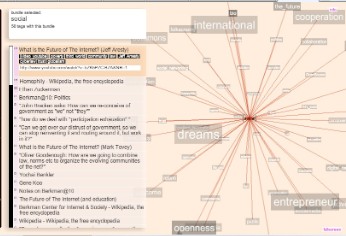
The Berkman Center has today launched an incredible user interface into the Berkman@10 conference. Put together by Bestiario, a group that has done some amazing work — you’ve got to see their home page! — this swirling pixellated cloud of info lets you dive into multiple relationships to browse by topic, person, tag, etc. The nodes that go swirling by display info as appropriate: a scrolling Twitter tweet, live video, etc. Your mind…is it blown yet?

Zack McCune, one of the Berkman’s Super Summer Interns, worked with Bestiario to put this together. Zack describes the process here. It took a lot of work by Zack and by Bestiario. Thank you!

Screen capture of lovely graphical ui by Bestiario

It’s all part of the Berkman Center’s One Web Day celebration.

[Tags: bestario onewebday owd2008 ui zack_mccune ]

Tweet
Follow me

Categories: Uncategorized Tagged with: bestario • digital culture • everythingIsMiscellaneous • onewebday • owd2008 • social networks • tagging • ui Date: September 22nd, 2008 dw

Be the first to comment »

« Previous Page | Next Page »


Creative Commons License
This work is licensed under a Creative Commons Attribution-NonCommercial-ShareAlike 3.0 Unported License.
TL;DR: Share this post freely, but attribute it to me (name (David Weinberger) and link to it), and don't use it commercially without my permission.

Joho the Blog uses WordPress blogging software.
Thank you, WordPress!