


logo
EverydayChaos
Everyday Chaos
Too Big to Know
Too Big to Know
Cluetrain 10th Anniversary edition
Cluetrain 10th Anniversary
Everything Is Miscellaneous
Small Pieces cover
Small Pieces Loosely Joined
Cluetrain cover
Cluetrain Manifesto
My face
Speaker info
Who am I? (Blog Disclosure Form) Copy this link as RSS address Atom Feed

September 7, 2012

Mitt Romney’s distrust of entrepreneurship

Mitt Romney is taking some flack for using some notoriously flaky science as his example of good science. But in the same passage he betrays a Big Corporate view of how innovation works that should cost him the support of every entrepeneurial startup in the country.

Here’s the passage from his Washington Examiner interview (with a hat tip to BoingBoing):

CARNEY: What role should government have in promoting certain industr

And keep in mind that Romney here is not talking about the auto industry specifically; rather, he is explaining why governments ought not to back entrepreneurial companies. It’s not just that governments are bad at picking winners, it’s that when the winners are startups — even when they’re way out of the prototypical garage — they’re unlikely to get past “delight.” So, wies or economic activities such as homeownership, or manufacturing, renewable energy or fossil fuel energy, eBig Corp xports, or just advanced technology? What sort of subsidies and incentives do you favor? You had some of these in Massachusetts, I know.

ROMNEY: Very limited — my answer Big Corp to your first question. I’m not an advocate of industrial policy being formed by a government. I do believe in the power of free markets, and when the government removes the extraordinary burdens that it puts on markets, why I think markets are more effective at guiding a prosperous economy than is the government.

So for instance, I would not be investing massive dollars in electric car companies in California. I think Tesla and Fisker are delightful-looking ve

And keep in mind that Romney here is nBig Corp ot talking about the auto industry specifically; rather, he is explaining why governments ought not to back entrepreneurial companies. It’s not just that governments are bad at picking winners, it’s that when the winners are startups — even when they’re way out of the prototypical garage — they’re unlikely to get past “delight.” So, whicles, but I somehow imagine that Toyota, Nissan, and even General Motors will produce a more cost-effective electric car than either Tesla or Fisker. I think it is bad policy for us to be investing hundreds of millions of dollars in specific companies and specific technologies, and developing those technologies.

I do believe in basic science. I believe in participating in space. I believe in analysis of new sources of energy. I believe in laboratories, looking at ways to conduct electricity with — with cold fusion, if we can come up with it. It was the University of Utah that solved that. We somehow can’t figure out how to duplicate it.

So, first the problem with his science remark. I understand that he’s boosting Utah. But the 1989 experiment by Stanley Pons and Martin Fleischmann was famous not only because it could not be replicated, but because it was prematurely hyped by Pons and Fleischmann before it had gone through peer review or had been replicated. (As BoingBoing points out, the Wikipedia article is worth reading.) No matter what you think of the experiment, it is a terrible example to use as proof that one appreciates basic science…unless you’re citing the rejection of the Pons-Fleischmann results, which Romney explicitly was not. The issue is not merely that Romney continues to believe in a discredited claim. The real issue is that this suggests that Romney doesn’t understand that science is a methodology, not merely the results of that methodology. That’s scary both for a CEO and for a possible president.

I’m at least as bothered, however, by Romney’s casual dismissal of entrepreneurial startups as a source of innovation: “I think Tesla and Fisker are delightful-looking vehicles, but I somehow imagine that Toyota, Nissan, and even General Motors will produce a more cost-effective electric car than either Tesla or Fisker.” “Delightful” is a dismisive word in this context, as evidenced by the inevitability of the “but” that follows it. Romney, it seems, doesn’t believe that startups can get beyond delight all the way to the manly heavy lifting that makes innovation real. For that you need the established, massive corporations.

Wow. Could there be a more 20th century vision of how a 21st century entrepreneurial economy should work?
Tweet
Follow me

Categories: business, politics Tagged with: economy • obama • politics • romney • startups Date: September 7th, 2012 dw

2 Comments »

September 6, 2012

One way Obama’s speech might go

He can’t possibly top Bill Clinton’s speech, but here’s what I hope President Obama does tonight.

First, I hope he stays entirely on policy points, although I wouldn’t mind a little uplifting rhetoric. I certainly don’t need to be told again about Bain.

Second, while Clinton did a superb job explaining what’s wrong with the Republican argument, there’s still work to do. So, I hope tonight President Obama reminds us of all that he has done, for his achievements are epic. But I hope he does so in a way that neatly folds and stacks each item on that laundry list.

For example, he might remind us of how bad the circumstances were, and then show us the method by which he addressed those problems. First, you stimulate the economy: what was the money spent on, and what were the results. Second, you take care of the most vulnerable: here’s what we did, and here are the results. Third, you make investments for the future: here’s what we invested in and here’s why it matters. Fourth, you do this while you also deal with the developments and opportunities the world presents: here’s what happened, and here’s how we responded. Fifth, from Ledbetter to ending Don’t Ask Don’t Tell, you try to make life more fair for all our citizens.

That’s my idea for conveying the methodological competency with which the Administration has dealt with the worst economic meltdown since the Great Depression. But, I’m looking forward to hearing the speech tonight and thinking, “Man, that’s waaay better!”

Tweet
Follow me

Categories: politics Tagged with: obama • politics Date: September 6th, 2012 dw

2 Comments »

September 4, 2012

Couchsnarking: I’ll be tweeting the DNC

Just a warning: I’m going to be watching the Democratic National Convention this week, and undoubtedly will be unable to keep my finger off the tweet button. When I tweeted Romney’s speech at the RNC, I was unable to control the pace of my tweeting, although I expect not to be as provoked during the DNC. (Spoiler: I am a Democrat.)


If you want to follow me — or mute me — my twitter handle is @dweinberger.

Tweet
Follow me

Categories: politics Tagged with: obama • politics • twitter Date: September 4th, 2012 dw

Be the first to comment »

September 3, 2012

If I were running the Democratic National Convention…

Speaker: A system that gives every child a free public education so they’re better citizens and workers. Who built that?

Audience: We built that!

Speaker: That’s right, we Americans built that. Together. And a national highway system in the 1950s that opened up markets for farmers, and small businesspeople. Who built that?

Audience: We built that!

Speaker: And the marvels of science and engineering that put people on the moon, and put the Curiosity rover on Mars. Who built that?

Audience: We built that!

Speaker: And a health care system so that every worker, every mother, every father, every child gets the medical care they need, without having to worry about losing their job or their home. Who built that?

Audience: WE BUILT THAT! WE BUILT THAT! WE BUILT THAT!

Well, you get the point. Let’s own the phrase.

(Also, I believe I have hereby demonstrated one good reason why I am not running the Democratic National Convention.)

Tweet
Follow me

Categories: politics Tagged with: politics Date: September 3rd, 2012 dw

3 Comments »

September 2, 2012

The electoral map looks better for Obama than you think

Vtgenie at DailyKos has an interesting analysis of Nate Silver‘s latest state-by-state polling numbers. (Nate Silver is, of course, the Eric Clapton of poll analysts.)

Here’s VTgenie’s explanation:

…starting with states that each candidate is guarranteed to win, work your way down the probabilities adding electoral votes as you go. So for example, Obama currently is given a 100% chance of winning nine states (go Vermont!) and Maine, district 1, followed by 11 states between 90 and 100%, ending at Pennsylvania with 91%. Assuming Obama will win all of these, we proceed through the next four states, all between 70 and 80%, ending with Ohio at 71% for a total of 275 electoral votes.

Notice that to get to 270, using only Obama’s highest probability states, we never had to use a state with lower than 70%. On the other hand, doing the same process for Romney, using only his highest probability states, he has to use states for which he has a less than 50% chance of winning– in some cases, much less. Put another way, the easiest path to 270 for Romney– in terms of current probabilities– runs through three states between 30 and 40%, ending with Ohio, at only a 29% chance of winning. That’s gotta hurt.

But wait! There’s more…

While Romney has no path to victory using states where his chance of winning is greater than 50%, Obama has not just one but many such paths.

I can’t make it any clearer than that.

VTgenie notes that of course this depends on the accuracy of Nate Silver’s numbers, and things may change, etc. But it seemed trenchant to me. Of course, my math skills do not allow me to have an opinion. Is VTgenie’s analysis right?

Tweet
Follow me

Categories: politics Tagged with: nate silver • obama • politics • polling Date: September 2nd, 2012 dw

Be the first to comment »

August 31, 2012

How Mitt made himself the Invisible Man

[Note: I am Democrat and an enthusiastic Obama supporter. Surprise surprise!]

It took the tweetstream (Ana Marie Cox, for example. Baratunde for another) to get me to watch Mitt Romney’s speech last night. I get too wound up, so I was planning on first reading about the speech and then watching it the next morning (= today). But the tweetstream provided the distance I needed, so I turned on the TV. And then, inevitably, not only did I start tweeting, I couldn’t stop.

I came out of the speech feeling even better about President Obama’s chances. I think Mitt turned himself into Clint’s empty chair last night.

Mitt’s speech was poorly crafted. Oh, I got verklempt when he talked about waking up to a pile of children; that concrete detail did indeed remind me of that ineffably full phase of my life. But like bad fiction where you see the writer’s intention too clearly, it was too apparent that Mitt was telling us these stories in order to get us to see him as a warm human who has shared the elemental moments of life. I do not doubt at all that Mitt loves his family, but the fact that he felt that he had to convince us of that emphasized that the Party feels there’s a question about Mitt’s shared humanity.

Put this next to Clint Eastwood’s bizarre performance art piece, and I think the two elements will quickly merge in America’s mind: An empty chair will symbolize not President Obama, but Mitt as a man who is worried about being perceived as empty. After all, the empty chair trope is usually reserved for a candidate who skips a debate out of fear, which makes no sense in the context of the Republic convention. So, it had to be a way of making the emptiness of character into an issue. And that’s not a winning issue for Romney.

Then add to this the fact that the Net broke the old record for Speed of Satire. Eastwooding became an instant meme. Someone took the Twitter handle “InvisibleObama“and got 22,000 followers by the end of the speech (44,411 right now). Then check the headlines about last night. “Invisible” has become the word of the night.

So, I think Mitt’s speech has set the subtextual agenda: The Invisible Man versus Barack Obama’s character and substance. Even if you don’t much like Obama’s policy proposals, Obama doesn’t have to convince us that he is real, and that his policy comes from his substance as a person.

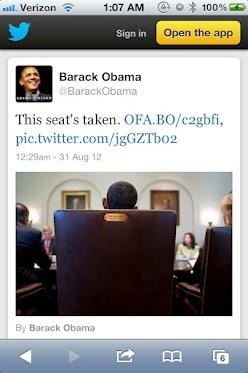
As early evidence of this, check the response — brilliant, I think — from the official “BarackObama tweetstream:

Obama sitting in a chair

Personally, I think Obama should and will win on the basis of the content of his policies. I would prefer that the campaign be about the policies that matter. But the Republican Party made its choice last night, for example, reducing the peril of climate change to a shameful punch line, and issuing a “five-part plan” that stated zero plans. Too bad for all of us, but especially for them. You don’t make “healing the family” your capstone if your acceptance speech plays like a rejected audition tape for Ward Cleaver’s role in “Leave it to Beaver.” The Republicans will lose because last night they made their fears about Mitt the center of the election: He’s just a man in a suit who’s looking for his next promotion.

Tweet
Follow me

Categories: politics Tagged with: obama • politics Date: August 31st, 2012 dw

1 Comment »

July 25, 2012

The Anglo-Saxon president

Wow. An adviser has explained to the Brits that Romney better understands and appreciates the UK because Romney is Anglo-Saxon:

We are part of an Anglo-Saxon heritage, and he feels that the special relationship is special,” the adviser said of Mr Romney, adding: “The White House didn’t fully appreciate the shared history we have”.

This is as close to a casually racist remark as we’re likely to get, at least I hope. I’m finding it hard how to take it otherwise. So, maybe the adviser thought he (she?) was making a positive statement about shared heritage, the way President Clinton might have talked about feeling a special bond with Ireland because of his Irish heritage. But I think this goes beyond tone deafness. This is not a statement of warm feeling, but a negative statement that without that shared heritage, you can’t really understand the UK. It is (to me) very clearly an attempt to boost Romney while declaring Obama to be Other: Obama can’t understand America because he’s not really one of us, where the “us” means Anglo Saxons. If there’s a more charitable way of taking this and its implications, let me know.

I only wish that the first stop had been Germany so that the adviser could have talked about how to fully appreciate the shared history we have with that country, we need an Aryan president.


[A couple of hours later:] The Romney campaign has officially denied it. His press secretary said:

“‘It’s not true. If anyone said that, they weren’t reflecting the views of Governor Romney or anyone inside the campaign,’ she told CBSNews.com in an email. Saul did not comment on what specifically was not true.”

Tweet
Follow me

Categories: politics Tagged with: obama • politics • racism • romney Date: July 25th, 2012 dw

3 Comments »

February 10, 2012

Power politics in the age of Google

[live-blogged yesterday] I’ve come in 30 minutes late (Sorry! I had it marked wrong on my schedule) to a panel at the Kennedy School about politics and the Net. The panel is outstanding: Susan Crawford, Micah Sifry, Nicco Mele, Alexis Ohanian [reddit] and Elaine Kamarck, moderated by Alex Jones.

NOTE: Live-blogging. Getting things wrong. Missing points. Omitting key information. Introducing artificial choppiness. Over-emphasizing small matters. Paraphrasing badly. Not running a spellpchecker. Mangling other people’s ideas and words. You are warned, people.

As I enter, Susan is saying that SOPA was put forward to make PIPA [Senate version] look reasonable, but it obviously backfired. But, she warns, the type of concerted effort that defeated SOPA is special and rare; we can’t count on it happening again.

Nicco says that Google has doubled its lobbying budget, spending $10M this past year. But it hasn’t made much of a dent against the tight relationships among the entertainment industry lobbyists and Congress. “This is not the end of this issue,” he says, referring to the battle over Hollywood content. “It’s more like a battle in the middle of the opening third.” He adds, “The power of the grassroots to shape and drive the debate…was a shock to the insular world inside the Beltway.”

Alex: Suppose there had been the outcry but not the going dark? Was it going dark that did it?

Nicco: It was an expression of the intensity of the situation. It might have had the same outcome. Google didn’t go dark and drove a huge amount of traffic to anti-SOPA sites.

Susan: Google joined a parade smaller sites like Reddit.com had started.

Alex: Is this a watershed moment?

Elaine: No. Sometimes DC gets things wrong. E.g., a Medicare bill was repealed after 16 months because the seniors went nuts about it. This was pre-Internet. “Old ladies were throwing rotten eggs at Dan Rostenkowski.” Also, in 2006 there were local protests against a bipartisan immigration reform law. SOPA was a perfect example of a bunch of old guys — Chris Dodd et al. — not understanding that they were playing with fire. They didn’t take into account the intensity the Net citizens felt. There’s nothing fundamentally different from what we’ve seen before: Sometimes the folks in Washington just don’t get it.

Alex: We tried to get people on the other side to join us, but I’ll take their side. An op-ed yesterday said that the anti-SOPA digital tsunami was an abuse of democracy.

Micah: That was a frustrating op-ed because he doesn’t imagine that the citizens who were linking and faxing had agency. He assumes they were all duped by Google etc. Citizens can inform themselves, make up their minds, and take action. That said, I think it’s worth noting that some of these companies have immense power. It’s fair to ask how far can they responsibly use that power? I’d argue that most of these companies are in a more responsive relationship to their users than much of old media, especially not Hollywood and the recording industry. They are far more likely to listen to their customers and respond to them. Also, anyone who raises the issue of abusive media power needs to be asked how Fox News helped create the Tea Party Movement, cheerleading people to go to the first rallies. The media coverage on Fox took place before the manifestation of what it was “covering.” For me the fact that the anti-SOPA movement was a civic-commercial hybrid is fascinating.

Alex: Truman ordered the Army to bust up a train strike. Google and the Web overall have become the nervous system of the world. At what point does the power of a privately owned nervous system becomes so great that its even considering withholding services becomes inappropriate?

Alexis: The op-ed was malarkey. All sites are made equal, so if Wikipedia closed down for a week, there would be a new instance of it almost immediately. Likewise if the search engines went down. It is such a frictionless market.

Susan: Legally, infrastructure like transportation and physical access lines is different from the content. When it comes to train line or someone providing cable access to your home, there are extraordinarily high start-up costs. They can be natural monopolies since it may not make sense to have more than one. Google is not a natural monopoly.

Elaine: Laying a transatlantic cable is a big, expensive undertaking. Those infrastructure companies are governed like utilities. The Net access providers claim that they should be able to charge Google more for carrying their content, and that battle will play out over the next decade. So, there are clashes, but the SOPA battle isn’t like that. The US federal govt is not prepared to think about governing the Net. You can see this in its approach to cybersecurity. There’s a nasty cycle: cybercrime is one of those crimes you can pretty much guarantee you’re never going to be caught at. We’re not ready as a country to think about regulating the Net to prevent it. The MPAA and RIAA are really not ready to deal with this. They’re playing an old game. They and a lot of people in Washington don’t understand the issues.

Alex: What are the issues where the govt ought to be thinking about regulation?

Nicco: I don’t think we have a handle on these issues yet. Our leaders lack a fundamental understanding. One way to deal with this would be to introduce a mandatory retirement age for Congress. [it’s a joke, sort of.] They’re fundamentally out of touch with how most Americans are living their lives.

Alex: How seriously should we take Anonymous? The nihilistic impulse and incredible skill?

Micah: It’s hard to generalize about Anonymous. It’s a shape shifter. I asked someone researching them if she could assure me that they’re not the Russian Mafia. She said she couldn’t; you just don’t know. And it’s not just Anonymous: the Arabs and Israelis are going after each other. We should also keep in mind that on sites like Reddit.com and CraigsList.com you get daily acts of altruism.

Susan: User empowerment/agency is almost always the right reaction to bad acts and bad speech.

Alex: How about identifying malefactors?

Micah: It’s a good thing you can’t. If we reengineered the Net so you could, the people who would be hunted down would mainly by dissidents. It’s a double-sided sword.

Elaine: You’ve expressed the Zeitgeist of the Net. At some point, criminals will get smarter and will steal billions of dollars from people on Facebook. There’s a crisis point for the Net coming. It won’t be shut down, but it will fundamentally change. It’s not inconceivable that in 20 yrs will have a different Net because people will demand it because someone will have stolen thousands of dollars from us all, or they will withdraw from the one Net and instead will form cloistered nets.

Susan: I agree. There will be a meltdown and people will react with fear. We need to train our reps to understand what the Net is so that they can have an intelligent response.

Alexis: People are afraid of hackers. But the problem is that security is terrible. Banks need to take online security much more seriously.

Alex: Has Wikileaks changed the way people share info?

Susan: The State Dept. no longer shares cables with the Defense Dept.

Alexis: The weak point is always human.

Micah: When I hear you talking about criminals attacking the banks, I think the criminals are running the banks. We’re moving away from trust in centralized institutions and more trust in ourselves. I mentioned Kickstarter.com at the start of this panel [missed it!], and it’s taking off to the extent that in Detroit they’re starting to refer to it as a grassroots WPA. Nicco and I think that the anti-SOPA moment was different because it wasn’t just a shout, but it was when a large community began to realize its own power to shift how things work.

Elaine: Seniors aren’t an interest group?

Micah: Yes, but they worked through a single lobbying group.

Susan: Now they have network.

Alex: But you said we can’t do this too many times…

Suan: But now that the Internet community can see itself, it is forming new associations and networks…

Alex: Hollywood doesn’t seem interested in working together…

Alexis: Hollywood should see the Net as another channel to make money. 10% of the entries at Sundance this year were funded by fans via Kickstarter.

Alex: The anti-SOPA group spanned politics. Matt Drudge was part of it. Are either the Dems or the Repubs better at this?

Alexis: It’s become a political issue.

[And just under the wire, Micah gets in a Google-Santorum joke.]

Q: The Net can be brought down any time…
Susan: It would be extremely difficult to bring it down. The root servers are echoed all over the world. The real risk is that physical cables between companies can be cut. We have too few Internet providers. The great thing about the Net is that it works just well enough — a best-effort network. The NSA has a tremendous amount of info about the threats and attacks. That info should be shared with the operators of the networks and banks in ways that are safe for them so they can cooperate. But you don’t want to burn the village to save it.

Q: What are the lessons from SOPA for citizens and for smaller sites?
Alexis: It’s easy to put up a one-off site to help organize and get attention. That just takes some html and a good idea.
Nicco: How much do you think of Reddit as a political force?
Alexis: It’s not. The people there are. The SOPA protest bubbled up from subreddits. At that point it got the attention of the staff. For us, it was 12 hours of lost revenues, but traffic was up the next day. We built Reddit as a meritocracy. We strive to make sure that if something comes to the front page, it’s genuinely popular.

Nicco: The point of the Constitution is to regulate lunatic populism.

Elaine: No, you take populism into account when governing.

Nicco: Someday Reddit’s mgt may be faced with a decision about going against the community’s preferences.

Alex: The huge anti-SOPA outpouring was only about 10M, which is less than a plebiscite.

Elaine: This is an issue with no clear answer. They heard the outcry, and the reps who had signed on without reading the bill pulled back. This happens not just with Net issues. E.g., Cap and Trade.

Q: [me] Is there a Net constituency, Net values, and does the Net shape political consciousness?
Micah: We’re seeing a change in consciousness: a willingness to dig and share. The Net is conducive to those values, although not everyone who uses it will share those values. But many of these sites have constituencies. This is a sharing economy. The Net is enabling something that was always there in American culture: barn raisings, rent sharing. And some of the things you can do are organically natural: I don’t think you can convince 75M American teens that they’re all thieves. And they’re going to be voters. They’re going to ask what sorts of businesses they can build on top of that sharing.

Q: Alexis, how have you been tweeting during this panel?
A: Katrina has been tweeting in my name. That’s trust!

Q: Tim Wu has made a compelling argument that historically information empires start out open and then become monopolies. Google is young and it’s already finishing our sentences [auto-complete], which is a powerful way of shaping consciousness. The more people are searching, the easier it is to improve your service, so there are economies of scale in search. Hence, monopolies could emerge that have serious barriers to entry.
Nicco: The history of personal computers + connectivity is about empowering individuals and making it easier for small things to destroy big things. I’m not convinced that Google’s advantage is large enough to make it a monopoly.
Micah: I worry that Google can manipulate search results in undisclosed ways. If they favor results that favor their own products, which they’re starting to do now, they’re taking a risk. Their value is that they give us the best results, and if they don’t do that, other sites may get traction. And if they start favoring their own products they can be accused of antitrust violations. They have immense power and I don’t see how to get them to be more transparent without giving up trade secrets.
Alexis: We’re allies with Google as a matter of convenience. If they started lobbying in DC against Net interests, everyone would abandon them. And we think when it comes to building products, we could beat ’em.

Q: Google is becoming a content producer. Might they switch to pro-SOPA?
Alexis: I don’t know, but if they did, we’d line up against them.

Q: People in this room could switch search engines, but for many people, it’d be harder.
Susan: There’s something about the Google logo that’s like the clown in a horror movie. They haven’t broadened their model beyond targeting ads. Antitrust authorities look at Google very hard. The FTC and DoJ are watching.

Q: Why didn’t Facebook protest SOPA?
Micah: FB is one of the more serious monsters. They signed onto some of the letters but there was no serious activity by the leaders. They want to get into China and don’t want the Chinese govt to think they’re a platform for dissension. Interpret all their actions in that context.
Susa: They see themselves like a media property. They’re the ESPN of the network. Watch FB’s relationship with the carriers. They’re going to want special treatment so that FB becomes the Internet for you. AOL tried it and Americans loved it.

Tweet
Follow me

Categories: copyright, egov, liveblog, net neutrality, policy, politics, social media Tagged with: egov • google • government • politics Date: February 10th, 2012 dw

2 Comments »

November 12, 2011

Italian Pirate Party to launch today?

While the Pirate Party already has an association in Italy, it seems likely that this afternoon it is going to register as an official party. That’s an exciting and encouraging step.

I of course don’t know what its platform will be, but if it’s similar to that of the other Pirate Parties, then I won’t agree with all of it, but will still welcome its presence as a voice not only for an open Internet — far wider than copyright reform — but for the set of values an open Internet permits: new forms of collaboration, lowering the hurdles to expression, bold experimentation and its concurrent willingness to fail, transparency, and joy in the new possibilities.

Tweet
Follow me

Categories: culture, net neutrality, politics Tagged with: collaboration • internet • italy • net neutrality • open internet • pirate party • politics Date: November 12th, 2011 dw

10 Comments »

July 22, 2011

Racism is dead? Not hardly

From the latest American Journal of Political Science 55, 463 (2011):

Not All Equal to Politicians

Barbara R. Jasny

In considering how much progress the United States has made toward racial equality, one aspect that has been hard to study has been the political system itself. Do legislators give preferential treatment to certain constituents? To answer this question, Butler and Broockman conducted a field experiment. They sent 4859 U.S. state legislators an e-mail asking about how to register to vote. The e-mail letter was signed by one of two aliases: Jake Mueller or DeShawn Jackson. Previous studies had indicated that these aliases were strongly associated with individuals identifying themselves as white or black, respectively. Alternate forms of the letter indicated no party affiliation or Democrat or Republican, resulting in six experimental situations. The DeShawn alias received significantly fewer responses than the Jake alias when a Republican affiliation or no party affiliation was given. Legislators (or at least their offices) from both political parties were more responsive when they thought the letter writer was from their own party. Minority legislators replied more frequently to the DeShawn alias than to the Jake alias. The authors conclude that racial discrimination is still present in U.S. politics.

Tweet
Follow me

Categories: culture, politics Tagged with: politics • racism Date: July 22nd, 2011 dw

1 Comment »

« Previous Page | Next Page »


Creative Commons License
This work is licensed under a Creative Commons Attribution-NonCommercial-ShareAlike 3.0 Unported License.
TL;DR: Share this post freely, but attribute it to me (name (David Weinberger) and link to it), and don't use it commercially without my permission.

Joho the Blog uses WordPress blogging software.
Thank you, WordPress!