



logo
EverydayChaos
Everyday Chaos
Too Big to Know
Too Big to Know
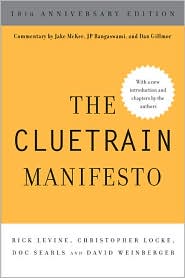
Cluetrain 10th Anniversary edition
Cluetrain 10th Anniversary
Everything Is Miscellaneous
Small Pieces cover
Small Pieces Loosely Joined
Cluetrain cover
Cluetrain Manifesto
My face
Speaker info
Who am I? (Blog Disclosure Form) Copy this link as RSS address Atom Feed

November 15, 2012

The person who beat Nate Silver – DailyKos and journalism

One political analyst was actually ever so slightly more accurate than Nate “Poll God” Silver: Markos Moulitsas, the founder of DailyKos.

I’ve always checked in on DailyKos occasionally, but over the past year or so it’s become a multi-daily stop, and was one of my primary sources of news about the campaign. It embodies a lot of the good stuff the Net is doing to news, and some of the bad.

DailyKos is obviously a partisan site. It’s perfectly clear about that. In fact, it wants to build its followers into an effective political force. The news it presents takes sides. Yet, I find it a really useful source of political news, for a few reasons:

1. I’d rather have the bias visible than hidden.

2. My understanding itself is biased: I have political views and commitments. DailyKos generally is in line with my views. So, when I want to understand the impact of some event political event, DailyKos’ contextualization is immediately helpful; I don’t have to read through it, unpacking the assumptions that I don’t share. Reading the Republican contextualization is an interesting and even an important anthropological exercise, but DailyKos gets me to understanding much faster.

3. Although it’s a partisan site, it’s also reality-based. For example, when DailyKos happily reports today that opposition to Obamacare is at its lowest, it prominently adds, “That doesn’t mean that America is suddenly in love with Obamacare, though. The support/oppose numbers remain in the range they’ve been in since the law was passed…” It’s what keeps DailyKos from being a standard-issue echo chamber.

4. It’s a community. The people writing on the front page are generally on staff, but there are thousands of bloggers (or “diarists” in Kos nomenclature) writing on the site and a useful system for bringing them to attention.

5. It’s funny. Often the humor is biting, and it frequently is more negative and personal than I’m comfortable with. But it’s also frequently damn funny.

You can find as much to not like at DailyKos as you want. With all those diarists, there’s no shortage of bad ideas and nasty edges. And the staff writers give plenty of materials to critics. So? DailyKos is one good model for tribal news.

But…

Of course I’d say that. People in echo chambers always think their echo chambers are Halls of Truth. That’s what it means to be in an echo chamber. So, is DailyKos any better than, say, Fox News?

I think so. But, again, that’s #1 and trending at ThingsPeopleInEchoChambers Say.com.

I’d point to a few reasons DailyKos is (a) a better echo chamber than Fox, (b) is not an echo chamber, (c) is a good echo chamber, (d) something else.

1. DailyKos seems to me to be more willing to point to negatives in its own positive news — it’s got more respect for reality.

2. DailyKos seems to me to be more often right at the level at which facts are checked. It also has not been caught as often at Photoshopping (taking “Photoshopping” literally and metaphorically). There have been times when I think DailyKos has taken candidates’ remarks out of context — I still think Romney’s “Corporations are people, my friend” may have meant to point to the consequences for real people when corporations fail. But I haven’t seen (or haven’t recognized) the massive and I believe Fox’s knowing editing of quotes to get them to sound like people are saying something entirely different (“You didn’t build that”).

3. DailyKos seems to me not to spend as much time on paranoid theories. There is nothing that I know of that DailyKos has pursued that sinks to the level of birtherism, or that is pursued with as much single-minded intensity as “You didn’t build that.”

4. DailyKos is genuinely committed to building a community in which all have a voice. Yes, not everyone has an equal voice, but the upvoting mechanism and the ability to follow favorites helps people further down the long tail.

5. DailyKos does not pretend to be non-partisan as the news part of Fox News does. Of course, no one is fooled by Fox’s protestations.

I may be falling prey to the Echo Chamber Fallacy — the belief that my echo chamber isn’t really an echo chamber — but even if I am, there’s no reason to think that all echo chambers are equally bad. And there is, I believe, reason to think that an echo chamber can in fact be a useful way of getting information…and of forming a movement that can then act on that information.


I sent the link to this post to Markos, and he replied in part:

I often see people accuse me of “preaching to the choir”. My response is if that’s so bad, why do churches exist?

People want that tribal experience. So Daily Kos is like a church for the progressive movement — a place where people come to get informed, get validated, find community, and get organized so they can evangelize outside its walls.

Not to mention, anyone who thinks that Daily Kos is an echo chamber didn’t see the site in 2010, when we spent months preparing our readers for the electoral catastrophe that would inevitably hit in November. We were the exact opposite of Republicans this year.

Tweet
Follow me

Categories: journalism, politics, too big to know Tagged with: 2b2k • journalism • politics Date: November 15th, 2012 dw

2 Comments »

November 9, 2012

[2b2k] What do we learn from our failure to believe the polls?

There’s lots being written about why the Republicans were so wrong in their expectations about this week’s election. They had the same data as the rest of us, yet they apparently deeply believed they were going to win. I think it’s a fascinating question. But I want to put it to different use.

The left-wing subtext about the Republican leadership’s failure to interpret the data is that it’s comeuppance for their failure to believe in science or facts. But that almost surely is a misreading. The Republicans thought they had factual grounds for disbelieving the polls. The polls, they thought, were bad data that over-counted Democrats. The Republicans thus applied an unskewing algorithm in order to correct them. Thus, the Republicans weren’t pooh-poohing the importance of facts. They were being good scientists, cleaning up the data. Now, of course their assumptions about the skewing of the data were wrong, and there simply has to be an element of wish-fulfillment (and thus reality denial) in their belief that the polls were skewed. But, their arguments were based on what they thought was a fact about a problem with the data. They were being data-based. They just did a crappy job of it.

So what do we conclude? First, I think it’s important to recognize that it wasn’t just the Republicans who looked the data in the face and drew entirely wrong conclusions. Over and over the mainstream media told us that this race was close, that it was a toss-up. But it wasn’t. Yes, the popular vote was close, although not as close as we’d been led to believe. But the outcome of the race wasn’t a toss-up, wasn’t 50-50, wasn’t close. Obama won the race decisively and not very long after the last mainland polls closed…just as the data said he would. Not only was Nate Silver right, his record, his methodology, and the transparency of his methodology were good reasons for thinking he would be right. Yet, the mainstream media looked at the data and came to the wrong conclusion. It seems likely that they did so because they didn’t want to look like they were shilling for Obama and because they wanted to keep us attached to the TV for the sake of their ratings and ad revenues.

I think the media’s failure to draw the right and true conclusions from the data is a better example of a non-factual dodge around inconvenient truths than is the Republicans’ swerve.

Put the two failures together, and I think this is an example of the the inability of facts and data to drive us to agreement. Our temptation might be to look at both of these as fixable aberrations. I think a more sober assessment, however, should lead us to conclude that some significant portion of us is always going to find a way to be misled by facts and data. As a matter of empirical fact, data does not drive agreement, or at least doesn’t drive it sufficiently strongly that by itself it settles issues. For one reason or another, some responsible adults are going to get it wrong.

This doesn’t mean we should give up. It certainly doesn’t lead to a relativist conclusion. It instead leads to an acceptance of the fact that we are never going to agree, even when the data is good, plentiful, and right in front of our eyes. And, yeah, that’s more than a little scary.

Tweet
Follow me

Categories: politics, too big to know Tagged with: 2b2k • facts • politics • polls Date: November 9th, 2012 dw

7 Comments »

November 7, 2012

1.5 minutes of First Family beautifulness

Go ahead an give yourself a little treat. Here’s 1.5 minutes of the First Family last night.

Tweet
Follow me

Categories: politics Tagged with: obama • politics Date: November 7th, 2012 dw

Be the first to comment »

November 4, 2012

Your vote counts, but exactly that way

If when the votes are counted you feel betrayed because you were told “Your vote counts!” but it turns out that the election would have gone the same way even if you had stayed home, I understand. If you take “Your vote counts” as really only being true when your vote determines an outcome, then in my lifetime of voting, my vote has never counted. (For a different reading, see the the incredibly smart Peter Norvig’s election FAQ.)

Still, I vote and I hope you do too — even the young, despite some contempt for them). But my reasons have more to do with community than outcomes.

First, voting is a a rite that affirms the most basic and magnificent thing about our country: We believe everyone has an equal voice.

Second, my vote is unlikely to determine an outcome of an election, but it is certain to affect — fractionally, for sure — the total number of people who have voted. And that bears on our sense of the success of our democracy and of our national community. This is not merely information about community, but is information that forms community.

Third, if you don’t vote, you have no right to complain. So, vote or for God’s sake STFU.

As for who to vote for: (a) check my Twitter feed for links to the vids etc. that I find amusing/moving, and (b) really?


(To volunteer to help Pres. Obama’s Get Out the Vote effort, click here. And because I’m a liberal, here’s Romney’s GOTV site.)

Tweet
Follow me

Categories: politics Tagged with: elections • gotv • obama • politics Date: November 4th, 2012 dw

1 Comment »

October 10, 2012

Obama and Romney make their cases to techies. Guess who fails to mention the Internet?

New York Tech Meetup asked the Obama and Romney camps to write letters explaining how their policies would help the NY tech community. NYTM has just posted their replies.


Without the prefatory comments, you’d be hard-pressed to tell that Romney’s letter is about tech policy. Not only does Romney miss any mention of Internet or its synonyms, he fails to reiterate his opposition to Net Neutrality.


Obama on the other hand lays out his policies and accomplishments, starting with creating a federal CTO on his first day in office, opening up government data (at data.gov and elsewhere), creating Presidential Innovation Fellows, and protecting the open Internet.


(PS: I’ve posted the link to the letters at Reddit. Feel free to upvote…)


Related to this, the Australian radio show has posted an episode on whether the Obama administration has fulfilled the promise of Government 2.0. It interviews Ethan Zuckerman, Micah Sifry, Michael Turk, Bill Adair, and me.

Tweet
Follow me

Categories: egov, politics Tagged with: egovernment • government 2.0 • politics Date: October 10th, 2012 dw

1 Comment »

October 8, 2012

Mitt v. Mitt

Tweet
Follow me

Categories: politics Tagged with: politics Date: October 8th, 2012 dw

3 Comments »

October 7, 2012

Obama’s argument

This is by Lucas Gray, a Simpson’s and Family Guy animator. (Hat tip to Gawker)


[Minutes later:] I came across this at Gawker as well.

Tweet
Follow me

Categories: misc Tagged with: comedy • infographics • obama • politics • steve martin Date: October 7th, 2012 dw

Be the first to comment »

October 4, 2012

Social media unite. Unwin Mitt.

The narrative was primed to develop, and so it did: Romney won the debate. The instant polls say so, and the mainstream media say so. And although I thought Obama did a far better job, I know that I’m biased that way. I’m willing to acknowledge: Romney won the debate last night.

But, although Romney won it last night, he lost it today, because now we know for sure how much he lied. We can reverse the narrative. We have an obligation to do so.

When cheaters are discovered after a game, they are stripped of their victory. That is what we of social media need to do. The mainstream media won’t because they claim they don’t proclaim winners, although that is exactly what they do.

It is up to us, the tweeters, the bloggers, the updaters of our status, the mailing listers, the tumblrs…all of us. We can turn the mainstream narrative around. That is what social media are for. We can tell the truth. We can speak honest memes to false narratives.

The truth is that Romney lost because he cheated. We together are the truth-checkers.

So here is the narrative we can make true: Romney won last night, but he lost today.

Tweet
Follow me

Categories: politics, too big to know Tagged with: politics • social media Date: October 4th, 2012 dw

7 Comments »

September 25, 2012

Explaining Mitt: An hypothesis

Like many people, I’m scratching my head trying to understand how Romney can say some of the things that he’s said over the past few months.


After he offered to bet Rick Perry $10,000 at one of the debates, you know his handlers took him aside and said something like, “Governor Romney, the bet was a good idea. Punchy and fun. But, just so you know, $10,000 is a lot of money to most people. Just knock off two or three zeroes next time. In fact, that’s in general a good rule of thumb for you: ‘Before you speak, two digits off the peak.'”


And when Romney told college students to borrow money from their parents to start a business, his handlers said, “Great going with the pep talk, Governor. But next time keep in mind that most parents don’t have a lot of spare cash around. Here’s a mnemonic for you: ‘Parents pay-rents.’ Got that?”


And when Romney said that he has friends who own NASCAR teams, his handlers said to him, “Good for you for bonding with the NASCAR crowd, but most people are there to root for a team, not because they own one. Here’s a phrase that might help: ‘Owners are boners. Employees, puhlease.'”


So why doesn’t it sink in? Mitt’s smart. And I don’t think he’s incapable of empathy. So, I have an hypothesis, which I offer as a way to make sense of his repeated and, frankly, weird stumbles.


Remember when in 5th grade you picked a foreign country to write a report on? Let’s say it was China. You read some age-appropriate books. You drew some pictures. You explained, as best as your 10-year-old brain allowed, some of China’s history, a bit about their language — pictograms are cool! — and then perhaps you wrote about what life is like in China for a child your age. And, if you were very lucky, you got a pen-pal in China. Sure, after a few exchanges, the correspondence ended. But it was pretty thrilling while it lasted.


And if you were a typical ten year old, you made a bunch of dumb mistakes that now you laugh about. You asked your pen-pal what his favorite baseball team is, or what she got for Christmas. From this you learned that life in China is more different from yours than you had imagined. It’s a crucial lesson.


My hypothesis is that Mitt has trouble with this lesson: Romney is unable to cognitively understand the situation of others. He can talk so casually about firing people — and he could “restructure” a distressed company so cooly — not because he doesn’t care about workers but because he doesn’t intellectually grasp that most people don’t have the financial backup that he has always had. For the same reason, he genuinely thinks that during his time in Paris as a missionary he struggled the way ordinary folks do. I think it’s the same lack of cognitive imagination that leads him to see others as feeling entitled, when his whole life seems to be based on his own sense of entitlement. It’s a cognitive problem, not an emotional one.


Hey, it’s a theory. But if it’s wrong, as it’s like to be, then we need another hypothesis to explain his pattern of statements that show a fundamental misunderstanding of how life looks to the rest of us.

Tweet
Follow me

Categories: politics Tagged with: cheap psychologizing • politics • romney Date: September 25th, 2012 dw

4 Comments »

September 16, 2012

Elizabeth Warren FTW!

At last Elizabeth Warren, the Warrior of the Middle Class, has opened up a 6-point lead on the Truck Drivin’ Triangulator Scott Brown. That lead increases if you look only at registered voters.

We are thus one poll closer to the dream Clinton-Warren 2016 ticket.

Tweet
Follow me

Categories: politics Tagged with: elizabeth warren • hillary clinton • politics Date: September 16th, 2012 dw

2 Comments »

« Previous Page | Next Page »


Creative Commons License
This work is licensed under a Creative Commons Attribution-NonCommercial-ShareAlike 3.0 Unported License.
TL;DR: Share this post freely, but attribute it to me (name (David Weinberger) and link to it), and don't use it commercially without my permission.

Joho the Blog uses WordPress blogging software.
Thank you, WordPress!