

logo
EverydayChaos
Everyday Chaos
Too Big to Know
Too Big to Know
Cluetrain 10th Anniversary edition
Cluetrain 10th Anniversary
Everything Is Miscellaneous
Small Pieces cover
Small Pieces Loosely Joined
Cluetrain cover
Cluetrain Manifesto
My face
Speaker info
Who am I? (Blog Disclosure Form) Copy this link as RSS address Atom Feed

April 18, 2009

Hyperlink aggregation circa 1689

Ann Blair sent me an illustration she showed during her fascinating talk on the history of the book:
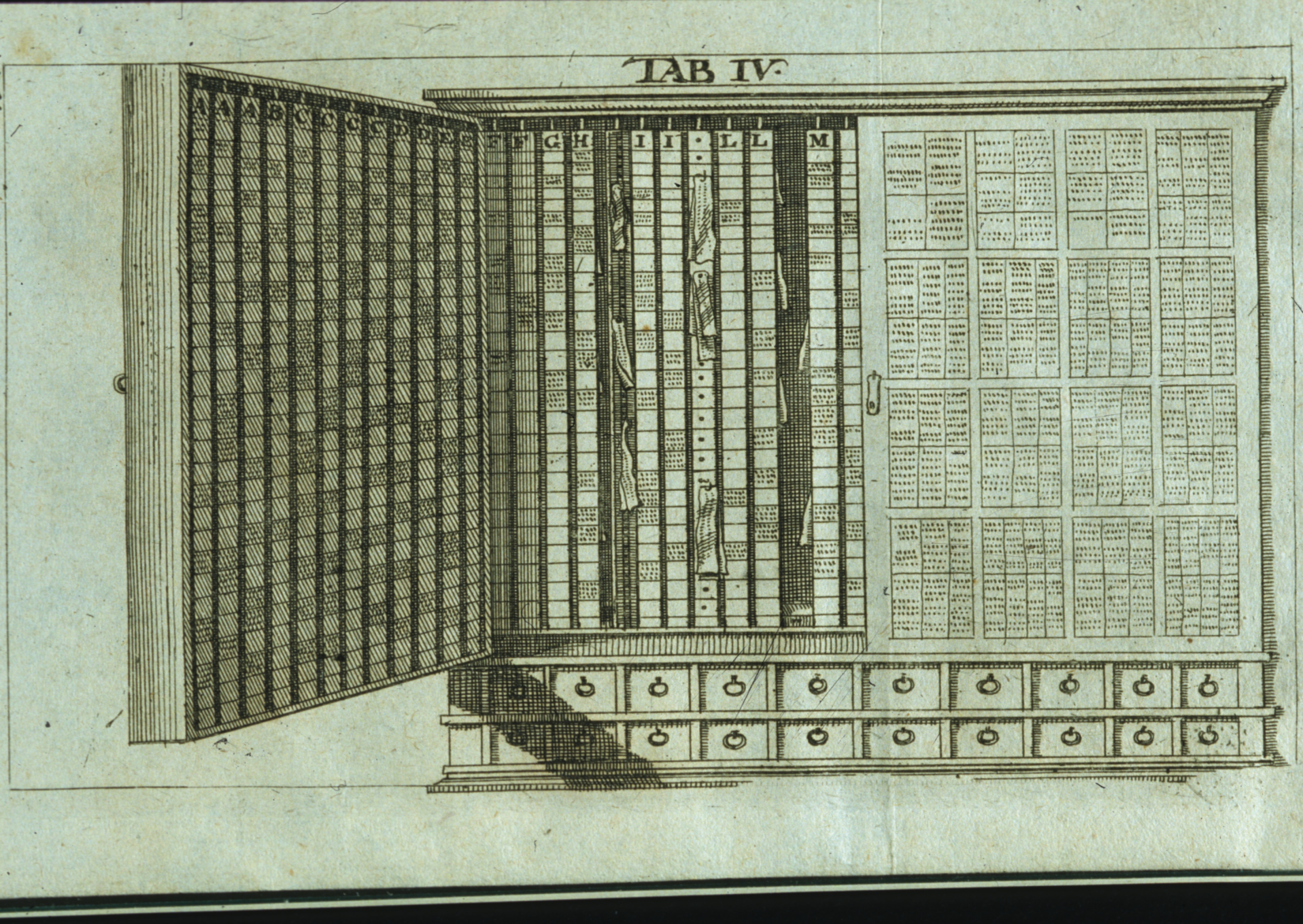
1689 cabinet for arranging notes
Click on image to download large version

The cabinet was designed by Vincentius Placcius. It had 3,000 hooks for topics, each with places where you could hang scraps of paper with notes pertaining to those topics.

BTW, I came across a fascinating blog on note taking that says that Leibniz had perhaps a million notes on scraps of paper, and owned a Placcius cabinet. Leibniz certainly corresponded with Placcius.

[Tags: note_taking knowledge placcius leibniz ann_blair everything_is_miscellaneous ]

Tweet
Follow me

Categories: Uncategorized Tagged with: culture • everythingIsMiscellaneous • knowledge • leibniz • libraries • philosophy • placcius Date: April 18th, 2009 dw

10 Comments »

April 8, 2009

PhilosophyTalk goes miscellaneous

On Sunday, I was the guest on PhilosophyTalk, an NPR show that you can listen to via PRX.org (free membership required). We talk about how and why we dice up the world the way we do.

[Tags: everything_is_miscellaneous philosophy radio ]

Tweet
Follow me

Categories: Uncategorized Tagged with: everythingIsMiscellaneous • philosophy • radio Date: April 8th, 2009 dw

Be the first to comment »

March 4, 2009

Three from the Boston Globe: Conflict, amusement, and maddening missing of the point

Part One

The big page two story of today’s Boston Globe is an article by Lori Montgomery of the Washington Post. It begins:

Two of the administration’s top economic officials defended President Obama’s $3.6 trillion budget plan yesterday, arguing that the proposal would finance a historic investment in critical economic priorities while restoring balance to a tax code tipped in favor of the wealthy.

The first nine paragraphs are about the fierce conflict. Only in paragraph ten do we get the most important news:

Despite those and a few other contentious issues, Obama’s budget request was generally well-received yesterday, as lawmakers took their first opportunity to comment on an agenda that many have described as the most ambitious and transformative since the dawn of the Reagan era. Democratic budget leaders said they are likely to endorse most of Obama’s proposals sometime in April in the form of a nonbinding budget resolution.

If it bleeds, it leads. Sigh.


Part Two

Because I generally disagree on policy with the Globe’s conservative columnist Jeff Jacoby, I try to give him the benefit of the doubt in his reasoning. But this morning, he’s driven me officially nuts. Well done, sir!

Jacoby devotes his column to the philosopher Peter Singer. First, he lauds Singer for “his commitment to charity.” But the bulk of the column is given over to Singer’s controversial — too mild a word — argument for permitting infanticide under careful legal conditions.

Actually, I’ve misspoken. Jacoby doesn’t mention Singer’s argument. He only gives the conclusion. Jacoby’s own conclusion is that Singer’s stance shows what happens “if morality is merely a matter of opinion and preference — if there is no overarching ethical code that supersedes any value system we can contrive for ourselves…”

In fact, Singer’s most objectionable conclusions come from rigorously applying standards of morality against opinion and preference. For example, if we say it’s our superior intelligence that gives us certain rights, then we should be willing to accord those rights to other creatures that turn out to have the same intelligence, even in preference to humans who lack that intelligence by accidents of birth or personal history. Or, as Singer says in the conclusion of the brief column in Foreign Policy that Jacoby cites:

…a new ethic will … recognize that the concept of a person is distinct from that of a member of the species Homo sapiens, and that it is personhood, not species membership, that is most significant in determining when it is wrong to end a life. We will understand that even if the life of a human organism begins at conception, the life of a person—that is, at a minimum, a being with some level of self-awareness—does not begin so early. And we will respect the right of autonomous, competent people to choose when to live and when to die.

There are lots of ways to argue with Singer’s conclusions. (I found him so convincing on animal rights in the 1970s that I’ve been a vegetarian ever since. I find him less convincing on infanticide.) But saying that Singer is merely expressing personal opinion is not to argue with him at all. In short, Jacoby is merely expressing his own opinions and preferences, and thus is guilty of exactly what he criticizes Singer for.


Part Three

The headline over the continuation of an article from the front page says:

Amid Maine’s extremes, teams of dogs and humans vie

It’s mildly disappointing to learn that the article is about dog sled racing in Maine, rather than about a dogs vs. humans sports event. [Tags: media newspapers journalism ethics philosophy peter_singer jeff_jacoby stimulus ]

Tweet
Follow me

Categories: Uncategorized Tagged with: ethics • journalism • media • newspapers • philosophy • stimulus Date: March 4th, 2009 dw

4 Comments »

December 30, 2008

Animal vids

Great set of user-chosen top animal videos of the year over at the Wired blog.

It makes you realize how inadequate our categories are for understanding animals. For example, is the gibbon “playing”? There’s no way we can answer that question, because if the gibbon could speak, we couldn’t understand it.

But the videos are durn cute!

[Tags: animals videos wittgenstein ]

Tweet
Follow me

Categories: Uncategorized Tagged with: animals • entertainment • philosophy • videos • wittgenstein Date: December 30th, 2008 dw

2 Comments »

December 27, 2008

Informationalized conversation

In his important 1996 book, Using Language, Herbert H. Clark opens Chapter 7 by analyzing two lines of conversation between ” a British academic” and “a prospective student”:

When Arthur says “u:h what modern poets have you been reading -” he doesn’t want Beth merely to understand what he means — that he wants to know what modern poets she has been reading. He wants her to take up his question, to answer it, to tell him what modern poets she has been reading. She could refuse even though she has understood. To mean something, you don’t have to achieve uptake, and to understand something, you don’t have to take it up. Still, Beth’s uptake is needed if she and Arthur are to achieve what Arthur has publicly set out for them to do at this point in their interview. p. 191

My first response, and probably yours, is: Well, duh But that’s the point. The fact that Clark has to explicitly state that we ask questions usually in order to get a response is evidence of just how deeply we’ve adopted the information-based paradigm that says that communication consists of the transfer of messages from one head to another. Language is a social tool used by embodied creatures to accomplish complex and emergent projects in a shared world. The transfer of messages is the least of it.

[Tags: herbert_clark language information communications conversation ]

Tweet
Follow me

Categories: Uncategorized Tagged with: communications • conversation • infohistory • information • language • philosophy Date: December 27th, 2008 dw

1 Comment »

November 30, 2008

Philosophical problems with folksonomies

[Note from the next day: This is a little embarrassing. I just noticed that this was first published in 2006. It came through my inbox on Saturday, and I carelessly thought it had just come out.]

Elaine Peterson, associate professor at Montana State University, has an article in D-Lib Magazine called “Beneath the Metadata: Some Philosophical Problems with Folksonomy.” It’s good to see the issues taken seriously, and many of her premises strike me as true. But, I disagree with her pragmatic conclusion that “A traditional classification scheme will consistently provide better results to information seekers.” And I think I disagree with her philosophical critique, although I am not confident that I’m understanding it as she intends.

I read the article two different ways. At first I thought it was a critique of folksonomies on the grounds that they contradict traditional philosophical premises. The next time I read it, I thought it was simply pointing out the differences. Now I’m tending toward my first reading, in part because her section on the traditional defends it against some objections while about half of the section on folksonomies is critical of them.

Her philosophical criticism seems to be rooted in what she presents as the Aristotelian approach to classification: Things are lumped with other things like them, and simultaneously distinguished from them. Most important, she says, is the idea that “A is not B,” which means that A cannot be truthfully classified also as a B. But what about digital items that “can reside in more than one place”? That is “irrelevant,” she says, “since one is talking about a classification scheme, not about the items themselves.” I have to admit I don’t understand this. What is the philosophical basis for restricting things to one category if not that that restriction reflects the metaphysical truth that A cannot also be B? So, I think she’s saying we are to reject multiple classifications because such classifications are untrue metaphysically.

This reading is supported by the section on folksonomy, where she identifies philosophical relativism as “the underlying philosophy behind folksonomies,” and pretty clearly intends this as a criticism. (I personally am no fan of philosophical relativism, although there’s a longer story there.) The problem with relativism, she writes, is that it means classification escapes from the demand that A be A and not be B. I take this as indicating that, in her section on traditional classification, she is agreeing with the 1930 textbook she cites that recommends that classifiers give “emphasis to what the author intended to describe.” If you’re arguing that, on metaphysical grounds, things should only be classified in a single category, I guess looking for the author’s intention gives you a way forward…even though categorizing only by the author’s intent is to me like insisting that readers only underline passages that the author considers significant.

And this highlights what I think is my root disagreement with Elaine’s piece (if I’m understanding it correctly). It’s fine to raise pragmatic problems with folksonomies, as she does. But Elaine is pointing at philosophical problems. And those problems require assuming that folksonomists are trying to do what Aristotelian categorizers are trying to do. But they’re not. Aristotelians (I’m using this sloppily as shorthand, so pardon my “tagging”) are trying to find the one true and right category for each thing, creating a well-ordered system free of contradictions. Folksonomies are trying to help us find stuff.

Inconsistencies in tags actually make a folksonomy useful; a folksonomy that consists of 1,000 instances of a single tag isn’t worth the folksonomizing. But these inconsistencies are a problem for Elaine because she is thinking of a folksonomic classification as a philosophical statement rather than as a mere tool. She says that “perhaps … the strongest criticism one could make of folksonomies” is that because tags can be true for one group and false for another,

a folksonomy universe allows both true and false statements to coexist. Because tags are relativized, personal, idiosyncratic views can coexist and thrive in the form of tags, in spite of their inconsistencies. Readers of texts on the Internet become individual interpreters, despite the document author’s intent.

To this many of us will say “Hallelujah!” because we disagree with Elaine’s opening claim that all classification is about answering the philosophical question, “What is it?” Indeed, she’s a hard-liner: An inconsistency to Elaine is any multiple classification, not simply one that contradicts others. Classifying a dissertation about “Moby-Dick” under “ecology” as well as under “novels: 19th Century” would introduce an insupportable inconsistency (in Elaine’s terms). She seems to assume that tags are Aristotelian judgments in which we say that A is a B. But, when I tag a photo of my wife as “ann,” “birthday,” “2008,” and “family events,” I am not saying the essence of Ann (or her photo) is any of those things. Even if I believed in essentialism (I pretty much don’t), we could make use of Aristotle’s idea of “accidental properties” (non-essential but true) to explain what I’m doing. And if I tag Oliver Stone’s “Alexander” as “Angelina Jolie” or “tripe” knowing full well that I am not staying true to the author’s intent, well, tough on Oliver. Tags are not always truth claims, and a folksonomy is not intended to mirror nature. Indeed, a folksonomy can reveal the most appalling areas of ignorance and prejudice in a populace — and, pragmatically, we may well want to address those popular errors, especially since a folksonomy can indeed reinforce them

But, Elaine is right to point to the philosophical implications of folksonomies. An individual folksonomy may make no claim to providing the real truth about how the world is ordered, but the use of folksonomies generally carries some philosophical implications. Elaine sees relativism underneath them while I see a form of pragmatism. But folksonomies didn’t arise out of philosophy. They are a “found” ordering: Hey, we have all these tags, so why don’t we make use of them in a more systematic way? So, I think Elaine is mislocating the philosophical moment in folksonomies. Philosophy isn’t underneath them or behind them. It’s after them, in their effect. Folksonomies reinforce our move away from the essentialist view that every thing has a single category that reflects its single and real essence. We’ve been moving away from that view for a long time as a culture. The success of folksonomies as a tool reveals that we accepted the traditional Aristotelian scheme in part because it was useful. If its utility has been undercut, then we have to ask for the other reasons we should believe in an Aristotelian metaphysics.

The ball is in Aristotle’s court.

* * *

Most of Elaine’s outright criticisms of folksonomies are actually practical, not philosophic. She makes them without empirical evidence. She has not convinced me that she’s right. For example, her final paragraph says:

A traditional classification scheme based on Aristotelian categories yields search results that are more exact. Traditional cataloging can be more time consuming, and is by definition more limiting, but it does result in consistency within its scheme. Folksonomy allows for disparate opinions and the display of multicultural views; however, in the networked world of information retrieval, a display of all views can also lead to a breakdown of the system… Most information seekers want the most relevant hits when keying in a search query.

By “exact” she apparently means the results include fewer false results (where a result is false if the search term doesn’t really apply to the result, as when you search for “fish” and get back posts about dolphins). And that seems correct: A professionally constructed index should have fewer of those sorts of mistakes. But the second criterion in her concluding paragraph is relevancy, and there folksonomies well may beat a professionally constructed index. Not only might a folksonomy retrieve results more relevant to me personally or to my cultural sub-group, but it constructs a semantic system that can retrieve results the narrow and carefully categorizing by experts might miss. So, I disagree with her last sentence: “A traditional classification scheme will consistently provide better results to information seekers.” Traditional classification is best for certain types of searches — ones where you want precision over recall and relevancy, and especially where there is a confined domain of contents that you have to be sure you’ve searched thoroughly — but is not as good as a folksonomy for other types of searches.

In short, neither traditional nor folksonomic classifications are best. Each is best for something.

[Tags: folksonomy taxonomy philosophy elaine_peterson ]

Tweet
Follow me

Categories: Uncategorized Tagged with: everythingIsMiscellaneous • folksonomy • libraries • metadata • philosophy • tagging • taxonomy Date: November 30th, 2008 dw

10 Comments »

November 19, 2008

Bertha Bassam lecture

I gave a lecture at my alma mater, the University of Toronto, a few weeks ago, at the Faculty of Information. The video is here. (Nit: The slides have the wrong font.)

[Tags: university_of_toronto knowledge moi_moi_moi ]

Tweet
Follow me

Categories: Uncategorized Tagged with: digital culture • digital rights • education • everythingIsMiscellaneous • knowledge • philosophy Date: November 19th, 2008 dw

Be the first to comment »

November 7, 2008

A taxonomy of philosophy

David Chalmers and David Bourget are creating a taxonomy of philosophy. David C blogs about it here.The notion of conceiving of philosophy as a tree, with each topic in one right spot, strikes me as both a producing of meaning and a paring down of meaning. But, if it’s useful in some contexts, then great. [LATER: This link back to this post is really informative and interesting.]

[Tags: everything_is_miscellaneous philosophy taxonomy ]

Tweet
Follow me

Categories: Uncategorized Tagged with: everythingIsMiscellaneous • philosophy • taxonomy Date: November 7th, 2008 dw

2 Comments »

August 16, 2008

Philosophical lexicon

The new edition of the Philosophical Lexicon is out. Compiled by Daniel Dennett and Asbjørn Steglich-Petersen, the PL compiles witty definitions of philosophers’ names. It focuses on recent philosophers, and it’s full of in jokes, almost all of which I don’t get.

Here are some samples:

rand, n. An angry tirade occasioned by mistaking philosophical disagreement for a personal attack and/or evidence of unspeakable moral corruption. “When I questioned his second premise, he flew into a rand.” Also, to attack or stigmatise through a rand. “When I defended socialised medicine, I was randed as a communist.”

turing, v. To travel from one point to another in simple, discrete steps, without actually knowing where one is going, or why. Hence, turing machine, n. A form of transportation that became popular with adventurous but aimless souls without motorcycles in the 1960s. Also tur, n. Such a travel; used especially metaphorically, “Searle’s lecture comprised a grand tur of every inconceivable position in the literature, and ironically “The latest book on connectionism is a real tur de feys”.

Isn’t this the sort of thing we’d do as a wiki these days? (BTW, I am listed as one of the many contributors, but it had to be 25 years ago and I don’t remember which is mine. Buber, maybe?)

[Tags: humor philosophy ]

Tweet
Follow me

Categories: Uncategorized Tagged with: humor • philosophy Date: August 16th, 2008 dw

Be the first to comment »

August 1, 2008

Seth Lloyd on “its are bits”

I’m reading Seth Lloyd‘s breezy book “Programming the Universe.” Breeziness is a good thing when you’re writing about quantum mechanics and information theory for a lay readership. But I’m finding myself frustrated that he’s not digging deeper into the ontological questions about information. I find myself asking whether he could just as well say that the universe is a dance because the particles move or stand still, which would be true but a not particularly fundamental metaphor. (Oh, don’t dance the Wuli dance to me in response! Seth seems to mean information to be more than a useful metaphor. He thinks it’s alongside energy in importance as a scientific phenomenon. It’s not like saying the universe is like a dance, or a game (oh, don’t Glass Bead me!), or a lovers quarrel.) I lose him even in his assumption that the universe is made of digital bits. Why think things — tossed coins or spinning particles — always reduce to simple on-off states?

Maybe I’ll understand it better as I read more of the book. On the other hand, I’ve also struggled through other books on this topic, including “The Bit and the Pendulum” and “A New Kind of Science,” to name the two that spring to my dialup-unaided brain. I just may lack the education, imagination and context required to understand this. [Tags: seth_lloyd information_theory quantum_computers ]

Tweet
Follow me

Categories: Uncategorized Tagged with: infohistory • philosophy • science Date: August 1st, 2008 dw

7 Comments »

« Previous Page | Next Page »


Creative Commons License
This work is licensed under a Creative Commons Attribution-NonCommercial-ShareAlike 3.0 Unported License.
TL;DR: Share this post freely, but attribute it to me (name (David Weinberger) and link to it), and don't use it commercially without my permission.

Joho the Blog uses WordPress blogging software.
Thank you, WordPress!