

logo
EverydayChaos
Everyday Chaos
Too Big to Know
Too Big to Know
Cluetrain 10th Anniversary edition
Cluetrain 10th Anniversary
Everything Is Miscellaneous
Small Pieces cover
Small Pieces Loosely Joined
Cluetrain cover
Cluetrain Manifesto
My face
Speaker info
Who am I? (Blog Disclosure Form) Copy this link as RSS address Atom Feed

June 25, 2011

Interesting reading abounds

Ever since I ended my paper-based relationship with the Boston Globe, I’ve done my breakfast reading in front of a monitor on our kitchen table. Today, I spent a little longer, and read some excellent articles:

  • Stephen Metcalf writes about Robert Nozick’s legitimizing effect on Libertarianism, and the philosophical weakness of the case he made for it. I have not heard anyone else make Metcalf’s critique of the Wilt Chamberlain argument (so far as I recall).

  • In Scientific American, John Horgan defends Stephen Jay Gould from the charge that his brilliant example of personal bias affecting scientific outcomes was itself based on Gould’s own biases. It’s actually a weak defense, with Horgan instead defending a related point SJG was making: “Maybe Gould was wrong that Morton misrepresented his data, but he was absolutely right that biological determinism was and continues to be a dangerous pseudoscientific ideology.” By coincidence, a couple of days ago I came across my old copy of an anthology titled “The Sociobiology Debate” that was compiled in 1978 when the idea that evolution shape ours our social behavior was not just controversial, but to many of us (including me) seemed quite threatening: it implied a lack of free will (which I no longer care about) and it was sometimes used to give a sheen of inevitability to the most conservative and even oppressive of social behaviors. Unfortunately, Horgan’s argument against sociobiology consists of the following single paragraph:

    “Biological determinism is a blight on science. It implies that the way things are is the way they must be. We have less choice in how we live our lives than we think we do. This position is wrong, both empirically and morally. If you doubt me on this point, read [Gould’s] Mismeasure [of Man], which, even discounting the chapter on Morton, abounds in evidence of how science can become an instrument of malignant ideologies.”

  • Also in Slate, I disagree so sharply with Jack Shafer’s criticism of Jose Antonio Vargas that I think I must be missing something obvious. Jose is the former Washington Post and Huffington Post journalist (and Pulitzer-prize winner, by the way) who came out as an undocumented immigrant in an article in tomorrow’s NY Times Magazine. Shafer declares himself to be an “immigration dove”: “I believe in open borders and detest our current laws and their enforcement.” If you hate the law’s enforcement, how can you also get in a snit about someone who lies to evade that enforcement? Or perhaps it’s only journalists who shouldn’t lie to their employers about their immigration status because there needs to be a special bond of trust between the editor and the journalist. So, which jobs does Shafer think do not require trust? Or is this just journalism dealing with its self-esteem issues again? Jose didn’t lie about his credentials, and he didn’t lie in his stories. He lied about the thing the bad laws Shafer “detests” made him lie about, just as forty years ago he likely would have had to lie about his sexual preferences. If Shafer thinks Jose’s admission makes him unreliable, then go through his work and find where this lack of reliablity manifests itself. If it doesn’t, then salute Jose for his honesty and courage. (Disclosure: Although I haven’t talked with him in a year or two, I count Jose as a friend, beginning in his pre-Pulitzer WaPo days. He has struck me as an honest, open-minded, and impassioned inquirer. I like him a lot.)
Tweet
Follow me

Categories: culture, journalism, media, philosophy, politics, science Tagged with: jose anotion vargas • libertarianism • nozick • philosophy • science • sociobiology • stepohen jay gould Date: June 25th, 2011 dw

3 Comments »

June 8, 2011

Six degress of philosophy

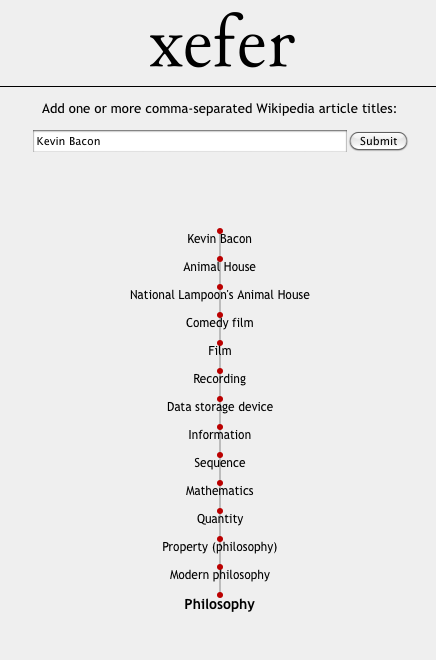
In what is certainly the coolest proof that philosophy is the Queen of the Sciences, and also the Duke and all of the in-laws, xefer shows the relation of any Wikipedia topic to its “Philosophy” article. (Hat tip to Hal Roberts.)

Kevin Bacon to Philosophy

Tweet
Follow me

Categories: humor, philosophy Tagged with: kevin bacon • philosophy • wikipedia Date: June 8th, 2011 dw

1 Comment »

May 30, 2011

The titles of philosophy

Philosophers Carnival at Philosophy, etc. points to philosophical posts from around the Web over the past three months. Many of them weigh in on age old questions about the continuity of consciousness, whether objective morality is possible without Heaven and Hell, and whether time travel is possible.

But I was especially struck by the online sites and journals where the articles were posted:

  • What Blag?

  • Gavagai!

  • Only a Game

  • Yeah, Ok

  • Horseless Telegraph

  • The Partially Examined Life

  • Huenemanniac

This is a far cry from titles such as the Review of Metaphysics and Journal of Medieval and Early Modern Studies typical of the printed output of the old school. (Browse a list here.) The new titles seem to mock the academy, even though many of the papers would be at home in its traditional publications. But slowly the wrapped will take on the properties of the wrapper…

Tweet
Follow me

Categories: philosophy, too big to know Tagged with: 2b2k • philosophy Date: May 30th, 2011 dw

Be the first to comment »

March 13, 2011

Former philosophy majors

Here’s a list of famous people who started out as philosophy majors.

You can take this either as evidence of the utility of majoring in philosophy, or as evidence that if you want to succeed, you should flee from your background as a philosophy major.

Tweet
Follow me

Categories: philosophy Tagged with: philosophy Date: March 13th, 2011 dw

3 Comments »

July 19, 2009

Transparency is the new objectivity

A friend asked me to post an explanation of what I meant when I said at PDF09 that “transparency is the new objectivity.” First, I apologize for the cliché of “x is the new y.” Second, what I meant is that transparency is now fulfilling some of objectivity’s old role in the ecology of knowledge.

Outside of the realm of science, objectivity is discredited these days as anything but an aspiration, and even that aspiration is looking pretty sketchy. The problem with objectivity is that it tries to show what the world looks like from no particular point of view, which is like wondering what something looks like in the dark. Nevertheless, objectivity — even as an unattainable goal — served an important role in how we came to trust information, and in the economics of newspapers in the modern age.

You can see this in newspapers’ early push-back against blogging. We were told that bloggers have agendas, whereas journalists give us objective information. Of course, if you don’t think objectivity is possible, then you think that the claim of objectivity is actually hiding the biases that inevitably are there. That’s what I meant when, during a bloggers press conference at the 2004 Democratic National Convention, I asked Pulitzer-prize winning journalist Walter Mears whom he was supporting for president. He replied (paraphrasing!), “If I tell you, how can you trust what I write?,” to which I replied that if he doesn’t tell us, how can we trust what he blogs?

So, that’s one sense in which transparency is the new objectivity. What we used to believe because we thought the author was objective we now believe because we can see through the author’s writings to the sources and values that brought her to that position. Transparency gives the reader information by which she can undo some of the unintended effects of the ever-present biases. Transparency brings us to reliability the way objectivity used to.

This change is, well, epochal.

Objectivity used be presented as a stopping point for belief: If the source is objective and well-informed, you have sufficient reason to believe. The objectivity of the reporter is a stopping point for reader’s inquiry. That was part of high-end newspapers’ claimed value: You can’t believe what you read in a slanted tabloid, but our news is objective, so your inquiry can come to rest here. Credentialing systems had the same basic rhythm: You can stop your quest once you come to a credentialed authority who says, “I got this. You can believe it.” End of story.


We thought that that was how knowledge works, but it turns out that it’s really just how paper works. Transparency prospers in a linked medium, for you can literally see the connections between the final draft’s claims and the ideas that informed it. Paper, on the other hand, sucks at links. You can look up the footnote, but that’s an expensive, time-consuming activity more likely to result in failure than success. So, during the Age of Paper, we got used to the idea that authority comes in the form of a stop sign: You’ve reached a source whose reliability requires no further inquiry.

In the Age of Links, we still use credentials and rely on authorities. Those are indispensible ways of scaling knowledge, that is, letting us know more than any one of us could authenticate on our own. But, increasingly, credentials and authority work best for vouchsafing commoditized knowledge, the stuff that’s settled and not worth arguing about. At the edges of knowledge — in the analysis and contextualization that journalists nowadays tell us is their real value — we want, need, can have, and expect transparency. Transparency puts within the report itself a way for us to see what assumptions and values may have shaped it, and lets us see the arguments that the report resolved one way and not another. Transparency — the embedded ability to see through the published draft — often gives us more reason to believe a report than the claim of objectivity did.

In fact, transparency subsumes objectivity. Anyone who claims objectivity should be willing to back that assertion up by letting us look at sources, disagreements, and the personal assumptions and values supposedly bracketed out of the report.


Objectivity without transparency increasingly will look like arrogance. And then foolishness. Why should we trust what one person — with the best of intentions — insists is true when we instead could have a web of evidence, ideas, and argument?


viagra online new york

In short: Objectivity is a trust mechanism you rely on when your medium can’t do links. Now our medium can. [Tags: objectivity transparency journalism media knowledge epistemology jay_rosen science everything_is_miscellaneous ]

Tweet
Follow me

Categories: misc Tagged with: digital culture • education • epistemology • everythingIsMiscellaneous • expertise • journalism • knowledge • media • objectivity • philosophy • science • transparency Date: July 19th, 2009 dw

4 Comments »

July 18, 2009

When there’s no such thing as the best

I posted my post about the Sotomayor hearings over at Huffington, where I got a grand total of two comments. The second one raised an interesting point. (The first one was funny.)

Or, “Senator, would you simply prefer that the Court be comprised of the best legal minds in the nation, regardless or their race, creed, or color, despite the fact that such a concept is foreign to the race conscious liberals among us?” – Parducci

That’s a reasonable response (leaving out everything after the “despite”), but I think it’s fundamentally wrong, since it assumes there is a way to rank order legal minds. There isn’t, because there is no such order.

Look at the current Justices. You may be able to say that one particular Justice’s “legal mind” is not as good as the rest (“Judge So-and-So just isn’t up to snuff”), but there isn’t any real way to rank them in order (except perhaps by ow well their decisions accord with political sides). With heart surgeons, maybe you can look at the survival rates of their patients — and there are problems with that — but for judges, there aren’t criteria that result in a reliable, accurate, and agreed-upon quantitative ranking. Likewise, who would think there’s any sense in trying to numerically rank philosophers, historians, or chefs? You can see that a particular one isn’t in the top rank or is out of her league, but within that top rank, there isn’t a numeric ordering.

So, for nominees to the Supreme Court, the idea that we should take “the best legal minds” actually means that we should choose from among those who are highly qualified for the job. Since that class is far larger than nine, we get to choose our Justices based on many considerations, including the likely effect they’ll have on the political balance of the court and — yes — the likely effect they’ll have by bringing a diversity of experience and outlook. For the wisdom of a group is enhanced by including difference within it.

In fact, it would be interesting to see how the degree of qualification (based on whatever criteria one wants to suggest) going into the Court matches with the performance of the Justice over the course of her or his term.

[Tags: sotomayor diversity everything_is_miscellaneous philosophy ]

Tweet
Follow me

Categories: misc Tagged with: diversity • everything_is_miscellaneous • misc • philosophy • sotomayor Date: July 18th, 2009 dw

6 Comments »

June 18, 2009

Why I love the Web, Reason #1375

Yesterday, I was sitting in the comfy chair, waiting for the dentist to come back with a larger mallet, browsing around on my Blackberry (“Your Knothole to the Web!”). I settled on part 5 of Akma’s series on exegesis. I like Akma, I’m interested in how we interpret texts, Akma’s Christian perspective deeply respects its differences with others, Akma is a genuine scholar, and he is a lovely, funny writer. What could be bad? Nothin’ that doesn’t have the word “dentist” in it!

So, there I am, in a three-minute interstice. Before the Web, I’d have been contemplating my aching stub of a tooth. Now I’m getting to spend time with a wise friend talking about something I barely understand. It feels like the Web has made Time itself better.

Sure, I’m just as likely to have clicked on a link to some gossip or a joke. Telling you about Akma served my twin nefarious purposes of pointing you at his series on exegesis and making me sound smart by reference. But, while the Web is not ubiquitous, it’s worth remembering how wonderful it is to for those of us who have ubiquitous access to it. That’s all. Just a little moment of thanks.

[Tags: misc everything_is_miscellaneous ]

Tweet
Follow me

Categories: misc Tagged with: digital culture • everything_is_miscellaneous • philosophy Date: June 18th, 2009 dw

1 Comment »

May 31, 2009

Utopianism: Threat or danger?

Shannon Bain has posted a long, thoughtful probing of Everything Is Miscellaneous and my defense of cyber-utopianism. It’s philosophical, serious, and generally right in its criticisms. He writes about my ideas in their philosophical context, as few have. I am very grateful for (and flattered by) this extended piece of clear-headed, morally-centered thinking.

His most telling criticism is (imo, anyway) that although he and I agree the Web is revolutionary, I assume the revolution will be for the good. Shannon worries that Cass Sunstein is right, and the Web’s openness and linkiness is really leading us to harden our positions, rather than opening up us to more diversity of thought.

My position has changed over the years on this, in part because I’ve had to the opportunity to hang out with folks at the Berkman Center. So, I now accept that the danger Sunstein points to is real. But, my reaction to this “echo chamber” argument is complex and confusing. I think (a) there are enormous challenges to evaluating the extent to which the Web is closing off thought; (b) the Web is probably leading us to be both more closed and more open simultaneously; (c) there is something wrong with the formulation itself; (d) the question probably mythologizes the degree of our openness in the pre-Web world. So, ultimately my position is: I don’t know, but it doesn’t matter too much because even if Sunstein is totally wrong (which he’s not), we’re still not doing enough to increase our interests and enlarge our sympathies. The Web won’t have this beneficial effect on us by itself; we must be ever vigilant and purposeful.

Shannon usefully connects this to my out-of-the-closet Heideggerianism. He wonders if I think cocooning (or, echo-chambering, if you prefer) “isn’t all bad”:

Maybe these cocoons of confirmation – these little webs of shared connotations and self-reinforced absolutist understandings, which I claim are negative aspects of a naturally biased humanity – are really what Heidegger’s beleaguered teacher Edmund Husserl called “lifeworlds:” the necessary and inescapable social, cultural and historical contexts within and through which we experience the world. Maybe so, but the problem is, these life worlds are hermetically sealed wholes of historical and cultural prejudice, incommensurable and unassailable. As Heidegger’s most influential student Hans-Georg Gadamer formulated it, prejudice – the historical, social and cultural “situatedness” we’re born into – is essential to Being-in-the-world. Outside of your lifeworld, your cocoon of prejudice, you simply aren’t… in the big metaphysical sense. Thus primordial prejudice – our cocoon of reinforcing ideas ever ready to disregard inconvenient or inconsistent “facts” – is the foundation of meaning in this Heideggerian sense.

Shannon’s right to see a connection, but I disagree with the conclusion he draws. I do strongly believe that we are inescapably thrown into a culture, language and history, and these determine much of who we are and how we thinkg. But, I don’t think that echo chambers are ok because of that. We cannot fully escape our context, but being a small-minded bigot who assumes that your beliefs and values are right simply because you believe them is not virtuous, wise, good, or acceptable.

This is, indeed, one of the reasons I think the “echo chambers” argument is mis-founded. The sharing of ideas, language, and values is essential to who we are. Without it, there is no culture and no conversation. But we are almost always in a complex dialectic of agreement and disagreement, identity and difference: We can only argue about something because we agree about so much already. So, in most arenas of life, we do better (as people, as a society) if we try to get past our own assumptions and sympathetically try to understand how the world matters to others. (FWIW, that’s what I found appealing about the academic study of philosophy. I saw it as a way to pry up the floor I was standing on, to see how many of the ideas I take for granted in fact have long, complex histories, and thus are not as “natural” and “self-evident” as I’d thought.)

(Also FWIW, I do think there are lots of areas in which asserting one’s agreement or identity has positive value, because it forms social and political bonds. But if that’s all you do, then you’re a small-minded nebbish.)

Shannon then tries to hang some anti-scientific beliefs on me, which I’m surprised he thinks I might hold. I don’t think science is just a Western superstition. Or whatever. But — and I’m sure Shannon agrees — I also don’t think science is the only way of thinking. It works at what it does. It doesn’t work at what it doesn’t work at. But, I love science. Sign me up for my flu shots!

Now, that doesn’t mean that every question can be settled, by facts, science, or by superstition for that matter. For example, in the piece Shannon refers to, I try to argue that the dispute among cyber-utopians, cyber-dystopians, and realists won’t be settled by facts because we are engaged in a political struggle, and the unknowable outcome of that struggle will give us the lens through we we look back and say “Hurray for the utopians!” or “Damn those utopians!” or whatever.

That criticism is toward the end of the piece, where Shannon then proceeds to argue against what I think is a strawman:

So, back to Weinberger’s utopianism. Remember that utopianism is the idea that the web is essentially good or for the best. Specifically that its native capacity to allow users to add metadata to content and make subtle, personal connections and relations is fundamentally and wholly positive.

Let’s drop the “wholly” from that last sentence. I never thought that the Web is wholly positive and I doubt I ever said it. (I am, however, quite capable of overstatement, so maybe I did. I am a writer with political interests, not a philosopher.) Shannon and I are closer than he thinks. He gives two alternatives to validate my utopianism. Either (says Shannon) I’m saying that we “Ignore the unfortunate facts about humans’ tendency to avoid disconfirmation…” or that we “embrace these tendencies as a prerequisite of authentic, human meaning.” I agree with Shannon that neither of these are acceptable. In order:

(1) I acknowledge our tendency to prefer the comfortable and closed. I acknowledge that the Web won’t magically overcome that. Rather, it is an unprecedented opportunity to work on overcoming it. Constant vigilance. And I think that may be a change in my thinking over the past decade. As I’ve said, I think the echo-chamber alarmists sometimes fail to acknowledge what sharing assumptions and values enables for us humans. But, my utopianism is not based on Shannon’s first alternative.

(2) I know ten years ago I thought “authenticity” was a good idea. But for the majority of the years since then, I’ve thought it’s a pretty bad idea. It does capture something that we want to be able to talk about — a country-western singer who grew up rich but pretends to be hardscrabble — but the metaphysics of authenticity is all screwed up…and within Heidegger it’s an unfortunately throwback to the essentialism he hated. (It did give philosophically-minded Germans a rationale for dying for their fatherland, however. Fucking Nazi.) I do think it’s good to acknowledge the inescapable effects of our birth, language, culture, history, family, etc. But acknowledging that doesn’t mean you can just settle into your prejudices. The reality is that we share our world with lots of people. They care about their lives and their world. If you reject that realization, you’re schizophrenic or evil. It’s our responsibility to always try to expand our circle of sympathy, to understand and care about how the world matters to others.

So, in what sense do I call myself a cyber-utopian? Applying that admittedly ridiculous term to myself is a political act. As I tried to say in the piece Shannon is commenting on, there are political consequences to these labels. I am a utopian because (in my view) it is useful to The Struggle to be one. Utopians remind us that the opportunity in front of us is epochal, and keep us from settling for too little imagination and hope. But the good the Web can do will not happen automatically, as we sit passively on our couches and let the Web work its magic on us. It will only manifest itself if we work tirelessly. My utopianism, as I understand it, is a denial of the sort of technological determinism that Shannon criticizes me for.

But, when you come down to it, I am indeed optimistic about the change we’re going through. It’s not inevitably or purely good, of course. And Shannon is completely right that I do tend to overstate the positive and understate the negatives. I tell myself that I do that for political reasons — there are enough fear mongers, and if they get their way, the Web gets restricted in ways I don’t want — but it means that I’m often writing a form of polemics. We are living through a “transvaluation of values,” and at this stage I feel a need to push on the door that’s opening. That undoubtedly means I need to acknowledge the risks and dangers more than I do, but I still want us to push on that door until it’s all the way open.

Thanks, Shannon, for your post. Truly. [Tags: shannon_bain everything_is_miscellaneous utopianism technodeterminism philosophy heidegger authenticity echo_chambers ]

Tweet
Follow me

Categories: Uncategorized Tagged with: authenticity • culture • digital culture • digital rights • heidegger • philosophy • technodeterminism • utopianism Date: May 31st, 2009 dw

4 Comments »

May 5, 2009

Philosopher’s Digest digests philosophers

Here’s a useful and provocative resource, suitable for browsing: The Philosopher’s Digest provides juicy engagements with articles in the current philosophical literature, and encourages conversation among readers. (Nit: How about tags?)

[Tags: philosophy ]


Also from Leiter Reports comes a link to The Philosophers Carnival, which talks about philosophy as if it were actually fun.

Tweet
Follow me

Categories: Uncategorized Tagged with: everythingIsMiscellaneous • philosophy Date: May 5th, 2009 dw

Be the first to comment »

April 28, 2009

[berkman] Stephen Wolfram – WolframAlpha.com

Stephen Wolfram is giving at talk at Harvard/Berkman about his WolframAlpha site, which will launch in May. Aim: “Find a way to make computable the systematic knowledge we’ve accumulated.” The two big projects he’s worked on have made this possible. Mathematica (he’s worked on it for 23 yrs) makes it possible to do complex math and symbolic language manipulation. A New Kind of Science (NKS) has made it possible that it’s possible to understand much about the world computationally, often with very simple rules. So, WA uses NKS principles and the Mathematica engine. He says he’s in this project for the long term.

NOTE: Live-blogging.Posted without re-reading

Getting things wrong. Missing points. Omitting key information. Introducing artificial choppiness. Over-emphasizing small matters. Paraphrasing badly. Not running a spellpchecker. Mangling other people’s ideas and words. You are warned, people.

You type in a question and you get back in answers. You can type in math and get back plots, etc. Type in “gdp france” and get back the answer, a graph of the history of the shows histogram of GDP.

“GDP of france / italy”: The GDP of France divided by the GDP of Italy

“internet users in europe” shows histogram, list of highest and lowers, etc.

“Weather in Lexington, MA” “Weather lexington,ma 11/17/92” “Weather lexington, MA moscow” shows comparison of weather and location.

“5 miles/sec” returns useful conversions and comparisons.

“$17/hr” converts to per week, per month, etc., plus conversion to other currencies.

“4000 words” gives a list of typical typing speeds, the length in characters, etc.

“333 gm gold” gives the mass, the commodity price, the heat capacity, etc.

“H2S04” gives an illustration of the molecule, as well as the expected info about mass, etc.

“Caffeine mol wt/ water” gives a result of moelcular weights divided.

“decane 2 atm 50 C” shows what decane is like at two atmospheres and at 50 C, e.g., phase, density, boiling point, etc.

“LDL 180”: Where your cholesterol level is against the rest of the population.

“life expctancy male age 40 italy”: distribution of survival curve, history of that life expectancy over time. Add “1933” and adds specificity.

“5’8″ 160 lbs”: Where in the distribution of body mass index

“ATTGTATACTAA”: Where that sequence matches the human genome

“MSFT”: Real time Microsoft quote and other financial performance info. “MSFT sun” assumes that “sun” refers to stock info about Sun Microsystems.

“ARM 20 yr mortgage”: payment of monthly tables, etc. Let’s you input the loan amount.

“D# minor”: Musical notation, plays the D# minor scale

“red + yellow”: Color swatch, html notation

“www.apple.com”: Info about Apple, history of page views

“lawyers”: Number employed, average wage

“France fish production”: How many metric tons produced, pounds per second, which is 1/5 the rate trash is produced in NYC

“france fish production vs. poland”: charts and diagrams

“2 c orange juice”: nutritional info

“2 c orange juice + 1 slice cheddar cheese”: nutritional label

“a__a__n”: English words that match

“alan turing kurt godel”: Table of info about them

“weather princeton, day when kurt godel died”: the answer

“uncle’s uncle’s grandson’s grandson”: family tree, probabiilty of those two sharing genetic material

“5th largest country in europe”

“gdp vs. railway length in europe”:

“hurricane andrew”: Data, map

“andrew”: Popularity of the name, diagrammed.

“president of brazil in 1922”

“tide NYC 11/5/2015”

“ten flips 4 heads”: probability

“3,7,15,31,63…”: Figures out and plots next in the sequence and possible generating function

“4,1 knot”: diagram of knot

“next total solar eclipse chicago”: Next one visible in Chicago

“ISS”: International Space Station info and map

It lets you select alternatives in case of ambiguities.

“We’re trying to compute things.” We have tools that let us find things. But when you have a particular question, it’s unlikely that you’ll find that specific answer written down. WA therefore tries to compute answers. “The objective is to reach expert level knowledge across a very wide range of domains.”

Four big pieces to WA:

1. Data curation. WA has trillions of people of curated data. It gets it from free data or licensed data. Partially human partially automated system cleans it up and tries to correlate it. “A lot can be done automatically…At some point, you need a human domain expert in the middle of it.” There are people inside the company and a network of others who do the curation.

2. The algorithms. Take equations, etc., from all over. “There are finite numbers of methods that have been discovered in the history of science.” There are 5-6 millions lines of Mathematica code at work.

3. Linguistic analysis to understand the inputs. “There’s no manual, no documentation. You get to interact it with just how you think about things.” They’re doing the opposite of natural language processing which usually tries to understand millions of pages. WA’s problem is mapping a relatively small set of short human inputs to what the system knows about. NKS helps with this. It turns out that ambiguity is not nearly as big a problem as we thought.

4. Automated presentation. What do yo show people so they can cognitively grasp it? “Algorithmic presentation technology … tries to pick out what is important.” Mathematica has worked on “computational aesthetics” for years.

He says that have at least a reasonable start on about 90% of the shelves in a typical reference library.

Q: (andy orem) What do you do about the inconsistencies of data? We don’t know how inconsistent it was and what algorithms you used.
A: We give source info. “We’re trying to create an authoritative source for data.” We know about ranges of values; we’ll make that information available. “But by the time you have a lot of footnotes on a number, there’s not a lot you can do with that number.” “We do try to give footnotes.”

Q: How do you keep current?
A: Lots of people want to make their data available. We hope to make a streamlined, formalized way for people to contribute the data. We want to curate it so we can stand by it.

Q: [me] Openness? Of API, of metadata, of contributions of interesting comparisons, etc.
A: We’ll do a variety of levels of API. First: presentation level: put output on their pages. Second, XML-level so people can mash it up. Third level: individual results from the databases and from the computations. [He shows a first draft of the api] You can get as the symbolic expressions that Mathematica is based on. We hope to have a personalizable version. Metadata: When we open up our data repository mechanisms so people can contribute, some of our ontology will be exposed.

How about in areas where people disagree? If a new universe model comes out from Stanford, does someone at WolframAlpha have to say yes and put it in?
A: Yes
Q: How many people?
A: It’s been 150 for a long time. Now it’s 250. It’s probably going to be a thousand people.

Q: Who is this for?
A: It’s for expert knowledge for anyone who needs it.

Q: Business model?
A: The site will be free. Corporate sponsors will put ads on the side. We’re trying to figure out how to ingest vendor info when it’s relevant, and how to present it on the site. There will also be a professional version for people who are doing a lot of computation, want to put in their own data…

Q: Can you define the medical and population databases to get the total mass of people in England.
A: We could integrate those databases, but we don’t have that now. We’re working on “splat pages” you get when it doesn’t work. It should tell you what it does know.

Q: What happens when there is no answer, e.g., 55th largest state in the US?
A: It says it doesn’t know.

Q: [eszter] For some data, there are agreed-upon sources. For some there aren’t. How do you choose sources?
A: That’s a key problem in doing data curation. “How do we do it? We try to do the best job we can.” Use experts. Assess. Compare. [This is a bigger issue than Wolfram apparently thinks where data models are political. E.g., Eszter Hargittai, who is sitting next to me, points out “How many Internet users are there?” is a highly controversial question.] We give info about what our sources are.

Q: Technologically, where do you want to focus in the future?
A: All 4 areas need to be pushed forward.

Q: How does this compare to the Semantic Web?
A: Had the Web already had been semantically tagged, this product would have been far far easier, although keep in mind that much of the data in WA comes from private databases. We have a sophisticated ontology. We didn’t create the ontology top-down. It’s mostly bottom-up. We have domains. We have ontologies for them. We merge them together. “I hope as we expose some of our data repository methods, it will make it easier to do some Semantic Web kind of things. People will be able to line data up.”

Q: When can we look at the formal specifications of these ontologies? When can we inject our own?
A: It’s all represented in clean Mathematica code. Knitting new knowledge into the system is tricky because our UI is natural language, which is messy. E.g., “There’s a chap who goes by the name Fifty Cent.” You have to be careful.

Q: What reference source tells you if Palestine exists…?
A: In cases like this, we say “Assuming Case A or B.” There are holes in the data. I’m hoping people will be motivated to fill them in. Then there’s the question of the extent to which we can build expert communities. We don’t know the best way to do this. Lots of interesting ideas.

How about pop culture?
A: Pop culture info is much shallower computationally. (“Britney Spears” just gets her name, birthdate, and birthplace. No music, no photos, nothing about her genre, etc.) (“Meaning of life” does answer “42”)

Q: Compare with CYC? (A common sense reasoning system)
A: CYC deals with human reasoning. That’s not the best method for figuring out physics, etc. “We can do the non-human parts of reasoning really well.”

Q: [couldn’t hear the question]
A: The best way to debug it is not necessarily to inspect the code but to inspect the results. People reading code is less efficient than automated systems.

Q: Will it be integrated into Mathematica?
A: A future version will let you type WA data into Mathematica.

Q: How much work do you have to do on the NLP sound? Your searches used a special lexicon…
A: We don’t know. We have a daily splat call to see what types of queries have failed. We’re pretty good at removing linguistic fluff. People drop the fluff pretty quickly after they’ve been using WA for a while.

Q: (free software foundation) How does this change the landscape for open access? There’s info in commercial journals…
A: When there’s a proprietary database, the challenge is making the right deals. People will not be able to take out of our system all the data that we put into it. We have yet to learn all of the issues that will come up.

Q: Privacy?
A: We’re dealing with public data. We could do people search, but, personally, I don’t want to.

Q: What would you think of a more Wikipedia-like model? Do you worry about a competitor making a wiki data that is completely open and grows faster?
A: That’d be great. Making WA is hard. It’s not just a matter of shoveling data in. Wikipedia is fantastic and I use it all the time, but it’s gone in particular directions. When you’re looking for systematic data there, even if people put in systematic data — e.g., 300 pages about chemicals — over the course of time, the data gets dirty. You can’t compute from it.

Q: How about if Google starts presenting your results in response to queries?
A: We’re looking for synergies But we’re generating these on the fly; it won’t get indexed.

canadian pharmacy viagra | cialis online

Q: I wonder how universities will find a place for this.
A: Very interesting question. Generating hard data is hard and useful, although universities often prefer higher levels of synthesis and opinion. [Loose paraphrase!] Leibniz had this nailed: Take any human argument and find a way to mechanically compute it. [Tags: wolfram wolframapha search expertise google metadata libraries ]

Tweet
Follow me

Categories: misc Tagged with: education • everythingIsMiscellaneous • expertise • google • infohistory • knowledge • libraries • metadata • philosophy • science • search • taxonomy • wolfram • wolframapha Date: April 28th, 2009 dw

11 Comments »

« Previous Page | Next Page »


Creative Commons License
This work is licensed under a Creative Commons Attribution-NonCommercial-ShareAlike 3.0 Unported License.
TL;DR: Share this post freely, but attribute it to me (name (David Weinberger) and link to it), and don't use it commercially without my permission.

Joho the Blog uses WordPress blogging software.
Thank you, WordPress!