


logo
EverydayChaos
Everyday Chaos
Too Big to Know
Too Big to Know
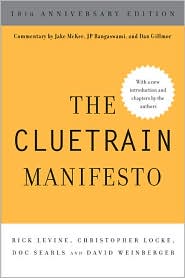
Cluetrain 10th Anniversary edition
Cluetrain 10th Anniversary
Everything Is Miscellaneous
Small Pieces cover
Small Pieces Loosely Joined
Cluetrain cover
Cluetrain Manifesto
My face
Speaker info
Who am I? (Blog Disclosure Form) Copy this link as RSS address Atom Feed

November 27, 2008

Control doesn’t scale

I sometimes put up a Powerpoint (well, Keynote) slide that says “Control doesn’t scale.”The assumption that large projects only succeed if they’re centrally controls led and managed turns out to have been true because we limited the scope of what we we considered realistic. You can build a Britannica using a centrally controlled system, but you could not build a Wikipedia that way.

But I know that there are some important counter-examples, so I’ll frequently add, “Except at an huge cost in expense and freedom,” for we know all too well that some regimes have managed to maintain intense control over massive populations for generations.

Today there’s an interview in the Sydney Morning Herald with Isaac Mao, pioneering Chinese blogger and Berkman fellow, in which he says the Chinese authorities are unable to keep up with increasing volume of social communications the 108M bloggers, millions in social networks, and people texting and twittering away.

So, maybe control doesn’t scale after all.

[Tags: isaac_mao control china berkman ]

Tweet
Follow me

Categories: blogs Tagged with: berkman • blogs • bridgeblog • china • control • digital culture • everythingIsMiscellaneous • globalvoices • peace • social networks Date: November 27th, 2008 dw

6 Comments »

November 25, 2008

[berkman] Antony Loewenstein on blogging in rerpressive regimes

Antony Loewenstein is giving a Berkman Center lunchtime talk on “The Blogging Revolution: Going Online in Repressive Regimes.” He begins by reading a short paper. [Note: I’m live-blogging. Getting it wrong, Missing stuff. And this comes out far choppier than the actual discussion.]

In the paper he says that bloggers are at risk of being silenced in repressive regimes In Antony’s home, Australia, the PM is proposing filtering child porn and “excessively violent” sites. There has also been talk of blocking euthanasia and pro-anorexia sites. Wha next? Block Hamas sites? (Antony does not consider Hamas to be a terrorist group.) Despite all this, Australia isn’t one of the more repressive regimes when it comes to the Net. Antony’s book looks at bloggers’ attitudes toward their governments. E,.g., bloggers in the Middle East generally are angry at their governments for repressing the rise of Islamic government. There is a widespread desire to make incremental change without government involvement. Bloggers everywhere are unpacking issues governments would rather hide from view. “Blogging is not in itself revolutionary but the act of expressing yourself online can be.” Many of the bloggers he met with were aware of their international audience and hoped that would bring pressure on their regimes. They are also angry at global companies such as Microsoft, Yahoo, and Google in enabling the restrictions on the Net. “International laws and norms must be applied.” We need ethical labeling on media, as we have Fair Trade labels. And it’s not just other countries that we need to worry about it. Sen. Lieberman pressured YouTube to remove videos from supposedly Islamic fundamentalist terrorists. Blogging lets people write and publish without a Western filter.”

Q: [ethanz] In your book, you look at how the rest of the world gets filtered by the Western media. You say that the blogosphere lets people see the world unfiltered. But, people aren’t queueing up to read international blogs. There isn’t enough demand for it. What’s an ideal relationship among the people raising their voices — probably not in English — and the people around the world who could change policy and structure?
A: The bloggers I met with have very popular sites within their own country. Part of my job as a journalist is to talk with other journalists and tell them they ought to be paying more attention to these voices. It doesn’t mean that they will, but it’s likely these people will have an effect. During the Olympics, over Tibet, bloggers on both sides were shouting across each other. For one thing, language is a key problem. On the positive side, newspapers ran what Arab bloggers thought about the election.
Q: [ethanz] But wouldn’t the old man-on-the-street interviews be more representative than a handful of bloggers?
A: We need both. You, Ethan, may be underestimating the effect bloggers are having on journalists.

Q: [me] Do you have examples of blogging affecting repression?
A: Egypt. Bloggers filmed torture and rape. It was distributed via mobiles. Eventually the government was forced to respond. Police torture still goes on, but now people talk about it. Also, in Iran there are far more discussions of issues such as women’s rights, religious affiliations, the Iraq War. I don’t want to overplay that, but that is going on.

Q: The effect of Al Jazeera?
A: Major. Satellite is having more effect in many ways than the Net. It reaches more people.

Q: Yes, Western media ultimately turns everything into what’s about “us.” Western media define Arabs in light of the geopolitical struggle. The press reduces my identity to whether I’m pro or against Hamas. What is a positive message we can get out about working the system to get them to report on the real cases happening on the ground?
A: The Western media sense is that the Israelis are good and the Arabs are bad. Almost all Western journalists are based in Israel. That biases them. Not every story about the Middle East has to be focused through the terrorism prism.

Q: [jillian] What about Syria? Why didn’t you write more about that?
A: I don’t the Syrian blogosphere as having as much impact on that country as the Iranian and Egyptian blogosphere does on those countries.

Q: I was born in Poland and saw the Solidarity movement go from tiny to 1/3 of the population supporting it, in just a couple of months. It was so successful not because the NY Times supported it (which it did). I haven’t seen similar movements come about through the Net or cell phones. Why is it that even though we have all of this beautiful technology, we haven’t seen anything like Solidarity happening?
A: Blogging communities generally don’t have massive mainstream support. Many of the bloggers are not dissidents. E.g., Iranian bloggers are frequently pro-regime. Blogging plays one role among many. Bloggers on their own won’t bring down a regime. Frequently the reforms are old school. It’s not easier to get people on the streets to protest. No one I spoke to is looking for a violent revolution.

My understanding is that with the advent of the Net in Islamic states, people are finding new channels to discuss their questions about Islam, instead of going to the religious authorities or your family. This is eroding the authority of traditional religious authorities. Have bloggers in Islamic states mentioned this to you?
A: Even those who criticize the state still want an Islamic state.

You say a great deal of speech comes out of the Moslem Brotherhood that represents the people better than the Egyptian government does. What should those bloggers be doing to have a bigger influence nationally and internationally?
A: There’s a struggle within the Brotherhood between moderates and hard-liners. The old guard doesn’t like showing these internal struggles. It’s not about the Brotherhood changing their message to make the West happy. To bring about greater engagement means putting a Western-friendly face on.

[From the IRC comes a strong recommendation for this post by Roland Soong about Chinese blogging.]

Q: Technology backbones?
A: Facebook and Twitter are being localized. YouTube.

Q: Should YouTube block particular videos that offend, say, the Thais. Or should they just pull out of Thailand? If they block the particulars, is that collusion?
A: I think it’s inappropriate to do this without transparency. I’d rather have them block a few sites than block all of them, but what happens next?

[I had to leave at this point …] [Tags: berkman_antony_loewenstein blogging democracy ]

Tweet
Follow me

Categories: blogs Tagged with: blogging • blogs • bridgeblog • culture • democracy • digital culture • digital rights • peace Date: November 25th, 2008 dw

1 Comment »

November 24, 2008

Chinese won’t let blogger travel

Rebecca MacKinnon reports that the Chinese government has refused to let citizen journalist blogger Zhou Shuguang (known as Zola) travel outside the country. This is not the first time he’s faced the Chinese authorities. This time, he twittered it as it was happening.

Rebecca posts: “I just communicated with Zola online. I asked him how he’s feeling – he said he’s tired but he feels ok, isn’t stressed.” She is concerned, however, as we all should be.

[Tags: zola blogging Zhou_Shuguang china ]

Tweet
Follow me

Categories: blogs Tagged with: blogging • blogs • china • digital rights • peace • zola Date: November 24th, 2008 dw

Be the first to comment »

November 5, 2008

We. One.

If John Kerry had won in 2004, I would have woken up the next day smiling because we had wiped the smirk off America’s face. The long snarl of the Bush administration would have been over.

But this morning I woke up weeping with joy. As I had gone to bed weeping.

Not just because we elected as president a black man — yes, of mixed race, but that’s how it works in this country — although that would have been enough.

Not just because of the wave of joy that his election unleashed.

Not just because that joy itself occasions joy. This was not a grudging acceptance.

But also because something I never even imagined happened yesterday: We not only elected a black person to the presidency, but racial progress itself became a symbol of something larger.

Yesterday I would have said, along with many others, that there is no frame more pervasive, insidious, or toxic than that of race in this country. Today, with our embrace of this man — and his glowing, loving family — we framed race in something larger.

We elected Obama in the face of an old politics of division driven in its extremity to caricature. For once we said no to that. Enough! The global crowd that gathered yesterday was expressing — I believe without facts but with all my heart — its weariness with division and its deep yearning to be together in peace.

The defining moment in our country’s continuing struggle against racism wasn’t about race. We found something bigger. At last, at last.

This is not to say the struggle against racism is over. Of course not. Yesterday did not desegregate our cities or wipe clean our prejudgments. Four years of images of that gorgeous black family in our White House will make a far larger difference, and it will make the difference right at the perceptual level, where our worst prejudices cower.


To live up to the ideal we just embraced, we have to do intentionally what Obama does by nature. He listens to those with whom he disagrees, but he responds only to the goodness expressed in even the most fear-driven of statements. Ignore the small, the petty, the self-involved, the defensive, and respond to the moments of goodness in all of us.

This is a practical program. I’ve seen it adopted on purpose and I’ve seen it work. Avoiding getting dragged into negative shoutfests is basic troll management. Learning to hear and respond to what is good and shared in an expression we find detestable is harder. The best teachers do this routinely. We can all learn to do it. We can. Yes, we can.

It is a big part of how Obama brings out the better nature in us. It is a big reason the unrelenting and unreasoned negative campaign aimed at him failed.

It is also a task performed historically all out of proportion by African-Americans. That is a blessing we have not deserved, but could not have survived without.


No more Bush. I felt an almost physical relief. My shoulders rose. My back straightened.

I can look out at the world for the first time in my life and say I am proud to be an American without feeling a need to explain why, and first getting some apologies out of the way.


I know Barack Obama is going to disappoint us. I know I will deeply disagree with some of his policies. But I trust his deliberative process and I trust his open heart.


Our children last night said that they were jealous that my wife and I got to live through the era of great heroes, that we can talk about the times we saw JFK, RFK, and Martin Luther King, Jr., and how we were moved by them.

I told them they had seen that moment tonight. But they knew that already.

And we get four — eight! — more years of watching this man — that one — approach a podium to speak, knowing that our best natures are about to be summoned.

So forgive me for weeping as I relearn that we are not fully human when we are without hope.

[Tags: obama president_obama election politics peace ]

Tweet
Follow me

Categories: Uncategorized Tagged with: election • obama • peace • politics Date: November 5th, 2008 dw

36 Comments »

September 8, 2008

Report on One Laptop Per Child from Nicaragua

Waveplace is bringing the One Laptop Per Child laptops (AKA “The $100 Laptop”) to poor parts of the world. Here’s a terrific post about teaching kids how to use the EToys program that’s included. For context, there’s this. And you want photos? Yes, you do. Here are some fantastic pictures. (And here’s one of my favorite photos of all time. BTW, the little girl is a double amputee.)

[Tags: olpc xo nicaragua waveplace ]

Tweet
Follow me

Categories: Uncategorized Tagged with: bridgeblog • digital culture • education • nicaragua • olpc • peace • waveplace • xo Date: September 8th, 2008 dw

4 Comments »

August 2, 2008

Oh yeah, that’s why we have a Constitution!

Harry Lewis puts just right the way Homeland Security goes off the rails with its decision to give itself permission to confiscate laptops at the border:

I love Michael Chertoff’s explanation of why border guards won’t bother with the niceties of probable cause provided for in the Fourth Amendment: “As a practical matter, travelers only go to secondary [for a more thorough examination] when there is some level of suspicion. Yet legislation locking in a particular standard for searches would have a dangerous, chilling effect as officers’ often split-second assessments are second-guessed.”

He’s right, of course. The Bill of Rights has a chilling effect on the government. That’s what it’s there for!

[Tags: harry_lewis homeland_security laptops privacy creeping_totalitarianism ]

Tweet
Follow me

Categories: Uncategorized Tagged with: digital rights • laptops • peace • politics • privacy Date: August 2nd, 2008 dw

2 Comments »

July 6, 2008

RMack on the GV Summit

Great reflective post about the Global Voices Summit from Rebecca MacKinnon…

[Tags: berkman gv globalvoices rebecca_mackinnon ]

Tweet
Follow me

Categories: Uncategorized Tagged with: berkman • globalvoices • gv • peace • social networks Date: July 6th, 2008 dw

Be the first to comment »

July 4, 2008

Declaration of Independence

The Declaration is obviously a remarkable document, part philosophy, part legal document, part performative, part a moral accounting, part beautiful rhetoric. It’s good reading, although I do tend to skip the long middle that lists the particular complaints and justifications.

Here are some resources:

Text
Wikipedia
US Archives
Facsimile
With annotations of our failure to live up to it
Lightly annotated to show draft changes
Martin Luther King’s Declaration of Independence from the War in Vietnam
Ho Chi Minh’s Vietnamese Declaration of Independence

[Tags: july4 declaration_of_independence ]

Tweet
Follow me

Categories: Uncategorized Tagged with: declaration_of_independence • july4 • peace • politics Date: July 4th, 2008 dw

Be the first to comment »

July 3, 2008

The fallacy of examples

Nicholas Kristof has a terrific column today about how the donation of a goat to a family in Uganda ultimately led to one of the children, Beatrice, earning a degree from Connecticut College, and beginning a path of service for her community. It’s a wonderful story, the point of which is what Jeffrey Sachs calls the “Beatrice Theorem” of development economics: “small inputs can lead to large outcomes.”

Well, yes, of course. In fact, small changes have determined the success or failure of us all. And I have no misgivings whatsoever about this past Channukah having given our children certificates announcing that Oxfam had given goats in their name. Yes, I am a goat-giver, and proud of it.

But…

…I’ve noticed in business writing in particular the frequency of what we can call the Fallacy of Examples (a type of Fallacy of Hasty Generalization). You read some story about a successful CEO as if we should learn from his (yes, usually it’s a him) example. But we are struck by examples frequently because they’re exceptional. As exceptions, examples are the last thing you want to learn from.

Not always, though. Sometimes examples are typical. That’s different. The trick is determining which are which.

An even when you can, you’re still not done. Is Beatrice and her goat an exception? Yes. That’s why her story is so inspiring. As an exception, it may be exactly what we should not be emulating. After all, if she’d won the lottery, we wouldn’t think that giving lottery tickets to the poor is a sensible approach to the problem of world poverty. But, even though Beatrice is an exception, the typical effect of donated goats (and other such small-ish gifts) may be quite good.

That’s why the Fallacy of Examples is a fallacy. Reasoning from examples doesn’t always lead to false conclusions. The reasoning just isn’t enough to tell you what the valid conclusions are.

And in the absence of valid conclusions, here’s Kristof’s list of ways to donate goats or their equivalents. And here’s Oxfam’s program. And, because it’s the Internet, here’s samizdata’s warning that goats cause poverty. [Tags: philanthropy nicholas_kristof beatrice goats ]


Ethanz brilliantly contextualizes this post. Thanks, Ethan!

Tweet
Follow me

Categories: Uncategorized Tagged with: beatrice • globalvoices • goats • peace • philanthropy Date: July 3rd, 2008 dw

15 Comments »

June 14, 2008

Gay rights and differential hermeneutics

In the June issue of Harper’s, Gary Keizer has an article called “Turning away from Jesus: Gay rights and the war for the Episcopal Church” that I kept trying not to like, I think because he’s too right and too good. But the article won me over. Alas, Harper only posts miniature, unreadable images of the pages, so you’ll have to do something primitive like trudge to your local library to read it.

Gary paints a picture of a church traditionally less interested in enforcing doctrinal homogeneity than in ministering to those in need. He personally favors the ordination of gay clergy, but the article focuses a level up from that: How can a church handle disagreement and difference? And he explicitly applies those lessons beyond the church to the country and the world.

It made me think of AKMA‘s idea of differential hermeneutics, a theory of interpretation (which is to say, of understanding) that assumes we’re never going to agree. He opposes this to what he calls “integral hermeneutics,” which aims at resolving issues, and thus showing that one person’s interpretation is right and another’s is wrong. And, yes, AKMA is fully aware of the issues that arise from his position. (I blogged about this here.)

I am convinced that Gary and AKMA are raising exactly the right questions, and are answering them the only way that lets us live together in peace, which is not to say in harmony or quietude. And I find what they say based upon their similar religious convictions to be quite in line with what I understand the Jewish attitude toward interpretation to be: The arguing continues all the way into the next life. If you’re so lucky. [Tags: episcopalians gay_rights gary_keizer akma peace judaism everything_is_miscellaneous ]

Tweet
Follow me

Categories: Uncategorized Tagged with: akma • culture • episcopalians • everythingIsMiscellaneous • judaism • marketing • peace • philosophy Date: June 14th, 2008 dw

4 Comments »

« Previous Page | Next Page »


Creative Commons License
This work is licensed under a Creative Commons Attribution-NonCommercial-ShareAlike 3.0 Unported License.
TL;DR: Share this post freely, but attribute it to me (name (David Weinberger) and link to it), and don't use it commercially without my permission.

Joho the Blog uses WordPress blogging software.
Thank you, WordPress!