

logo
EverydayChaos
Everyday Chaos
Too Big to Know
Too Big to Know
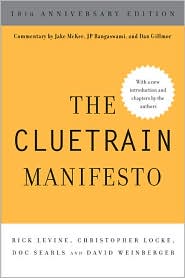
Cluetrain 10th Anniversary edition
Cluetrain 10th Anniversary
Everything Is Miscellaneous
Small Pieces cover
Small Pieces Loosely Joined
Cluetrain cover
Cluetrain Manifesto
My face
Speaker info
Who am I? (Blog Disclosure Form) Copy this link as RSS address Atom Feed

May 29, 2007

Give (some of) the public airwaves to the public, and support structural separation

Save The Internet has a new posting up, asking the FCC to make sure the chunk of the airwaves about to become available stays open for public and market innovation.

David Isenberg, meanwhile, in an important piece writes that we won’t get Net neutrality if we rely on policy to achieve it. The carriers are structurally incapable of being Net neutral. So, David argues for structurally separating those who provide Net connectivity from those who sell content and services over the Net. [Tags: net_neutrality savetheinternet david_isenberg telecommunications spectrum fcc ]

Tweet
Follow me

Categories: Uncategorized Tagged with: net neutrality Date: May 29th, 2007 dw

2 Comments »

April 7, 2007

Why a wifi blanket?

For something I’m writing (for free), I want to make the case for the benefits of having a “wifi blanket,” by which I mean, loosely, making wireless Internet connectivity so common that we can rely on it being available just about anywhere we are in this country. Depending on how it’s implemented, that might work out to coverage as broad as the reach of TV or cell phones, or, say, cheap or free connectivity available to 90% of the population. (I’m making up this number.) And it doesn’t have to be wifi. If it’s WiMAX or open spectrum or something else, I don’t care, so long as it’s cheap or free, truly open, crosses economic strata, and is so common that we take it for granted.

For now ignore the costs and the practicalities. If such a thing were accomplished, how might it affect us? What opportunities would it open? What sort of economic stimulus might it provide, especially if we assume that a wireless blanket would stimulate the growth of wifi phones (or combo phones), which be more general purpose Internet devices. What might the blanket do for education? Politics? News and entertainment? Marketing? National security? Do you have any statistics you’ve found or made up? Pointers to actual research? Wild-ass speculation? Science fiction scenarios? Paranoid plots? Bring ’em on! [Tags: wifi net_neutrality telephony ]

Tweet
Follow me

Categories: Uncategorized Tagged with: business • digital culture • net neutrality • wifi Date: April 7th, 2007 dw

14 Comments »

March 15, 2007

Jay Sulzberger on the essential neutrality of the Net

The FTC has posted comments on its workshop on Net neutrality held on Feb. 13 and 14. Here is a pdf of Jay Sulzberger’s lucid explanation of how the Net works — ports ‘n’ protocols — and exactly why the Net is essentially different from cable TV. (The PDF is 280 pages long, but Jay’s comments are are a mere 12 pages of typescript — easy and fun reading.)

Also of special interest: eBay‘s comments and joint comments by Senators Dorgan and Snowe [Tags: net_neutrality jay_sulzberger ftc ]

Tweet
Follow me

Categories: Uncategorized Tagged with: digital rights • media • net neutrality • politics Date: March 15th, 2007 dw

3 Comments »

March 13, 2007

Among the cables

On Monday, I gave the lunchtime keynote at the Cable Television Public Affairs Association meeting. About 400 people had assembled in the DC Ritz-Carlton to spend a few days discussing cable’s future and how to achieve it. It was quite an educational experience for me. And not just because I got boo-ed.

In the morning, I watched a panel discussion by cable industry executives. (I live-blogged it here.) I went to a breakout session on how the cable companies are covering the upcoming presidential election. (Yes, 600 days away has become “upcoming.”) I had a chance to talk with a few people outside of the sessions. But I came in as an outside voice, and I left surprised by what I learned…even though I should have known it going in.

My presentation was, at the request of the organizers, cluetrain-y. I talked about the rise of person-to-person communications, contrasting it with the assumptions of the broadcast era. (“Broadcast” to the cablers means “over the air,” so I had to explain at the beginning, and remind them a few times throughout, that “broadcast” to me means “one-to-many.”) I then talked about networked markets (have you heard that markets are conversations?) and mentioned Doc‘s other great line: “There’s no market for messages.” I spent the bulk of my time taking blogs as my example, going through about ten different common misunderstandings of them. I ended by saying that in the P2P era, we’re taking back our culture, pointing out very quickly some ways in which we’re making it ours, which has become a magic word for me. In the course of listing things that are ours, I had a slide that showed “Support Network Neutrality” sprayed onto a brick wall; in preparing, I thought that those 8 seconds would be all that I spent on the Net neutrality topic.

Well, it didn’t quite go that way. Since I had heard the morning panel, I ended up reacting to it as I went through my prepared presentation. E.g., when I introduced the topic of person-to-person vs. broadcast, I pointed out that the “10 megs down, one meg up” mentioned by one of the panelists assumes that we’re “consumers” rather than creators; we should have symmetric up and down. And for some reason I dragged Net neutrality into it early, and got hissed. But I’m not sure it wasn’t good-natured hissing, if you know what I mean.

But I really annoyed them when I complained about the panel’s whining about competition. I said that the cable market isn’t competitive. People yelled from the audience. I said that where I live, the town has franchised only one cable provider, although I think we’re letting in a second. But, people in the audience said, I could get the Net by satellite or DSL. A more gracious and honest person would have accepted that, and clarified: Cable competes with other forms of delivery, but generally doesn’t compete with other cable companies within a region…although they compete for franchises. I instead just got sarcastic. Yeah, real mature. In fact, cable is more competitive than I’d thought, and these folks do wake up every day worrying about competitors, as one of the panelists had said. On the other hand, it’s not like before the Supreme Court in the Brand X decision said that the carriers no longer have to rent out their lines to other ISPs. If Congress would roll back that decision, we’d see some real competition.

I also at one point poked at the panel for saying that they were up against big scary Google. “Google has two lobbyists!” I said, which I’ve since found out was once true but is no longer. They have maybe a dozen. (Whoops. Sorry.) Nevertheless, the Net neutrality folks are certainly out-lobbied by the carriers. But, as I found out later when talking with a friendly Time-Warner guy, the cable industry is used to thinking of itself as the upstart battling the entrenched telephone giants, so it was odd and unpleasant for them to hear me treat them as if they were an entrenched giant. I had no idea.

During the panel beforehand, and in a conversation with a different Time-Warner guy afterwards, they kept coming back to their concern that if Net neutrality passes, the cable companies won’t be able to raise capital. Oddly, the TW guy also argued that TW has absolutely no intention of violating Net neutrality. So, I said, TW ought to announce that and take the wind out of the NN sails. But announcing that, he said, would discourage investors. But, I said, it’s either part of their business plan or it’s not. We did not come to closure on that point. And I’m personally not convinced that that’s the real reason they oppose Net neutrality. It sounds to me like a supporting reason, as is the argument that since no one has violated NN yet, we don’t need a law forbidding people from violating it, as well as the “Google is getting a free ride” line of reasoning. I think — and I’m indulging my hunches here — that the real reason they oppose NN is that they want to ensure their subscribers have a “good experience,” where the criteria of a good experience are those that govern expectations for how television works. They’re thinking that users most of all want to be able to watch programs in high def and on demand, and so those packets need to get preference. They are frustrated by Web fanatics who want to hold back this rational load-balancing. The cable companies are in the business of selling us video content, and they see their ability to satisfy their customers being hampered by fanatics holding on to an out-dated architectural principle.

There are, of course, answers to this argument, but I think the primary response should be: No commercial entity should get to decide which experience needs to be optimized. Maybe I want to watch high def video, but you want to play video games, and someone else wants to download the high-resolution scan of the Bayreaux Tapestries. It’s not obvious that video should win. The decision should not be made by the people who have a vested, commercial interest in the outcome. IMO.

It was for me a fascinating glimpse. Plus, I got boo-ed twice.


Susan Crawford has two especially fine pieces on her blog at the moment. The first explains the Universal Service Fund scandal. This is money that those with phone access pay to subsidize access for those whom the market would not reach. But it’s become a mess.

The second is a well-told vignette about a birthday concert she played for a friend. (She’s an accomplished violist. And she’s going to make a heck of an FCC chairperson.) [Tags: susan_crawford cable net_neutrality ctpaa telecommunications fcc ]

Tweet
Follow me

Categories: Uncategorized Tagged with: digital culture • digital rights • media • net neutrality • politics Date: March 13th, 2007 dw

1 Comment »

« Previous Page


Creative Commons License
This work is licensed under a Creative Commons Attribution-NonCommercial-ShareAlike 3.0 Unported License.
TL;DR: Share this post freely, but attribute it to me (name (David Weinberger) and link to it), and don't use it commercially without my permission.

Joho the Blog uses WordPress blogging software.
Thank you, WordPress!