


logo
EverydayChaos
Everyday Chaos
Too Big to Know
Too Big to Know
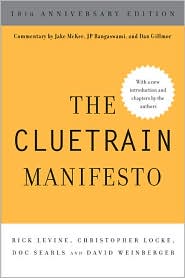
Cluetrain 10th Anniversary edition
Cluetrain 10th Anniversary
Everything Is Miscellaneous
Small Pieces cover
Small Pieces Loosely Joined
Cluetrain cover
Cluetrain Manifesto
My face
Speaker info
Who am I? (Blog Disclosure Form) Copy this link as RSS address Atom Feed

April 29, 2009

The census device

Ethan Zuckerman has a fun, informative post about the device being used by Census takers. It delves into the particulars, it drives toward some broader conclusions.

So, beside the pleasure of the piece itself, consider it as a piece of journalism. No, Ethan doesn’t spend the time to track down every detail. But he tracks down the details that the weight of the topic deserves. And it is a piece that it is hard to image would have made it through the editorial filters of paper-based news media.

I understand that pointing to a good post by someone who is not a trained journalist (but who has expertise in a field) does not provide reassurance that the system of journalism will survive. That system covers fields systematically that the flood-the-field approach of the Web may not reach. But, still, we can allow ourselves some hope. Some cautious, vigilant hope.

Tweet
Follow me

Categories: Uncategorized Tagged with: culture • digital culture • everythingIsMiscellaneous • media Date: April 29th, 2009 dw

Be the first to comment »

April 24, 2009

Craigslist Killer – PR in the news

Doc blogs about the unfairness of Craigslist becoming an adjective attached to “killer.” Yes, it’s unfair. It’s what the tabloid press does. And increasingly, that just means “the press.”

That’s the sort of catchy name that sells papers. But, as Craig points out in his blog, Craigslist does not promise anonymity. In fact, it promises that it will rat out rats. Wikipedia makes the same promise. Good. Of course, this assumes the police are not persecuting innocents as part of a totalitarian state, but I’m happy Craigslist helped the police arrest the sick fuck who otherwise probably wasn’t done murdering women allegedly.

The PR job doesn’t stop with the media, of course. Craigslist’s PR company fumbled the ball here in Boston. This Businessweek story is excellent, but the Boston Globe coverage has been miserable (here, here and here). The PR agency seems intent on keeping Craig from commenting, shunting inquiries to CEO Jim Buckmaster. Nothing against Jim, but Craig’s name is on the site. Craig has earned his reputation for honesty, bluntness, and service. Craig is known, respected, and even beloved. So, master the buck, Craig. It stops with you.

PS: The Globe ought to take a look at the “Erosphere” classified ad section of the Boston Phoenix before coming down on Craigslist.

[Tags: craigslist anonymity pr marketing ]

Tweet
Follow me

Categories: misc Tagged with: anonymity • craigslist • culture • digital rights • marketing • media • policy • pr Date: April 24th, 2009 dw

11 Comments »

April 22, 2009

SpokenWord.org getting excellenter

Doug Kaye keeps on polishing SpokenWord.org, a free site that collects spoken word podcasts (well, it only collects pointers to them) and lets you find, rate, discuss, and hear them. You can also add ones links to ones you like to the collection (i.e., share them). SpokenWord is getting quite useful and usable. Give it a try. (Disclosure: I’m on its board of directors; it’s a non-profit.)

[Tags: podcasts media ]

Tweet
Follow me

Categories: Uncategorized Tagged with: digital culture • education • entertainment • everythingIsMiscellaneous • libraries • media • metadata • podcasts Date: April 22nd, 2009 dw

Be the first to comment »

April 21, 2009

[berkman] Dan Gillmor on journalism supply and demand

Dan Gillmor is giving a Berkman lunch on media literacy.

NOTE: Live-blogging. Getting things wrong. Missing points. Omitting key information. Introducing artificial choppiness. Over-emphasizing small matters. Paraphrasing badly. Not running a spellpchecker. Mangling other people’s ideas and words. You are warned, people.

He whips through a history of media, from stone age to now, in about ten seconds. He cycles through a dozen sites doing interesting work, compressing twenty minutes of his normal talk to about 20 seconds. He says he’s no longer very worried about the supply of good journalism.

He says the question of “Who is a journalist?” is the wrong one to ask. Better to ask “What is journalism?” It’s an And, not an Or, situation. NGOs and individuals have been doing good reporting. The best reporting on Guantanamo has come from the ACLU, not from professional journalists. As Clay Shirky says, there’s no barrier any more between ideas and action. Try things out, let them fail, try again. Dan quickly shows some student projects at ASU, where he teaches, ProPublica, NYTimes APIs, etc. “I’m just pretty sure we’re going to get enough journalism.” But, says Dan, that doesn’t solve the quality problem.

He says he is really worried about demand. There’s too much information. Not all of it is accurate, including info in the mainstream media. “The ecosystem is in bad need of repair.” He talks about principles for “consumers” (he puts it in quotes) and suppliers.

For news consumers, he says we need skepticism and judgment. We need to have our “bullshit meter” working all the time. “It’s a mistake to think of credibility as starting at zero.” We should be thinking of it as having a negative starting point. Anonymous comments start with negative credibility. “They’d have to work really hard to get to no credibility.” Sometimes there’s something good in there, but …

Anonymous speech is crucial, Dan says. It’d be a big mistake to try to ban it. “It’s a bad idea” to refuse to stand behind your words in most cases, but it’s crucial when we need it. People should assume that a personal anonymous attack on someone is a lie. Assume it’s false.

Another principle: Do research. Ask your own questions, especially when making big decisions. E.g., Wikipedia is often the best place to start, and usually the worst place to stop. Dan says that WP is getting better and better and becoming one of the most valuable sources of info on the planet.

Another principle: Get outside your own comfort zone. E.g., Global Voices.

Another principle: Question your own beliefs. Dan used to keep a list of things he believes, and every six months he’d relentlessly attack it. E.g., these days he’s thinking Google is getting worrisome, doing things that are “anti-trust worthy” [nice pun!] He needs to revisit and ask if that trend is true.

Finally, we need to learn the techniques by which media is created and manipulates us. Sourcewatch, NewsTrust, MediaCritic (for Phoenix AZ)

The principles for journalists include all of the above, plus: Asking the readers what they know; thoroughness; accuracy; fairness (enabling right of hyperlinked reply); independence; transparency. Dan’s example of the need for transparency: The NYT won a Pulitzer for exposing the Pentagon’s coopting of military experts showing up on TV shows in the run-up to the Iraq War, but the network news did not mention that when covering the Pulitzers. Transparency means “you’ll be believed less but trusted more.”

Dan is creating a users guide, under the name mediactivecom. It’ll be a book and a site. He’s also exploring the nature of books. Perhaps the slower moving stuff will be in the book and the faster stuff will be online. He’ll write it entirely in public.

Q: Is the media organization the right unit of trust? Maybe we trust the NYT for tech reporting but not on Iraq…
A: Yes. There are reporters who I trust and others I don’t so much. And good reporters sometimes get things wrong. We’re looking for people to help us develop systems that combine population and reputation, and reputation is an incredibly complicated word…

Q: Your principles for journalists look like an updated version of the professional code of ethics for journalists. The code hasn’t been updated since 1996. Maybe that’s a framework for you…
A: One of my beefs with the NYT and WaPo is how routinely they violate their own standard. BTW, you’ll notice the word objectivity occurred nowhere in my presentation.

Q: I’m worried that money + anonymity (or fake identity) means that people can be shills. And someone who has to work all day can’t contribute as much to citizen efforts.
A: It’s going to be messy. But we’ll have more good things. Manipulation via money is not a new problem. Relentless media criticism is the best sunlight. I don’t know if it’ll be enough. As far as the inability to participate: There will be various scales. Most people can’t do media criticism all day. They have a life. People are now aware that if the see something newsworthy and they have a cellphone camera, they should record it. They don’t all know what to do next, and that’s an area for education.

Q: At our university, all students must take media literacy. Do you have advice for students.
A: I wonder if it’s too late by college. We need to do this when kids are young. But to teach critical thinking in grade schools would get you fired as a dangerous radical in half the school districts.

Q: (eszter) Even if we agreed that literacy is something we need, it’s not clear whose jurisdiction it falls under.
A: I know of one university that has a course devoted to this required of all students: U NY Stony Brook.

Q: The best media criticism today is on Comedy Central. We need the political will to do this work.
A: The Daily Show has some of the best criticism of television news, but that’s a very narrow part of journalism in terms of its content. You want to see bad news watch local tv news.

(lisa williams) What happens when local newspapers go?
A: I challenge your assumption that there will be no daily paper in the top 50 cities in the US. There’s still a business to be had in print journalism for some period of time (but not forever). The problem is most of these guys have so much debt. If the Boston Globe goes, within weeks there will be two smaller newspapers that will be better than the Metro. They won’t be comprehensive. There will be no lack of information, though it’ll be harder to find the things that trust. Messiness is not something merely to fear.

Q: (cbracy) How do some sites/papers get past zero in credibility? E.g., Talking Points Memo
A: From the beginning, TPM told you who he was, stood behind his works, had some journalistic background. Then, over time, it’s earned our trust.
Q: Rush Limbaugh uses his own name …
A: But an important criterion is that what you say is true. I have nothing against Fox existing. I just despise the slogan “Fair and balanced” because it’s a lie. We’re never going to agree on everything, so the reputation system needs to include knowing the opinion of people who broadly think about the world as I do but also what people who don’t think the way I do, because I want to make sure that I read that to. I prefer the uncomfortable world of nuance and uncertainty than one to which we simply accept the news as given.

Q: (harry lewis) Where is the right place to teach people not to beleive anonymous stuff?
A: The best single thing we could do to have better journalism is to have journalist be covered by some other journalism. It sure as hell made me better. It a smart world, getting burned would not be the way you learn. But for some period of time, people are going to have to be burned by believing something anonymous and telling their friends. It’ll take a generation…

People will miss the current newspapers because they are a unifying force. Also, what about objectivity>
A: Objectivity is a nice ideal that is hopelessly impractical. The principles I outlined add up to something better. No one should ever believe only one media source. And, no, I’m not happy about the dissolution of forces that gave us some common ground. But I see all these self-organize things happening… Before it’s over, everyone will have heard Susan Boyle sing. We have a better chance of figuring things out now that the information accretes over time to a place where there’s more clarity. And, by the way, I do not buy the echo chamber idea; I think that’s easier to do in the era of broadcasting.

Q: (darius) I’m skeptical. Aren’t lazy users aren’t lazy. They work hard all day and then want to be entertained
A: They’re not lazy in their lives, but they’re being lazy in what they believe about the news. The era of mass media has encourage an intellectual and civic laziness that’s dangerous. We all to take more responsibility for knowing what we know.

Q: You’re worried that the demand side isn’t strong enough. Even if every university had a course in media literacy, but the 2/3’s of the country that doesn’t go to university …
A: There’s lot of work going on in media literacy at all levels of education. I avoid the phrase “media literacy” because it works better than Ambien in putting people to sleep. It has to start with parents. Journalists should have been working on this for years; it would have given them a reason for existing.

[Posted without being re-read. Sorry!] [Tags: berkman journalism media dan_gillmor citizen_media ]

Tweet
Follow me

Categories: Uncategorized Tagged with: berkman • conference coverage • digital culture • everythingIsMiscellaneous • journalism • media Date: April 21st, 2009 dw

3 Comments »

April 17, 2009

[ugc3] Final panel

I went first. I talked about exceptionalism, responding to Eli Noam’s challenge at the beginning of the conference that if we’re going to think the Net is going to bring about substantial changes, we have to be able to point to characteristics of it that are different from other technologies that also looked revolutionary but that turned out to be rather prosaic.

NOTE: Live-blogging. Getting things wrong. Missing points. Omitting key information. Introducing artificial choppiness. Over-emphasizing small matters. Paraphrasing badly. Not running a spellpchecker. Mangling other people’s ideas and words. You are warned, people.

Len Downie was executive editor of Washington Post. He’s not going to propose any new form of delivery of the news. He’s not sure the old will die out completely. WaPo is reorganizing itself as a news operation and as a company. They have Facebook and iPhone apps, etc. When it comes to UGC, “this is not a zero sum game.” On WashingtonPost.com you find lots of user comments, participation in blogs, user photos and videos, crowd-sourcing. E.g., Amanda Michel’s “Off the Bus” crowd sourcing, which went through professional editors. (Amanda is now at ProPublica.) They hope the Net will help end the traditional alienation from their readers. And the Net has made their audience bigger than ever before.

The big problem is the loss of classified advertising. Hundreds of millions of dollars lost, hitting local newspapers especially hard. Also, display ads have been driven down. Local news stations are covering fewer stories. There’s less reporting. That’s the problem Len is going to examine in his new academic role at Arizon State.

There are some things the government could do, but not a “bail out,” Len says. Maybe newspapers will become 501C3’s. Maybe they’ll become LC3’s, so they could still be profitable and yet receive tax-exempt contributions. Maybe convert them into endowments, although Len says there isn’t enough money for that: You’d need a ginormous endowment to generate the requisite funds. There are more and more non-profit investigative reporting organizations. There’s a lot going on. It’s impossible to tell what’s going to happen.

Q: How much does investigative reporting cost?
A: At ProPublica, they do it in the best way, and it’s tens of thousands of dollars, mainly for the reporter’s time.

Q: In Germany they’re aggregating news and selling access [I got this wrong] …
A: I’d have to look at it.
Q: Isn’t that what AP does?
A: Don’t get me started. AP is supposed to be a collaborative. If we don’t all charge at the same time, we won’t be able to raise enough money. Alan Mutters [sp] suggests that we all decide on July 4 to start charging. The Obama admin is concerned about the future of news. They’re going to look at loosening anti-trust regs so newspapers can band together, but you don’t want to create another cartel like AP.

Q: If the NYT shut down its presses and went totally online, how would that affect their costs and prices?
A: The Times might save 40-50% of their costs, but it would take away 90% of their revenue. Kindle is great for books but not very good for newspapers. Looking forward to the big multimedia tablets.

Q: The NYT is doing well on the Web. But last year their Web revenue increased just 1%. What’s the future business model?
A: That’s what I’m trying to figure out.


Greg Lastowka (law prof, Rutgers) is going to talk about legal aspects of UGC. First question: What is UGC? It’s a fuzzy concept. “User” is an important term because of copyright. Copyright is not about monetizing the works of authors. Copyright is there to promote the progress of science and the useful arts. Our Constitutional mention is based on the earlier British Statute of Ann that took control away from publishers and gave it to authors, in order to promote education.

Greg predicts that copyright won’t change very much in the next ten years. Copyright law will probably ignore UGC and be large unaffected by it. UGC will be treated as a problem, it will change the rules somewhat (through litigation), but the fundamental shape of copyright law won’t change in response to UGC (says Greg). Ten years ago, he was more optimistic about it. He thought UGC was a huge social boon that was a very bad fit for copyright law, so copyright law would change to reflect that value. The Web was meeting the goals copyright law was established to meet.

Four changes to get copyright law to fit the Web: 1. Simplify the law. 2. People want credit for their work even when they’re happy to have it spread. People get copyright law mixed up with plagiarism. We should work the attribution right into it. 3. Reform terms of service and their enforcement. 4. Subsidize free access content. Copyright is a subsidy for authors.

Greg was arguing this ten years ago. Not much has changed, although there’s progress in open access to academic work. Why haven’t there been more changes? Maybe because our legislators don’t understand what’s happening. The better, sadder, answer is that Greg’s politics were naive. Copyright law today is realistically about protecting big money incumbents. Dan likes copyright and blockbuster movies, but thinks there should be an ecology that enables them and UGC. We’re unlikely to strike a new social contract that reflects the rights of amateur creators.

Q: To what extent is international trade motivating maintaining strict copyright?
A: Legislators certainly care about it.


Stefaan Verhuist (Markle Foundation) presents his model of UGC: Mediation 3.0. It has three new mediating functions that converge to create a new type of mediation. Those functions can be accelerated and made more valuable by making sure they are cheap, deep, and speed. The success depends on four challenges: the 4 Ps.

Setfaan draws a triangle: 1. Establish relations. 2. Provide a new kind of resource that has value for users and that may be created by the users. 3. Remix. Ensure a relation that creates a resource that may be remixed. Their convergence creates UGC. If you can provide resources that are cheap, deep (the value for its users, related perhaps to a geographical location), and speediness. But it can be hard to be cheap, deep and speedy; that’s the challenge.

The 4 Ps: Privacy (relationship), Property (remix), Public sphere obligations and responsibilities (resource), Push and pull (in the center of the triangle) of information. The push-pull presents the policy challenges.

[Posted without re-reading. Gotta run.]

[Tags: journalism media newspapers copyright copyleft creative_commons marketing ]

Tweet
Follow me

Categories: Uncategorized Tagged with: business • conference coverage • copyleft • copyright • culture • digital culture • digital rights • entertainment • everythingIsMiscellaneous • journalism • marketing • media • newspapers Date: April 17th, 2009 dw

Be the first to comment »

[ugc3] Sustainable business models and long tails

Andres Hervas-Drane
Begins by noting the long tail in the market share of products. There’s empirical evidence that this is happening online. Why there? Standard answer: Supply side. But he wants to look at factors on the demand side that can affect this distribution.

He sets up a case where consumers have difference preferences and come to the market uninformed. In the offline world, search happens through word of mouth. They can search with evaluations or with recommendations. Recommendations come from consumers who searched with evaluations. Word of mouth results in a high concentration of sales.

Almost a third of Amazon’s sales are generated by recommendations. These are generated by users as meta-content, finding consumers who have similar preferences. This is taste-matching and it reduces sales concentration.

Then there are “artistic markets”: that increase the demand for niche producers and results in long term cultural variety.


Peyman Faratin talks about a case study of prediction markets. His main point: Scarcity is at play even in the UGC system. The new scarcity is of attention.

An incentive engineering problem is at foot in prediction markets. When you can’t bet real money, the incentives go down. The reward streams are delayed. You have to search for the market. There are significant transaction costs [which he goes over in some detail, but too hard to capture briefly…sorry]. That’s why prediction markets aren’t going very well; they’re lonely.

Solution: Reward the big hitters. Let them transfer their reputations. Give them content management rights. Rank markets and reputations. “Invisible hand of the algorithm: Recommendations.” Use widgets to let the market come to the user. [I missed the end of this. Sorry!]


Chris Derllarocas talksabout “Your Operations hvae become your New Marketing.” “Every customer is a potential brand ambassador or a lethal bran assassin.” E.g., in 2006, Comcast spent $100 M in advertising, wiped out by the youtube of a sleeping technician. UGC can make or break your business.

Most influential UGC occurs spontaneously and represents non-representative experiences. Companies need to take preventive measures. Consumers use UGC to decide if they should consume a product. Once they have, they decide what to report. Companies need to “Strategically re-engineer the consumption experience to spontaneously provoke the right mix of consumer content.”

Rules: Pay attention to extreme events. Move towards a culture that pays attention to outliers, positive and negative. “Redesign your monitoring practices and career incentives to accentuate the positive and eliminate the negative.” Also, “reasses yesterday’s yield management practices.” That is, make sure you do not systematically produce a small number of unhappy customers” (e.g., but routinely overbooking, or by routinely selling undesirable hotel rooms at very low rates). Also, get to know your power customers, i.e., the ones more likely to be vocal. They should receive “the special teratment that loyal big spenders used to receive ten years ago.” Also, not sock puppetry. Also, maybe have a Chief Perception Officer.

Q: You’re proposing an operational hit since we won’t be selling all the seats or rooms.
A: Yes. That’s the decision to be made. We need to make these decisions holistically. We don’t have the complete answer, There’s room for innovation.

Q: [me] This morning we heard that the population is not nearly as adept at using these tools as some of us (= me) would like to believe. This afternoon we hear about markets that are adept. How did you hear this morning’s research?
A: It varies by market. And consumers aren’t necessarily savvy. The UGC has effect even when they’re not savvy. You need to tier your efforts, taking account of the consumers’ Web savviness.

Q: How’s it work in other countries?
A: We haven’t done that research. Happy collaborate…

Q: How does this apply to B2B?
A: More limited.

Anindya Ghose will talk about combining textmining with econometrics. Firms want to know if there’s any economic value to social networks and UGC. How can they monetize UGC?

There’s economic value embedded in the content. E.g., product reviews, geo locations, online purchase behavior. His software mines the text and assesses the economic value of, say, a positive review and even more particular comments. E.g., “good packaging” lowers the value by $0.56 because customers expect superlatives. Particular keywords have particular monetary effects.

Hypothesis: The increasing availability of UGC is reflected in sponsored search metrics. And, yes, he found a correlation between the frequency with which key words are used in blogs and their cost-per-click on search sites. He’s researching whether there’s some sort of causal effect, but it’s not an easy problem. Hence, UGC can be monetized through sponsored search.

[Posted without re-reading. I have to prepare for my unprepared comments. I’m on a panel that’s supposed to be reflecting on the day.] [Tags: ugc ugc3 marketing cluetrain advertising textmining advertising prediction_markets everything_is_miscellaneous ]

Tweet
Follow me

Categories: Uncategorized Tagged with: advertising • business • cluetrain • conference coverage • everythingIsMiscellaneous • expertise • marketing • media • textmining • ugc • ugc3 Date: April 17th, 2009 dw

1 Comment »

[ugc3] Scott McDonald

NOTE: Live-blogging. Getting things wrong. Missing points. Omitting key information. Introducing artificial choppiness. Over-emphasizing small matters. Paraphrasing badly. Not running a spellpchecker. Mangling other people’s ideas and words. You are warned, people.

Scott McDonald of Conde Nast gives the lunchtime talk. He reminds us of how big CN is: magazines, websites, events, digital apps.

His numbers show that lots of people are creating content.

UGC issues for “traditional” [the quotes are on Scott’s slide] media: Brand compatitiblity (vs. “snark/coarsening”. Commoditization of content (all gets treated the same). Value as “listening post” (media can hear their readers). DRM when everyone is an aggregator. Monetization.

Advertisers are reluctant to jump in, Scott says. They worry about brand. UGC video is cheap and plentifu. but it’s not selling. The CPMs are deeply discounted. Ad revenues are not going to UGC and marketing execs are pessimistic about this; only 22% think UGC is a “high-growth opportunity.” 73% of advertisers say they definitely will not run ads on UGC.

So, what are the other models? You can incorporate UGC on a site as a “retention device.” [CNN’s turn-the-channel “iReports”?] Authentication fees on microblogging sites? E.g., Twitter charges DominosPizza to assure that it in fact represents Dominos Pizza. How about sponsorships on crowdsourcing sites such as Digg? E.g., at Reddit, maybe a sponsor could be an “amplifier” that announces that each thumbs up counts 5x. [Wha??? Wouldn’t that destroy Reddit’s credibility?] Finally, there’s cross-platform marketing. Only 10% of visitors to a mag’s site are subscribers. So, cannibalization isn’t a worry. But how do you make money on the web site? Ads only work for very big sites. But,” online subscriptions sales are sweet.” People who subscribe that way have higher value than subscribers through other means: They’ve sought out the mag, they pay with a credit card, they are more likely to take an automatic renewal contract, they get added to the email list, etc.

He points to Conde Nast examples of UGC. Contests for designs, NYer caption contest, GQ tips on good grooming. [These are as much UGC as a man-in-the-street interview.]

He points to Reddit, a CN site. He acknowledges the bad language on the page. It produces no subscription revenues. They’re starting to have sponsored posts that still can be voted up or down.

Q: Are people dropping subscriptions because they can get the content for free online?
Scott: In general, no. The conditions for reading mags are special, e.g., reading one on the subway to create zone of privacy. [A good e-reader will destroy this.] For news mags, that’s more of an issue.

[Tags: ugc ugc3 conde_nast media mainstream_media advertising marketing ]

Tweet
Follow me

Categories: Uncategorized Tagged with: advertising • business • cluetrain • conference coverage • culture • digital culture • marketing • media • ugc • ugc3 Date: April 17th, 2009 dw

Be the first to comment »

[ugc3] Understanding evolving online behavior

NOTE: Live-blogging. Getting things wrong. Missing points. Omitting key information. Over-emphasizing small points. Paraphrasing badly. Not running a spellpchecker. Mangling other people’s ideas and words. You are hereby warned.

John Horrigan of Pew Internet and American Life, gives a “non-Koolaid” presentation. He says that about 12% of Internet users have a blog. The percentage of people doing some form of content sharing is not increasing much at all. The demographics says that 18-24 do the most sharing, and then it goes down in pretty much a straight line. The change over time is not distributed evenly across age groups. Younger adults are turning away from the 6 core UGC behaviors, the 24-35s are increasing. The rest: not much change.

But people are increasingly going to social networkingIf UGC is migrating to rules-based environments, is it a good bargain? On the one hand, good governance can build sustainable mechanisms. OTOH, bad governance is a risk, so you want an open Internet.

Q: A decrease in activity among younger folk? Because they were so heavily involved initially?
John: They’re going to social networking sites instead of maintaining their own sites. But UGC is still an important activity to them.

Q: The changing behaviors as people age and how that will effect UGC?
John: Impossible to answer because we don’t know how the tech will change.


Mainak Mazumdar of The Nieslen Company begins by looking at blogging topics. It’s quite diverse he says. Next: size. Wikipedia has many more topics than Britannica. Also, social networking is very big: Member communities are #4 on most visited lists, after search, portals, and software manufacturers. #5 is email. Social media is big everywhere. (Biggest: 80% of Brazil. 67% in US.) The US is showing comparatively slower growth in “active reach of member communities.” Time spent in CGM has been increasing. So is the time spent on social networking. 35-49 years are the fastest growing audience for social networking sites. Teen consumption of SNS is going down, because they’re going more and more mobile. Mobile will be huge. TV will be big. People are watching more TV. Big media companies are doing well. “Becoming a mother is a dramatic inflectin point and drives women to the Web in search of advice and a desire to connect with others in her shoes” (from the slide).

Is the Net a game-changer for research companies? He compares it to scanner data in the 90s and online surveys in 1990s. In 2000s, perhaps [perhaps??] social networking will once again change the game. Reasons to think the Net is a game-changer overall [i.e., exceptionalism] : Pervasive, sticky, generational.

Q: Is TV watching growing on all screens or just on the living room screen?
Mainak: Time spent watching TV content on a TV.

Q: Maybe SNS have surpassed email because email was used to listserves to serve the social function.
Mainak: We’re talking about how long you spend in Outlook + Web mail. We install monitors that report on how long you spend in each application.

Russ Neuman: Be careful of projecting out from the current tech. It can be disrupted easily.

Q: Older people are entering SNSs. I call them “parents.” To what extent will that change what started out as a youth movement? Is the move to mobile a move out of the SNS as they become mom and dad’s spots? [Oprah is on twitter.]
A: Yes. Some younger teens are going straight to mobile and circumventing the Internet.


Eszter Hargittai talks about the role of skill in Internet use. Yes, young people use digital media and spend a lot of time online, but it’s true that they engage in lots of online activities or that they’re particularly savvy about the Net and Web tools. So, the idea of “digital natives” is often misguided.

She’s particularly interested in the skills people have and need. Her methodology: Paper and pencil surveys to avoid biasing towards those comfortable with using Web tools. 1,060 first year students at U of Illinois. Most of the data comes from 2007, although she has some pre-pub data from 2009. The question is: What explains variation in skill? Gender, education and income predict skill. “The Web offers lots of opportunities but those who can take advantage of them are those who are already privileged.”

This has an effect on how we intervene to equalize matters. You can’t change socio-economic status. And it turns out that motivation doesn’t seem to make much of an effect. You can only be motivated to do something that you already know is a possibility. She shows new data, not ready for blogging, that show that very small percentages of users have actually created content, voted on reviews, edited Wikipedia pages, etc. The number of teenagers who have heard of Twitter is quite low. [Sorry for the lack of numbers. I’m not sure I’m supposed to be reporting even these trends.]

Mainstream media remain strong. Eszter points to the media story about Facebook users having lower grades. Eszter looked at the study and finds it to be of poor quality. Yet it got huge mainstream play. Eszter tweeted about it. She blogged about it. The tweet led to a co-authored paper. Even so, the mainstream probably won’t care, and most of the tweets are still simply retweeting the bad data. The Net is a huge opportunity, but it’s not evenly distributed.

Q: A study found that people online are lonely. It was picked up by the media. The researcher revised to say that it’s the other way around. It wasn’t picked up. The media pick up on the dystopic.

Q: Your data reflects my experience with my students. They don’t blog, they don’t tweet. There’s a class component to this.
Eszter: We measure socio-economic status. Why does it correlate? We’re exploring this. We now ask about parental support of technology use, rules at home about tech use, etc. So far we’re finding (tentatively!) that lower-educated parents tend to have more rules for their kids.

Q: What happens when there’s universal wireline connection?
Eszter: As the tech changes, the skill sets change. The privileged stay ahead, according to my 8 years of studies.

Q: What skills should we be teaching?
A: Complicated. Crucial issue: The evaluation of the credibility of sources. There’s an extreme amount of trust in search engines. That’s one place we need to do more work. And librarians are highly relevant here.

Q: How do people use the Net to learn informally, e.g., WebMD?
Eszter: There are lots of ways and types to do this. But, first you need to know what’s on the Web. You need good search skills, good credibility-evaluation skills.


Cliff Lampe talks about how Mich State U students use Facebook. He presents a study just completed yesterday, so the data isn’t yet perfect. 97% of his sample are FB users (although Cliff expresses some discomfort with this number). Mean average of 441 friends; median = 381. Ninety percent of these they consider to be “actual” friends. 73% only accept friend requests from people they know in real life. Most spend just a little time (under 30mins) at FB per day. About half lets their friends (but not everyone in their network) to see everything in their profile. Almost everyone puts a photo of themselves up. Vast majority have a photo album. About a third think their parents are looking at their page. Overall they think they’re posting for their college and high school friends.

He talks about Everything2.com, a user-generated encyclopedia/compendium that is 11 years old. Why have people exited? Research shows they left because other sites came along that do the same thing better. Also, changes in life circumstances. Also, conflict with administration of the site. There’s a corporitization of some of the UGC sites. He also has looked into why new users don’t stick: They don’t glom onto the norms of the site.

Q: Are reasons for exiting a negative network effect? More than 150 and the network deteriorates?
Cliff: We see that in Usenet. But not so much at Facebook where you’re just dealing with your friends.

Q: Any sites that have tried to drive away new users?
Cliff: Metafilter has a bit of that. Slashdot has a “earn your bullshit” tagline.

Q: Are your students alone or with others when they are online? Are they aware of the technology?
Cliff: The rise of the netbook has had an effect. Most of my students experience social media as a group activity. But a lot of them are not that savvy. They generally don’t know how Wikipedia operates. [Tags: sns social_networking facebook exceptionalism tv wikipedia environment ]

Tweet
Follow me

Categories: blogs Tagged with: blogs • business • conference coverage • digital culture • education • entertainment • environment • everythingIsMiscellaneous • exceptionalism • expertise • facebook • knowledge • libraries • marketing • media • sns • tv • wikipedia Date: April 17th, 2009 dw

2 Comments »

[ugc3] The Evolution of UGC

Dan Hunter of NY Law School begins with an informal talk called “UGC: From Threat He disagrees with Eli Noam that the end game will be commercialization. [Ah, the exceptionalist battle is joined!] He thinks about UGC as amateur media, focusing on the motivation of the users. His question: Is there a role for commercial providers, outside of providing the infrastructure? The content will increasingly be provided by people whose motivations are non-commercial. (He shows Wolf Loves Pork at YouTube.com. Very cool.)

It’s important to not think this is about traditional media forms, he says. It includes virtual worlds, collaborative games. People are living out their lives in these environments. UGC is not something separate from our lives. It is our environment.

Amateur work is crowding out the commercial, he says. E.g., YouTube, music, user reviews at Amazon etc. Most of the money is in the infrastructure, not the content: Blizzard providing World of Warcraft, Google, etc.

Q: Google lost $500M this year on YouTube.
Dan: If you’re suggesting there’s no money in infrastructure…We can’t yet know if that’s a blip, a market indicator, etc.

Q: Two examples that support your case: 1. Orpheus Orchestra has no conductor. 2. YouTube orchestra is collaborative.
Dan: Sites like Wikipedia can be quite bureaucratic. There’s a range of examples, some totally spontaneous.

Q: Wolf Eats Pig actually ends the other way around, which is a bad moral and is very worrisome for Japanese society.


Next, David Card of Forrester Research presents research. [I’m not going to try to capture the numbers.]

Social networking is becoming ubiquitous, but the “creative stuff” is still a minority behavior and is not growing at the same pace as social networking, watching videos, or writing reviews. Budgets for social marketing are still pretty low because the value of it is unproven. [His data actually show that few people can prove profitability from social marketing but a majority think it is valuable]

Social network business models: It will be like air (cf. Charline Li). Or it’s a walled garden. Or it’s a media model. The portal model faces threates from Google and social networking sites. AT SNS’s people view photos and videos, keep up with friends, etc. They’re not consuming much professional content there. Marketers should “tap entertainment media, then build out social marketing promise.” Facebook’s “Beacon” idea was powerful but ineptly handled. [Beacon: When buy something, it asks if you want to share that news with your FB friends.] Money is more likely to come from the audience than from authors; the real social marketing potential is untapped.

Q: Opportunity: Harvesting social networking data for customer relationship management. [Doc Searls: This one’s for you! :)]
David: Lots of people do this. P&G. Fox. They bring in the audience to get feedback. “If you get them into real product development, that’s a nirvana.” Although you have to be careful that you’re not handing design to a niche market of your most enthusiastic customers.
Q: Keeping track of the metadata about the types of info makes this huge market of info usable.
David: Do you mean Amazon ought to make its customer available to others?
Q: No.

Q: The virtual is piercing the physical, ending up in offline retail.
A: Interesting.

Q: What guidance for employees active in these spaces, so they feel free to express their ideas but also potentially censorship?
David: Forrester analysts have personal blogs as well as company blogs. Neither are reviewed. We have policies that say you should think about what you’re saying. But if it’s too heavy handed so that employees look like shills, they won’t get a very big audience. You have to play by the rules of the medium — uncensored, rapid response (e.g., WholeFoods responds instantly, even if it’s an intern in a closet sometwhere) — authenticity, etc. It’s a delicate line.


Robert Cohen talks about business adoption of virtual worlds. He points to the broad use of interactive sites by children 7-12, suggesting that we’re seeing a deep change. There are over 100M subscribers to the Barbi site and 100s of millions of Habbo users. This may portend a generational change.

He points to three waves: Content-centric, Surface [he’s using a Microsoft chart], and immersive. He’s interviewed 50 vendors about how virtual worlds will be used. It has the potential to affect the way business operates (he says). First, it enhances training and teamwork. Then, more interactive corporations. Over the next tend years we’ll see collaborative corporations (among suppliers and product developers) and “modern guild system firms” (“highly technologically competent firms that come together to collaborate on projects”). He points to oil companies using virtual worlds to model environments for training, exploration.

Q: The press is reporting that SecondLife has stumbled in growth and development. And how can we get from Barbi style product focus to a platform approach?
Bob: There’s controversy about this. BTW, Mitch Kapor is working on putting your photo on your avatar and making the movement more realistic. SecondLife also has bought a company that does business operations. But IBM has shown a way to connect virtual worlds through a firewall. But SecondLife is trying. There’s a lot going on i n Europe.

[Posting without rereading so I can go to the break. Sorry.] [Tags: ugc ugc3.0 user_generated_content exceptionalism virtual_worlds second_life social_networks everything_is_miscellaneous ]

Tweet
Follow me

Categories: Uncategorized Tagged with: business • conference coverage • digital culture • everythingIsMiscellaneous • exceptionalism • expertise • marketing • media • ugc Date: April 17th, 2009 dw

1 Comment »

[ugc3] W. Russell Neuman

Russ Neuman begins with a Firesign ref: Everything you know is wrong. If you project from current media to its future, you’ll be wrong. We always have been (he says). E.g., our early vision of the telephone viewed it as a broadcast medium that would lend itself to demagoguery. [NOTE: Live-blogging. Typing too fast. Believe nothing that you read. Thank you.]

He shows an attempted typology of UGC with 24 categories. It will probably make the same mistakes as our early understanding of the phone. Western Union, which declined to buy the patents, didn’t understand it as a long-distance device.

[Tags: ugc everything_is_miscellaneous web2.0 telephone media ]

Tweet
Follow me

Categories: Uncategorized Tagged with: conference coverage • digital culture • media • telephone • ugc Date: April 17th, 2009 dw

Be the first to comment »

« Previous Page | Next Page »


Creative Commons License
This work is licensed under a Creative Commons Attribution-NonCommercial-ShareAlike 3.0 Unported License.
TL;DR: Share this post freely, but attribute it to me (name (David Weinberger) and link to it), and don't use it commercially without my permission.

Joho the Blog uses WordPress blogging software.
Thank you, WordPress!