


logo
EverydayChaos
Everyday Chaos
Too Big to Know
Too Big to Know
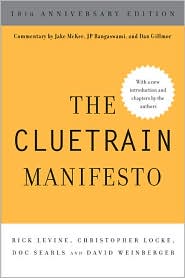
Cluetrain 10th Anniversary edition
Cluetrain 10th Anniversary
Everything Is Miscellaneous
Small Pieces cover
Small Pieces Loosely Joined
Cluetrain cover
Cluetrain Manifesto
My face
Speaker info
Who am I? (Blog Disclosure Form) Copy this link as RSS address Atom Feed

June 10, 2009

[newmedia] Journalism panel

Dan Gillmor is not as pessimistic as many others about the future of journalism. We’re in a fertile period of innovation. But we need better audiences. Passive consumers need to be active readers, and this ought to be part of school curricula, starting in pre-school.

Jim VandeHri from Politico agrees with Dan that we’re going to end up with more and better journalism, although he has no idea what it’s going to look like and he thinks that newspapers are in much worse shape than most acknowledge.

Nick Wrenn from CNN says they use social media like Twitter both to engage the audience and as an early warning system.

David Kirkpatrick of Fortune (who’s writing a book about Facebook) is not so sure it’s a great time to go into journalism because the business model isn’t there. “I’m happy I’m getting out of it.” Yet the “number of kids who want to be journalists is astonishingly high.” He makes a few points. First, if Google gets better at its search, its ads become less relevant and valuable, and he thinks Bing is intended to force Google to get better at searching for that reason. Second, the number of minutes spent on Facebook has gone up hugely; it is uniquely influential as a media platform, both as a place where people create content and distribute others’ content.

Dan agrees that the business models aren’t there, but he’s jealous of his students because they get to invent their jobs and invent what journalism will be. Jim thinks that over time, there will be more organizations (like Politico) that can pay journalists. There will be lots of journalism, but just not dominated by the big papers and broadcasters. It’ll be non-profits, startups, etc. Politico makes money out of ads. Over the next six months, Politico will experiment with charging for some specialized content.

Q: Is it time to put the broadsheet out of its misery?
A: Dan: Print won’t shut down quickly because there’s still a whole lot of cash flow. And if you reset the debt via bankruptcies, there’s still profit to be had.
A: CNN: Newsrooms have to figure out how to deal with the changes. It’s amazing that newspapers still report on yesterday’s news.

Q: Who’s going to pay to gather dull but important information at the local level?
A: Dan: The newspapers aren’t gathering it now. No one is. We are going to lose eat-your-spinach journalism. Back when newspapers sent journalists to the boring meetings, the journalists were deterrents to bad behavior. Maybe we should hire circuit forensic accountants to work with journalists…
A: David: But now every member of the school board can be a broadcaster. So, the role of the community newspaper can be different. I am incredibly optimistic about the future of society in terms of info being distributed. But I’m not optimistic about the future of journalism.

[Tags: journalism newspapers medianms09 ]

Tweet
Follow me

Categories: Uncategorized Tagged with: journalism • knowledge • media • newspapers • nms09 Date: June 10th, 2009 dw

2 Comments »

[2b2k] Chapter 4 – inappropriately concrete?

Chapter 3 left readers with a problem without resolution. If facts don’t provide as firm a bedrock as we’d thought, then are we left to believe whatever we want? Is there no hope? [Spoiler: No, we’re not free to believe whatever we want.]

Because Chapter 3 was pretty abstract, I want to be sure to address its question in some concrete ways. So, Chapter 4 opens with a brief scene-setter that says that we all love diversity, but when there’s too much, we can’t get anything done. I’m now at the beginning of a section that will give maybe four general rules for “scoping” diversity so that a group has enough internal difference to be smarter than the smartest individual, but not so much that they can’t get past bickering. I plan on following that with a more abstract section that asks whether the Net is making us more open or closed to other people’s ideas. At the moment, I like the idea of beginning with the concrete and moving to the abstract, in large part because I think the abstract question is pretty much impossible to answer.

I can’t tell yet if the chapter structure is going to work. There is so much to say about this topic. And I have a concern that the reader is not expecting the book to take this turn. But I won’t be able to tell that until I have enough distance on the prior chapters to be able to read them with some degree of freshness.

Tweet
Follow me

Categories: too big to know Tagged with: 2b2k • broadcast • business • conference coverage • echo chambers • knowledge • marketing • media • newmedia • news • pr Date: June 10th, 2009 dw

9 Comments »

June 8, 2009

Next, he dehydrates water

Rob Matthews has printed out and bound Wikipedia’s featured articles, creating a 5,000 page volume.

In case you were wondering, featured articles are articles that get a gold star from Wikipedia – about one in every 1,140 at the moment, for the English language version.

(If Rob hadn’t copyrighted the excellent photos, they’d be popping up in every third slide deck from now on.)

[Tags: wikipedia ]

Tweet
Follow me

Categories: Uncategorized Tagged with: digital culture • everythingIsMiscellaneous • knowledge • media • wikipedia Date: June 8th, 2009 dw

1 Comment »

June 2, 2009

[berkman] Lokman Tsui: Beyond objectivity

Lokman Tsui is giving a Berkman talk called “Beyond Objectivity: Global Voices and the future of Journalism.” This is based on research he’s been doing for his doctoral dissertation.

NOTE: Live-blogging. Getting things wrong. Missing points. Omitting key information. Introducing artificial choppiness. Over-emphasizing small matters. Paraphrasing badly. Not running a spellpchecker. Mangling other people’s ideas and words. You are warned, people.

Lokman has been long interested in the Chinese Internet. He was born and raised in Amsterdam, and says that the Dutch often don’t like difference and diversity; they’re struggling with the idea of cultural complexity. After wrestling with what to study, he talked with Andrew Lih and came away wanting to study something that works but that we don’t understand well. Lokman chose Global Voices.

He’s interested in “how the world comes to know itself.” Lokman thinks journalism is crucial to this. James Carrey [sp?]: The public is what forms when people get together to talk about the news. Now, with the Internet, we have strangers everywhere. “What does that mean for the kind of journalism we want?” Lokman cites Habermas. We need to re-think journalism. “My purpose here is not to celebrate the Internet” or to dismiss the dangers, but to see it as an historic opportunity. By thinking about the global nature of communication, we can design better institutions.

His research begins with a study of GV as a a “newsroom.” What are the journalists’ routines? How do they socialize? How do they get news? E.g., it used to be easy and convenient to get info from gov’t sources, leading to a bias towards those sources. But the GV newsroom is different. Multicultural, global. And the newsroom is online, which leads to different interactions and shapes the news. We need a new conceptual toolkit to understand it.

Is GV journalism at all? GV is the trickster of journalism, in Lewis Hyde’s sense: it provokes us to respond and develop. GV and journalism are both ways of seeing. There are three ideals of journalism, intertwined with ideals of democracy. (1) Professional J, with liberal democracy, aimed at providing information. (2) Alternative media, with participatory democracy, aimed at representation. (3) Public journalism along with deliberative democracy, aimed at conversation.For a long time, we’ve taken objectivity as the “gold standard” of journalism. But this doesn’t make sense for public journalism; it makes no sense to ask whether a conversation is objectivity. How do we judge conversations? GV gives some hints. GV supports “communicative” democracy (a la Iris Young) , aiming at conversation, and replacing objectivity with hospitality. Habermas was thinking of coffee houses where people have to bracket differences to enable conversation. Hospitality enables conversations even when there’s a disparity of power. Differences can be very useful in having a good conversation. E.g., the powerful host serves the guest, subverting the power relationship. That’s hospitality. It’s a way of judging journalism as well, seeking to include difference and diversity.

Hospitality goes back to Kant’s “Perpetual Peace.” His third law suggests that hospitality is a right based on the fact that we share a world. Kant says we cannot refuse a visitor if it will lead to his/her destruction. Hospitality is about access, recognition, and appropriate response. Arendt wrote about intersubjectivity as a way toward truth. We now have an abundance of stories on line. The constraints have changed, so the way we judge journalism should change. The challenge is that, while the cost of speech as gone down, our attention is still scarce.At RottenTomatoes.com, the objectivity is in the dry summary. But the subjective reviews are more interesting and useful. The professionals should aggregate and amplify all these voices. You need to put them all together. What would an aggregation site look like for the news? It’d look a bit like GV. You get curated news and posts and tweets, and then comments and conversation.

Q: [me] Why has the term “hospitality” become less used precisely when we are most in contact with different cultures?
A: It may be partially due to the paradox of choice, and a fear of the unknown that’s come about in recent years. We’re very happy to send our products, our TV programs, and our money everywhere. But the flow of people is restricted. And it’s a matter of being able to listen, which some places are better at than others. I’m playing with the hospitality ratio: how much you listen vs. how much you speak. E.g., how many films you import vs. expert. A few years ago I looked at how many links link back to you and how many links to others. I compared a-list blogs and newspapers. Newspapers didn’t link out much at all.

Q: How do we train people for journalism?
A: J is a craft as well as a profession. The Internet is making us think about J as a craft: pursuing excellence for its own sake in something you care about. Most GV people think of themselves as craftspeople. Q: Where’s the hook in what you’re saying? And, btw, journalist didn’t come out of people seeking the truth but hard-drinking people who were getting paid to present a point of view. Also, you might look at Erik Erikson.

Q: Hospitality is reciprocal. How might the concept of respect apply to journalism?
A: Reciprocity is a huge part of hospitality. It means journalist need to include more views.Q: There are many public spheres, even within GV.
A: Yes.

Q: Does GV connect to other kinds of civic spaces, other than journalism?
A: GV isn’t just a bunch of people trying to do journalism. It’s an infrastructure for other sorts of projects, such as translation, herdict.org… There are tons of other civic practices there. Q: [ethanz] I want to temper some of your optimism. I think it’s great that you’re offering a new criterion — hospitality — for evaluating journalism. I think these ideas get stronger in combination. My main criticism of your work is that you’re not critical enough of GV [which Ethan co-founded]. GV is at best partially successful.

[I missed the last few questions. Sorry.] [Tags: journalism diversity objectivity hospitality global_voices everything_is_miscellaneous ]

Tweet
Follow me

Categories: Uncategorized Tagged with: bridgeblog • digital culture • diversity • globalvoices • hospitality • journalism • media • objectivity • peace Date: June 2nd, 2009 dw

Be the first to comment »

May 21, 2009

Wired.com vs. Wired.mag, out loud

There’s a really interesting discussion going on at BoingBoing gadgets about the relationship between Wired Magazine and Wired.com. Chris Anderson, the editor of the mag, who turned it off its path of Rich Nerd Fetishism, and has made it interesting and important again, is diving in. It’s great to see this sort of discussion done in public.

[Tags: wired media ]

Tweet
Follow me

Categories: blogs Tagged with: blogs • cluetrain • digital culture • expertise • media • wired Date: May 21st, 2009 dw

5 Comments »

May 16, 2009

Whitehouse.gov: Give your bloggers’ names!

The Whitehouse.gov blog continues to improve, by which I mean it’s getting less like the glass-topped version of White House press releases. But it’s missing a big opportunity by keeping the blog posts anonymous.

The White House bloggers seem quite aware that a press release isn’t a post and are trying to create a difference between the two. For instance, the blogger begins the post on President Obama’s speech on credit card reform with a friendly paragraph about the citizen who introduced him. It’s not much and it’s still directly tied to the President’s remarks, but that paragraph doesn’t read like a press release or like a speech. And, that post ends with the blogger’s evaluation of the President’s proposal: “Long overdue.” That last phrase, expressing some personal enthusiasm, is uncalled for, and thus is refreshing, for blogging is a medium for the uncalled and the uncalled-for. (Which is why I love it.)

Still, it’s hard to see how the posts can blow past this minimal level of bloggishness…unless and until the bloggers start signing them.

The problem, I believe, is that the bloggers feel (and are made to feel) the awful weight of speaking for the White House. Their posts come straight from the offices behind the long lawn and the pillared portico. In some weird, ineffable way, they represent the building, its inhabitants, and its policies, just as press releases do. Press releases have authority because they’re not an individual expression. They have authority because they are unsigned and thus speak for the institution itself. Blog posts come from the same building, and, if they’re unsigned, maybe they’re supposed to have similar authority, except written in a slangier style. So, we don’t yet know exactly what to make of these unsigned posts. And neither do the bloggers, I think. It’s too new and it’s too weird.

But, if the bloggers signed their posts, it would instantly become clear that bloggers are not speaking for the institution of the White House the way press releases do. We would have something — the bloggers — that stands between the posts and the awesomeness of the White House. That would create just enough room for the bloggers to express something other than the Official View. They would be freed to make the White House blog far more interesting, relevant, human, and central to the Administration’s mission than even the most neatly typed press releases ever could be.

Already most of the bloggiest posts at Whitehouse.gov come from guest bloggers who are named and identified by their position. They feel free-er to speak for themselves and as themselves, in their own voice. Now, I don’t expect the official White House bloggers to speak for themselves exactly. They are partisans and employees; they work for the White House because they love President Obama. But, if they signed their names, they could speak more as themselves.

This might let them do more of what the White House blog needs to do, in my opinion. For example, I’d like to read a White House blogger explaining the President’s decision to try some Guantanamo prisoners using the military tribunals President Bush created. White House communications officials probably consider it bad politics to acknowledge the controversy by issuing a defense. But bloggers write about what’s interesting, and hearing a spirited, partisan justification would be helpful, and encouraging. I personally think that Pres. Obama probably has good reasons for his decision in this matter, but the “good politics” of official communications are too timid. I want to hear a blogger on the topic. And I would love to learn to go to the White House blog first on questions such as this. And isn’t that where the White House would like me first to go?

Bloggers with names are the best way to interrupt the direct circuit from politics to official public expression. That would put people in the middle…which is exactly where we want them. [Tags: blogs white_house obama blogging media egov e-gov e-government ]


Posted in slightly improved form at HuffingtonPost and TechPresident.

Tweet
Follow me

Categories: blogs Tagged with: blogging • blogs • e-gov • e-government • egov • media • obama • politics Date: May 16th, 2009 dw

39 Comments »

May 6, 2009

Evidence-based journalism

Richard Sambrook, director of the BBC‘s World Service and Global News, has posted an excellent engagement with Jay Rosen’s piece on He Said/ She Said journalism. He agrees that that type of journalism is a problem, but the problem isn’t with the He Said/She Said format. The problem is lazy journalism, says Richard. He points to some cases where we want a juxtaposing of views, which I’m sure Jay agrees with. Richard says his real concern is that some may take Jay’s piece as license to simply spout off. He writes:

Evidence-based reporting, the basis of objectivity (as distinct from impartiality) is in retreat and needs to be bolstered. He Said, She Said started life a hundred years ago as a journalistic discipline to counter yellow-journalism as Pulitzer and others tried to establish a degree of civic responsiblity in the press. It may have run its course but there are many who simply favour journalism of opinion – under the cloak of “calling the story”. I maintain we need evidence, fact-based reporting more than ever in a world awash with information rumour and opinion. That sometimes calls for a journalism of restraint – in which the New York Times (and the BBC) has an honourable tradition.

Evidence-based is a nice way of cutting through the argument about objectivity’s corrupt philosophical underpinnings. Of course, people are going to argue about what counts as evidence and what the evidence means — that is, I disagree with the implication of Richard’s blog’s tagline — “Everyone is entitled to his own opinion but not to his own facts,” Daniel Patrick Moynihan — but evidence is an important term not used often enough in these discussions. Evidence provides a way to disagree that can progress towards truth, or at least towards agreement, or at a minimum, an understanding of where the actual disagreement lies.

Of course, I offer this opinion without any evidence :).

[Tags: journalism objectivity evidence media ]

Tweet
Follow me

Categories: Uncategorized Tagged with: evidence • expertise • journalism • knowledge • media • objectivity Date: May 6th, 2009 dw

Be the first to comment »

May 2, 2009

Andrew Lih and me on C-SPAN

C-SPAN’s monumentally, overwhelmingly, epically popular series, BookTV, this week is broadcasting the Berkman session with Andrew Lih on his The Wikipedia Revolution that I moderated. Andrew speaks for a few minutes, then I interview him, then the audience asks questions. I thought Andrew’s presentation was terrific, and the audience asked good questions. It’s on Sunday, May 3, at 12:30 AM, Sunday, May 24, at 4:30 PM and — for those for whom twice isn’t enough — at Monday, May 25, at 4:30 AM.

[Tags: andrew_lih wikipedia books everything_is_miscellaneous ]

Tweet
Follow me

Categories: Uncategorized Tagged with: andrew_lih • books • digital culture • education • everything_is_miscellaneous • knowledge • libraries • media • wikipedia Date: May 2nd, 2009 dw

Be the first to comment »

Facebook doesn’t make your stupid. Whoops.

Remember how the media leapt on the study that showed that being on Facebook lowered your grades in school? The study was, shall we say, flawed. But it was a media-seeking rocket. Now, 2.5 weeks later, Josh Pasek, eian more, and Eszter Hargittai have published “Facebook and academic performance: Reconciling a media sensation with data” at First Monday, a peer-reviewed site.

Here’s the abstract:

A recent draft manuscript suggested that Facebook use might be related to lower academic achievement in college and graduate school (Karpinski, 2009). The report quickly became a media sensation and was picked up by hundreds of news outlets in a matter of days. However, the results were based on correlational data in a draft manuscript that had not been published, or even considered for publication. This paper attempts to replicate the results reported in the press release using three data sets: one with a large sample of undergraduate students from the University of Illinois at Chicago, another with a nationally representative cross sectional sample of American 14– to 22–year–olds, as well as a longitudinal panel of American youth aged 14–23. In none of the samples do we find a robust negative relationship between Facebook use and grades. Indeed, if anything, Facebook use is more common among individuals with higher grades. We also examined how changes in academic performance in the nationally representative sample related to Facebook use and found that Facebook users were no different from non–users.v

And what are the chances that the media are going to trumpet these results that are based on actual data and careful analysis?

[Tags: facebook social_networks media ]

Tweet
Follow me

Categories: Uncategorized Tagged with: digital culture • education • facebook • media • social_networks Date: May 2nd, 2009 dw

1 Comment »

April 30, 2009

New Zealand starts copyright from scratch

New Zealand has decided that trying to amend copyright for the digital age is like trying to adjust a horse’s carburetor. So, it’s going to start all over again.

That’s what we ought to do. Fresh piece of paper, a very big table, and an open bar. I don’t see any other way forward, really.

[Tags: copyleft copyright new_zealand ]

Tweet
Follow me

Categories: Uncategorized Tagged with: copyleft • copyright • digital rights • everythingIsMiscellaneous • media • new_zealand Date: April 30th, 2009 dw

5 Comments »

« Previous Page | Next Page »


Creative Commons License
This work is licensed under a Creative Commons Attribution-NonCommercial-ShareAlike 3.0 Unported License.
TL;DR: Share this post freely, but attribute it to me (name (David Weinberger) and link to it), and don't use it commercially without my permission.

Joho the Blog uses WordPress blogging software.
Thank you, WordPress!