
logo
EverydayChaos
Everyday Chaos
Too Big to Know
Too Big to Know
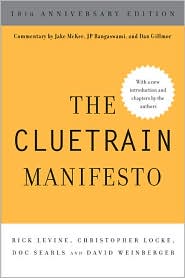
Cluetrain 10th Anniversary edition
Cluetrain 10th Anniversary
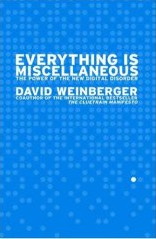
Everything Is Miscellaneous
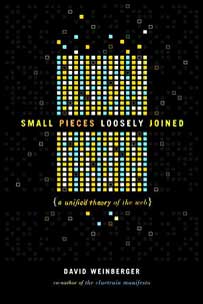
Small Pieces cover
Small Pieces Loosely Joined
Cluetrain cover
Cluetrain Manifesto
My face
Speaker info
Who am I? (Blog Disclosure Form) Copy this link as RSS address Atom Feed

March 5, 2007

[f2c] Yochai Benkler

Yochai Benkler, author of the single most important book about the Internet — The Wealth of Networks — is giving a “theme-setting” talk.

He points to the wide distribution of computer power and “insight, intuition and experience” across the population, as opposed to their concentration during the industrial revolution. The behaviors that have already been there but on the periphery — friendship, cooperation, decency — now move to the core. We see “commons-based prodiuction,” i.e., produciton without exclusion from the inputs and outputs. This decentralizes the authority to act. “The commons locates authority to act where capacity resides.”

It enables peer production and sharing: cooperation without control or the price system. It is based on social relations. (See “Sharing Nicely.”) He points to the success of open source software, and to a mapping of Mars craters by a collaborative process (“Martian clickworkers”). Also, of course, Wikipedia. He asks us to imagine when Wikipedia started that someone predicted that Nature would find it about equal to Britannica in its science articles in five years. He concludes: “We’re beginning to see a solution space, rather than a particular phnenomenon.” There’s a “load balancing of motivations over time” — people can contribute when they want and for whatever reasons they have.

“Building such platforms is hard.” “Coase’s Penguin” says peer production tasks require modularity, granularity and integration. (He says he’s been working on seeing how this works. He’s looking at experimental literaure on cooperation and reciprocity, game theory, evolutionary biology and anthropology. “There are more design levers than I initially thought.” Factors include: Self-selection, communication, humanization, trust construction, norm creation, transparency, monitoring/peer review/discipline and fairness. Introducing money can muck things up.

So long as large-scale needed to be concentrated, we were llimited to firms and governments, or we could work in decentralized form through the market. Now we’re seeing a non-market decentralization via social sharing and exchange…a parallel form of production. We go from recording industry to p2p, Microsoft to open source, Grollier to wikipedia, telecoms to Skype. And there are new “opportunity spaces,” from well behaved appliances to production tools. He points to the BBC citizen journalism effort, among other examples. [Yochai moves very quickly. . This is the double fudge Death by Chocolate form of knowledge overload.]

But, this is a threat to incumbent business models. So there’s a battle on. Yochai shifts to politics. “The core idea is that people now as a practical matter can do more for and by themselves.” And they can do more in loose assoiciation with others. When it comes to democracy, our epxerience “is purely with a mass mediated public sphere.” We’re beginning to learn what it means to have a networked public sphere. He recounts how concerns about e-voting machines from Diebold were raised by activitists, put out info, and how it spread.

The Internet democratizes. It’s boring by now, but important, he says. The first generation objections are generally unfounded: “The Daily Me” fragmentation hasn’t happened, and it doesn’t polarize the way claimed. For one thing, polarization is a matter of interpretation: Is 85% of links pointing to like-minded sites a sign of polarization or its opposite? And the power law misses the topology of the Net that hooks small sites to large sites as part of a community. Those large sites then can get the word out.

There’s a strong “see for yourself” ethic. We come to understand that everything we read is a provisional judgment, rather than training ourselves to seek authority as we did in the mass distribution system.

The Human Development Index depends on who and how produces information, Commons-based and peer production are beginning to help: open source, open academic publishing , free hs science texts in South Africa, BiOS and BioForge out of Australia.

The threat is being played out over institutional ecology. “Rules can make some actions easier or harder.” Incumbernts are trying to make distributed production harder, more expensive, subject to permission. And there’s a push back to be free and productive. Broadband duopoly vs. muni broadband. “Trusted computing systems” vs. general purpose devices. Software patents vs. free and open source. DMCA vs. sharing and open innovation. There’s been a tightening up of all the “toggles,” e.g., copyright. “Law has been systematically optimized for control-based business models…”

“But we’re beginning to practice new ways of being free and equal human beings.” This is subject to a persistent battle.

Now there’s a panel: Mark Cooper, Elliot Maxwell, KC Clafy and Gigi Sohn.

Elliot Maxwell talks about Yochai’s ideas applied to pharmaceuticals. Among other things, he points to the PLoS library of failed clinical trials.

KC Claffy (Cooperative Association for Internet Data Analysis). Things we cannot measure on the Internet: The topology from one point to another at any layer. Propagation of routing. Router won’t give us its entire state (it’s second best routes.) One way delay from two places on the Internet without customized instruments. Can’t get an hour of packets from the core. Accurate flow counts. Accurate bandwidth. How much spam, phishing. A commons infrastructure would allow all this. (See this presentation.)

GG Sohn from Public Knowledge first praises The Wealth of Networks. Then she says that her one complaint is that Yochai gives the government too much of a break.

Mark Cooper wants to chart a course between Yochai’s optimism and Lessig’s pessimism. Yochai points to the use of collaborative production in the material economy. But, in his politics he shrugs off the attacks under the claim that in the long run the superior mode of production will prevail. “I think he’s clueless about politics.” But, “we can build an alternative politics on Yochai’s epistemological and moral base.” We need more than the blogosphere. We have not yet shown we can transform the public sphere. The public sphere needs institutions that transform the routine activities of daily life. [Yes, but how we do this except by having good ideas an implementing them? E.g., come up with another Creative Commons.]

Q: (isenberg) Yochai, would you like to address whether loose goosey has a chance against righty tighty?
A: There’s a common thread between Gigi and Mark. In the long term we care about social practices rather than policies, laws and institutions, because those are subsystems we occupy and life practices are the outcome. Law matters, but the critical question is: Do we need an affirmative set of rules that will enable things, or is blocking bad law and rules enough? I used to work on reforming laws and was pessimistic, and now I’ve flipped. “I do think that what we’re seeing in the Net roots, in the blogosphere, in the global access to knowledge is that political organization is also shifting away rom the standing institutional model, toward more ad hoc networks that mix different kinds of players nad get updated over time…and that disconnect and reconnect, rather than relying on stable institutions…I see the future of political engagement being much flatter, ad hoc…” [Tags: f2c yochai_benkler economics peer_production ]

Tweet
Follow me

Categories: blogs Tagged with: blogs • business • conference coverage • media • philosophy Date: March 5th, 2007 dw

2 Comments »

March 1, 2007

BostonNow – bloggy journalism for the Hub of the Universe

From the BostonNow blog:

BostonNOW is a new free daily newspaper launching this year that will incorporate both traditional and citizen journalism. Your ideas about the Boston community (news, politics, sports, the arts, etc.) will appear side-by-side with the words of BostonNOW staffers and wire service journalists. We will promote your work prominently both in the paper and on the website, not in a “local blogs” or “reader photos” ghetto.

Every day, BostonNOW will direct readers to the Web, where they will find real depth and discussion. BostonNOW will become the place to learn what folks around here really think about politics, entertainment, sports, and their fellow humans. This dialogue will create a newspaper of the people, by the people, for the people.

BostonNOW will truly be your newspaper.

Sounds good on paper, so to speak. In fact, it sounds great. They’re holding a get-to-know-the-bloggers party this Saturday, March 10:

Saturday, March 10, 2007

11am to 2pm

All Asia Café

334 Mass. Ave.

Central Square

Cambridge, Mass.

RSVP here. (Thanks to Steve Garfield for the link.) [Tags: boston media msn journalism blogosphere blogs ]

Tweet
Follow me

Categories: blogs Tagged with: blogs • digital culture • everythingIsMiscellaneous • media Date: March 1st, 2007 dw

Be the first to comment »

February 28, 2007

Blogs, journalism (yawn), and a correction

James McGrath Morris has an article at Law.com that tries to de-hype blogging’s contribution to news by saying what bloggers do is nothing new and pointing out that blogs are error-prone.

We’ve all been over the error prone argument forever. As for the argument that blogging is nothing new, well, nothing is really new. The importance of blogging for journalism does not rest on a claim that it’s without any precedent. In fact, James says that the blogs’ claim to a lack of objectivity is a return to the “Golden Age of Journalism,” which would mean that while it’s not new, it’s different. James is arguing against a strawperson, and thus sleighting the real effects of blogging on journalism.

Finally, he goes on to say that “blogging may be more democratic, but it’s also likely to be less read. There is a point when there are simply too many blogs. With 30 million blogs today, we may well have reached that point.”

That last point sounds a bit like the Yogi Berra remark that no one goes to that nightclub any more because it’s too crowded. It ignores the research that shows there’s a short head and a long tail, which means that a handful of blogs are being massively read and — more important — there’s a huge network of nodes each of which accretes a local readership.

And then he sort of misrepresents me. The nerve! He says that I announced in an “All Things Considered” commentary that I am no longer reading many of my friends’ blogs. Not exactly. I didn’t stop reading my friends’ blogs; I gave up on keeping up with them every day. There’s a difference: I still read my friends’ blogs, just not as steadily as I once did. And, fwiw, my point was that it should be considered rude to assume that anyone has been keeping up with your blog. So, James was off a shade. But, then, we all know that articles about blogs and journalism are error-prone. (Damn humans!) [Tags: blogging journalism media citizen_journalism msm everythin everything_is_miscellaneous]

Tweet
Follow me

Categories: blogs Tagged with: blogs • digital culture • everythingIsMiscellaneous • media Date: February 28th, 2007 dw

Be the first to comment »

PR at its finest

Just when you thought the Anna Nicole Smith affair had brought out the worst in our media institutions, along comes this hard-hitting press release:

What do former playmateAnna Nicole Smith and Godfather of Soul James Brown have in common? No, Brown didn’t father Smith’s child (at least as far as we know.) But even if they didn’t get together in life they share the same problem in death — their embalmed bodies are trapped in legal limbos. And both could have been resting in peace by now if they’d had Online Safety Deposit Boxes from KeepYouSafe.com.

Yes, the death of a minor porn star who left behind a tiny infant is just the right marketing opportunity for a classy joint like KeepYouSafe. Well branded, suh! [Tags: publicrelations pr anna_nicole_smith marketing]

Tweet
Follow me

Categories: Uncategorized Tagged with: culture • humor • marketing • media Date: February 28th, 2007 dw

7 Comments »

February 27, 2007

[berkman] Matthew Pearl

Matthew Pearl, author of The Dante Club, is giving a Berkman talk. Gene Koo (his ex roommate) introduces him as someone doing a form of literary remix. He’s teaching a class at Harvard Law called “Literary Visions of Copyright.” He’s going to talk about the 19th Century copyright battles. [As always, I’m approximating. Matthew speaks eloquently; live blogging generally misses the eloquence.]

The Copyright League consisted mainly of authors who “wanted to rethink and reshape” copyright. James Russell Lowell — poet and president of the League — came up with the motto:

“In vain we call old notions fudge and bend our conscience to our dealing. The Ten Commandments will not budge and stealing will still be stealing.” [Approx.]

“This became a mantra for copyright advocates.” Note the appeal to a higher authority, Matthew points out.The motto compares commercial dealings to an older and higher regime. Writers at the time — Louisa Alcott, Mark Twain, etc. — petitioned Congress in support of copyright. The US laws were pretty much are they are today, but there was no international protection: British authors couldn’t get copyright protection here. This meant US publishers could publish British authors without paying a cent. This also undermined several generations of American authors because a Dickens book only cost $0.25 but a Twain might cost $1.25. (Harper, the publisher, was “the most notorious and proud pirate,” says Matthew.)

Kipling wrote a poem about buccaneers that’s about book poetry, which someone referred to as “bookaneers.” Poe’s “Purloined Letter” is about writing stolen but left in public view, another metaphor for book piracy. Dickens, who called himself “the biggest loser” because of his lost royalties, wrote Martin Chuzzlewit about an unstable American system. Harriet Beecher Stowe sued a publisher for publishing a German translation. She lost the case, and was criticized for being against treating people as property but favoring treating books as property. [Wow. These seem to be separable issues!]

There was tentativeness among the authors supporting copyright, says Matthew. They wanted to protect authors but not crush the laborers who manufactured books; if copyright were introduced, they feared book manufacturing would move to other countries. Also, the lack of international copyright enabled cheap editions, supporting a democratic ideal. Mark Twain and Walt Whitman were especially sensitive to these concerns; Whitman’s Leaves of Grass positioned him as a friend of labor. Dickens was making tons of money on his speaking tour and was painted as greedy for wanting royalties also. Matthew compares this to current attitudes towards rich rock bands. People also argued that we needed copyright freedom in order to alter British texts for American readers, including taking out some of the lords-and-ladies feel. (A Connecticut Yankee in King Arthur’s Court is about American hostility to that, Matthew says.)

Matthew says some of the fun of studying this is that the authors are imposing a narrative on the topic. It’s a narrative of natural rights and pirates, even though according to the law at the time, the “pirates” were doing nothing wrong. “They became pirates because that’s what we put into our rhetoric until we believed it.” “All of this gradually wore down the paradigm of a collective ownership of the works.”

Matthew says that we should learn at how we’re creating our own narrative of piracy. E.g., the FBI warning at the beginning of DVDs even though copying a DVD for your own use is legal. E.g., Disney recently bought the copyright to Oswald the Rabbit (its pre-Mickey character) even though Oswald’s first three cartoons are out of copyright and thus Oswald is out of copyright; Disney is shaping the narrative. Google Books is now also trying to shape the narrative.

Q: [me] Were there moral arguments in favor of not having international copyright?
A: The most effective argument was that it would hurt our workers.

Q: What about logical consistency, protecting authors everywhere?
A: There was a different sense of boundaries. We assume a globalized world. But people were not embracing the natural rights argument. Copyright didn’t come out of a rights argument originally, in the Constitution. Someone said it was about copy privilege, not copy right.

Q: (ethanz) In other parts of the world, they make an argument that they need pirated texts in order to go to university. The US violated British copyright when it was developing, so it’s right for India and China to do so now. How would Twain et al. have replied to this?
A: Fascinating argument. We didn’t have a national literature in the 19th C. Moby-Dick was dismissed. All we can do is imitate, it was thought. One argument was that we need easy access to the British texts until we’ve established our own American literature.

Q: Would people have paid more if there were a different copyright regime?
A: They get into the minutia of it in the Senate arguments. There’s no agreement. The introduction of public access libraries in the middle of the century threw the pricing up into the air.

Q: Was there a parallel rhetoric in Europe?
A: There wasn’t much market for American books in England (Cooper and Twain were exceptions), so the British were all for copyright. The government got involved.

Q: Dickens and others acknowledged that they got wider distribution because their earlier books were pirated in the US.
A: Same thing with Google Books: You’re getting attention for your books, especially for books that are out of print.

Q: Did people argue that writers wouldn’t write or wouldn’t share it with the public?
A: Yes. You see this in the Senate hearings. Without copyright, you couldn’t professionalize writing enough to enable writers to earn a living, it was argued. Twain said that writers should go live in England for a bit before publishing to get British copyright protection; he was out of touch with what writers can do.

Q: Initially, copyright protection went to printers, not authors. How did that transition happen?
A: (Simon) In the Renaissance, patrons gained prestige from the affiliation. In 18th C Ireland, Swift was able to prosper without copyright. It’s an interesting to compare cultures that have and do not have copyright protection.

Q: When did we go from writing to being a professional writer?
A: (Simon) It’s hard to pinpoint. [He mentioned a 1774 copyright decision that I missed.]

Q: The audience wasn’t receptive to the economic argument, because it came from rich authors. How about the reaction to the moral argument?
A: It’s hard to say because the public wasn’t a part of the conversation. Women weren’t even part of it.

Q: (cbracy) What was the relation between the authors and their works?
A: Authors still tend to have control over their books than musicians generally do. If you publish a book, you own the copyright. That’s not the case with screenplays: You sell the copyright. But publishers want to reinforce the idea of single authorship; they don’t even like long acknowledgements.

Q: [me] The piracy narrative doesn’t hold up in even on its own terms now; now we can’t even use works we’ve bought all the ways we want, and “piracy” just doesn’t work as a metaphor. Do you see any other narratives around that might work better?
A: The commons? There’s so little discussion of public domain in these 19th C discourses. I’d love to read a history of the concept of the commons (which Louis Hyde is doing).

A: (ethanz) There are developments in the UK that might make Beatles albums public domain in 2012, which will recreate the 19th C situtation in which cheap British imports compete against US music. a: “Sharing” is a counter narrative.

Q: (Gene) You have made a career out of both sides of the copyright issue (i.e., copyrighted works about copyright)…
A: I definitely do feel Jekyl and Hyde about copyright. I’d enforce my copyright if it came up, and we complain when the royalty statements from the Chinese publishers are wrong, but all we can is complain. “I even write the copyright notice for my books.” The notice originally said that no characters are intended to resemble people living or dead.

Q: (egeorge ) How would you feel if I did fan fiction based on your work?
A: I haven’t spent a lot of time thinking about that. They’re writing a screenplay of my book, and it’s nothing like the book. I’m getting paid to let them alter my text. If I’m not getting paid, I guess I’d feel that so long as it’s non-commercial, I’d be fine about it. It gets word out about your book.

Q: The difference in prices between American and British was multiples. Why?
A: You wouldn’t have to pay an advance. Competition. And there was variance.

Q: Who’s your next book about?
A: It’s secret.

[Great talk. And a very likable, modest fella.] [Tags: copyright copyleft matthew_pearl everything_is_miscellaneous]

Tweet
Follow me

Categories: Uncategorized Tagged with: culture • digital culture • digital rights • everythingIsMiscellaneous • media Date: February 27th, 2007 dw

1 Comment »

February 25, 2007

My failed BeyondBroadcast talk

I did the “wrapup” at BeyondBroadcast, and tried to talk about the thought I keep coming back to but am never able to articulate. At least it was brief – under 10 minutes, I think. Here’s the outline of what I said:

1. What’s the thread between participatory culture and participatory democracy? Why think one has to do with the other? How can participatory culture be “transformative,” as Henry Jenkins suggested in his terrific opening talk. (Digression: The mainstream media are focused on including “user-generated content” on their sites as their response to participatory culture, but that’s not transformative.)

2. Well, what is democracy. There are bunches of definitions: Majority vote, society of equals, government that gets its authority from the people. But most important, it’s ours. The government isn’t theirs, the way it was the king’s.

3. So, what does “ours” mean? Again, there are bunches of definitions: What the law gives you control over, on our side, of our nature or essence. But, when it comes to culture, look at the difference between your study of a foreign culture and your participation in yours. Culture is ours because it makes us who we are; we are indistinguishable from it.

4. But, participatory culture is changing the nature and topology of ours. It’s ours in a different way. We can create works with strangers, with anonymous crowds, and in all the other ways we’re inventing. This is a very different sense of ours. And it’s not just that we can build Wikipedia or Flickr streams. We also get to make these works matter to one another: That we can surface and pass around the video or the prose so that it becomes a shared cultural object also changes the nature of the ours.

5. So, how does this new ours affect democracy? (And it’s more likely to affect democracy before it affects politics since those folks have a death grip on power.) How does this ours get turned into an us that operates politically? I dunno. I.e., this talks makes no progress on the question it raises :( [Tags: beyondbroadcast07 culture politics democracy media everything_is_miscellaneous ]

Tweet
Follow me

Categories: Uncategorized Tagged with: conference coverage • culture • digital culture • everythingIsMiscellaneous • media • peace • philosophy Date: February 25th, 2007 dw

11 Comments »

February 24, 2007

[bb] Participatory vs. commercial culture

Jesse Walker, managing editor of Reason magazine, is moderating a panel on the relation of participatory and commercial cultures. He begins by saying that the inersection is older than the Web 2.0, “or, as I like to call it, The Web.”

Panelists: Kenny Miller, creative vp for MTV media; Elizabeth Osder, sr. dir. of product dev at Yahoo media; and Arin Crumley, one of the creators film Four-Eyed Monsters .

Kenny talks about “navigational dominance. [What a phrase!] “We navigate our world by means of brands,” he says. Each of the MTV properties has its own demographics (ComedyCentral, Nickelodeon, etc.). Each is a brand with navigational dominance. But now there are lots of ways to getting to info. “How do you enter that world in a respectful way?” It’s no longer a one-way conversation, he says. There’s more chunking. It’s a fundamental shift. MTV is getting more of the audience’s voice back on the air. “American Idol is awesome and we think about that.” It’s a binary world and we’re divided into teams; people might like another option, but people don’t know what it is. Attention is a zero-sum game.

Elizabeth (who was the first girl to play Little League softball officially) says that Yahoo makes connections among people. She points to the single sign-in identity system with 400M registered users. Yahoo bought Flickr, Delicious.com and MyBlogLog, she points out. “Every day citizen journalism and photo journalism is happening” there. Now at Yahoo she’s trying to figure out how to disrupt Yahoo news. Seven years ago Yahoo started a Digg-like facility for news.

Arin talks about the reception of his movie. They did festivals for 9 months and 3,000 people saw it. The same number saw the first portion of it in the first 36 hours they put it on line.

Jesse asks questions.

Q: Arin, how is the process affecting your film-making?
A: The MySpace page surfaces ideas and questions that would never show up in the Q&A at a conference showing. Real conversation. We can see what the audience got from the movie and can adjust. Also, we can share the backstory, etc.

Q: Elizabeth and Kenny, how have users used your tools in ways you didn’t expect?
A: Kenny: We put up a message board. We made a game. They took moderation off a board.

A: Elizabeth: Flickr taught us that users want to take your stuff and stick it on their site.

Q: What do you have to offer that we can’t get elsewhere?
A: Kenny: You can’t compete with everyone. The world is open and flat. We only ask if the audience is liking what we’re doing and is it growing. [Shouldn’t use the “audience” word in this crowd.]

A: Eliz.: We’re part of an ecosystem. The job on our news sites is to point people to the best info on and off the site.A: (arin) A lot of what’s been done seems contrived. The Web is becoming a means of expression. “We’re just peers.” We’re sharing what we do with other peers. And we have tutorials about how to create videos and post them.

Q: (audience) How do commercial sites connect the needs of advertisers with needs of participatory participants?
A: Eliz.: We understand our audience. And we share revenues with bloggers.

A: Kenny: That’s the big question.

[Tags: beyondbroadcast07 media yahoo mtv]

Tweet
Follow me

Categories: Uncategorized Tagged with: conference coverage • digital culture • everythingIsMiscellaneous • marketing • media Date: February 24th, 2007 dw

4 Comments »

[bb] John Palfrey

John Palfrey says we don’t know how the Internet might affect democracy, but there lots of possibilities. He lays them out. [I’m typing quickly trying to capture the outline. As always, I’m missing stuff and getting it wrong.]

First, it might affect participatory democracy by providing open information enviornments, making new networks, enabling tools for individual activists, a productivity tool for campaigners, and attracting new participants. On the other hand, it might provide too much information, it can fragment us (“The Daily Me”), the participation can be watered down, it limits participation to those with access, some states are instituting censorship (cf. the ONI project), and maybe we should be jumping to “postdemocratic” order. So, maybe we’ll see refinements; the context matters a lot and it depends “a ton on what baseline you choose.” That is, if you’re only asking if participatory culture makes demcoracy better, that’s an easy bar. But maybe we should be aiming higher.

Second, acadmics says that the real story is about economic democracy and the emergence of a stronger middle class, and Doc Searls’ “Vendor Relationship Management.”

Third, academics also talk about semiotic democracy, e.g., control of cultural goods, with meaning created by many, not by the few. More YouTube and Second Life, less Disney. But (he asks), will people participate? Will we just create the old structures online? And won’t new intermediaries emerge to decide what we see?

John lists takeaways:

The Web is about creativity, innovation, and greater power at the edges.

This is a global phenomenon.

Big media companies generally have no idea how to deal with participatory democracy.

The legal and political battle over the future of the Internet is where a lot of this will play out. The outcome is not assured.

This conference is about where theory meets practice.

Q: First, participatory culture and democracy are non-partisan. Second, someone has to tell us what’s true or else we’re liable to end up with fascism, racism, anti-semitism, etc.
A: Something to talk about this afternoon. [Tags: beyondbroadcast07 john_palfrey media democracy politics berkman]

Tweet
Follow me

Categories: Uncategorized Tagged with: conference coverage • culture • digital culture • digital rights • entertainment • everythingIsMiscellaneous • media • politics Date: February 24th, 2007 dw

2 Comments »

[bb] Henry Jenkins

MIT’s Henry Jenkins (Convergence Culture ) opens the Beyond Broadcast conference. Henry asks what the line is that connects participatory culture and participatory democracy.

Henry begins with the always-delightful chain that led a parody site’s photos of “Ernie is Evil ” (the Muppet) to be included in genuine, pro-Bin Laden posters. Henry points out that our current images of democracy recycle previous images, such as Mr. Smith in Washington, Rockwell paintings, etc. He shows captures of an avatars’ protest march in a game space in China, an anti-Bush music video, Flickr images of the London bombing, American Idol voting (and “Vote for the Worst” as an anti-corporate Idol site), and the Moonite lite-brite (which he says is becoming a symbol for the young for a regime that’s “frightened of its own shadow,” is unaware of pop culture, and unable to respond to threats). Are these the new images of politics, Henry asks. The left, he says, uses the same images as the media does when talking about media reform. We talk about conformity, being narcotized, being turned into idiots and fools…as if we are victims of media. “The media reform movement is self-defeating the moment it holds mass media in contempt.” He is going to propose a way of conceiving media reform.

He cites Stephen Duncombe’ s vision [but my computer stopped working so I have no notes :( ]

What should politics look like? Henry points to a purple map of the US that shows states as a mix of red and blue depending on the proportion of Reps and Dems. This is not a partisan issue, he says. First, he says, we need free speech. We need to fight how copyright is being used by government and business as a “pincer move” squeezing participatory clture. We also have to “guarantee that everyone has access to participate,” he says. We need to look at non-political sites where we come together, e.g., we could have used Survivor as an opportunity to talk about race, or 24 to have a dialogue about torture. We should mobilize fans without condeming the fantasies they embrace. We need to look critically at astroturf but also see it as a sign that participatory clture matters. He ends by looking at AskANinja’s rant on the Net neutrality movement.

Q: My high school blocks all social networking.
A: Our schools are turning off sutdents’ best access to information. It’s a mass deskilling…

[Great talk. I’m left wondering more particularly about how the democratizing of media affects democracy, i.e., the very point of the conference.]

[Tags: beyondbroadcast07 henry_jenkins media democracy politics ]

Tweet
Follow me

Categories: Uncategorized Tagged with: conference coverage • digital culture • everythingIsMiscellaneous • media • peace • politics Date: February 24th, 2007 dw

1 Comment »

February 23, 2007

JD interviews Doc

JD Lasica interviews Doc Searls. [Tags: jd_lasica doc_searls]

Tweet
Follow me

Categories: Uncategorized Tagged with: digital culture • media Date: February 23rd, 2007 dw

2 Comments »

« Previous Page | Next Page »


Creative Commons License
This work is licensed under a Creative Commons Attribution-NonCommercial-ShareAlike 3.0 Unported License.
TL;DR: Share this post freely, but attribute it to me (name (David Weinberger) and link to it), and don't use it commercially without my permission.

Joho the Blog uses WordPress blogging software.
Thank you, WordPress!