



logo
EverydayChaos
Everyday Chaos
Too Big to Know
Too Big to Know
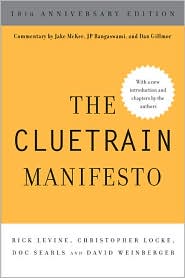
Cluetrain 10th Anniversary edition
Cluetrain 10th Anniversary
Everything Is Miscellaneous
Small Pieces cover
Small Pieces Loosely Joined
Cluetrain cover
Cluetrain Manifesto
My face
Speaker info
Who am I? (Blog Disclosure Form) Copy this link as RSS address Atom Feed

September 15, 2011

Iain Tait: the Old Spice man

I’m at a conference in Helsinki. The speaker before me is href=”http://www.crackunit.com/”>Iain Tait, creative director of Weiden + Kennedy, the agency behind the genius of the Old Spice man commercials.

NOTE: Live-blogging. Getting things wrong. Missing points. Omitting key information. Introducing artificial choppiness. Over-emphasizing small matters. Paraphrasing badly. Not running a spellpchecker. Mangling other people’s ideas and words. You are warned, people.

He says the secret of going viral is to find a beautifully attractive man who men feel safe liking, do a personalized social media campaign, etc. It is, in short, completely unrepeatable advice, which is his point.

He talks about how they did 186 personalized videos responding to influential bloggers who had commented favorably on the ad. It was taking 10-15 mins for the text to come in, to tape it, and to post it. To decide who to respond to, they looked at reach but also the creative opportunity: could they find something funny to say. They were careful not to reply only to celebrities, so that everyone would feel they might get a response. They got 40M views in week. And sales went up. And it helped to rebrand Old Spice “which used to be how your grandfather smelled.”

One approach to Web marketing is to go for the “big sneeze”: Create something big and push it hard through every channel you can find. The Old Spice ad went viral through lots of little sneezes: ordinary folks pointing and reposting. The world now works through little sneezes.

You should also try to create “lubrication,” making the act of sharing as frictionless as possible. The personalized videos were all re-shared. To do this, you need something that is “good, funny, or interesting”? It also should be easy to describe to someone else. And “what does the content say about me?” And “Will I get kudos for posting it?” Also, it’s good to respond in human time, not in “brand” time.

“Think about content creating its own media spaces.”

The secret formula for guaranteeing viral effect:

(Big Sneeze) x (Tiny Sneezes to the power of the number of tiny sneezes) x Shareability x (Content and Distribution that play together) x The Intangible. But what is that intangible? What was the magic ingredient in the Old Spice ad? The six pack? The writing? The acting? The rapid response? Unfortunately, the magic is not itself subject to a formula. And if you don’t have any magic, the viral campaign will never amount to anything.

Tweet
Follow me

Categories: business, marketing Tagged with: marketing • viral marketing Date: September 15th, 2011 dw

1 Comment »

May 31, 2011

[berkman] Miriam Meckel on communicating trustworthiness

Miriam Meckel is giving a Berkman lunchtime talk on “Communicating Trustworthiness: Drivers of Online Trust.” She will present research she has been doing at U. of St. Gallen along with government and some businesses. She’s investigating how trustworthiness is communicated, and what the initial drivers and cues are. She’s going to look at the changing conditions, some basic ideas on initial trust formation, then her study, and then the cues identified in initial trust formation.

NOTE: Live-blogging. Getting things wrong. Missing points. Omitting key information. Introducing artificial choppiness. Over-emphasizing small matters. Paraphrasing badly. Not running a spellpchecker. Mangling other people’s ideas and words. You are warned, people.

Users’ willingness to provide data about themselves depends on some sort of trust. There’s been much discussion about this, including the importance of preserving privacy. For example, Facebook restricted info about users to the user’s schoolmates, but over time it has become far more permissive. (See here for article and diagram.) Both Facebook and Google have said things indicating they believe our attitude towards privacy has changed. E.g., Eric Schmidt: “If you have something you don;’t want anyone to know, maybe you shouldn’t be doing it.”

What is trust? Miriam provides three definitions, each of which involves vulnerability. When we trust someone online, we understand we are making ourselves vulnerable in various ways. Trust enables us to manage the complexity of our social world, reduces the cost of negotiations, facilitates the adoption of new technologies, and reduces perceived risks. Initial trust is especially important since you can lose a customer forever by screwing it up.

In her study, they interviewed 23 online businesses active in Germany. They also did in-depth interviews with 43 users representing a range of socio-demographic sections. From this they derived a model of nine trust drivers: Reciprocity and exchange, proactive communications, user control, brand, third party endorsements, design of user interface, offline presence, technology, and customer service. Then they did a quantitative survey of German users to find out how the different factors are applied to diff business models. 11,000 users from across socio-demographic segments were invited to participate in an online survey for a little money, with a response rate of 12%.

She goes through the nine components of trust:

Reciprocity explains about 35% of the variance of the data. The mutual relationship of customer and organization is crucial. Users are willing to hand over personal info, if they know what they gain from it, if it is transparent, and if both sides benefit.

Brand and reputation: A well-known, establish brand helps build trust. If it has a large customer base, it is perceived as more reputable. You also need a professional feel for the web site.

User control: Users want to know who will have access to their data. Ask permission.

Proactive communications. [missed it. sorry]

Customer service: Multiple ways to reach a person. Provision of different payment methods.

Offline presence: The existence of physical stores helps build trust. Show a photo on your web of your brick and mortar store.

Technological reliability. This can be an issue when your service involves third parties.

Third party endorsements: Not only are seals of approval helpful, but so is having a high search ranking for third parties.

The next step is how these factors are differentiated by B2C business models. Only four factors turn out to be relevant across the board: reciprocity, third party endorsements, user control, and technological reliability. Miriam looks at online shopping, online banking, etc., to see which factors are relevant [but I can’t keep up with my typing. sorry] It seems that for building trust-based relationships with potential clients, you have to have fair communication, mutual benefits signaled, privacy and security policies being displayed, clear T&C’s, engage in issues mgt to follow what is being said about you on the Web, explain the business model and data needs, explain the flow of info to third parties and what the policies are, communicate third party endorsements, engage, peer groups and communities, bring in your offline reputation, and consistently apply corporate design with good design.

Some implications: 1. Users are more willing to trust large, well-established and popular online services. High search-engine ranking can be considered a trust measure.

2. The visual appearance counts.

3. Reciprocity is very relevant in all online transactions.

4. Offline presence, technical reliability and customer service have barely been researched yet.

5. Organizations need a strategic approach for communicating trust to their stakeholders. Take an integrated communication approach, including issues and risk management. They should communicate proactively, in a conversational tone, and transparently.

What not to do? Don’t be Facebook asking Burson Marsteller to find bloggers who would attack Google.

Q: [me] Customer ratings? And the presence of customized trust mechanisms as at eBay and Amazon?
A: Third party endorsements include customer ratings. But we surveyed a represented group of German users, not ones as sophisticated as others, plus there may be cultural differences.

Q: Is your work ethical? An evil company can read your work and figure out how to appear to be ethical. Also, Germany has stronger regulatory protection, which change the signals
A: Yes, companies could fake being trustworthy.

Q: How about SSL?
A: The awareness of the need for SSL is frighteningly low.
Q: Anyone care about authentication certs?
A: [general laughter]

Q: Would the same trust drivers be applicable in news sites and other such non-sales sites?
A: Just in parts. [I can’t read her table because I’m too far back :( ]

When you look at the erosion of privacy caused just be clicking on opt-ins, you get to a point where you just accept whatever the terms are and however they’re changed.
A: People don’t read privacy policies when they’re changed.
Q: Maybe it’s that when the privacy policy looks impressive, it’s a signal of the quality of the service. But, the key question is whether people who say privacy policies are a trust driver actually read them.
Q: There’s some survey support that most people mean think that a privacy policy is there to protect your privacy. [general laughter]

Q: [me] To me, third party endorsement means you get celebrities or associations or other companies to endorse you. But the real trust-driver for me frequently is peer endorsement. Maybe it would be worthwhile to separate those two, especially since businesses need to do different things to gather other companies’ endorsements and to gain a good reputation among peers.
A: Yes, that would be interesting.

Q: What supersedes trust?
A: There may be the desire to be “in” as opposed to “out.”
Q: There are network effects are. How many of friends have to join before I throw away my privacy cBerkman

Tweet
Follow me

Categories: cluetrain, marketing Tagged with: business • cluetrain • marketing • trust Date: May 31st, 2011 dw

Be the first to comment »

April 7, 2011

Shel Israel’s Cluetrain interviews

Shel Israel [twitter:ShelIsrael] has posted email interviews with Doc Searls and me about how cluetrain came about and how it’s held up. He asked us the same questions. We responded fairly consistently about the history, but ran down different paths in the more forward-looking questions.

Tweet
Follow me

Categories: business, cluetrain, marketing Tagged with: cluetrain • doc searls • marketing • shel israel Date: April 7th, 2011 dw

1 Comment »

March 21, 2011

Foursquare

Foursquare’s general manager, Evan Cohen, is giving a talk at the ILM conference I just spoke at.

NOTE: Live-blogging. Getting things wrong. Missing points. Omitting key information. Introducing artificial choppiness. Over-emphasizing small matters. Paraphrasing badly. Not running a spellpchecker. Mangling other people’s ideas and words. You are warned, people.

He says there have been 381,000,000 check-ins so far. In every single country. The last country to check in was North Korea. The biggest single event was the Rally to Restore Sanity. “The most basic user experience is simply when friends check-in to their current location to find their friends.” “We help engineer serendipity” in which you discover a friend is nearby.

Their value proposition: Discovery, encouragement, and loyalty.

Discovery: They want to push people out into the real world. They’ve just launched an “explore” tag, a recommendation engine. It uses info about what your friends like to do, what people like you like to do, what people are saying in the “tips” review feature, etc. “We want to be like that best friend who knows every cool bar in Chicago, or every restaurant…”

Encouragement: Use gaming mechanics to get people to do what they wouldn’t have done otherwise. The mayor races have become really competitive. If someone loses it, they’ll go back to the place over and over. Their badges also encourage people to go out. E.g., go out to the gym a few times a week and you’ll get the gym rat badge. They have also improved their leader board. The Ambassador program enables users to bring merchants onto Foursquare.

Loyalty: They encourage merchants to offer rewards of various types. They’ve relaunched this part of the platform: easier for merchants, for users, and new “specials” types. They’re now offering “flash specials” to drive traffic when the place is under-utilized. Not all specials are discounts. “It’s an experience.” They also have a “friends special” that only works if you show up with some number of friends. Over 250,000 venues have verified on the merchant platform. Merchants have done creative things with Foursquare. Even when Starbucks offered a mere $1 off a frappucino to the local mayors, checkins jumped by 50%. “It’s about the experience and recognition as much as anything.”

They have a full and easy API, modeled on Twitter’s.

[I find Foursquare fascinating. To the users it’s a game. To the merchants, it’s a form of marketing. And as a blending of the virtual, the real, gaming, and marketing, it’s amazing.]

Tweet
Follow me

Categories: business, cluetrain, games, marketing Tagged with: business • foursquare • games • marketing Date: March 21st, 2011 dw

Be the first to comment »

December 8, 2010

A blog not to trust

Just a note: if you’re going to Barcelona and come across blogs that favorably review the BCNinternet guide site, you should be aware that the site pays bloggers to write reviews and link to them. I know because they asked me to, and then confirmed it in an email.

Hmm, I wonder if this post counts as a review…

Tweet
Follow me

Categories: cluetrain, marketing Tagged with: barcelona • marketing • pay-for-play Date: December 8th, 2010 dw

Be the first to comment »

November 17, 2010

[defrag] Maggie Fox on privacy

Maggie Fox [twitter:maggiefox] says we think about privacy wrong.

NOTE: Live-blogging. Getting things wrong. Missing points. Omitting key information. Introducing artificial choppiness. Over-emphasizing small matters. Paraphrasing badly. Not running a spellpchecker. Mangling other people’s ideas and words. You are warned, people.

We can feel violated when what we thought was private goes into unwanted hands. “Violated” is a strong word, and originally meant someone crossing physical space, coming into your house. Our laws of privacy are all about physical place. “We suck at context. We think here and now is all there is.” Privacy is not universal, she says. The notion that you have a private space that no one else can come into is a Western concept. In fact, ours is an American concept. There is no Russian word for privacy. George Lowenstein’s study showed the cultural basis of privacy. He found that when guarantees of confidentiality were given and people were asked to disclosed things, disclosure dropped by 50%. And the more informal the disclosure statement on a site was, the more they disclosed. People don’t think about privacy unless they’re told to think about it.

Privacy is a new concept, relative to human history. It is not global. Rooted in 18th centure property law. And it’s very squishy (= contextual). And now we’re digital. But most people really aren’t all that interested in privacy. We leave breadcrumbs all the time. “In the digital revolution, that data is incredibly valuable, but not to Big Brother.” “If you’re a spy, you shouldn’t be on Twitter.” Worrying about that is a red herring.

We ought to be much more worried about advertisers’ use of data. Their business model is ending, Maggie says. They want to transition from trying to get all the eyeballs to getting the right eyeballs. There is a market for your data. Your privacy is no longer a place. It is a commodity — something people want to buy. You should worry more about Facebook than Big Brother.

So we need to approach privacy differently. Right now, we treat privacy as something that makes you feel weird when someone violates it, e.g., when your Mom refers to your FB page. But, the marketers aren’t just making you feel weird. They’re taking something from you: your data.

Your data has value, and you ought to extract that value. Advertising recognizes that with profit-sharing, discount, loyalty programs: you can trak me in exchange for something I want.

The big sites like Amazon have value because of the data we’ve given them. Our aggregated data is the information age’s natural resource.

We need to think about privacy differently, Maggie concludes.

Q: [esther dyson] What will a company that create a service that does represent the user?
A: Great question. I don’t have the answer.

Tweet
Follow me

Categories: cluetrain, liveblog, marketing Tagged with: marketing • privacy Date: November 17th, 2010 dw

Be the first to comment »

November 4, 2010

Customer satisfaction surveys that are totally unsatisfactory

I’ll skip explaining exactly why Citibank is impossible to deal with and how they are screwing up my credit by having created a fictitious account for me [see second comment for an update] and then sending it to a collection agency without ever having sent me a bill, and how multiple calls and escalations have not fixed this because Citibank’s various parts don’t communicate with one another, so getting it resolved with, say, the Customer Service folks remains invisible to the Personal Credit Destruction people.

So, last night, I spent another 20 minutes with Citi on the phone, talking with people who simply could not help me. They are fine folks doing their job as best they can, but they can’t see the computer files they need, and they can’t change the ones they can see. Citibank is broken.

Today I got a robocall from Citi asking me to complete a telephonic survey about my satisfaction. Hahahaha. But, in typical fashion, the questions pertain to the customer support person. How satisfied am I with her? Fine. She did what she could. But she couldn’t do anything because Citibank as a system sucks so bad. I’m not going to trash her because Citibank makes it structurally impossible for her to do her job.

If Citibank asked the right questions, it might find out just how broken it is.

Tweet
Follow me

Categories: cluetrain, marketing Tagged with: citi • citibank • cluetrain • marketing • vrm Date: November 4th, 2010 dw

6 Comments »

August 20, 2009

New issue of JOHO the Newsletter

I’ve just sent out the August 18, 2009 issue of JOHO, my newsletter. (It’s completely free, so feel free to subscribe.) It’s all new material (well, new-ish) except for one piece.

Cluetrain@10: Recently, the tenth anniversary edition of The Cluetrain Manifesto came out, a book I co-authored. Here’s some of what we got wrong in the original version.

In the new edition’s introduction, I list a bunch of ways the world has become cluetrain-y, many of which we take for granted. The fact is that I think Cluetrain was pretty much right. Of course, at the time we thought we were simply articulating things about the Web that were obvious to users but that many media and business folks needed to hear.

But Cluetrain also got some important things wrong…and I don’t mean just Thesis #74: “We are immune to advertising. Just forget it.”

Our kids’ Internet: 

Part 1: Will our kids appreciate the Internet?: Will the Net become just another medium that we take for granted? 

I love the Internet because even now, fifteen years into the Web, I remember what life used to be like. In fact, give me half a beer and I’ll regale you with tales of typing my dissertation on an IBM Model B electric, complete with carbon paper and Wite-Out. Let me finish my beer and I’ll explain microfiche to you, you young whippersnappers.

The coming generation, the one that’s been brought up on the Internet, aren’t going to love it the way that we do…

Part 2: The shared lessons of the Net: The Net teaches all its users (within a particular culture) some common lessons. And if that makes me a technodeterminist, then so be it.

In my network of friends and colleagues, there’s a schism. Some of us like to make generalizations about the Net. Others then mention that actual data shows that the Net is different to different people. Even within the US population, people’s experience of it varies widely. So, when middle class, educated, white men of a certain age talk as if what they’re excited about on the Net is what everyone is excited about, those white men are falling prey to the oldest fallacy in the book. 

Of course that’s right. My experience of the Web is not that of, say, a 14 year old Latina girl who’s on MySpace, doesn’t ever update Wikipedia articles, isn’t on Twitter, considers email to be a tool her parents use, and — gasp — hasn’t ever tagged a single page. The difference is real and really important. And yet …

Part 3: How to tell you’re in a culture gap: You’ll love or hate this link, which illustrates our non-uniform response to the Net.

The news’ old value:  

Part 1: Transparency is the new objectivity: Objectivity and credibility through authority were useful ways to come to reliable belief back when paper constrained ideas. In a linked world, though, transparency carries a lot of that burden.

Part 2: Driving Tom Friedman to the F Bomb: Traditional news media are being challenged at the most basic level by the fact that news has been a rectangular object, not a network.

Bogus Contest: Net PC-ness: What should we be politically correct about in the Age of the Web?

[Tags: joho newsletter technodeterminism news journalism media cluetrain ]

Tweet
Follow me

Categories: Uncategorized Tagged with: business • cluetrain • digital culture • digital rights • joho • journalism • marketing • media • news • newsletter • technodeterminism Date: August 20th, 2009 dw

2 Comments »

August 17, 2009

meta-meta-spam

I received this today:

FOR IMMEDIATE RELEASE

TWITTER ATTEMPTS TO SHUT DOWN USOCIAL

Twitter has recently moved to shut down web promotions company uSocial.net, by claiming the advertising agency is “spamming”.

According to uSocial CEO Leon Hill, Twitter recently sent accusations via a brand-management organisation that uSocial are using Twitter for spam purposes. Despite this, uSocial say the claims are false.

“The definition of spam is using electronic messaging to send unsolicited communication and as we don’t use Twitter for this, the claims are false.” Said Hill.

uSocial believe the claims are due to a service the company sells which allows clients to purchase packages of followers to increase their viewership on the site.

“The people at Twitter who are sending these claims are just flailing around trying to look for any excuse they can, though it’s going to take much more than this if they want us to pack up shop.” Said Hill. “We’re not going away that easily.”

The service in question can be viewed on uSocial’s site by going to http://usocial.net/twitter_marketing.

Based upon this press release, uSocial is correct: It is not a spammer. Rather, it enables spammers. And then they spammed me to tell me about it.

uSocial also helps companies game sites such as Digg.com by purchasing votes. uSocial is thus explicitly a force out to corrupt human trust. So, screw ’em.

(The uSocial site is down at the moment. Check this post by Eric Lander to read about the site.)

[Tags: spammers twitter marketing conversational_marketing ethics cluetrain ]

Tweet
Follow me

Categories: Uncategorized Tagged with: business • cluetrain • conversational_marketing • ethics • marketing • social networks • spammers • twitter Date: August 17th, 2009 dw

1 Comment »

August 13, 2009

Lego hops off the Cluetrain onto the tracks in front of it, wondering what that increasingly loud sound could be

Jake McKee was the Global Community Relations Specialist at Lego. In his essay in the tenth anniversary edition of Cluetrain (subtle product placement, eh?) he tells how Lego learned to engage with its users, and how this was good for everyone. (Josh Bernoff writes about this here.) Lego was a great example of how a business can benefit by getting down off its high horse and playing in the grass with its customers. Thank you, Jake.

Now Jake is gone from the company, and Lego has become an excellent example of how to be a clueless, frightened laughingstock. A 14-year-old user used Legos to create a stop-motion homage to Spinal Tap, which Spinal Tap projected in concert and wanted to include in its DVD. Lego refused to give permission. As a company spokesperson said: “…when you get into a more commercial use, that’s when we have to look into the fact that we are a trademarked brand, and we really have to control the use of our brand, and our brand values.”

First, I am not a lawyer, but: No. The Lego logo wasn’t shown anywhere in the video, and it’s hard to believe that Lego could win a suit.

Second, No. How customer unfriendly can you get? You sell us something that enables us to create what we want, and now you say you get to control what we create? You won’t let us take photos or videos of what we create? Does Crayola get to tell us we can’t post photos of the inappropriate messages I write with their crayons, because it might hurt their image among their target audience of 3-9 year olds and cretinous participants in political debates?

So:

Top Five Inappropriate Items to Construct out of Legosâ„¢ brand Legosâ„¢, owned by Lego Systemsâ„¢, a Lego Groupâ„¢ company

5. Legoâ„¢ Mindstormsâ„¢ dildo

4. Legoâ„¢ ThePiratesBay ship logo

3. Legoâ„¢ world’s most ineffective and uncomfortable condom

2. Legoâ„¢ official Spinal Tapâ„¢ Mud Flaps

1. Legoâ„¢ giant upraised middle finger

[Tags: copyleft copyright drm trademark spinal_tap harry_shearer ]

Tweet
Follow me

Categories: Uncategorized Tagged with: business • cluetrain • copyleft • copyright • digital rights • drm • harry_shearer • marketing • spinal_tap • trademark Date: August 13th, 2009 dw

1 Comment »

« Previous Page | Next Page »


Creative Commons License
This work is licensed under a Creative Commons Attribution-NonCommercial-ShareAlike 3.0 Unported License.
TL;DR: Share this post freely, but attribute it to me (name (David Weinberger) and link to it), and don't use it commercially without my permission.

Joho the Blog uses WordPress blogging software.
Thank you, WordPress!