



logo
EverydayChaos
Everyday Chaos
Too Big to Know
Too Big to Know
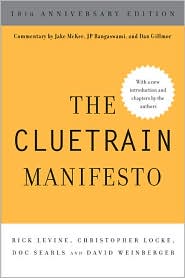
Cluetrain 10th Anniversary edition
Cluetrain 10th Anniversary
Everything Is Miscellaneous
Small Pieces cover
Small Pieces Loosely Joined
Cluetrain cover
Cluetrain Manifesto
My face
Speaker info
Who am I? (Blog Disclosure Form) Copy this link as RSS address Atom Feed

August 3, 2009

Twitter, markets, and marketing

Today’s WSJ has a good article by Sarah Needleman on companies using Twitter as a public relations tool.

Obviously, companies are paying attention to Twitter because lots of people have joined it; if it were a startup with 500 users, big companies wouldn’t care about it. But the way the massness of Twitter works may be teaching companies a lesson about the Web overall, and about markets.

Traditionally, marketing views a market as the set of potential customers — roughly, the people who are or might be made interested in the company’s offerings, and who are in a position to make a purchase. Marketers then segment their market according to some defining characteristics relevant to how the company can pique their interest and move them to completing a sale. Which means that messages define markets: Marketers choose age or ethnicity as the defining characteristics (for example) only if they think that those traits carve off a set of people susceptible to the same message.

Now, Twitter has this odd property of being able to support multiple scales: It works if you’re Ashton Kutcher with two million followers or if you’re a college kid with four followers. For Kutcher, Twitter is a mass medium. For most of his followers, it’s a far more social medium. This ability to work easily and simultaneously at scales separated by orders of magnitude is distinctive of the Web itself. Oh, sure, you could organize a phone bank to reach two million folks with your message, but that’s the opposite of an easy and natural use of telephones. For the Web, it’s just what it does.

Marketers are among those not used to this sort of continuity of scaling. Traditional marketing has aimed for the efficiencies bigger scales bring. Even the 1990s interest in “personalization” was a type of mass customization. So, it’s interesting to watch as marketers try to adjust to this new, slippery environment. The companies cited in the WSJ article seem not to be paying attention exclusively to Twitterers with huge followings. That by itself is a useful webby lesson to learn. But will marketers figure out how to make marketing scalable up and down, without violating norms or sounding like dicks?

[Tags: twitter marketing business cluetrain ]

Tweet
Follow me

Categories: Uncategorized Tagged with: business • cluetrain • marketing • social networks • twitter Date: August 3rd, 2009 dw

2 Comments »

July 21, 2009

Boston: The New Marketing hub!

As everyone knows, Boston is the Hub of the Universe. The fact has been well-documented in Boston tourist literature, and in the way Bostonians superciliously ignore outsiders. Super-superciliously! We couldn’t do it if we weren’t the hub!

Now Scott Kirsner has proved that Boston is also the hub of the new wave of marketing literature, and he’s built the Amazon list to prove it.

[Tags: marketing web_marketing twitter boston the_hub ]

Tweet
Follow me

Categories: misc Tagged with: boston • business • cluetrain • marketing • the_hub • twitter • web_marketing Date: July 21st, 2009 dw

3 Comments »

July 9, 2009

Brad Sucks latest album for free — and Brad still gets paid!

NOTE: The 50 copies are gone. Took about an hour.

I’m trying an experiment with a business model I like to call a reverse referral fee. Here’s how it works…

You click on a link that lets you download a copy of Brad Sucks’ latest album, Out of It. The album of wonderful music is yours for free in every sense. (Share it! Please!) But, I’m going to pay Brad for each copy downloaded, at a bulk rate he and I have agreed on.

This offer is good for the first fifty people who download it. After that, you can buy a copy on your own. Of course, Brad also makes his music available for free (in every sense), but don’t you want to support a truly webby, big-hearted musician who’s giving us his talent free of copyright, studios, and DRM? Doncha?

So, if you want to be one of the fifty, click here for your free-to-you-but-not-to-me copy of Brad Sucks’ Out of It.

[Tags: bradsucks music drm copyright copyleft business_models everything_is_miscellaneous ]free ]

Tweet
Follow me

Categories: Uncategorized Tagged with: bradsucks • business_models • copyleft • copyright • digital culture • drm • entertainment • everythingIsMiscellaneous • everything_is_miscellaneous • free • marketing • media • music Date: July 9th, 2009 dw

14 Comments »

Putting the “us” into customers

Newegg, my favorite online store for electronics (well, if eBay doesn’t have what I’m looking for), runs informal online polls. The current one [note: this link will be wrong whenever Newegg posts its next poll]:

What kind of Product information is most important to you when making a purchasing decision?

* Images
* Product Specifications
* Manufacturer Content: manuals, installation guides
* Product Overview & Highlights
* Buying Guide
* Other Customer Reviews
* Additional Content Regarding the Product
* I love your current product page

Of the 4,100 people who voted, 40% say the product specs are the most important info, followed by 30% who say customer reviews are. The rest of the results are in single digits, except for the 15% who responded that they love the current page.

Granted this is an unmonitored, game-able online poll. In fact, I gamed it a bit by voting for customer reviews, even though the product specs are usually my first criterion: If I need a male-male USB cable, I don’t care how good the reviews are for a female-female USB cable. On the other hand, if the specs say that one monitor has a lower refresh rate than another, but customer reviews say that the lower refresh rate isn’t apparent when playing games, the customer reviews will be the decisive factor for me. And I do love Newegg’s current product page. So, faced with having to pick just one, I decided to encourage Newegg to continue featuring customer reviews.

(By the way, did I ever mention that the Tenth Anniversary edition of Cluetrain came out a couple of weeks ago, with new chapters by each of the authors and with comments from some Highly Respected Individuals?

[Tags: marketing cluetrain ]

Tweet
Follow me

Categories: Uncategorized Tagged with: business • cluetrain • marketing Date: July 9th, 2009 dw

2 Comments »

July 3, 2009

15 creepiest vintage ads

Yup. Pretty damn creepy.

[Tags: cluetrain advertising ]

Tweet
Follow me

Categories: Uncategorized Tagged with: ads • advertising • humor • marketing Date: July 3rd, 2009 dw

1 Comment »

June 19, 2009

FlyClear: Cutting in line so the terrorists won’t win

At the Reagan Airport (would I be jumping the gun to start calling it the Obama Airport already?), Clear has a little square of space right before the security inspection stations. For $200/year, you can skip the long lines and go for the exceedingly short line to Clear. There the uniformed employees will compare some of your body parts (iris and fingerprints) with the information on the Clear card you present. Once you’re through, you can go straight to the Conveyor of Transparencies where you rejoin the hoi polloi so that the TSA can make sure your shoes aren’t on fire.

What I don’t get is why Clear has to give you an extra special biometric scan. Why can’t they just do what the TSA folks do: Look at your drivers license, look at you, and wave you on through? All I can figure is that Clear’s market research showed that people would be more willing to pay to cut in line — which is what Clear is really about — if there’s a pretense that it enhances security.

As far as whether all the fancy-shmancy biometrics — heck, my face is the only biometric I need! — actually increases security, if I were an evil do-er, I’d just bribe a Clear airport employee. They don’t go through security clearances the way TSA folks do, at least according to the Clear employee I asked.

[Tags: airports security tsa terrorism line_cutters ]


June 22, 2009: Clear just went out of business.

Tweet
Follow me

Categories: misc Tagged with: airports • line_cutters • marketing • misc • security • terrorism • tsa Date: June 19th, 2009 dw

8 Comments »

June 16, 2009

Intimacy defined

As Cluetrain’s 10th Anniversary Edition launches, it seems appropriate to note that today I received a notice that the Australian Central Credit Union is now using Consona customer relationship management solutions to overcome its fear of intimacy:

Today, member intimacy is now a core component of ACCU’s competitive advantage, and the Consona CRM solution allows ACCU to:

  • View members’ holdings and interactions across all channels of the organization at a glance;

  • Easily locate or compose customized documents and correspondence in order to respond to an enquiry or provide customer guidance;

  • Reduce and streamline manual and semi-manual work processes, enhancing productivity and providing a more effective audit trail functionality; and

  • Expand its business strategy to adopt an integrated advice model and link members to personalized products and services.

By the way, tonight Doc and I are going to be interviewed by Jonathan Zittrain about Cluetrain. You’re invited: 6pm, Austin Hall. [Tags: cluetrain markting crm vrm ]

Tweet
Follow me

Categories: Uncategorized Tagged with: cluetrain • crm • marketing • markting • vrm Date: June 16th, 2009 dw

4 Comments »

June 12, 2009

Tenth Anniversary of Cluetrain celebration at Berkman

The Berkman Center is putting on a little book launch for the tenth anniversary edition of Cluetrain. Doc and I will be interviewed by the estimable Jonathan Zittrain on the topic “Cluetrain at 10: So How’s Utopia Working Out for Ya?” at 6pm, Tuesday, June 16, at Austin East at Harvard Law [map.

If you can’t make it, or if you’ll only show up if there’s pizza (there isn’t), it’s being webcast.

BTW, the tenth anniversary edition has the complete original text (available here for free), as well as new chapters by each of the four authors, plus an intro to the intro by me, plus articles by Dan Gillmor, Jake McGee, and J.P. Rangaswami.

[Tags: cluetrain ]

Tweet
Follow me

Categories: Uncategorized Tagged with: business • cluetrain • digital culture • marketing Date: June 12th, 2009 dw

1 Comment »

June 11, 2009

[newmedia] Measuring social media’s effects

NOTE: Live-blogging. Getting things wrong. Missing points. Omitting key information. Introducing artificial choppiness. Over-emphasizing small matters. Paraphrasing badly. Not running a spellpchecker. Mangling other people’s ideas and words. You are warned, people.

Q: How do you define social media at Whirlpool?
Brian Synder: It has to be defined separately for each area, and we tie it back to business objectives. We track share of voice and favorability. On customer service, we do interesting text mining.
Lee Aase (Mayo Clinic): We use the free tools that are available. “The need for measurement varies inversely with the amount of money you spend on it.” We use the measurement tools to prove the value of what we’re doing.

Q: Your biggest challenge?
Marcel Lebrun (Radian6): We only measure if there’s a practical purpose. Social media are now multi-purpose. We use social media for every possible purpose. So, it’s disrupting everything in the enterprise that has to do with reaching out to customers. But those different practices have different business goals and thus different needs for measurement.

Q: Where it’s going?
Marcel: In the past six months, we’ve gone from explaining what social media is, to businesses understanding that their brand is the sum of all the conversations about it.

[Missed some. Sorry]

Q: How do you measure influencers for a brand?
Marcel: We integrate a bunch of digital breadcrumbs and social metrics. We measure things like how often a person talks about a subject, how much comments, how many unique comments, inbound links, which ones of those are also talking about that topic. Influence is very topic-centric. You sometimes want to see total reach, and sometimes you just want to find the topic geeks.

Q: How do you determine sentiment?
Brian: Synergy1 has humans reading the posts. The Tensity program automates this.
Lee: We eyeball it. And we’re looking for the really positive ones so we can spread the word and engage.
Brian: We look to engage by actually talking about product issues. E.g., an unhappy customer was tweeting about a product arriving damaged three times. We talked with him and redesigned the packaging based on his suggestions. We’ve taught some of our customer care phone folks how to engage via social media.
Marcel: The bulk of brands are at the listen stage. But Dell has a full blogger outreach team, focused on different kinds of users. The measure quantitatively and qualitatively (e.g., stories).

Marcel: The fastest way to get a new feature into a product is to tweet it. The developers get excited. They like being in touch.

[Tags: nms09 marketing twitter pr social_media cluetrain ]

Tweet
Follow me

Categories: Uncategorized Tagged with: business • cluetrain • conference coverage • marketing • nms09 • pr • social networks • social_media • twitter Date: June 11th, 2009 dw

1 Comment »

[newmedia] New media in a regulated industry (health)

NOTE: Live-blogging. Getting things wrong. Missing points. Omitting key information. Introducing artificial choppiness. Over-emphasizing small matters. Paraphrasing badly. Not running a spellpchecker. Mangling other people’s ideas and words. You are warned, people.

Marc Monseau (Johnson & Johnson): 50% of people change their behavior based on the medical advice they read on line. And most people are looking for info from other people like themselves. But that info isn’t always accurate. That means that the healthcare industry has an obligation to get out into the online world to present accurate info. We have lots of information, and we are companies of relationships: We have close relations with physician groups, patient groups, advocacy groups, gov’t organizations. We can tap into those resources of information and relations. E.g., we have an ADD product. The best info patients receive often come from other parents. at ADHD Moms at Facebook, there’s info, but also the possibility of linking to other patients. We set it up, but it’s unbranded.

Virginia Cox (Consumer Healthcare Products Association) gives an example: Teens getting high on cough medicine. There were 200 videos on YouTube about how to get high that way. So, we used social media to build awareness among mothers. We were completely transparent about who we are. Another example: We recruited five moms because people want to hear from other people like them. We put it on Gather and then on Facebook. We wanted to have them talking. It meant giving up control over what they’re saying.

Earl Whipple (AstraZeneca) says that while you want to provide accurate information, you don’t want to encroach on the physician-client relationship. You also have to be mindful of gov’t regulations, of course. He also notes that the search results are more often coming from bloggers than from sites of credentialed providers. The most controversial posts get pulled up first, frequently, and many people assume that those are the most reliable. Therefore, the question isn’t what’s the risk of engaging in the new social media space; the question is what’s the risk of not engaging.

Q: How are things changing? How authentic can you be?
Earl: The concept of spokespeople is now laughable. People want to hear directly from the content area expert.
Marc: You can be authentic while talking about highly regulated products by being transparent about what you can talk about and what you can’t. People understand we’re under limitations. And we can at least direct the traffic to the right place.

Q: Info across a global world?
Earl: When we put out information, we include who the information is intended for. It’s an unbounded environment.

Q: What is it that you can’t tell people because of regs?
Marc: The FDA limits what pharmas can say about approved products. If people notice a new use for a product, you have to go back to the script and say what’s on the product label. It doesn’t prevent you from engaging. But you can’t get into a detailed conversation about unapproved uses. And if you come across someone who’s had a problem with the product, you have to report that back.
Virginia: There are strict regulations around advertising. Companies have to be careful about what counts as advertising.
Earl: There are many unanswered issues. E.g., if you’re in a genuine dialog and someone brings up an unapproved use, what exactly is your responsibility?

Q: How do you monitor the Five Moms site, for example?
Virginia: We don’t have to monitor it for content. The Moms respond on their own. But we are required to monitor it for adverse reports, etc.

Q: What should all students know about social media and health if their in the communications field?
Virginia:


From the Five Moms Site:

Tips to monitor your kids online.

* Make sure that your children are never online without your permission.
* Be clear with your kids about your rules on Internet use at home and outside of the home.
* Place your computer in an area of the house where you can easily supervise their Internet activity.
* Ask your children about who they talk to and what activities they do online.
* Use parental filters to block access to questionable sites.
* Build an open and trusting relationship with your kids about their online use.

The last point is an unintentional punchline. [Tags: nms09 pr marketing health_care pharmaceuticals social_media social_netowrking cluetrain ]

Tweet
Follow me

Categories: Uncategorized Tagged with: business • cluetrain • conference coverage • marketing • nms09 • pharmaceuticals • pr Date: June 11th, 2009 dw

1 Comment »

« Previous Page | Next Page »


Creative Commons License
This work is licensed under a Creative Commons Attribution-NonCommercial-ShareAlike 3.0 Unported License.
TL;DR: Share this post freely, but attribute it to me (name (David Weinberger) and link to it), and don't use it commercially without my permission.

Joho the Blog uses WordPress blogging software.
Thank you, WordPress!