


logo
EverydayChaos
Everyday Chaos
Too Big to Know
Too Big to Know
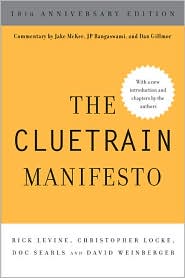
Cluetrain 10th Anniversary edition
Cluetrain 10th Anniversary
Everything Is Miscellaneous
Small Pieces cover
Small Pieces Loosely Joined
Cluetrain cover
Cluetrain Manifesto
My face
Speaker info
Who am I? (Blog Disclosure Form) Copy this link as RSS address Atom Feed

November 14, 2008

Obama appointments so good I thought I was being punk’d

Susan Crawford and Kevin Werbach are heading Obama’s FCC transition team.

OMG. This makes me so happy. Not only are they amazingly knowledgeable about the issues, they also share Obama’s political temperament: Strong beliefs, an ability to listen, a respect for others that is manifested as gentleness, and a practicality that carries them past mere ideology.

Change is coming to the FCC.

[Tags: fcc susan_crawford kevin_werbach obama net_neutrality ]

Tweet
Follow me

Categories: Uncategorized Tagged with: digital rights • fcc • net neutrality • obama • policy • politics Date: November 14th, 2008 dw

13 Comments »

November 12, 2008

Net neutrality point and counterpoint

The Cato Institute has published Tim Lee’s paper arguing for a neutral Net but against Net neutrality regulation. Stephen Schultze, of the Berkman Center, has posted a careful and thoughtful rebuttal.

[Tags: berkman net_neutrality cato tim_lee stephen_schultze fcc ]

Tweet
Follow me

Categories: Uncategorized Tagged with: berkman • cato • fcc • net neutrality Date: November 12th, 2008 dw

1 Comment »

November 4, 2008

FCC approves unlicensed White Spaces

The FCC has approved unlicensed use of the White Spaces. This frees up spectrum for innovation. See Harold..

[Tags: fcc spectrum white_spaces ]

Tweet
Follow me

Categories: misc Tagged with: fcc • misc • spectrum Date: November 4th, 2008 dw

Be the first to comment »

September 9, 2008

Tim Wu on McCain and Obama’s plans for the Internet

Tim Wu brings his customary clarity and vision to the McCain and Obama’s tech policies. Rather than sticking with the “McCain’s never used Google, oh, and he’s old, too,” Tim tries to get at the differences guiding them. Chief among them: McCain sees the Internet as just another bit of the telecom panoply, while Obama thinks it’s special. But read the whole thing to get past my over-simplification…

[Tags: tech_policy obama mccain tim_wu fcc net_neutrality ]

Tweet
Follow me

Categories: Uncategorized Tagged with: fcc • mccain • net neutrality • obama • policy • politics Date: September 9th, 2008 dw

2 Comments »

August 19, 2008

Free the white space

Google is taking to the public in its lobbying of the FCC to make the “white space” available for wireless broadband. This is the space between designated channels. Right now, we use it as sort of bowling alley gutter bumpers between assigned frequencies, but given modern technology, we can make better use of it, if only we’re allowed to.

Google has a form for sending a message to the FCC, as well as some useful explanatory materials…

[Tags: fcc google spectrum white_space ]

Tweet
Follow me

Categories: Uncategorized Tagged with: fcc • google • policy • spectrum Date: August 19th, 2008 dw

Be the first to comment »

July 24, 2008

Why the FCC should not be requiring that the Internet be safe for five year olds

A group of folks, led by Wendy Seltzer, Geoff Goodell and Steve Schultze, has filed a comment on the FCC’s proposal that it give away some public spectrum to be used for national Internet access, with the requirement that the provider censor it down to what’s safe for a five year old. Wendy and her friends produced what I think is an outstanding, thorough, and legally-based criticism of this plan. (I’m proud to be one of the many signatories.) [Tags: fcc censorship wendy_seltzer ]

Tweet
Follow me

Categories: Uncategorized Tagged with: censorship • digital rights • fcc • net neutrality Date: July 24th, 2008 dw

Be the first to comment »

June 24, 2008

Free ‘n’ censored Internet

Scott Bradner has a terrific column on the FCC’s idea that it will make some spectrum available for free Net access, so long as it’s censored. If the naughty bits can’t be stopped by filters, then the FCC wants the carriers to block it using other means, e.g., perhaps by blocking encrypted data?

I don’t know why the FCC thinks that it has the mandate to censor the Internet. And if they do, why don’t they insist on a morally pure telephone network? Why do they think the Internet consists of content instead of people communicating? And why does the FCC care so much about boobies?

More info: The company behind this. The .doc file with the FCC text. Reuters. M2Z comment (type “m2z” in “filed on behalf of”). DailyWireless.

[Tags: fcc ]

Tweet
Follow me

Categories: Uncategorized Tagged with: digital rights • fcc • net neutrality Date: June 24th, 2008 dw

10 Comments »

March 25, 2008

Google’s proposal for opening the spectrum for innovation

On the heels of her splendid explanation of the outcome of the 700MHz auction, Susan Crawford explains Google’s proposal to the FCC for the “white spaces.” Here’s my take on her take. (The NYT also has a useful article.) (Note: All errors in the following are mine. I am in over my head.)

Congress has mandated the end of over-the-air broadcast of analog TV signals. This frees up some spectrum. (Spectrum = frequencies = colors) Actually, it frees up a lot of spectrum: the 700MHz auction was for just 22MHz of frequency, whereas we’re now talking about 300MHz of spectrum. So, what should we do with this newly unbound stretch of public airwaves?

We could slice it up and sell it off to private companies. That’s generally what the FCC does with spectrum. And that made sense back in the 1930s when the FCC was created. Radios were so primitive that broadcasters had to be given untrammeled access to a frequency to avoid “interference” with other broadcasts. So, the FCC sold swaths of spectrum to broadcasters, but, recognizing that spectrum belongs to the public, the FCC also placed some requirements and restrictions on broadcasters.

Radio technology has advanced since the day the Titanic’s signal wasn’t decipherable. Not only are radios better able to tune in to particular frequencies and strip out noise, they are also able to respond dynamically. They can, for example, hop around the spectrum to hold on to a particular broadcast, if the broadcaster changes lanes, so to speak, in order to find a less unoccupied frequency. Not only does this sort of “open spectrum” approach promise far more efficient use of available spectrum — more bandwidth, to put it inaccurately — but it means that the government doesn’t have to decide for us who gets to use the spectrum. (For more on this, see David Reed’s explanation.)

Google has outlined to the FCC how it would use unlicensed white space spectrum. It’s proposing conservative approach that moves cautiously toward open spectrum, providing the FCC with a vision for how the white space spectrum might bring enormous benefits.

Google envisions how wireless devices running the Android operating system — Google’s mobile operating system — might use the white space frequencies. Google points out that such devices could help deliver Net access to rural areas, a sore spot at the FCC since the policy of handing the Internet over to a duopoly has kept the rural and the poor in the dark. (Surprise!) But, as Susan writes:

Google suggests that *all* devices for unlicensed use of the white spaces should be required to receive an “all clear” signal for the particular channel where they wish to operate, by using geolocation, checking a database of licensees in that location, and getting permission in advance.

This would achieve some of the objectives of an open spectrum system, allowing for the dynamic allocation of frequencies. Google suggests that they could use dynamic auctions to assign frequencies for limited times and strengths, adding another element of extrinsic control (as opposed to a fully open spectrum approach that depends on the devices negotiating for the airwaves). Further, Google suggests that some channels be kept unavailable for all but some high-priority, specialized uses.

This is a calm and rational approach that could see an enormous blossoming of innovation. Think about how many devices exist because tiny ranges of spectrum have been left unregulated. Opening a big swath of spectrum is like opening up a big tract of land. Who knows what we’ll build once we have the space? [Tags: fcc spectrum susan_crawford google open_spectrum wifi ]

* * *

Harold Feld thinks Google conceded too much too soon.

Tweet
Follow me

Categories: Uncategorized Tagged with: digital rights • fcc • google • policy • spectrum • wifi Date: March 25th, 2008 dw

1 Comment »

March 23, 2008

Susan Crawford on the 700MHz auction

Susan Crawford has a brilliant, clear explanation of the significance of Verizon’s winning the auction for Block C in the FCC’s 700MHz auction.

If that sentence made no sense to you once you got past the phrase “Verizon’s winning the auction for,” all the more reason to hie yourself to Susan’s post. Ten minutes ago it didn’t make sense to me, either. Don’t worry. Susan will explain it.

[Tags: susan_crawford auction 700MHz internet fcc verizon net_neutrality ]

Tweet
Follow me

Categories: Uncategorized Tagged with: 700MHz • auction • fcc • internet • net neutrality • net_neutrality • policy • susan_crawford • verizon Date: March 23rd, 2008 dw

Be the first to comment »

March 2, 2008

Susan Crawford: The Internet is not a medium

Susan Crawford comments on the Comcast FCC hearings, urging that we not view this simply as a matter of keeping net management neutral. Rather, she says, we should recognize that the Internet is not a medium but purely a transport system. The implication is that those who sell access to the Internet should not also be selling content and services over the Internet. (Delamination now!)

This is the crux of the matter. We’ve handed the implementation of our Internet over to companies that view themselves as providers of programming (in the TV, not the software, sense). That’s why they almost all think that giving you a fifth or a tenth of your download capacity for uploading makes obvious sense.

We could get a favorable (from my POV) ruling on Net neutrality from the FCC and still leave our Internet in the hands of those who are structured to treat it as a medium for passive viewers of high-def programming.

[Tags: susan_crawford net_neutrality comcast fcc ]

* * *

The Boston Globe has a pretty good editorial about the Comcast affair. My main concern with it is that it assumes this country’s failure to deliver a satisfactory Internet infrastructure shows that that infrastructure can’t come from a competitive market … as if the current situation is a competitive market. In my view, we need a mix of government steps to open the market (by rquiring access providers to act as wholesalers, for example), probably some direct government intervention (e.g., subsidies of some sort to reach areas quickly that the market won’t), and (I wish) government-enforced de-laminating of the industry. Something like that. But I have more faith in the power and efficiency of truly open markets than the Globe seems to have.

PS: I still wish we’d embrace the Open Spectrum idea. Lots of problems would be rapidly solved if and when it becomes practical technically and politically.

Tweet
Follow me

Categories: Uncategorized Tagged with: comcast • fcc • net neutrality • net_neutrality • susan_crawford Date: March 2nd, 2008 dw

4 Comments »

« Previous Page | Next Page »


Creative Commons License
This work is licensed under a Creative Commons Attribution-NonCommercial-ShareAlike 3.0 Unported License.
TL;DR: Share this post freely, but attribute it to me (name (David Weinberger) and link to it), and don't use it commercially without my permission.

Joho the Blog uses WordPress blogging software.
Thank you, WordPress!