


logo
EverydayChaos
Everyday Chaos
Too Big to Know
Too Big to Know
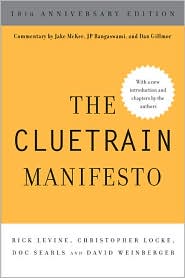
Cluetrain 10th Anniversary edition
Cluetrain 10th Anniversary
Everything Is Miscellaneous
Small Pieces cover
Small Pieces Loosely Joined
Cluetrain cover
Cluetrain Manifesto
My face
Speaker info
Who am I? (Blog Disclosure Form) Copy this link as RSS address Atom Feed

April 2, 2009

Kevin Werbach on the role of the FCC

Here’s a snippet from an interview with Kevin Werbach running at Knowledge@Wharton. Kevin was one of the chairs of Obama’s FCC transition team.

The FCC really needs to think about itself as an economic stimulus agency, as an agency that’s about creating jobs and fostering investment. Look at the telecommunications and media and technology sectors — there is a tremendous opportunity for growth. These are not industries that are going down. These are industries that, in many ways, are growing. And they’re the foundation for other kinds of new jobs

There’s a ton of policy stuff that needs to be done, but this is the kind of strategic thinking we need going forward. Here’s some more of Kevin. You know, I really wouldn’t be crying in my beer if Kevin were made an FCC Commissioner. In fact, you’d hear a whoop coming from my house that’d have you dialing the emergency number of the Happiness Police.

[Tags: kevin_werbach fcc net_neutrality telecommunications ]

Tweet
Follow me

Categories: Uncategorized Tagged with: fcc • policy • telecommunications Date: April 2nd, 2009 dw

Be the first to comment »

March 31, 2009

[f2c] Kevin Werbach and Dan Gillmor

[Note: Live blogging with all the suckiness and unreliability that that entails] Kevin Werbach was co-chair of the Obama FCC transition team, among many other things. Dan Gillmor is interviewing him:

Q: What does a transition team do?
A: You get to participate in a quasi-hostile takeover of a $14T organization. We reviewed the FCC to find out what was going on.

Q: What was going on at the FCC?
A: It’s no one thing. Commissioner Martin ran the agency in a closed, politicized way. He was very distrustful of the staff.

Q: What was broken?
A: I can’t discuss details.

Q: What would you do if you were Chairman?
A: If I told you, I’d ensure I could never have that job. The real opportunity for the FCC is to get ahead of the curve. What will the world be like in 20 years? What will be requirements of the iPhone in 20 years?

Q: Are we going to get to lots more open spectrum?
A: Chairman Powell was thinking about the future of spectrum. That got shoved aside by Martin.

Q: How real is this change, then? Will we see deep change?
A: There will be tremendous change. But people on the outside should keep pushing the Administration to do better. It really matters who wins the election.

Q: What some things that could be done that couldn’t be reversed?
A: Successes are the things that are hard to reverse. The telcos understand that they need to evolve to something else.

Dan opens up the Q&A to the audience.

[harold feld] What’s achievable with spectrum policy with this Admin?
A: NTIA just got its head, so it’s early. The FCC and NTIA need to coordinate. We need to know how spectrum is being used. Do an inventory.

Q: Can you start blogging again…?
A: I’d love to, but it takes too much time. So I’ve started tweeting ([email protected])

Q: Smart grids. What’s going on between the FCC and other bodies in trying to set new standards?
A: I don’t know what’s going on in that, but it’s important. I have a law review article coming out that argues that standards are a form of regulation.

Kevin asks Dan: What would you do as FCC Chair.
A: Resign.

[Tags: kevin_werbach dan_gillmor f2c09 f2c fcc ]

Tweet
Follow me

Categories: Uncategorized Tagged with: conference coverage • digital rights • f2c • f2c09 • fcc • policy Date: March 31st, 2009 dw

Be the first to comment »

March 30, 2009

[f2c] Politico-Regulatory talks

[Note: Live blogging. Sloppy. Incomplete. Unchecked. Wrong. Flee! Flee!]

Chris Savage talks about “The Re-Birth of Intelligent Regulation and the Chicago School.” The Chicago School overemphasizes the value of individual thought (= “revealed preference theory”). When people make choices, that’s the best way to know what’s good for them (Chris says). But how can people know which wireless plan they want? “Empirical studies of decision making show that people don’t know what they want.” They don’t act rationally. They have trouble when there are too many alternatives, need to assess risk, etc. But, if you can’t assume that people know what they want, there’s no reason to think that the results from markets are good results. Hence, we need to regulate. If there’s no factual basis to think open competition will lead to the best outcome, regulators may have a role in shaping the outcome. But, timing matters and now is the time to make a “more citizen-friendly regulatory system.”

Derek Slater, a policy person for Google (and a former Berkman Fellow). He’s going to talk about MLab. We have all asked “WTF?” he says, especially when an app starts running badly. We don’t know what’s going on. We don’t have the tools to get the data that would help us understand that. Broadband policy needs data. mLab provides end-user testing tools. (It’s not just a Google project.) “We call it beta but that’s only because most people don’t now what alpha means.” Thirty-six servers at the moment.

John Peha, chief technologist of the FCC, talks about the “Mythology of Rural Broadband.” Myth 1: There’s less interest in broadband in rural areas. Nope. The percentage of US households with Internet overall and rural are almost the same, but rural has less broadband. They probably don’t like their Internet slow. About one third of rural households have no access to broadband of any ttype (except satellite). Myth 2: Customers are unwilling to pay the cost of the buildout. But there are spill-over benefits, affecting the community and not just the individual subscribers. Myth 3: Rural communities may not gain from the broadband they don’t have access to, but it doesn’t hurt them. Nah. “Reducing the size of a network harms those who remain.” Broadband is becoming the norm, hurting those who do not have it. Myth 4: “Government involvement in infrastructure always helps.” Nope. No “one size fits all” solution. We shouldn’t have the gov’t replicate solutions the market is doing well already. We shouldn’t assume that the market solves all problems. We’re getting some more spectrum in 2009 as the switch to digital TV kicks in, and there’s a new national broadband plan under development.

Q: [tim denton, CRTC commissioner] Expand on your point that we don’t know what market conditions will work, Chris?
Chris: We don’t know. It’s important for people, esp. regulators, to remember that.

Q: How can regulators make policy and maintain technological neutrality since technologies offer different capabilities?
Jon: Tech neutrality is a good thing to aim at.
Chris: I want to challenge that. We’re not neutral about houses that have electricity or not, or cars with airbags or not. The market won’t figure this out correctly, necessarily.
Derek: We need to set the goals and look at the data at what different technologies bring to the table.
Jon: The setting of the goals is the key part of that.

[amy wohl] I am a recovering Chicago economist. When the gov’t tries to fix market mistakes, it often introduces a lag that can create a new mistake. How can we help the gov’t make good decisions?
Chris: Elect the right people.
Derek: Infrastructure is special. That’s the message we need to be building on.
David I: Say more …
Audience: Because infrastructure is being built now but not being designed. [Tags: f2c f2c09 fcc broadband regulation ]

Tweet
Follow me

Categories: Uncategorized Tagged with: broadband • conference coverage • digital rights • f2c • f2c09 • fcc • policy • regulation • wifi Date: March 30th, 2009 dw

Be the first to comment »

March 7, 2009

Tales of data pirates: Opting out of Verizon’s open-ended sharing

A small legalistic pamphlet from Verizon arrived today telling me that I have 45 days to opt out of “agreeing” to let Verizon share Customer Proprietary Network Information, i.e., “information created by virtue of your relationship with Verizon Wireless,” including “services purchased (including specific calls you make and receive,” billing info, technical info and location info. They promise to only share this with “affiliates, agents and parent companies.” It will definitely not be shared with “unrelated third parties” … unless, perhaps that third party pays Verizon to become an affiliate, whatever the heck “affiliate ” means.

To opt out you can call 1-800-333-9956. Or you can follow the instructions in the mailing to go to verizonwireless.com and log into My Verizon where you will find no mention, no button, no link and no help. Ah, but you forgot to check your Messages. There you will indeed find a link to CPNI. The link is marked “Not available.” Dead end.

You could then call Verizon’s excellent telephone support. (Nope, I’m not being sarcastic.) They won’t be able to find the opt out button either. But during the 8 minutes the rep puts you on hold, you’ll be amused to hear one of their continuous bits of self-promotion tell you that Verizon never shares your personal information. Oh, what a wry sense of humor Verizon has!

When you escalate the call, you will finally be told to click on the My Profile tab in My Verizon, then click on Phone Controls, and there you will conveniently find the link. It’s just that simple!

The whole thing sucks :( [Tags: verizon marketing privacy fcc ]


[March 10:] Verizon responds in its blog. GigaOm responds more broadly to that response. And I still say that the if you’re going to make the mistake of opting us in to sharing private info, then you have an ethical obligation to make it damn clear to us that you’re doing so, and making it a damn site easier for us to opt out.


[March 11:] Al Gidari, Jr. of Perkins Cole is giving a talk at the Berkman Center about the privacy of mobile-based info. I asked him about CPNI. Here are my notes on what he said:

The kerfuffle was an example of bad journalism. The article expressed it badly. The info you are opted in to giving can be used only within the family of companies for marketing purposes. For sharing outside, it requires explicit opt-in. And CPNI has a higher standard for location info, which does not get shared. An “affiliate” is an entity you own or control. Verizon is incorporated in separate states, so they’re trying to share the info among that family of corporations.

Tweet
Follow me

Categories: Uncategorized Tagged with: digital rights • fcc • marketing • privacy • verizon Date: March 7th, 2009 dw

214 Comments »

February 13, 2009

Things you can’t do with real estate

David Reed blogs about recent research on “practical ways to construct EM (radio) waves with new, complex 3D structures that propagate while maintaining that structure, not necessarily in spherical or cylindrical shapes.” I am not even close to understanding the physics, but, as David writes, this sort of possibility makes it clear how foolish it is to regulate the airwaves as if they were real estate that has to be divided up into slices that are awarded as monopolies to the highest bidder. David writes:

… the policy issue is that such systems for multiplexing such EM fields don’t fit the “law of the land” regarding sharing the medium. So, like UWB [ultra wideband] and spread spectrum underlay, and white spaces, all that capacity will evaporate in attempting to fit the technology into the procrustean bed of the FCC’s “property rights in spectrum” legal framework.

The “property rights” model of spectrum allocation and radio regulation is based on physics-by-analogy, ignoring the reality of propagation. It’s time to end the ignorance of economists and lawyers, and replace physics-by-analogy with better physical analysis.

Or, to put the analogy the other way, if real estate operated the way energy and information do, the little slice of beach front you’re charging $5,000 a night for would go from having room for four honeymooning couples to being the 127 miles of the New Jersey coastline and simultaneously a set of holiday villas in Brazil, just because a Swedish scientist found some new way of twisting it around. In such a case, the FCC (Federal Coastal Commission) would probably want to rethink its rules for allocating beachfront properties. [Tags: david_reed fcc spectrum open_spectrum ]

Tweet
Follow me

Categories: Uncategorized Tagged with: fcc • policy • spectrum Date: February 13th, 2009 dw

3 Comments »

January 29, 2009

Radio Berkman: Steve Schultze on regulating the Internet – an explainer

Steve Schultze explains how the FCC got into the business of regulating the Internet in this Radio Berkman interview. I’m the interviewer, so I’m biased, but I think Steve does a great job talking us through this, so that Title I vs. Title II, etc., is clear at last.

[Tags: berkman stephen_schultze steve_schultze fcc telecommunications internet net_neutrality ]

Tweet
Follow me

Categories: Uncategorized Tagged with: berkman • fcc • internet • net neutrality • policy • telecommunications Date: January 29th, 2009 dw

Be the first to comment »

January 11, 2009

Should Telco 2.0 be Telco -1 ?

Ken Camp follows up on his follow up to his provocative post that says that Telco 2.0 is not a winning idea. He compares telcos to five attributes of social media companies:

Five words that do not describe telecommunications or the telecom industry – Participation, Openness, Conversation, Community and Connectedness. The industry, the whole construct of that framework is to control four of those by ensuring there is no community in the first place. To embrace community is not to become Telco 2.0, but to create something entirely new.

Ken worked in the industry for twenty years, btw.

[Tags: telcos telecommunications fcc policy social_networks social_media ]

Tweet
Follow me

Categories: Uncategorized Tagged with: digital culture • fcc • net neutrality • policy • telcos • telecommunications Date: January 11th, 2009 dw

1 Comment »

January 7, 2009

Reform the FCC

There are lots of ideas, resources, and discussion about how to reform the FCC at the aptly named Reforming the FCC site put together by Public Knowledge and Silicon Flatirons.

[Tags: fcc net_neutrality ]

Tweet
Follow me

Categories: Uncategorized Tagged with: fcc • policy Date: January 7th, 2009 dw

Be the first to comment »

December 17, 2008

Radio Berkman podcast: Free, national, and for five-year-olds

In this week’s Radio Berkman podcast, I interview Stephen Schultze about the FCC’s auctioning off spectrum to a national provider who would be required to use 25% of it for free, nationwide wifi. There’s only one catch: That wifi would have to only connect to sites and services that are safe for minors (defined as people between 5 and 18).

After we had recorded this interview last week, the FCC postponed voting on the proposal, and since it’s the baby of the outgoing Chair, it’s probably postponed forever. Still, the idea raises some really interesting issues. Steve and I focus on the free speech considerations, although the opposition from other spectrum-holders certainly could not have encouraged the FCC.

[Tags: berkman fcc wifi wi-fi spectrum free_speech censorship kevin_martin podcast stephen_schultze ]

Tweet
Follow me

Categories: Uncategorized Tagged with: berkman • censorship • digital rights • fcc • net neutrality • podcast • podcasts • policy • spectrum • wi-fi • wifi Date: December 17th, 2008 dw

Be the first to comment »

December 1, 2008

How the FCC transition works

Harold Feld steps through the various scenarios of how the FCC will go through its transition next year. You’d think it’d be a straightforward process. Hah! Harold lays it all out. Does Martin step down? How many new commissioners will Obama get to appoint? If the Republican commissioners were replaced by 19th century French Impressionists and the Democrats were replaced by unicorns, who would win the touch football match? Harold considers every possibility …

[Tags: fcc harold_feld ]

Tweet
Follow me

Categories: Uncategorized Tagged with: fcc • policy • politics Date: December 1st, 2008 dw

Be the first to comment »

« Previous Page | Next Page »


Creative Commons License
This work is licensed under a Creative Commons Attribution-NonCommercial-ShareAlike 3.0 Unported License.
TL;DR: Share this post freely, but attribute it to me (name (David Weinberger) and link to it), and don't use it commercially without my permission.

Joho the Blog uses WordPress blogging software.
Thank you, WordPress!