



logo
EverydayChaos
Everyday Chaos
Too Big to Know
Too Big to Know
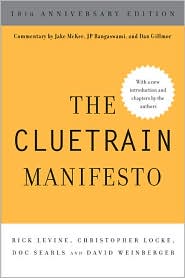
Cluetrain 10th Anniversary edition
Cluetrain 10th Anniversary
Everything Is Miscellaneous
Small Pieces cover
Small Pieces Loosely Joined
Cluetrain cover
Cluetrain Manifesto
My face
Speaker info
Who am I? (Blog Disclosure Form) Copy this link as RSS address Atom Feed

June 29, 2009

[pdf09] Mark McKinnon and Joe Rospars

On stage at PDF, Mark McKinnon and Joe Rospars, the Net guys for McCain and Obama.

NOTE: Live-blogging. Getting things wrong. Missing points. Omitting key information. Introducing artificial choppiness. Over-emphasizing small matters. Paraphrasing badly. Not running a spellpchecker. Mangling other people’s ideas and words. You are warned, people.

Andrew Rasiej begins the interview by asking Mark about the way the media took up his statement at PDF08 that “John McCain is aware of the Internet.”

MM: This shouldn’t be viewed as left v. right but old v. new. “Joe’s a genius, I’m a woolly mammoth.” I’m not the Rospars of the right, I’m old media. We have our own Joe Rospars. It’s all about democratization. Back in 2000, we were creating content via analog. In 2004, it changed radically. We could create longer content digitally and send it out to millions of supporters. In 2008 we saw the effect of YouTube, which means campaigns are losing control. What Obama did: The real key is not tech but harnessing energy. Create the excitement.

JR: All of the online stuff was integrated with the traditional, offline aspects of the campaign.

AR: The power of the Net crystalized for me when I saw my dad emailing Obama YouTubes to people. How do you convince traditional pols that the online is an opportunity?

JR: It’s not a replacement. It’s an integrated thing. It wasn’t clear from the beginning that it was going to happen. In my job interview, Plouffe said we’re only going to be able to build national campaign, we’re going to have to use the online new media to build the love. The old and new media directors sat at the same table. Obama and Michelle said when we first met that they wanted to run the campaign in a way that would leave the political process better off, even if they lost.

AR: What about bumps in the road, e.g., Obama’s support of the FISA bill?

JR: It was hard. But Obama was the candidate, not the plurality of web sites. So he took the time to write a note explaining his position. It was a testimony to the maturity of the campaign and the supporters. After we sent back the donations disappointed donors wanted back, the majority of those were returned because they appreciated how we handled it.

AR: Now that Obama is running the White House, there seems to be more of a disconnect with bloggers, etc.

JR: I dispute that characterization. This is the most transparent WH ever. And we’re not starting from scratch when governing, as opposed to when you’re building a campaign.

AR: Mark, for the next campaign, how much of it will be tools and how much will be candidate?

MM: It’s 95% energy and ideas, 5% tools. Did Obama revolutionize campaigning? Yes, the way Secretariat revolutionized horse racing… How many Republicans are in the audience? [Look like about ten people out of 1,000 raised their hands.]

AR: What advice would you give MM, JR?

JR: Get new candidates. Even Mark’s language is off: He talks about “embracing technology.” We got millions of people who hadn’t been involved in politics to get out and do something. I don’t see any Republican on the horizon doing this.

MM: I agree with JR. It’s about connecting, interacting with people, fundamental issues that matter to them. The best part is day you’re elected; it gets tougher and tougher from then. I hope Pres. Obama is extraordinarily successful for the sake of country, but the hard stuff is just beginning, and people will get disillusioned, and REpublicans will have an opportunity…

MM: Do you have any thoughts about tech is playing out in Iran?

AR: I’m fascinated by our willingness to accept info we can’t verify.

JR: It’s not the tech. It’s the desire.

AR: Micah and I have been thinking that making info “public” should be redefined as accessible and searchable online. Public shouldn’t mean it’s in a drawer in DC.

MM: Transparency is key to effective democracy.

[I missed some questions. Working on my presentation, which I have worked on obsessively for weeks, making it less coherent with each rev.]

Q: Privacy protection hasn’t kept pace with tech…
AR: Privacy is being redefined by the new generation.

JR: I hope people are using the online tools they used during the campaign to organize smaller group now that the campaign is over.

MM: Info is power and tech is providing info.

AR: Bills ought to be posted for 72 hours after it’s finalized and before it’s voted on.

JR: Blue State’s clients are only 25% political. This goes beyond politics.

MM: Fascinating to watch. Campaigns and companies understand they have to tell better stories, opening up the doors so that all the constituencies understand their business.

Q: What are the risks?
JR: We need to make clear to everyone what we’re doing.
MM: Setting expectations

[I did a particularly crappy job of liveblogging this, mainly because of Twitter and the rewriting of my presentation. Sorry.] [Tags: pdf09 e-government e-gov politics ]

Tweet
Follow me

Categories: Uncategorized Tagged with: conference coverage • e-gov • e-government • egov • pdf09 • politics Date: June 29th, 2009 dw

Be the first to comment »

June 26, 2009

[reboot] Government officials take it on the chin

I went to a fascinating breakout at Reboot at which two government guys came to talk about national policy. The government guys were culturally of the Reboot crowd (or so it seemed to me), and one of them came to his position straight out of a tech start-up. But the group of thirty people in the small, converted men’s room (!) met their openness with pent-up hostility. I was surprised at the anger. The gov’t guys ought to listen (which is what they were doing at this meeting), should not expect ideas for free, need to maybe do nothing, need to get the country over the digital divide, should give grants to small businesses, should stay clear of small businesses, don’t be afraid to lose control, build communities, participate in communities, stay out of communities… My untutored sense was that the Web community felt frustrated that this initiative was so late at getting started. As an American, I was actually impressed with the government folks’ openness and webbiness.

Afterwards, I talked with my friend Morten Kamper. He wasn’t at the session, but he said that there was concern that the government’s broadband committee is comprised of the telcos without sufficient citizen or webizen participation, and that Net neutrality is indeed an issue, as the telcos assume they can prefer some of their bits to others.

BTW, I asked the room if there was reluctance on the part of the government to be transparent, and, if so, where’s the Danish version of the Sunlight Foundation. The general answer I got was: There’s no official reluctance, but it’s going too slowly. And Ton Zijlstra said that in the Netherlands, the official policy is to be transparent but there are cultural resistances.

I also asked, at the beginning, if it was clear that the “broadband policy” they were talking about was actually committed to delivering an open, unfiltered, non-discriminatory Internet. The answer was “Yes,” with an implied, “Why would you even have to ask?” (And the answer to that implied question is: Because it’s not clear in America.)

[Tags: denmark e-gov e-government egov reboot reboot11 rb11 ]

Tweet
Follow me

Categories: Uncategorized Tagged with: broadband • conference coverage • denmark • digital rights • e-gov • e-government • egov • net neutrality • policy • rb11 • reboot • reboot11 Date: June 26th, 2009 dw

3 Comments »

June 11, 2009

[newmedia] Engagement and transparency in government

Clay Johnson of the Sunlight Foundation and David Almacy (Edelman’s public affairs VP and former Director of Internet Operations, White House) are talking about government and engagement.

NOTE: Live-blogging. Getting things wrong. Missing points. Omitting key information. Introducing artificial choppiness. Over-emphasizing small matters. Paraphrasing badly. Not running a spellpchecker. Mangling other people’s ideas and words. You are warned, people.

Clay says he’s a product guy who likes building things. Coming out of the Dean campaign, he co-founded Blue State Digital. When asked why Obama was successful online, he says he replies “Because Howard Dean had bad lawyers.” He could just build stuff there without consulting lawyers. Now, when they try to apply this stuff to governing, the lawyers are involved, and creativity is coming to a screeching halt, Clay says. But, he says, there’s another way: Publishing data. Data.gov aggregates data from the executive branch. Lots of businesses have been built using gov’t data, and this will be a seed bed.

Clay says that Twitter is as important to a political campaign as email. “I’m willing to go on record that in 2012 Twitter will be a bigger fund-raiser for campaigns than email.” Obama raised 80% of his funds through email. E.g., Tim O’Reilly has 200,000 subscribers.

He talks about Apps for America, a contest for apps that do useful things with open data. The new round has people working with the data at data.gov.

Q: [me] How can we encourage the gov’t and others to produce data in open formats?
Clay: I’m more focused on just getting the data out. I don’t care about the format. We should tell them just to do it in plain text, if that’ll get it out faster. Once the gov’t starts pumping it out we can have the debate about which standards.

[Tags: politics e-gov egov e-government transparency ]

Tweet
Follow me

Categories: Uncategorized Tagged with: conference coverage • e-gov • e-government • egov • everythingIsMiscellaneous • politics • transparency Date: June 11th, 2009 dw

Be the first to comment »

June 4, 2009

White House bloggers get names

The bloggers who write the posts at the White House blog now are putting their names on their posts. I think this is a terrific move.

As I posted a couple of weeks ago, my interest isn’t in accountability. On the contrary. Usually, we think that along the Continuum of Responsibility, putting your name to something will push you toward the Staying In Line side, while being anonymous lets you run toward the Recklessness goal post. But, it doesn’t always work that way. At a site like WhiteHouse.gov, the anonymity of bloggers reinforced the notion that the blog is a faceless voice of authority, with an adjoining door to the Office of Press Releases. I’m hoping that now that the bloggers are signing their posts, they will feel free-er to speak in their own voices, and present shades of view that are a bit more off-angle, and thus more interesting than the Official View. That’s already been true of the posts of the guest bloggers on the site. Now I hope the official bloggers will feel ok about occasionally saying “OMG!!!! I CAN’T BELIEVE I’M IN THE WHITE HOUSE!!!!!!” except maybe a little more constructively and definitely with the caps only implied.

[Tags: white_house whitehouse obama e-gov e-government e-democracy egov blogs anonymity accountability ]

Tweet
Follow me

Categories: blogs Tagged with: accountability • anonymity • blogs • digital culture • e-democracy • e-gov • e-government • egov • everythingIsMiscellaneous • obama • whitehouse • white_house Date: June 4th, 2009 dw

1 Comment »

May 24, 2009

Data.gov – Symbolic of what’s right with the Obama administration

Wired.com reports that Data.gov has opened to “mixed reviews.” Puhlease. It’s nowhere near what it will be, but OH MY TOASTY GOD, our government is now committed to making public data available in open formats to anyone who wants it. As if it were normal! As if it were obviously the right thing to do! In open formats, people!

So, sure, let’s keep an eye on it. Let’s make sure the news permeates every government department. But first let’s swoon in delight.

[Tags: egov e-gov e-government democracy open_standards open_government everything_is_miscellaneous ]

Tweet
Follow me

Categories: Uncategorized Tagged with: democracy • digital rights • e-gov • e-government • egov • everythingIsMiscellaneous • everything_is_miscellaneous • expertise • open_government • open_standards Date: May 24th, 2009 dw

1 Comment »

May 20, 2009

The White House wants comments on open government

The White House is looking for help formulating a directive on open government:

Executive Office of the President
Office of Science and Technology Policy
Transparency and Open Government

SUMMARY: The President’s January 21, 2009, memorandum entitled, Transparency and Open Government, directed the Chief Technology Officer, in coordination with the Office of Management and Budget (OMB) and the General Services Administration (GSA), to develop a set of recommendations that will inform an Open Government Directive. This directive will be issued by OMB and will instruct executive departments and agencies on specific actions to implement the principles set forth in the Presidents memorandum. Members of the public are invited to participate in the process of developing recommendations via email or the White House website at http://www.whitehouse.gov/open offering comments, ideas, and proposals about possible initiatives and about how to increase openness and transparency in government.

DATES: Comments must be received by June 19, 2009.
ADDRESSES: Submit comments by one of the following methods:
http://www.whitehouse.gov/open
E-mail: [email protected]
Mail: Office of Science and Technology Policy, Attn: Open Government
Recommendations, 725 17th Street, ATTN: Jim Wickliffe, Washington, DC 20502.

More here.

[Tags: open_government egov e-gov e-government obama ]

Tweet
Follow me

Categories: Uncategorized Tagged with: e-gov • e-government • egov • obama • open_government Date: May 20th, 2009 dw

5 Comments »

May 16, 2009

Whitehouse.gov: Give your bloggers’ names!

The Whitehouse.gov blog continues to improve, by which I mean it’s getting less like the glass-topped version of White House press releases. But it’s missing a big opportunity by keeping the blog posts anonymous.

The White House bloggers seem quite aware that a press release isn’t a post and are trying to create a difference between the two. For instance, the blogger begins the post on President Obama’s speech on credit card reform with a friendly paragraph about the citizen who introduced him. It’s not much and it’s still directly tied to the President’s remarks, but that paragraph doesn’t read like a press release or like a speech. And, that post ends with the blogger’s evaluation of the President’s proposal: “Long overdue.” That last phrase, expressing some personal enthusiasm, is uncalled for, and thus is refreshing, for blogging is a medium for the uncalled and the uncalled-for. (Which is why I love it.)

Still, it’s hard to see how the posts can blow past this minimal level of bloggishness…unless and until the bloggers start signing them.

The problem, I believe, is that the bloggers feel (and are made to feel) the awful weight of speaking for the White House. Their posts come straight from the offices behind the long lawn and the pillared portico. In some weird, ineffable way, they represent the building, its inhabitants, and its policies, just as press releases do. Press releases have authority because they’re not an individual expression. They have authority because they are unsigned and thus speak for the institution itself. Blog posts come from the same building, and, if they’re unsigned, maybe they’re supposed to have similar authority, except written in a slangier style. So, we don’t yet know exactly what to make of these unsigned posts. And neither do the bloggers, I think. It’s too new and it’s too weird.

But, if the bloggers signed their posts, it would instantly become clear that bloggers are not speaking for the institution of the White House the way press releases do. We would have something — the bloggers — that stands between the posts and the awesomeness of the White House. That would create just enough room for the bloggers to express something other than the Official View. They would be freed to make the White House blog far more interesting, relevant, human, and central to the Administration’s mission than even the most neatly typed press releases ever could be.

Already most of the bloggiest posts at Whitehouse.gov come from guest bloggers who are named and identified by their position. They feel free-er to speak for themselves and as themselves, in their own voice. Now, I don’t expect the official White House bloggers to speak for themselves exactly. They are partisans and employees; they work for the White House because they love President Obama. But, if they signed their names, they could speak more as themselves.

This might let them do more of what the White House blog needs to do, in my opinion. For example, I’d like to read a White House blogger explaining the President’s decision to try some Guantanamo prisoners using the military tribunals President Bush created. White House communications officials probably consider it bad politics to acknowledge the controversy by issuing a defense. But bloggers write about what’s interesting, and hearing a spirited, partisan justification would be helpful, and encouraging. I personally think that Pres. Obama probably has good reasons for his decision in this matter, but the “good politics” of official communications are too timid. I want to hear a blogger on the topic. And I would love to learn to go to the White House blog first on questions such as this. And isn’t that where the White House would like me first to go?

Bloggers with names are the best way to interrupt the direct circuit from politics to official public expression. That would put people in the middle…which is exactly where we want them. [Tags: blogs white_house obama blogging media egov e-gov e-government ]


Posted in slightly improved form at HuffingtonPost and TechPresident.

Tweet
Follow me

Categories: blogs Tagged with: blogging • blogs • e-gov • e-government • egov • media • obama • politics Date: May 16th, 2009 dw

39 Comments »

May 11, 2009

Smart and secure grids and militaries

The Wired.com piece I wrote about Robin Chase prompted Andrew Bochman to send me an email. Andy is an MIT and DC energy tech guy (and, it turns out, a neighbor) who writes two blogs: The Smart Grid Security Blog and the DoD Energy Blog. Neither of these topics would make it into my extended profile under “Interests,” but I found myself sucked into them (confirming my rule of thumb that everything is interesting if look at in sufficient detail). So many things in the world to care about!

[Tags: ecology power military security experts ]

Tweet
Follow me

Categories: Uncategorized Tagged with: ecology • egov • expertise • experts • military • power • security Date: May 11th, 2009 dw

2 Comments »

May 5, 2009

[berkman] Elizabeth Losh on Obama’s use of social media

Elizabeth Losh of UC Irvine is giving a Berkman lunchtime talk called “From the Crowd to the Cloud: Social Media and the Obama Administration.” She looks at “institutions as digital content creators.”

NOTE: Live-blogging. Getting things wrong. Missing points. Omitting key information. Introducing artificial choppiness. Over-emphasizing small matters. Paraphrasing badly. Not running a spellpchecker. Mangling other people’s ideas and words. You are warned, people.

She begins by pointing to a Congressional hearing in which someone unknowingly referred to some footage from Battlefield 2, in which you can play on either side, as proof that Jihadists are recruiting on the Net.

In the 2008 election, McCain had a series of rhetorical disasters when using social media, Liz says. McCainSpace, she says, was “an unmitigated disaster.” She also points to the mashups done with greenscreen videos of McCain. The Obama campaign, on the other hand, used social media well. It used low bandwidth interactivity effectively (e.g., online tax calculator). And third parties injected memes.

So, how much change has happened now that Obama is president?

It’s not all that difference. She compares 4parents.gov, an abstinence site put up by the Bush administration. The Obama administration has kept it pretty much the same, except that some of the conversation starters have been slightly modified. Ready.gov/kids has moved from featuring mountain lions as the guardians of children (an odd choice, says Liz) to Muppets. The Bush admin did some health initiatives using SecondLife, she points out.

How much privacy? Whitehouse.gov uses YouTube.com and has responded to concerns about the privacy implications. When you leave a .gov domain, it signals that you are leaving a protected area. Liz wonders about the efficacy of using disclaimer language, however. At Change.gov, if you decided to apply for a job, you start getting a lot of emails from the transition team.

The State Dept. Blog, “unfortunately named DipNote,” has been expanded. They twitter now. On Twitter, they’ve responded to citizen questions. E.g., Rebecca MacKinnon pointed out that a Chinese citizen had been arrested. The State Dept. tweeted that they were looking into it, although that tweet was deleted from Twitter shortly afterward. Rebecca also noticed that State Dept. photos posted on Flickr were marked as copyrighted; State now gives them Creative Commons licenses. Liz points to the CC notice and the DMCA takedown notice on the same page at Change.gov and says that there we see the manifestation of the conflict between acknowledging the culture of sharing and the support of existing rules.

She worries about the “googlization of government,” i.e., commercial entities hosting info that is part of the public record. E.g., gov’t sites that use Google Maps.

At Recovery.gov, you are encouraged to “share your story.” But what happens to those comments? How are they archived? Which ones will be displayed. They say in six months they’ll start posting that material, but it’s not clear how.

Q: [me] Whitehouse.gov has started posting at Facebook where people can comment…
A: And this is a disaster for archiving.
Q: What would you do with comments at Whitehouse.gov blog?
A: I’d like to see moderated comments. I do understand that there are limited government resources. Creating digital versions of Congressional records would maybe be a better way to spend the money.

Q: By going onto Facebook, the Admin is reaching out into civic society. That conversation would have been in coffee shops and not part of the public level. So maybe this shouldn’t be archived. How do we draw the lines as the lines between public and private are being blurred?
A: It’s a complicated thing. Suppose there are responses from officials to comments on FB? These are always difficult issues. [Paraphrasing!]

Q: Does government data include the back and forth between citizens? If we say it’s part of the public record, the gov’t won’t be able to participate, or build helpful stuff, as quickly. Would we want an archived federal Twitter that was crappy but kept a permanent record? Should the gov bring more of these social tools in house, or use existing, commercial sites and give up on including everything in the permanent record?
A: I tend toward wanting more stuff in public and archived. Let’s think about harvesting some of the discourse going on in the crowd.

Q: It seems like they’re doing lots of experimentation without the backbone of a full, stable archive behind it. Is this experimentation is leading us into an unknown state…?
A: The Archive is archiving some material on third party sites. The WhiteHouse.com blog is impersonal and press-release-y, while the TSA blog (started under Bush) is folksy. So, some of these experiments have histories.

A: I’d give Recovery.gov low marks for transparency because the PDFs are packed with charts that are not reusable.

Q: Social media is relatively new but and people express things that they don’t want known 5 years later…
A: A student applying for a job as a police officer found that they looked at his FB page and the pages of his friends. In the old days, they would have called his friends and asked questions.
Q: We’ve shifted the line between public and private life. Are we going to be able tor retract things from the public record?
A: That will be an issue.

Q: Any examples of the next frontier or participation, namely direct democracy
A: They still count emails. It’s quantitative, not qualitative. I worry about pseudo-interactivity, such as town hall meetings and the use of the Internet for political spectacle. That’s why I worry about these “share your stories” sites.

Q: During the Malagasi coup, people in Madagascar started talking about the deposed president finding sanctuary in the US Embassy, using Twitter. That could have flash-mobbed the embassy. Within 7 mins, the US embassy had responding, tweeting that the rumor was false. Can we give Obama a little bit of a break? All of us engaged in social media will screw up dozens of times …
A: That’s why we shouldn’t be cheerleaders. “I’m impressed by many of the social media efforts, but I think this form of criticism is important to do.”
Q: How do we encourage people to experiment in these spaces? As people go into these tools, they’re inept at first. At what point does the criticism discourage government officials from experimenting?
A: Many of my criticisms are that they’re not doing enough. Not enough commenting, with data representation, experimenting with new forms of participation.

Q: How much of out-of-the-box thinking are they doing with social media?
A: Theyre usually using them the way people already do. I wish they’d be more experimental.

Q: A crowd consists of the people who are uninformed. Government is about managing uncertainty. But if the info you get is biased and uninformed, you can’t manage. What’s the role of the crowd?
A: I don’t take as dark a view of the crowd. You can create political spectacles where a crowd is just a display, but you can get more participatory forms. There can be smart mobs. There are ways they can participate that are meaningful. The Obama admin is trying to take advantage of social occasions that are oriented around civic identity, not persuasion. “As a rhetorician, this is an interesting administration to watch.”

Q: Are Republicans inherently bad at social media?
A: Not at all. Sam Brownback had a great Web site. It does not divide easily along partisan lines.
Q: It depends in part on the demographics of the party. Libertarians have an incredible presence on line.
Q: Markos Moulitas says that Republican’s political philosophy leads them to be uncomfortable with bottom-up media…
A: Republicans do seem to like talk radio, where only a few get to participate.

Q: There was a time when there were a small number of leftwing political blogs and they bemoaned the fact that they had so little Web presence compared to conservative and libertarian blogs, around 2002-3. The populist element is present in all parties and drives a lot of social media. Some believe that the Dean campaign derailed because it thought the comments on its blog were representative of the world…
A: The postmortems are still being done.

Q: I’m not sure how I feel about the gov’t investing enough in social media to do it well. Experimentation is great, but totally botching it at the federal level isn’t good for anyone…
A: Good search on gov’t websites should be a top priority. To get all of Bush’s signing statements, you’d have to know to search on “shall construe.”

Q: Don’t you need a proprietary company to provide those services?
A: We need to be asking questions. [Tags: egovernment egov e-gov social_media facebook twitter transparency ]

Tweet
Follow me

Categories: Uncategorized Tagged with: e-gov • egov • egovernment • facebook • social networks • transparency • twitter Date: May 5th, 2009 dw

1 Comment »

May 3, 2009

Whitehouse.gov turns on the comments. Sort of.

To me, the coolest thing about WhiteHouse.gov going all social media on us is not that it shows that the White House knows about this stuff, or even that it understands that we now want the news to come to us. It’s that at the White House Facebook page, the comments are turned on.

I do understand why the WhiteHouse.gov site has been reluctant to allow us to leave comments on the official site. Oh, sure, you can fill out a form and submit it, but this knowingly commits the Fallacy of Scale, i.e., believing that anyone is going to read your message. We want at least to be able to read one another’s messages. But, I assume the staff is afraid that open commenting on White House blog posts will enable situations that are sticky beyond escape. What do you do when people get racist, anti-Muslim, and all around stupid? There are answers, but none are as good (from the White House media point of view) as not enabling the problem in the first place.

So, now WhiteHouse.gov is cross posting to its Facebook page. If you want to comment, go there. Because it’s not the White House’s site, trashy comments don’t littering the White House lawn. Facebook allows WhiteHouse.gov to distance itself sufficiently from the commenters to enable commenting. It’s a great step forward.

The next step: WhiteHouse.gov should respond to some of the comments, either in the comments area or in blog posts themselves.

Meanwhile: Well done, WhiteHouse.gov! Well done.

[Tags: white_house whitehouse.gov egov e-gov cluetrain e-government blogging facebook ]

Tweet
Follow me

Categories: Uncategorized Tagged with: blogging • cluetrain • digital culture • e-gov • e-government • egov • facebook • white_house Date: May 3rd, 2009 dw

15 Comments »

« Previous Page | Next Page »


Creative Commons License
This work is licensed under a Creative Commons Attribution-NonCommercial-ShareAlike 3.0 Unported License.
TL;DR: Share this post freely, but attribute it to me (name (David Weinberger) and link to it), and don't use it commercially without my permission.

Joho the Blog uses WordPress blogging software.
Thank you, WordPress!