


logo
EverydayChaos
Everyday Chaos
Too Big to Know
Too Big to Know
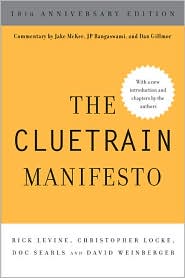
Cluetrain 10th Anniversary edition
Cluetrain 10th Anniversary
Everything Is Miscellaneous
Small Pieces cover
Small Pieces Loosely Joined
Cluetrain cover
Cluetrain Manifesto
My face
Speaker info
Who am I? (Blog Disclosure Form) Copy this link as RSS address Atom Feed

May 31, 2009

Utopianism: Threat or danger?

Shannon Bain has posted a long, thoughtful probing of Everything Is Miscellaneous and my defense of cyber-utopianism. It’s philosophical, serious, and generally right in its criticisms. He writes about my ideas in their philosophical context, as few have. I am very grateful for (and flattered by) this extended piece of clear-headed, morally-centered thinking.

His most telling criticism is (imo, anyway) that although he and I agree the Web is revolutionary, I assume the revolution will be for the good. Shannon worries that Cass Sunstein is right, and the Web’s openness and linkiness is really leading us to harden our positions, rather than opening up us to more diversity of thought.

My position has changed over the years on this, in part because I’ve had to the opportunity to hang out with folks at the Berkman Center. So, I now accept that the danger Sunstein points to is real. But, my reaction to this “echo chamber” argument is complex and confusing. I think (a) there are enormous challenges to evaluating the extent to which the Web is closing off thought; (b) the Web is probably leading us to be both more closed and more open simultaneously; (c) there is something wrong with the formulation itself; (d) the question probably mythologizes the degree of our openness in the pre-Web world. So, ultimately my position is: I don’t know, but it doesn’t matter too much because even if Sunstein is totally wrong (which he’s not), we’re still not doing enough to increase our interests and enlarge our sympathies. The Web won’t have this beneficial effect on us by itself; we must be ever vigilant and purposeful.

Shannon usefully connects this to my out-of-the-closet Heideggerianism. He wonders if I think cocooning (or, echo-chambering, if you prefer) “isn’t all bad”:

Maybe these cocoons of confirmation – these little webs of shared connotations and self-reinforced absolutist understandings, which I claim are negative aspects of a naturally biased humanity – are really what Heidegger’s beleaguered teacher Edmund Husserl called “lifeworlds:” the necessary and inescapable social, cultural and historical contexts within and through which we experience the world. Maybe so, but the problem is, these life worlds are hermetically sealed wholes of historical and cultural prejudice, incommensurable and unassailable. As Heidegger’s most influential student Hans-Georg Gadamer formulated it, prejudice – the historical, social and cultural “situatedness” we’re born into – is essential to Being-in-the-world. Outside of your lifeworld, your cocoon of prejudice, you simply aren’t… in the big metaphysical sense. Thus primordial prejudice – our cocoon of reinforcing ideas ever ready to disregard inconvenient or inconsistent “facts” – is the foundation of meaning in this Heideggerian sense.

Shannon’s right to see a connection, but I disagree with the conclusion he draws. I do strongly believe that we are inescapably thrown into a culture, language and history, and these determine much of who we are and how we thinkg. But, I don’t think that echo chambers are ok because of that. We cannot fully escape our context, but being a small-minded bigot who assumes that your beliefs and values are right simply because you believe them is not virtuous, wise, good, or acceptable.

This is, indeed, one of the reasons I think the “echo chambers” argument is mis-founded. The sharing of ideas, language, and values is essential to who we are. Without it, there is no culture and no conversation. But we are almost always in a complex dialectic of agreement and disagreement, identity and difference: We can only argue about something because we agree about so much already. So, in most arenas of life, we do better (as people, as a society) if we try to get past our own assumptions and sympathetically try to understand how the world matters to others. (FWIW, that’s what I found appealing about the academic study of philosophy. I saw it as a way to pry up the floor I was standing on, to see how many of the ideas I take for granted in fact have long, complex histories, and thus are not as “natural” and “self-evident” as I’d thought.)

(Also FWIW, I do think there are lots of areas in which asserting one’s agreement or identity has positive value, because it forms social and political bonds. But if that’s all you do, then you’re a small-minded nebbish.)

Shannon then tries to hang some anti-scientific beliefs on me, which I’m surprised he thinks I might hold. I don’t think science is just a Western superstition. Or whatever. But — and I’m sure Shannon agrees — I also don’t think science is the only way of thinking. It works at what it does. It doesn’t work at what it doesn’t work at. But, I love science. Sign me up for my flu shots!

Now, that doesn’t mean that every question can be settled, by facts, science, or by superstition for that matter. For example, in the piece Shannon refers to, I try to argue that the dispute among cyber-utopians, cyber-dystopians, and realists won’t be settled by facts because we are engaged in a political struggle, and the unknowable outcome of that struggle will give us the lens through we we look back and say “Hurray for the utopians!” or “Damn those utopians!” or whatever.

That criticism is toward the end of the piece, where Shannon then proceeds to argue against what I think is a strawman:

So, back to Weinberger’s utopianism. Remember that utopianism is the idea that the web is essentially good or for the best. Specifically that its native capacity to allow users to add metadata to content and make subtle, personal connections and relations is fundamentally and wholly positive.

Let’s drop the “wholly” from that last sentence. I never thought that the Web is wholly positive and I doubt I ever said it. (I am, however, quite capable of overstatement, so maybe I did. I am a writer with political interests, not a philosopher.) Shannon and I are closer than he thinks. He gives two alternatives to validate my utopianism. Either (says Shannon) I’m saying that we “Ignore the unfortunate facts about humans’ tendency to avoid disconfirmation…” or that we “embrace these tendencies as a prerequisite of authentic, human meaning.” I agree with Shannon that neither of these are acceptable. In order:

(1) I acknowledge our tendency to prefer the comfortable and closed. I acknowledge that the Web won’t magically overcome that. Rather, it is an unprecedented opportunity to work on overcoming it. Constant vigilance. And I think that may be a change in my thinking over the past decade. As I’ve said, I think the echo-chamber alarmists sometimes fail to acknowledge what sharing assumptions and values enables for us humans. But, my utopianism is not based on Shannon’s first alternative.

(2) I know ten years ago I thought “authenticity” was a good idea. But for the majority of the years since then, I’ve thought it’s a pretty bad idea. It does capture something that we want to be able to talk about — a country-western singer who grew up rich but pretends to be hardscrabble — but the metaphysics of authenticity is all screwed up…and within Heidegger it’s an unfortunately throwback to the essentialism he hated. (It did give philosophically-minded Germans a rationale for dying for their fatherland, however. Fucking Nazi.) I do think it’s good to acknowledge the inescapable effects of our birth, language, culture, history, family, etc. But acknowledging that doesn’t mean you can just settle into your prejudices. The reality is that we share our world with lots of people. They care about their lives and their world. If you reject that realization, you’re schizophrenic or evil. It’s our responsibility to always try to expand our circle of sympathy, to understand and care about how the world matters to others.

So, in what sense do I call myself a cyber-utopian? Applying that admittedly ridiculous term to myself is a political act. As I tried to say in the piece Shannon is commenting on, there are political consequences to these labels. I am a utopian because (in my view) it is useful to The Struggle to be one. Utopians remind us that the opportunity in front of us is epochal, and keep us from settling for too little imagination and hope. But the good the Web can do will not happen automatically, as we sit passively on our couches and let the Web work its magic on us. It will only manifest itself if we work tirelessly. My utopianism, as I understand it, is a denial of the sort of technological determinism that Shannon criticizes me for.

But, when you come down to it, I am indeed optimistic about the change we’re going through. It’s not inevitably or purely good, of course. And Shannon is completely right that I do tend to overstate the positive and understate the negatives. I tell myself that I do that for political reasons — there are enough fear mongers, and if they get their way, the Web gets restricted in ways I don’t want — but it means that I’m often writing a form of polemics. We are living through a “transvaluation of values,” and at this stage I feel a need to push on the door that’s opening. That undoubtedly means I need to acknowledge the risks and dangers more than I do, but I still want us to push on that door until it’s all the way open.

Thanks, Shannon, for your post. Truly. [Tags: shannon_bain everything_is_miscellaneous utopianism technodeterminism philosophy heidegger authenticity echo_chambers ]

Tweet
Follow me

Categories: Uncategorized Tagged with: authenticity • culture • digital culture • digital rights • heidegger • philosophy • technodeterminism • utopianism Date: May 31st, 2009 dw

4 Comments »

Andrew McLaughlin joins the Obama administration

According to CNet:

Andrew McLaughlin, currently listed as Google’s director of global public policy, will leave Google to accept a position within the Obama administration reporting to the nation’s new chief technology officer, Aneesh Chopra, according to a report in The New York Times. McLaughlin’s new title will be deputy chief technology officer, and he would become the third high-profile Google executive to join the government since Obama was inaugurated in January.

I know Andrew. He was a Berkman fellow and I’m happy to be one of the many people who call him a friend (not to overstate our relationship). Andrew is incredibly smart and very thoughtful. (He’s also kind and funny.) You may disagree with his policy recommendations on, say, Google’s presence in China or how to handle Turkey’s desire to block YouTube videos that mock Mustafa Kemal Ataturk but if you have a chance to hear Andrew talk about such issues, you will come away impressed by his knowledge, his seriousness, his vision, and his empathy. He is committed to open access and understands the power of the Net. I’m very happy to have him in our government.

[Later: Here’s Ethanz on Andrew.]

[Tags: andrew_mclaughlin obama google policy politics ]

Tweet
Follow me

Categories: Uncategorized Tagged with: andrew_mclaughlin • digital rights • google • obama • policy • politics Date: May 31st, 2009 dw

3 Comments »

May 27, 2009

Big news for One Web Day

It’s a big day for One Web Day! [Disclosure: I’m on its board.]

First, Mitch Kapor has agreed to become its chair. Mitch is an Internet lifer who has put his shoulder to the wheel in some of the founding efforts that have made the Net what it is today. So, yay!!!

What is One Web Day? As Mitch puts it:

OneWebDay is an annual, global event which is celebrated every September 22. Much like Earth Day, which inspired it, OneWebDay provides an opportunity for communities to celebrate the power of Web for positive change, to take action to protect what is precious about it, and to educate the public and policymakers on how the Web works.

Second, the Ford Foundation has given OWD a major grant — yay!! — so now we can move from being an all-volunteer organization to hiring an executive director…which leads to…

Third, Nathaniel James is the new executive director. He comes from the Media and Democracy Coalition, and is an ideal fit. Yay!!

One Web Day — founded by Susan Crawford — is a day for us to celebrate the Web, but also to renew our commitment to work together to advance the values that make the Web not just a technology but a hope. Today is a very good one for OWD and for what it can contribute to that hope.

[Tags: owd one_web_day mitch_kapor susan_crawford open_net ]

Tweet
Follow me

Categories: Uncategorized Tagged with: digital culture • digital rights • mitch_kapor • one_web_day • open_net • owd • susan_crawford Date: May 27th, 2009 dw

3 Comments »

May 26, 2009

[berkman] Chris Soghoian on privacy in the cloud

Chris Soghoian is giving a Berkman lunchtime talk called: “Caught in the Cloud: Privacy, Encryption, and Government Back Doors in the Web 2.0 Era,” based on paper he’s just written. In the interest of time, he’s not going to talk about the “miscreants in government” today.

NOTE: Live-blogging. Getting things wrong. Missing points. Omitting key information. Introducing artificial choppiness. Over-emphasizing small matters. Paraphrasing badly. Not running a spellpchecker. Mangling other people’s ideas and words. You are warned, people.


Pew says that “over 69% of Americans use webmail services, store data online, or other use software programs such as word processing applications whose functionality is in the cloud.” Chris’ question: Why have cloud providers failed to provide adequate security for the customers. (“Cloud computing” = users’ data is stored on a company server and the app is delivered through a browser.)

He says that providers are moving to the cloud because they don’t have to worry about privacy. Plus they can lock out troublesome users or countries. It lets them protect patented algorithms. They can do targeted advertising. And they can provide instant updates. Users get cheap/free software, auto revision control, easy collaboration, and worldwide accessibility. Chris refers to “Cloud creep”: the increasing use of cloud computing, its installation on new PCs, etc. Vivek Kundra switched 38,000 DC employees over to Google Docs becore he became Federal CIO. “It’s clear he’s Google-crazy.” Many people may not even know they’ve shifted to the cloud. Many cloud apps now provide offline access as well. HTML 5 (Firefox 3.5) provide offline access without even requiring synchronizers such as Google Gears.


Chris says that using a single browser to access every sort of site — from safe to dangerous — is bad practice. Single-site browsers avoid that. E.g., Mozilla Prism keeps its site in its own space. With Prism, you have an icon on your desktop for, e.g., Google Docs. It opens in a browser that can’t go anywhere else; it doesn’t look like a cloud app. “It’s a really cool technology.” Chris uses it for online banking, etc.


Conclusion of Part 1 of Chris’ talk: Cloud services are being used increasingly, and users don’t always know it.


Part 2


We use encryption routinely. SSl/TLS is used by banks, e-commerce, etc. But the cloud providers don’t use SSL for much other than the login screen. Your documents, your spreadsheets, etc., can easily be packet-sniffed. Your authentication cookies can be intercepted. That lets someone login, modify, delete, or pretend to be you. “This is a big deal.” (The “Cookie Monster” tool lets you hijack authentication cookies. AIMJECT lets you intercept IM sessions; you can even interject your own messages.)

This problem has been wn since August 2007, and all the main cloud providers were notified. It took Google a year to release a fix, and even so it hasn’t been turned on by default. Facebook, Yahoo mail, Microsoft, etc. don’t even offer SSL. Google says it doesn’t turn it on by default because it can slow down your computer, because it has to decrypt your data. But Google does require you to use it for Google Health, because the law requires it. To get SSL for gmail, you have to go 5 levels down to set it.

So, why doesn’t Google provide SSL bu default? Because it takes “vastly more processing power,” and thus is very expensive for Google. SSL isn’t a big deal when done on your computer (the client computer), but for cloud computing, it would all fall on Google’s shoulders. “If 100% of Google’s customers opt to use SSL, it sees no new profits, but higher costs.” “And Google is one of the better ones.” The only better one, in Chris’ view, is Adobe, which turns it on by default for its online image editing service. [Here’s a page that tells you how to turn on SSL for a Google Accounts account.]

Chris thinks that cloud computing security may be a type of “shrouded attribute,” i.e. am attribute that isn’t considered when making a buying decision. But, Chris says, defaults matter. E.g., if employees opt employees into a 401K, no one opts out, but if you leave it to employees to opt in, fewer than half do. Facebook, for example, seems to blame the user for not turning privacy features off. “Users should be given safe services by default.”

Part 3: Fixing it

Chris draws analogies to seatbelts and tobacco legislation. He recommends that we go down the cigarette pathway first: Raise publice awareness so that they demand mandatory warnings for insecure apps. E.g., “WARNING: Email messagew that you write can be read, intercepted or stolen. Click here to turn on protection…” [Chris’ version was better. Couldn’t type fast enough.]

Or, if necessary, we could pass regulations mandating SSL. T he FTC could rule that companies that claim their services are safe are lying.

Q: [me] How much crime does this enable?
Q: How about OpenID?
A: The issue of authentication cookies is the same.

Q: Should we have a star rating system?
A: Maybe.

Q: The lack of data about the crime is a problem for getting people to act. Maybe you should look at the effect on children: Web sites aimed for children, under 18 year olds using Facebook…
A: Good idea! Although Google’s terms of service don’t allow people under 18 to use any of their services.

Q: People also feel there’s safety in numbers.

Q: How much more processing power would SSL require from Google?
A: Google custom builds its servers. Adding in a new feature would require crypto-co-processor cards. I don’t think they have those. They’d have to deploy them.

Q: There are GreaseMonkey scripts that require FB to use SSL. Worthwhile?
A: FB won’t accept SSL connections.

Q: Google Chrome’s incognito mode? Does it help with anything?
A: It helps with porn. That cleans up your history, but it doesn’t encrypt traffic.

Q: The vast majority of people where I live don’t lock their house doors. And [says someone else] people don’t lock their mailboxes even though they contain confidential docs.
A: Do you walk around with your ATM PIN number on your forehead? Your bank uses SSL because it’s legally responsible for electronic break-ins, whereas Google isn’t.
A: The risk is small if you’re using a wired ethernet connection or a protected wifi connection.

Q: With seatbelts and smoking, your life’s at risk. For Gmail, the risk seems different. There aren’t data, screaming victims, etc. It makes the demand for regulation harder to stimulate.
A: The analogy doesn’t work 100%. But I think the disanalogy works in my favor: It’s hard to have a cigarette that doesn’t harm you, but it’s easy to have a secure SSL connection.

Q: Shouldn’t business care about this?
A: Yes, CIO’s can make that decision and turn on encryption for the entire org. Consumers have to be their own CIOs.


http://ramfarms.com/sites/blog/index.php?=prednisone-5mg

[from the IRC] Maybe the govrnment wants Google to be insecure to enable snooping.
A: Allow me to put on my tin foil hat. Last year the head of DNI said that the gov’t collects vast amounts of traffic. We don’t know how they’re doing it, which networks they’re collecting data from. If Google and AT&T, etc., turned on SSL be default, the gov’t’s job would be much harder. Google has other reasons to keep SSL off, but it works out to the gov’t’s benefit.

Does Adobe’s online wordprocessor, Buzzword, offer SSL for its docs?
A: Don’t know. [It does] [Tags: security identity_theft google ssl ]

Tweet
Follow me

Categories: misc Tagged with: digital rights • everythingIsMiscellaneous • google • security • ssl • tech Date: May 26th, 2009 dw

3 Comments »

May 24, 2009

Data.gov – Symbolic of what’s right with the Obama administration

Wired.com reports that Data.gov has opened to “mixed reviews.” Puhlease. It’s nowhere near what it will be, but OH MY TOASTY GOD, our government is now committed to making public data available in open formats to anyone who wants it. As if it were normal! As if it were obviously the right thing to do! In open formats, people!

So, sure, let’s keep an eye on it. Let’s make sure the news permeates every government department. But first let’s swoon in delight.

[Tags: egov e-gov e-government democracy open_standards open_government everything_is_miscellaneous ]

Tweet
Follow me

Categories: Uncategorized Tagged with: democracy • digital rights • e-gov • e-government • egov • everythingIsMiscellaneous • everything_is_miscellaneous • expertise • open_government • open_standards Date: May 24th, 2009 dw

1 Comment »

May 23, 2009

Degenerative computing

Here’s a future I fear:

Apple comes out with the iBook, a netbook that’s also perfectly designed as an e-book. It’s a Kindle-killer because it’s an actual computer, as well as being way cool in the way of things Apple.

Apple extends its App Store approach to this seemingly semi-special purpose device: The only apps you can get have to come through Apple.

The Apple iBook becomes a huge success. It is the future of reading the way the iPod is the future (well, the present) of listening.

The iBook replaces many laptops. It becomes the primary computer for many people.

Thus we go from generativity to locked down computers.

[Tags: apple ibook ebooks e-books generativity open ]

Tweet
Follow me

Categories: Uncategorized Tagged with: apple • digital rights • e-books • ebooks • generativity • ibook • open Date: May 23rd, 2009 dw

4 Comments »

May 19, 2009

Brewster Kahle on Google Books

Brewster Kahle, founder of the Internet Archive, and the instigator of an open access effort to scan books, has a good op-ed in the Washington Post about the Google Books settlement (some links).

Brewster focuses on the monopolistic concerns about the proposed settlement. He concludes:

This settlement should not be approved. The promise of a rich and democratic digital future will be hindered by monopolies. Laws and the free market can support many innovative, open approaches to lending and selling books. We need to focus on legislation to address works that are caught in copyright limbo. And we need to stop monopolies from forming so that we can create vibrant publishing environments.

Personally, I do not want to see the deal approved unamended. There are some pretty clearly anti-competitive clauses that need to come out (the “most favored nation” one in particular). And the proposed Book Rights Registry has too much power, especially since its supervised by parties whose interests are not aligned first and foremost with the public’s interests (which are, I believe, to achieve the Constitutional desire “[t]o promote the progress of science and useful arts” and to achieve the Internet’s desire to provide maximal access to the works of culture).

(Here’s a much longer interview with Brewster).

[Tags: google google_books google_books_settlement copyright copyleft everything_is_miscellaneous libraries books ]

Tweet
Follow me

Categories: Uncategorized Tagged with: books • copyleft • copyright • digital culture • digital rights • everything_is_miscellaneous • google • google_books • google_books_settlement • libraries Date: May 19th, 2009 dw

1 Comment »

May 18, 2009

South Carolina investigates sending Craig to the big house

Craig of the List blogs that South Carolina’s Attorney General General Henry McMaster feels he has “no alternative” but to investigate criminally prosecuting craigslist for continuing to run sex ads, even though (as Craig explains), craigslist has complied with the AG’s requests, and the ads that are running there are far more tame than what you can get in more mainstream locales. Yes, Mr. McMaster, I’m sure your hands are tied in this matter.

(And, by the way, sir, if you want your hands tied in that other way, you can find someone in the local yellow pages who’ll do it for you. Just look under “Adult Services.”)

[Tags: craigslist south_carolina ]

Tweet
Follow me

Categories: Uncategorized Tagged with: craigslist • digital rights • south_carolina Date: May 18th, 2009 dw

2 Comments »

May 16, 2009

Rebecca MacKinnon on China and Internet governance

Rebecca MacKinnon reports on China’s desire to shut down the Internet Governance Forum. The IGF was formed in 2005 to discuss among governments and some human rights groups how to govern the Internet. China now thinks it’s a pointless group. Its statement ends with a rousing defense of the right of nations to block access to Web sites they believe go against the interests of their people. And, of course, every country does reserve that right. (Don’t they?) The question is how much, and what, and in whose actual interest.


Later that day: Newsweek has a good article out on Herdict, The Berkman’s Jonathan Zittrain’s tool for crowd-sourcing info about blockages, outages, and censorship.

Tweet
Follow me

Categories: Uncategorized Tagged with: digital rights Date: May 16th, 2009 dw

Be the first to comment »

May 12, 2009

[berkman] David Bollier on the commons

David Bollier is giving a Berkman talk on governing the commons. David is the author of Viral Spiral: How the Commoners Built a Digital Republic of Their Own. His talk: “How shall we govern the commons?”

NOTE: Live-blogging. Getting things wrong. Missing points. Omitting key information. Introducing artificial choppiness. Over-emphasizing small matters. Paraphrasing badly. Not running a spellpchecker. Mangling other people’s ideas and words. You are warned, people.

His book looks at the arc of the development of open access and commonses. [What the heck is the plural of “commons”?] The commons is a new sector, and how we govern it is an urgent issue. Benkler, Zittrain, Lessig, and Bauers have addressed this, David says.

The commons is an ancient, new, and misunderstood paradigm, David says. It dates back to the medieval grazing of cattle. It’s a social system for managing shared resources. It was also a source of collective purposes, and custom and tradition. He recommends “The Magna Carta Manifesto” that looks at the struggle for the commons, with the Magna Carta being an armistice. The public domain was the closest we had to a commons until around 2000. The public domain was viewed by copyright traditionalists as a junkyward because the only people in it were things that had no commercial value. The first law review article on the commons didn’t occur until 1981. He cites Jack Valenti, a rich quote about a public domain work as “soiled and haggard, barren of its previous virtues.” Richard Stallman showed the efficacy and virtues of free software. He showed that incompatible code leads to a tower of Babel. The problem with Stallman’s Emacs Commune was that everything had to feed back to a central source (Stallman) and there was no governance. The General Public License gave legal protections to the Commons. Then the Net took off. We got new infrastructures for building commons, technologic, legal, and social.

Garrett Hardin who wrote about the “tragedy of the commons” later acknowledged that it didn’t apply to commons that have governance. The commons is generative (to use Jonathan Zittrain‘s term). “The commons is a macro-economic and cultural force in its own right.” So, how shall we govern it? “This area is terribly under-theorized.” Elinor Ostrom set forth 8 design principles to allow a commons to be governed as a commons, e.g., clear boundaries, appropriateness to the local area, monitoring, transparency, graduated sanctions against free riders and vandals…

Ostrom once showed David a photo of a chair occupying a shoveled out space during a snow storm with a chair occupying it until the person who shoveled it comes back. Ostrom says that that’s a commons because, “It’s a shared understanding by the neighborhood about how to allocate a scarce resource.” David says a commons arises when a neighborhood decides to manage a resource in an equitable way. One thing this shows is a conflict between commons governance and government, since the mayor tried to ban this practice.

He says we need a new taxonomy of digital commons. How do you protect the integrity of the shared resource and the community itself. He points to some distinctions:

Open vs. Free raises questions of business appropriation vs. community control, digital sharecropping vs. commons governance, monetization or maintenance as an inalienable resource.

Individual choice vs. Community. Creative Commons may undermine commons building because it allows opt in or opt out. The GPL is a purer type of commons: There’s a binary choice: you’re in the commons or you’re not.

Building within the house of copyright or challenge property discourse? Niva Elkin-Koren, for example, thinks CC encourages self-interest and doesn’t build out a coherent commons vision. [Paraphrase of a paraphrase! Reader beware!] The Global South views CC as depending on Western law and as a type of derivative of private property. Fair Use activists, on the other hand, want us to grapple wit hte prevailing practices in copyright law.

Commons vs. Markets. Or at they friends? It depends. There’s a spectrum. Open platforms. Innocentive (drug queries where answerers get a bounty). Democratizing innovation, a la Eric Von Hippel. Magnatune (a “respectful interface between the commons and the market”) or the Grateful Dead allowing home-made recordings. Market-oriented non-profits.

The commons is, David says, a “new social metabolism for governance and law, with economic and cultural impact.”

Q: How about more examples? How about Huffington Post?
A: Open platform with some participation. But how about: WikiTravel is an interesting mix. DailyKos: A user-generated community of commentary. Internet Archive. Flickr. Jamendo library of CC music. Blip.tv.

Q: (doc searls) You offer an organic metaphor, whereas we think of the Commons as a space. Will it take?
A: Who knows. But it presents it as a relationship.
Doc: I wonder if there’s a relato-sphere that isn’t metabolic. A metabolism burns energy. It creates gas.
A: A legal system is a conversation about shared power [he quotes someone I missed, and I’m paraphrasing] Q: But metabolism also implies homeostasis. A: Its organic property is why commons sometimes outperform markets. Charlie Nesson: Don’t confuse law in principle (we all live under the law, a set of shared values) and as a social environment (a mediated discourse in which people are assisted in relating by its structure).

Q: What about the international aspect of commons.
A: Cf. “Global Legal Pluralism.” There’s a case to dealing with this locally rather than doing it top-down through nation states. There are certainly tensions as you expand this trans-nationally.

Q: (wendy seltzer) The question of governance is partially a horiztonal dividing of what’s been shared and a vertical set of relationships to maintain the platform. Does this get towards how we can push for open platforms on which we can build commons?
A: Lessig once said he saw the amassing of a constituency for a commons as an important political strategy for assuring an open Internet. The commons is a verb, a commoning.

Q: The vast majority of free software projects are very hierarchical. The freedoms it lists are individualistic. Our rules on collective governance are based on highly individualistic control. How do we move forward.
A: The preponderance of SourceForge communities are small. How do you scale up governance? It is a key issue and I don’t know the answer.
Charlie: David Hoffman writes about this. It’s about creating a border that keeps out the griefers. That’s essential.
A: They have to be organically grow…

Q: [ethan zuckerman] The old idea of the commons was that we were independent homesteaders who can make our own butter. But the openness of the code doesn’t help most people. And it gets worse. A lot of the interesting communities are on closed, commercial platforms. The attempts to have a constitutional moment on Facebook are pathetic. How can you bring your thinking about governance into commercial spaces? Can that be done?
A: That’s the right direction. We have to find respectful relationships among private businesses and commons. Maybe we need new revenue models.

Q: [darius] The tragedy of the commons has devastated my country, Poland. Not because there was no governance. The structures were didn’t align public interest and private incentives. Intellectuals assumed people would contribute for free. You haven’t mentioned motivations…
A: Self-interest is far broader than traditional economists have regarded it. We need to devise structures that can be hearty and sustainable that serve the public interest.

Q: To what degree is power concentrated in different commons? Usually a small group holds veto power. E.g., most open source projects have lead developers. To what degree do you need a de facto leader?
A: You need de facto structures. And you do sometimes get concentrated monopolies where forking isn’t really an option.
Ben: Some large open source projects are governed democratically. E.g., Debian.

Q: [me]
A: I think you have a fragmented view. Trying to amass a unitary view of the commons is doomed to failure beause all of them have rootedness in the local
< me: Do we need a meta rule that says here's how we maximize local control of commons?
A: That’s the direction we need to go in. But that’s a political frontier we haven’t gotten to.

[wendy seltzer] Is there a natural limit to the size of commons?
A: Maybe, but there are all sorts of technological prostheses…
wendy: When you tie this to communities…
A: There may be a type of speciation.

Q: Something like BitTorrent — a true commons where people are sharing resources — suggests that there’s an outside of the fence direction…
A: Commons has some way of integrity of its asset.

Q: Commons can fail. What are the most common failure modes?
A: Not having adequate enforcement of boundaries, etc. Part of what’s so fascinating is watching commons proliferate, and dealing with the theory later.

Q: [charlie nesson] I think of the commons as everything you can reach for free. There are forces that want to capture the potential of the commons. What we’re looking for is the engine that makes the commons itself robust enough to resist that. I think of the law as the instrument of enclosure. The root to building that robustness is not litigation. We have to build up a force. The question comes down not to how we govern the commons, but how do given enterprises build self-sustaining business models on a gift economy?
A: Yes. We’re trying to build our space, our own republic.

[I missed a bunch. Sorry. Check the Berkman webcast site to find the webcast.] [Tags: commons creative_commons copyright copyleft everything_is_miscellaneous ]

Tweet
Follow me

Categories: Uncategorized Tagged with: commons • copyleft • copyright • digital rights • everythingIsMiscellaneous Date: May 12th, 2009 dw

Be the first to comment »

« Previous Page | Next Page »


Creative Commons License
This work is licensed under a Creative Commons Attribution-NonCommercial-ShareAlike 3.0 Unported License.
TL;DR: Share this post freely, but attribute it to me (name (David Weinberger) and link to it), and don't use it commercially without my permission.

Joho the Blog uses WordPress blogging software.
Thank you, WordPress!