

logo
EverydayChaos
Everyday Chaos
Too Big to Know
Too Big to Know
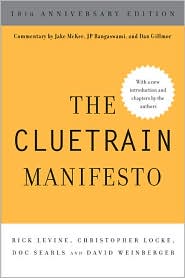
Cluetrain 10th Anniversary edition
Cluetrain 10th Anniversary
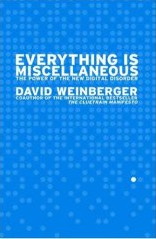
Everything Is Miscellaneous
Small Pieces cover
Small Pieces Loosely Joined
Cluetrain cover
Cluetrain Manifesto
My face
Speaker info
Who am I? (Blog Disclosure Form) Copy this link as RSS address Atom Feed

March 13, 2007

Among the cables

On Monday, I gave the lunchtime keynote at the Cable Television Public Affairs Association meeting. About 400 people had assembled in the DC Ritz-Carlton to spend a few days discussing cable’s future and how to achieve it. It was quite an educational experience for me. And not just because I got boo-ed.

In the morning, I watched a panel discussion by cable industry executives. (I live-blogged it here.) I went to a breakout session on how the cable companies are covering the upcoming presidential election. (Yes, 600 days away has become “upcoming.”) I had a chance to talk with a few people outside of the sessions. But I came in as an outside voice, and I left surprised by what I learned…even though I should have known it going in.

My presentation was, at the request of the organizers, cluetrain-y. I talked about the rise of person-to-person communications, contrasting it with the assumptions of the broadcast era. (“Broadcast” to the cablers means “over the air,” so I had to explain at the beginning, and remind them a few times throughout, that “broadcast” to me means “one-to-many.”) I then talked about networked markets (have you heard that markets are conversations?) and mentioned Doc‘s other great line: “There’s no market for messages.” I spent the bulk of my time taking blogs as my example, going through about ten different common misunderstandings of them. I ended by saying that in the P2P era, we’re taking back our culture, pointing out very quickly some ways in which we’re making it ours, which has become a magic word for me. In the course of listing things that are ours, I had a slide that showed “Support Network Neutrality” sprayed onto a brick wall; in preparing, I thought that those 8 seconds would be all that I spent on the Net neutrality topic.

Well, it didn’t quite go that way. Since I had heard the morning panel, I ended up reacting to it as I went through my prepared presentation. E.g., when I introduced the topic of person-to-person vs. broadcast, I pointed out that the “10 megs down, one meg up” mentioned by one of the panelists assumes that we’re “consumers” rather than creators; we should have symmetric up and down. And for some reason I dragged Net neutrality into it early, and got hissed. But I’m not sure it wasn’t good-natured hissing, if you know what I mean.

But I really annoyed them when I complained about the panel’s whining about competition. I said that the cable market isn’t competitive. People yelled from the audience. I said that where I live, the town has franchised only one cable provider, although I think we’re letting in a second. But, people in the audience said, I could get the Net by satellite or DSL. A more gracious and honest person would have accepted that, and clarified: Cable competes with other forms of delivery, but generally doesn’t compete with other cable companies within a region…although they compete for franchises. I instead just got sarcastic. Yeah, real mature. In fact, cable is more competitive than I’d thought, and these folks do wake up every day worrying about competitors, as one of the panelists had said. On the other hand, it’s not like before the Supreme Court in the Brand X decision said that the carriers no longer have to rent out their lines to other ISPs. If Congress would roll back that decision, we’d see some real competition.

I also at one point poked at the panel for saying that they were up against big scary Google. “Google has two lobbyists!” I said, which I’ve since found out was once true but is no longer. They have maybe a dozen. (Whoops. Sorry.) Nevertheless, the Net neutrality folks are certainly out-lobbied by the carriers. But, as I found out later when talking with a friendly Time-Warner guy, the cable industry is used to thinking of itself as the upstart battling the entrenched telephone giants, so it was odd and unpleasant for them to hear me treat them as if they were an entrenched giant. I had no idea.

During the panel beforehand, and in a conversation with a different Time-Warner guy afterwards, they kept coming back to their concern that if Net neutrality passes, the cable companies won’t be able to raise capital. Oddly, the TW guy also argued that TW has absolutely no intention of violating Net neutrality. So, I said, TW ought to announce that and take the wind out of the NN sails. But announcing that, he said, would discourage investors. But, I said, it’s either part of their business plan or it’s not. We did not come to closure on that point. And I’m personally not convinced that that’s the real reason they oppose Net neutrality. It sounds to me like a supporting reason, as is the argument that since no one has violated NN yet, we don’t need a law forbidding people from violating it, as well as the “Google is getting a free ride” line of reasoning. I think — and I’m indulging my hunches here — that the real reason they oppose NN is that they want to ensure their subscribers have a “good experience,” where the criteria of a good experience are those that govern expectations for how television works. They’re thinking that users most of all want to be able to watch programs in high def and on demand, and so those packets need to get preference. They are frustrated by Web fanatics who want to hold back this rational load-balancing. The cable companies are in the business of selling us video content, and they see their ability to satisfy their customers being hampered by fanatics holding on to an out-dated architectural principle.

There are, of course, answers to this argument, but I think the primary response should be: No commercial entity should get to decide which experience needs to be optimized. Maybe I want to watch high def video, but you want to play video games, and someone else wants to download the high-resolution scan of the Bayreaux Tapestries. It’s not obvious that video should win. The decision should not be made by the people who have a vested, commercial interest in the outcome. IMO.

It was for me a fascinating glimpse. Plus, I got boo-ed twice.


Susan Crawford has two especially fine pieces on her blog at the moment. The first explains the Universal Service Fund scandal. This is money that those with phone access pay to subsidize access for those whom the market would not reach. But it’s become a mess.

The second is a well-told vignette about a birthday concert she played for a friend. (She’s an accomplished violist. And she’s going to make a heck of an FCC chairperson.) [Tags: susan_crawford cable net_neutrality ctpaa telecommunications fcc ]

Tweet
Follow me

Categories: Uncategorized Tagged with: digital culture • digital rights • media • net neutrality • politics Date: March 13th, 2007 dw

1 Comment »

March 12, 2007

[ctpaa] Cable panel on Net neutrality

I’m at the Cable Television Public Affairs Association meeting to give a lunchtime talk to the marketing folks.

It’s in the Ritz-Carlton in DC, which tells you something about the industry. This is a well-dressed crowd. Maybe one-third are women. I’m the only one in the audience iwth an open laptop. (The Ritz provides wifi everywhere in the hotel for $10/day.)

I come in late to the morning panel. On it are Mark Robichaux (ed., Broadcasting & Cable Magazine), Mark Coblitz (SVP of Comcast), Laureen Ong (Pres, National Geographic Channel), Joseph Sapan (Pres, Rainbow Media), Michael Wilner (CEO, Insight Comms). Unfortunately, I don’t know who is who, except for the woman, and Robichaux, who is moderating. [As always, my live blogging is deeply flawed and more unreliable the closer to quotes and details it gets. Also, in the broad themes and characterizations. Also spelling.]

Blogs

In response to a question about negative blogs, one of the panelists says that some of their operators actually have blogs. “We embrace it.” Another writes them off as a few people who like to complain. “Everyone in this room should read blogs every day about their companies,” says another. “If we’re not listening as much as we’re speaking to our constituents, we’re not doing our job.” [Then how about symmetric bandwidth up and down, hmmm?] Mark Robichaux, the moderator, says “Sometimes bloggers are canaries in the coal mine.”

Laureen Ong of National Geographic says that bloggers and others online answer questions for them in a useful way.

A la carte tv

How about a la carte TV, asks Robichaux? Josh Sapan (Rainbow Media) praises the diversity of cable offerings, all the way from BET to National Geographic. “It’s a great diversity of voice.” [Hah!] Mark Coblitz agrees that’s lots of diversity. Each person may only watch seven channels, he says, but the seven channels vary from person to person. Michael (?) says we need to argue against a la carte, just as we have to argue against Net neutrality.

Net neutrality

“What’s Net neutrality?”

“That’s easy: People should be able to go anywhere they want to, attach any device, and know what the terms of their service are.” [He’s implicitly citing the FCC’s Four Principles, which isn’t what most people mean by Net neutrality. And I left one out because I couldn’t keep up.] “Isn’t that that the Internet is all about?,” says another. “Anyone get to do anything they want,” he continues, I think sarcastically. The first says “This is all about sharing resouces so everyone gets the maximum out of them.” The task, he says, is to communicate the technical reasons why Net neutrality is bad. “People said in the year 2000 that we need to save the Internet, but we don’t want the Net of 2000. I want the Internet that’s coming,” the one that lets people do the new things they want to do.” [The one that shows Time-Warner movies and requires a company to pay for competitively fast service? Or the one where anyone can create and innovate in any way she wants, on equal footing?]

They complain that they don’t have the anti-net neutrality sound bite. “We talked about Net neutering, but that doesn’t work too well. That’s our own internal, because that’s what it does.” [Cool! “Net neutrality” works! We’re so used to complaining that the anti-NN folks beat us at marketing that it’s great to hear the same sort of whining coming from them.]

“The Internet is beginning to show the strains of its technology,” says another. “We offer 10 meg down and one meg up, which is a lot.” [Only compared to the pathetic speeds in the US, and only down, not up.] The geeks who measure it don’t always get that.” “The infrastructure can’t handle what everyone’s idea of what the Internet is unless someone starts to build it out.” People won’t be able to make the investment to enable, say, Netflix, to use the Internet effectively so that it works all the time and people have a good experience almost all the time.

Robichaux: “So the government would be handcuffing you.”

“Exactly. And it’s not just the last mile. It’s all along the way.”

Another: “Back in the lat 90s, there was a lot of fiber put in the ground. And guess what? We’re using it up.” [Most of the fiber is unused. And see Bruce Kushnick on the $200B of tax money the incumbents took to run fiber to our houses, but then forgot to.] “Net neutrality says everone should be able to go where they want and be able to pay. We don’t diagree with the four principles. But as soon as you put them down in writing, they’re open to interpretation. And that interpretation changes everything.”

“You know who’s making the money and making the NN argument? Little companies like Google.” He cites someone who said that NN would kill innovation. “If you want Net neutrality, it should be Internet neutrality for all the elements.” E.g., Google is too dominant, eBay owns its means of payment. [This is equivalent to saying that if you want free speech, you really ought to enforce all points of view in your dinner time conversation.]

Competition

Mark Robichaux: Satellite?

Ong: Brand counts. Viewers know that the facts on our channel are triple-checked.

Sapan: It’s made us better via competitive pressure. E.g., IFC hosts small films, and we let you watch it on-demand simultaneously when it’s released to the theaters

“Congress says the problem with out industry is that we don’t have competitors. But we wake up every day thinking about how we compete in the marketplace. Every business we’re in is extremely competitive on the distriution side.” [Still, most of us don’t have much of a choice.]

“We’re all losing eyeballs to the Internet, and I’d go so far as saying you can lose your phone before you lose your video, and you can lose your video before you lose your online connection. It trumps everything. The younger generation is turning TVs off. They’re on the Internet. They’re watching the same content thanks to some of our friends [sarcastic] making it available.” [Wow.]

User-generated content

Robichaux: “What’s the best idea for using the Internet as a tool for your company?”

Ong: We have a tech savvy audience so the Internet is something we use to promote back to the channel, to put programming out that they can’t see on the linear channel, and we recognize that it’s making us rethink our business because no one is going to watch a full-length documentary on the Internet. [Maybe not, at least this month. But we’ll move it onto our iPod our TV, if we’re able.]

Sapan: The area we’re messing with right now is mixing user generated content with video on demand and linear television. Not much has been done with that.

Robichaux: why is ugc important?

Sapan: The history of TV is you make something, copyright it, put it on TV and the max number of people watch it. Now each of those is violated: There is no owner, there is no copyright. There’s all these people spending all this time looking at user generated content. From a purely mercantile point of view, if there’s a lot of time spent on it, that one way or another will be translated into money. What intriques is how to connect what people are making with video on demand. In the case of indie films, we’re asking people to submit their short films. We curate them. We would like to place those films on the servers of cable companies in the geographic areas from which they come, so there could be “the best of” films in that area, and the “the best of the best of” that would make it onto the channel. [Current.tv? Why do we need the cable companies to do this for us?] This is good because it gives them the fastest Internet connection to the video, video on demand, and a linear channel. We pursuing this on IFC and We TV.

Coblitz (Comcast): We’ve woven Internet into just about everything we do.

Q&A

Robichaux: Take-aways: Be honest. Keep it simple. It’s about relationships. For example, when you’re talking to a Congressperson… [And here I thought he was talking about talking with customers!]

Questions from the floor.

Q: What are you doing about Internet safety?
A: (comcast) We provide parental controls to people who want them. Our 12 yr old said, “Dad, block anywhere you don’t want me to go…but then don’t look where I go.”

A: (Insight) It’s up to the parents, but most parents don’t use the controls.The bad experiences are behind us [??]
A: (Rainbow) The computers aren’t in the kids’ bedrooms.

[Tags: ctpaa net_neutrality cable tv broadband blogs everything_is_miscellaneous media]

Tweet
Follow me

Categories: blogs Tagged with: blogs • conference coverage • culture • digital culture • digital rights • everythingIsMiscellaneous • media • politics Date: March 12th, 2007 dw

6 Comments »

March 6, 2007

[f2c] Susan Crawford

Susan Crawford gives a talk about our inability to communicate outside this room

Imagine there’s an easy-to-assemble toll booth. We drive into the gray world of the Land of Low Expectations. We’re getting what the current providers give us.We can then go to the Land of Glittering Generalities that attempt to maintain the incumbents in power.

How do we get reason back? “Communications regulation should be about optimizing human communication.” We have to persuade people that economic growth comes from new ideas, that the Internet is the greatest source of new ideas we’ve ever seen and that the telecom policy has to put the Internet at its core. We should claim that the Internet is different. “People are very uncomfortable when we say that, but we have to say it.”

To help reason, we should be showing pictures. E.g., a chart of the market plummeting recently, and a chart of the weakness of the US economy. “If the rate economic growth in the US over the next 45 yrs were to increase by 0.5% per year, it could resolve all of the budget difficulties associated with the aging of the Baby Boom generation” with plenty left over. So, how do we continue growth in the US? “We need more meta-ideas about the generation of new ideas.”

Aha! The internet – a source of new ideas.” It’s group-forming attributes and the chance to fail quickly are vital, too.

Policy outcomes: Universal service. Divestiture, separating services from content [i.e., the people who supply bit transport should not provide content.]

We need to professionalize, with better comparative data to show the effect of the Net on economy, the effect of Net neutrality, etc. And we need serious leadership.

We’re running out of time. The future of the Internet hangs in the balance.

[SC for FCC!]

[Tags: fcc susan_crawford net_neutrality f2c ]

Tweet
Follow me

Categories: Uncategorized Tagged with: conference coverage • digital rights • media • politics • wifi Date: March 6th, 2007 dw

2 Comments »

[f2c] Commissioner Adelstein

FCC Commissioner Jonathan Adelstein begins by playing harmonica with Howard Levy. Really. [As always, the following paraphrases, abbrevites, omits, and gets wrong.]

[I’m sitting next to Susan Crawford who is blogging away. Hers will be the post to read on this.]

Then he touts the E-Rate program. But “we lack a coordinated vision for success…We need to provide for all of our neighbors. This has to be a greater national priority than it is now.” A national strategy should have benchmarks. Update the current FCC definition of “high speed” as 200kb [which is laughable — dialup is 56k]. Have standards for expressing what rates customers are getting. We need meaningful competition. “We can’t let the broadband market settle into a comfortable duopoly…” We should worry about consolidation. The Congress should use tax incentives to bring access to under-served areas, and more [can’t keep up]. We should invest in basic R&D. Be creative and flexible. We need to preserve the creative freedom of the Net. “You’re all reinventing democracy, how we share music…” We need to preserve the Net’s openness. The AT&T merger brought about an agreement about Net Neutrality that isn’t the end of the story but at least refutes the notion that NN can’t be defined.

Q:(frankston) The FCC and the Net are incompatible. The Net is what we can get by connecting our home networks from the edge. The FCC defines it in terms of services instead of in terms of bits.
A: We took a step with the AT&T merger….
Q: No, you treat it as a service. We don’t need the phone companies to run the Internet.
A: We need an infrastructure. There’s a balance here. We need to be realistic.

Q: (isenberg) The chat was wondering how much power you have.
A: I’m one of five commissioners.

Q: (brough) What about cognitive radio opening up spectrum?
A: I was going to talk about that but cut it for time. Maybe I made the wrong choice. Software-defined radio is one of the most exciting developments I’ve seen and maybe the most revolutionary in spectrum use. We need to find ways to enable them to reach their full fruition. Our engineers are examining the ways they can work. It’s a way of doing more with less because, as someone said, G-d isn’t making any more spectrum. Of course, we have to be concerned about harmful interference, but in general I’m very high on it.

Q: (JH Snider) Please elaborate on what you said about the carrot-stick approach. The FCC has been 99.99% carrot. In the past few years, the FCC has given away $50B in spectrum allocation. Look at what you did with the MMDS band. You gave it away to Sprint and they haven’t built anything. Eight years later they may actually build it out. Where’s the stick?
A: It’s so much easier to give away carrots. Politicians like to do that. It’s happened time and again in spectrum policy.

Q: (Elisha McDonald): Is the definition of Net Neutrality workable? How is it enforceable?
A: It’s a baseline and opens up the possibility of having a rational discussion without sloganeering. The Chairman testified that he will enforce it, and he’s told me that too. [Joe Plotnick from the chat: “They haven’t enforced ANY PRIOR merger conditions, as Kushnick has thoroughly documented.”] [Tags: fcc net_neutrality spectrum ]

Tweet
Follow me

Categories: Uncategorized Tagged with: conference coverage • digital culture • digital rights • politics • wifi Date: March 6th, 2007 dw

Be the first to comment »

March 5, 2007

[ef2c] OpenMoko – OpenSource phone

The aim is not to create a mobile phone that mimics a PC. The OpenMoko phone is a “totally open system.” Engineers can rewrite the rules and have access to all the building blocks. But he can’t sell it in the US because the cellular carriers “whitelist” phone IDs, so they only support the ones they want.

An audience member says that Part 68 means the FCC says that any device not detrimental to the public has to be allowed to connect.

There’s much discussion among many learned people using acronyms I never heard of. [Tags: f2c openmoko telephony open_source ]

Tweet
Follow me

Categories: Uncategorized Tagged with: conference coverage • digital rights Date: March 5th, 2007 dw

1 Comment »

[f2c] panel

At Freedom to Connect , James Salter is talking about the need to get the US connected right. He builds fiber networks. We’re at 19 in the world in bandwidth and falling. Fiber can carry 100 terrabytes a second. [Did I hear that right?] YouTube uses more bandwidth than the entire iunterent did 5 years ago. A utility in the southeast is wiring every house with fiber, for $1250 per home, complete.

Who’s doing fiber? Verizon, selectively. They’ve done a million or more homes, but it’s going mainly to the rich and the white. Gov’t ought to be an enabler of fiber.

John Waclawsky of Motorola says we’ve evolved from plain ol’ telephony that was simple and reliable to having many options. Connectivity is becoming ubiquitous. And complex. But it will get simpler. We will have a smart edge and a facilitating core, as opposed to a smart edge and a dumb core.

Sanjit Biswas of Meraki has what David Isenberg thinks is the “holy grail” of wifi mesh networking. It’s a $50 mesh router. It’s a spinout of MIT’s Roofnet. They want to create networks deployed by communities without involving a telco (except for one person’s access). They’ve been in beta for 6 months. Meraki’s market is the “next billion” Internet users. They have 15,000 people connected. It costs users $1-$2 month. Meraki is trying to engage local entrepreneus to create these networks. Today he announces they’re building a “huge experiment” in San Francisco, building a network of 1,000 repeaters with free DSL bandwidth – maybe 30 lines would serve the area. [I spoke with Sanjit afterwards and asked him why he won’t get sued by the telcos. He said that it’s an uncertain area, there are some IPs who are ok with it, they’re working mainly in low income areas where a law suit would look really bad, and that he’s focused more on areas outside of the US.] [Tags: wifi fiber mesh meraki san_francisco ]

Tweet
Follow me

Categories: Uncategorized Tagged with: conference coverage • digital rights • wifi Date: March 5th, 2007 dw

1 Comment »

[f2c] Gov. Douglas on covering Vermont

Tom Evslin is interviewing Jim Douglas, 1the governor of Vermont. He is turning Vermont into an e-state. Anywhere you open a laptop, you will be online. [Note: As always, I’m paraphrasing, missing stuff, getting things wrong…Also, no time to re-read before posting., Ulp.]

Gov. Douglas says he’s doing this for reasons of public safety, and to help the economy. It’s also important for travel and tourism. He says Americans recognize the importance of innovation, but elected political leaders have been “fairly slow to respond.” He asks: “How do we apply technology in ways that enable innovation?” They’re up to 87% broadband availability. The last 10% will be the hardest, but it’s vital, he says. “We can’t let anyone go unserved” as Vermont uses the Net for local services. The state will partner with private providers and invest in infrastructure (e.g., fiber optic). The last mile will be provided by private providers. [Bob Frankston in the on-screen chat objects that the state should worry about coverage more than about broadband, and that the private partnerships are mistake.]

Q: What kind of things have you thought of so your providers can stay up to date?
A: That’s vital. I’m not a techie. Let’s ask Tom Evslin, who’s on the tech advisory board…
A: (tom) The goal is 3M by 2010. The goal for 2013 is 20M symmetric [download and upload…yay!]

Q: What’s the role of spectrum in your broadband vision? Why aren’t the rural governors asking for spectrum reform? 95% of spectrum in VT is unused.

Q: who besides VT is working this way?
A: No one. [Chris Meyer, sitting next to me, points to the RI-WINS program for border-to-border coverage in Rhode Island.]

Q: Verizon has proposed selling its VT infrastructure to FairPoint, a tiny company.
A: We haven’t decided whether we’ll support this transaction.

Q: I’m with the American Library Ass’n. Libraries are the #1 provider of Net access in VT. What role did libraries play in your planning?
A: Libraries are important. We hope they’ll play an even bigger role. E.g., access the Oxford library.

Q: There are challenges connectings kids to the Internet in a school setting, largely because the adults are uncomfortable with it and worry that it’s out of control.
A: Parents should be parents. [paraphrase]

Q: How about if the municipality owns the backbone, with private financing. E.g., Burlington
A: There are lots of models that work.

Q: The key question is: Who’s going to own this? Will some business interest be able to put in a toll booth, and also decide when the tech gets upgraded in a given corridor? Gov’ts don’t biuld roads; they put out bids to build roads. How will the state decide when it’s time to upgrade?
A: I’m cautious fiscally.

[Micah Sifry, who is in the house, posts to the chat the Gov’s financial profile…] [Tags: f2c vermont wifi broadband net_neutrality ]

Tweet
Follow me

Categories: Uncategorized Tagged with: conference coverage • digital culture • digital rights • wifi Date: March 5th, 2007 dw

3 Comments »

[f2c] Intro

David Isenberg opens the F2C conference with a ringing invocation to friends, wifi roamin’ and countrymen. (Actually, the incredible Howard Levy opened the conference with a harmonica solo. I’ve heard HL before. He does things with harmonicas that physics doesn’t like.)

It’s streaming here… [Tags: f2c net_neutrality david_isenberg ]

Tweet
Follow me

Categories: Uncategorized Tagged with: conference coverage • digital rights • wifi Date: March 5th, 2007 dw

1 Comment »

February 27, 2007

[berkman] Matthew Pearl

Matthew Pearl, author of The Dante Club, is giving a Berkman talk. Gene Koo (his ex roommate) introduces him as someone doing a form of literary remix. He’s teaching a class at Harvard Law called “Literary Visions of Copyright.” He’s going to talk about the 19th Century copyright battles. [As always, I’m approximating. Matthew speaks eloquently; live blogging generally misses the eloquence.]

The Copyright League consisted mainly of authors who “wanted to rethink and reshape” copyright. James Russell Lowell — poet and president of the League — came up with the motto:

“In vain we call old notions fudge and bend our conscience to our dealing. The Ten Commandments will not budge and stealing will still be stealing.” [Approx.]

“This became a mantra for copyright advocates.” Note the appeal to a higher authority, Matthew points out.The motto compares commercial dealings to an older and higher regime. Writers at the time — Louisa Alcott, Mark Twain, etc. — petitioned Congress in support of copyright. The US laws were pretty much are they are today, but there was no international protection: British authors couldn’t get copyright protection here. This meant US publishers could publish British authors without paying a cent. This also undermined several generations of American authors because a Dickens book only cost $0.25 but a Twain might cost $1.25. (Harper, the publisher, was “the most notorious and proud pirate,” says Matthew.)

Kipling wrote a poem about buccaneers that’s about book poetry, which someone referred to as “bookaneers.” Poe’s “Purloined Letter” is about writing stolen but left in public view, another metaphor for book piracy. Dickens, who called himself “the biggest loser” because of his lost royalties, wrote Martin Chuzzlewit about an unstable American system. Harriet Beecher Stowe sued a publisher for publishing a German translation. She lost the case, and was criticized for being against treating people as property but favoring treating books as property. [Wow. These seem to be separable issues!]

There was tentativeness among the authors supporting copyright, says Matthew. They wanted to protect authors but not crush the laborers who manufactured books; if copyright were introduced, they feared book manufacturing would move to other countries. Also, the lack of international copyright enabled cheap editions, supporting a democratic ideal. Mark Twain and Walt Whitman were especially sensitive to these concerns; Whitman’s Leaves of Grass positioned him as a friend of labor. Dickens was making tons of money on his speaking tour and was painted as greedy for wanting royalties also. Matthew compares this to current attitudes towards rich rock bands. People also argued that we needed copyright freedom in order to alter British texts for American readers, including taking out some of the lords-and-ladies feel. (A Connecticut Yankee in King Arthur’s Court is about American hostility to that, Matthew says.)

Matthew says some of the fun of studying this is that the authors are imposing a narrative on the topic. It’s a narrative of natural rights and pirates, even though according to the law at the time, the “pirates” were doing nothing wrong. “They became pirates because that’s what we put into our rhetoric until we believed it.” “All of this gradually wore down the paradigm of a collective ownership of the works.”

Matthew says that we should learn at how we’re creating our own narrative of piracy. E.g., the FBI warning at the beginning of DVDs even though copying a DVD for your own use is legal. E.g., Disney recently bought the copyright to Oswald the Rabbit (its pre-Mickey character) even though Oswald’s first three cartoons are out of copyright and thus Oswald is out of copyright; Disney is shaping the narrative. Google Books is now also trying to shape the narrative.

Q: [me] Were there moral arguments in favor of not having international copyright?
A: The most effective argument was that it would hurt our workers.

Q: What about logical consistency, protecting authors everywhere?
A: There was a different sense of boundaries. We assume a globalized world. But people were not embracing the natural rights argument. Copyright didn’t come out of a rights argument originally, in the Constitution. Someone said it was about copy privilege, not copy right.

Q: (ethanz) In other parts of the world, they make an argument that they need pirated texts in order to go to university. The US violated British copyright when it was developing, so it’s right for India and China to do so now. How would Twain et al. have replied to this?
A: Fascinating argument. We didn’t have a national literature in the 19th C. Moby-Dick was dismissed. All we can do is imitate, it was thought. One argument was that we need easy access to the British texts until we’ve established our own American literature.

Q: Would people have paid more if there were a different copyright regime?
A: They get into the minutia of it in the Senate arguments. There’s no agreement. The introduction of public access libraries in the middle of the century threw the pricing up into the air.

Q: Was there a parallel rhetoric in Europe?
A: There wasn’t much market for American books in England (Cooper and Twain were exceptions), so the British were all for copyright. The government got involved.

Q: Dickens and others acknowledged that they got wider distribution because their earlier books were pirated in the US.
A: Same thing with Google Books: You’re getting attention for your books, especially for books that are out of print.

Q: Did people argue that writers wouldn’t write or wouldn’t share it with the public?
A: Yes. You see this in the Senate hearings. Without copyright, you couldn’t professionalize writing enough to enable writers to earn a living, it was argued. Twain said that writers should go live in England for a bit before publishing to get British copyright protection; he was out of touch with what writers can do.

Q: Initially, copyright protection went to printers, not authors. How did that transition happen?
A: (Simon) In the Renaissance, patrons gained prestige from the affiliation. In 18th C Ireland, Swift was able to prosper without copyright. It’s an interesting to compare cultures that have and do not have copyright protection.

Q: When did we go from writing to being a professional writer?
A: (Simon) It’s hard to pinpoint. [He mentioned a 1774 copyright decision that I missed.]

Q: The audience wasn’t receptive to the economic argument, because it came from rich authors. How about the reaction to the moral argument?
A: It’s hard to say because the public wasn’t a part of the conversation. Women weren’t even part of it.

Q: (cbracy) What was the relation between the authors and their works?
A: Authors still tend to have control over their books than musicians generally do. If you publish a book, you own the copyright. That’s not the case with screenplays: You sell the copyright. But publishers want to reinforce the idea of single authorship; they don’t even like long acknowledgements.

Q: [me] The piracy narrative doesn’t hold up in even on its own terms now; now we can’t even use works we’ve bought all the ways we want, and “piracy” just doesn’t work as a metaphor. Do you see any other narratives around that might work better?
A: The commons? There’s so little discussion of public domain in these 19th C discourses. I’d love to read a history of the concept of the commons (which Louis Hyde is doing).

A: (ethanz) There are developments in the UK that might make Beatles albums public domain in 2012, which will recreate the 19th C situtation in which cheap British imports compete against US music. a: “Sharing” is a counter narrative.

Q: (Gene) You have made a career out of both sides of the copyright issue (i.e., copyrighted works about copyright)…
A: I definitely do feel Jekyl and Hyde about copyright. I’d enforce my copyright if it came up, and we complain when the royalty statements from the Chinese publishers are wrong, but all we can is complain. “I even write the copyright notice for my books.” The notice originally said that no characters are intended to resemble people living or dead.

Q: (egeorge ) How would you feel if I did fan fiction based on your work?
A: I haven’t spent a lot of time thinking about that. They’re writing a screenplay of my book, and it’s nothing like the book. I’m getting paid to let them alter my text. If I’m not getting paid, I guess I’d feel that so long as it’s non-commercial, I’d be fine about it. It gets word out about your book.

Q: The difference in prices between American and British was multiples. Why?
A: You wouldn’t have to pay an advance. Competition. And there was variance.

Q: Who’s your next book about?
A: It’s secret.

[Great talk. And a very likable, modest fella.] [Tags: copyright copyleft matthew_pearl everything_is_miscellaneous]

Tweet
Follow me

Categories: Uncategorized Tagged with: culture • digital culture • digital rights • everythingIsMiscellaneous • media Date: February 27th, 2007 dw

1 Comment »

GlobalVoices goes activist

Global Voices has hired Tunisian activist Sami Ben Gharbia to be a hub connecting anti-censorship efforts around the world. Sami’s been living in exile in the Netherlands for the past seven years, where, among many other things, he created the Google Maps mashup that plots secret Tunisian prisons. GV was able to fund the position thanks to Hivos, a Dutch foundation focused on human rights and development. Thanks, Hivos! (Disclosure: I’m proud to be on GV’s advisory board.) [Tags: gv globalVoices berkman hivos same_ben_gharbia]

Tweet
Follow me

Categories: Uncategorized Tagged with: bridgeblog • digital rights • peace • politics Date: February 27th, 2007 dw

Be the first to comment »

« Previous Page | Next Page »


Creative Commons License
This work is licensed under a Creative Commons Attribution-NonCommercial-ShareAlike 3.0 Unported License.
TL;DR: Share this post freely, but attribute it to me (name (David Weinberger) and link to it), and don't use it commercially without my permission.

Joho the Blog uses WordPress blogging software.
Thank you, WordPress!