logo
EverydayChaos
Everyday Chaos
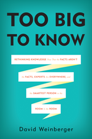
Too Big to Know
Too Big to Know
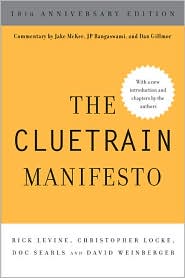
Cluetrain 10th Anniversary edition
Cluetrain 10th Anniversary
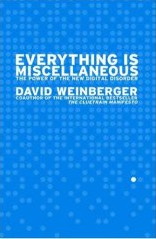
Everything Is Miscellaneous
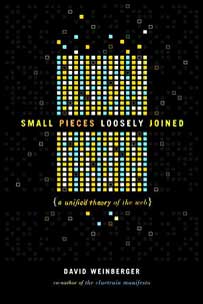
Small Pieces cover
Small Pieces Loosely Joined
Cluetrain cover
Cluetrain Manifesto
My face
Speaker info
Who am I? (Blog Disclosure Form) Copy this link as RSS address Atom Feed

April 20, 2007

[berkman] John Clippinger: A Crowd of One

John Clippinger is giving a presentation about his just-published book, A Crowd of One: The Future of Identity. [As always, I’m typing quickly, missing some stuff, getting things wrong, and making a seamless talk sound all choppy. But in this case, the remedy is easy: If you want to know more about what John is saying, buy his book.]

John approaches human nature through evolutionary biology and neuroscience. Identity, he says, is social and multiple. Trusted identity is essential for community, he says. And he’s interested in how virtual worlds “allow us to build new kinds of institutions, economies and identities.”

The brain is not a blank slate, he says, citing Steven Pinker. The brain is “highly specialized, opportunistic, and jerry-rigged.” Some of our most important decisions originate at a prec-conscious level. This is very different from thinking we make rational decisions. “It’s more a reflex.” He points to our “mirror neurons,” that enable us to have empathy. Descartes, Hobbes and Rousseau, and the Enlightenment are wrong. Research shows that our natural inclination is to reciprocate, trust and coordinate. Virtual worlds are the new state of nature. You may think you can create any identity you want, but “our identities are socially embedded.” And we all have multiple selves.

How do you have a trusted community on the Net? You need a persistent, trusted identity, says John. “But the Web was born without an identity layer.” We need one. Just look at all the fraud, flaming and phishing. “How do you make people accountable for their actions without having overly draconian measures? You have to have some way of creating a cost for breaking the rules, being deceptive, etc.” John refers to biological signalling theory — there’s a cost for deception. [I may be getting this wrong.] You want to make the cost greater than the payoff. That’s essential to any kind of trust network, says John.

In re-imagining identity as the virtual and real worlds become more intertwingled, people will want control over their identities. They’ll want to have a persistent identity. They’ll want multiple identities, the ability to take their identity info in and out of different virtual worlds. They’ll want a range of degrees of identification, from anonymity to authenticated anonymity to complete disclosure. And they’ll want to develop peer networks of trust and authentication.

Over the past two years, John’s been working on a project called “Higgins,” an open source interoperable identity system. (It’s called “Higgins” because higgins is a long-tail mouse.)

We are getting “new narratives about cultural and political futures, not laden with moralistic doctrine.” This is a kind of “social physics”: there are some predictable behaviors and phenomena. It looks for “evolutionary stable strategies.”

There’s an opportunity, John says, to invent new digital institutions: governance mechanisms, more reliance about measured risk and reputation, transparency and accountability for all forms of authority, and acceserated social innovation through digital experimentation. He says the Chinese are very interested in social physics because they want to know if there are rules are principles they can use. [China’s interest in social physics as a way of predicting and managing social behavior is not necessarily a good thing.]

Q: [me] Having an identity layer would solve of bunch of problems, but is there demand for identity itself, as opposed to a demand for solving those problems?
A: At SecondLife I was surprised that people do want to be able to authenticate themselves to others. But that doesn’t mean they know your real world identity. There are degrees and types of authentication and identity. The user gets to control it. You may give up small attributes or fragments of your identity for particular purposes in particular circumstances. Community norms will arise to govern that.

Q: Is it to authenticate you as a consistent person or to get to a level of trust?
A: There is a need for persistence, frequently, although that can just be a number. And there’s another issue about whether you can authenticate the claims you make about yourself. Another party may have to authenticate those, and they may change over time.

Q: How will reputation factor in the changing nature of public opinion? E.g., Don Imus.
A: You have to be careful what you mean by reputation. It may be people rating each other for particular attributes, e.g., trustworthiness at eBay. Those are often easily gamed. I’m interested in work being done on understanding how the immune system [the real one] identifiers cheaters.

Q: Do you see a role for government?
A: Government is going to play an important role. When you have a Linden Dollars exchange, [where Second Life money can be brokered for real money], the government will get involved. And when you set up ecommerce sites, identity matters.

Q: [me] Right now, sites solve their identity problems differently, and generally satisfactorily, pretty much. Given that there are risks to having an identity layer, at what point do we say the ad hoc system is broken enough that we want to have such a layer?
A: The layer won’t be uniform. There are risks of abuse, of course, but the identity layer will be an interoperable set of tools for disclosing what users want to disclose.

Q: [chris meyer] Massachusetts no longer uses the SSN for drivers licenses, presumably because it’s insecure to have a single number encode so much…
A: There may be one number that makes multiple sign-ins far more convenient. That will enable innovation. But you can’t get that without a pretty sophisticated layer underneath. Ad hoc-ery will give way, but not necessarily to uniformity.

Q: People worry about uniform identity not in Second Life but in larger systems. E.g., people have proposed used SpeedPass to use to issue tickets for speeding in the tunnel.
A: They’d be persistent, not consistent. It’d be hard to link them. And people will not do business with businesses that betray them.

Q: [chris meyer] Transparency is two sided. When you suggest it, people get worried that they’ll connect up too much information. When does transparency engender trust and when does it not?
A: Transparency may be transparency on not your full identity but on a chosen set of attributes.

Q: Integrated health care records are important for healthcare. If you try to set up a false identity, you could hurt yourself badly from a healthcare perspective.
A: [irving wladawsky-berger] When it comes to health care and children, I believe there will be legislation.
A: [someone else] Yet at Virginia Tech, people didn’t know the killer had been hospitalized because of privacy laws.
A: [clippinger] Right now it’s ham-fisted. It’s either/or. We need it to be more flexible so people can see what they need to see. That’s the new generation of social technology we now need.

[Fascinating, although I remain skeptical about the need for an “identity layer.” And the reception afterward was a great time to talk with some amazing folks, including the Clipmeister himself.]

[Tags: john_clippinger identity berkman everything_is_miscellaneous]

Tweet
Follow me

Categories: Uncategorized Tagged with: digital culture • digital rights • everythingIsMiscellaneous • philosophy Date: April 20th, 2007 dw

2 Comments »

April 17, 2007

[berkman] Wendy Seltzer on ChillingEffects and copyright take-downs

Wendy Seltzer is a founder of ChillingEffects.org. She talks about her “run in” with the National Football League.

Wendy waits for the room to fill by running a very funny YouTube clip of the Daily Show segment about Viacom vs. YouTube. (The room is now packed.)

She was watching the Super Bowl and saw the notice: “This telecast is copyrighted by the NFL for the private use of our audience. Any other use of this telecast or of any pictures, descriptions, or accounts of the game without the NFL’s consent, is prohibited.” She took the clip off her MythTV and posted it to YouTube under the title “Super Bowl Highlights,” with a caption that said: “The NFL’s overreaching copyright claim.” That was on Feb. 8. Five says later, she got a notification from YouTube saying that they had taken the clip down because the NFL claimed it was infringing under the DMCA .

YouTube had received a list of 158 clips the NFL claimed was infringing. It’s likely that the NFL had a robot search for anything that was titled or tagged as NFL. Wendy asked to see the list and received it.

Wendy believes her clip was Fair Use of copyrighted material. That copyright doesn’t protect people from giving accounts of the game or describing the game. It doesn’t even prevent people from making some pictures from the telecast. Wendy’s clip was Fair Use because:

My use is for nonprofit educational purposes; the copyright in the telecast is thin; the portion of football that follows the copyright warning is a minute portion of the whole, with no significant action or commentary, useful to show people what it was the NFL claimed its copyright covered; and the effect on the market for or value of the work is non-existent.

At ChillingEffects, there is a counter-notification generator form that requires the claimant to get specific about why the piece is infringing. Wendy filled it in. This gives YouTube the ability to re-post the material without penalty; the poster now takes the heat if the complainant still complains. Wendy says this isn’t quite an even balance because YouTube’s terms of service protect it from complaints by users anyway, so while Viacom can sue YouTube for not taking a clip down, users can’t really sue YouTube if it doesn’t put the clips back up upon receipt of a counter-claim.

YouTube put Wendy’s clip back up.

Then, on March 18, YouTube once again removed it because the NFL again complained. Wendy says that the DMCA has no explicit mention of a second take-down notice. If a company doesn’t like a counter-notification, it can sue.

This time, it was clear that an individual from the NFL had actually watched the clip. But, Wendy thinks they were falling foul of 512f of the DMCA, which makes a person liable for damages (including lawyers’ fees) for knowingly misrepresenting that a clip is infringing. YouTube was required to pass along Wendy’s original counter-notification, so the NFL knew that Wendy was saying that the clip was for educational purposes.

Wendy sent back the same counter-notification. The Wall Street Journal blog and the Newark Star Ledger covered it, resulting in a letter from the NFL saying that Wendy clearly “doesn’t understand” the DMCA. They objected to the fact that Wendy included 20 seconds of game play around the ten-second copyright notice. But, the letter said, she has their permission to use just the copyright notice. (She included the 20 seconds as context. It does not show a complete play.)

Wendy wrote back, saying that she thinks the clip in its entirety is covered under Fair Use.

They replied with an email, saying that “there is a substantial difference of opinion us on this matter that cannot be reconciled.” So, the clip is still on line. But the NFL says it can offer no assurance they won’t complain again.

YouTube is built on the DMCA safe harbor (512c) that says that it doesn’t have to screen or filter content, or check the copyright of each piece posted. Instead, YouTube has to reply to claims of infringement. No one has alleged that YouTube has not responded. It’s followed the DMCA to the letter. Instead, Viacom et al. say that it’s “too hard” to send YouTube all these notices, so they want to shift the burden to YouTube. Even if YouTube could manage to do all that work, the next startup would find that too high a hurdle; it’d badly hurt innovation…a chilling effect. “I think they’re trying to renege on the deal that was struck with the DMCA.” Wendy would like to see the DMCA reformed “to address some of the burdens on speech” but not thrown out.

Q: (catherine bracy) Why do you think the NFL is “materially misrepresenting”?
A: They know that this is non-infringing. The second notification makes it harder to claim it was a good faith mistake.

Q: (bracy) Can I take a camera into the stadium, tape it, and put it onto YouTube?
A: The guards frisk you and say that your ticket is a contract that prevents you from using a camera. You could look on from a rooftop and tape it from there.

Q: Could you sell it?
A: There’s no copyright in the game itself, so yes. But if you tape a concert you can hear from your house, there’s copyright in the music itself. And “Super Bowl” is trademarked, which is why ads for, say, chips say things like “Stock up for the big game.”

The “knowingly misrepresents” phrase, Wendy says, was added by the entertainment industry to make it harder to sue complainants.

Q: (john palfrey) What’s their strongest case against your Fair Use claim?
A: Their strongest claim against the 20 seconds of football is that I haven’t transformed it or added educational material into the clip itself. They’ll say the announcers describing the plays is a creative work. And there are markets for licensing virtually everything, they’ll say. If they want phone companies to continue paying them to stream clips to cellphones, this is a market into which I’m intruding.

Q: What might your damages be under 512f?
A: It’s hard to quantify damages from speech. I didn’t lose money from students not attending class because I couldn’t talk about the clip, etc.

Q: (gene koo) How long can this take-down and put-back dance go on?
A: California recognizes that legal process can be used to squelch legitimate speech, so if this process continued, I might have a claim.

Q: (me) Someone posted an aggregation of Couric’s questions of the Edwards. It was taken down. Was that fair use? And if this had been done by Jon Stewart, would it be protected the same way it was for the amateur who posted it.
A: Yes, it sounds like fair use, and Stewart and the poster are protected by the same law. But there is no DMCA coverage for broadcast. I don’t know if Stewart licenses his clips or just asserts they’re fair use.

[Tags: berkman fair_use copyleft copyright nfl youtube dmca]

Tweet
Follow me

Categories: Uncategorized Tagged with: business • digital rights • entertainment • everythingIsMiscellaneous • media Date: April 17th, 2007 dw

6 Comments »

April 3, 2007

ORG party

If you happen to be in London April 11, as I won’t be, be sure to drop by the Open Rights Group party. Have a pint for me! [Tags: org]

Tweet
Follow me

Categories: Uncategorized Tagged with: digital rights Date: April 3rd, 2007 dw

Be the first to comment »

April 1, 2007

Anonymous medical bloggers

Michelle Tempest points out that “the majority of UK medical bloggers choose to write under the cover of anonymity.”

Interesting. And something to point to in the uphill fight to keep anonymity the default on the Net. [Tags: anonymity doctors michelle_tempest ]

Tweet
Follow me

Categories: Uncategorized Tagged with: digital rights Date: April 1st, 2007 dw

Be the first to comment »

March 26, 2007

Registrar guide

Elliot Noss of Tucows has blogged a list of questions to ask of Internet domain name registrars before registering a domain name with them. This is in light of ICANN’s revoking of RegisterFly as an accredited registrar.

Since some points on Elliot’s list are difficult to ascertain, what we really need is a wiki spreadsheet — paging Dan Bricklin! — with those questions (and more to come, undoubtedly) so that knowledgeable customers can fill in the blanks.

(Disclosure: Elliot’s company, Tucows, is a registrar. But Elliot, who is a friend, relentlessly works for the best interests of the Net and us users.) [Tags: icann registry domain_names registerfly tucows elliot_noss wikicalc dan_bricklin]

Tweet
Follow me

Categories: Uncategorized Tagged with: digital rights • tech Date: March 26th, 2007 dw

1 Comment »

March 20, 2007

[berkman] Mary Wong on copyright and human rights

Mary Wong of the Franklin Pierce Law Center is giving a Berkman talk titled “Copyright & Access to Knowledge: Rights/Rhetoric, Openness/Opacity, Future/Fears.” [As always, I’m typing too quickly, missing stuff, getting stuff wrong, paraphrasing wildly…If you want verisimilitude, the event itself is webcast and recorded in multiple ways.] She’s going to talk about copyright policy and the a2k (access to knowledge) movement and how some important terms that, in their use in rhetoric, have been misunderstood.

She points to the simultaneous increase in openness and opacity. The “existing regimes” have put up roadblocks. “What is the future if we have rights battling rhetoric, openness fighting opacity?”

Copyright began as a tool of censorship used by the Crown, became a type of trade regulation, and then was established as a private property right, Mary says. The tropes we use to talk about it derive from that history. These tropes have been deconstructed by people like Foucault and Barthes. Mary says that she’s not going to examine today deconstructionist issues such as whether the author is a myth.

She says she’s not going to suggest stopping treating copyright as a private property right because she’s trying to come up with workable solutions. Rather, what can we do about the expansion of copyright in order to increase access to knowledge? “Reconize the spectrum of alternative property rights?” E.g., the commons, the public domain. “Establish balance through ‘user rights'”? E.g., elevate and reconfigure Fair Use, and treat it as a right. “Create flexible mechanisms within property?” E.g., Creative Commons.

On alternative property rights: We can all agree that a we need a robust public domain for democracy and for cultural, social and economic development. [No one here exclaims in shocked outrage :)] But how do you turn that into a concrete policy proposal? We don’t even have good definitions of public domain and the commons in a way that would let them serve as alternatives to copyright. Usually the public domain is defined more in terms of what it is not than what it is. Are the commons something unowned or owned by a group of people? Is it owned by society in generally? All of these uses are used in the law, and sometimes they’re used interchangeably with “the public domain.” We don’t have a consensus on a definition for either of these terms, but both have gained currency in the copyright debate, she says. “While they’re useful hooks and very important direction indicators, they’re not necessarily at this stage…the solution.” “How can the current discourse be refocused?” (Mary is encouraged by the fact that NGOs and civil society groups are participating in this debate, worldwide, rather than confining it merely to lawyers.)

Our traditional conception of the author is Romantic and has been affecting copyright law for a couple of hundred years. But this is “inadequate to deal with collaborative, communal and social forms of creativity.” The term “author” shows up all over the Berne convention. But it’s a one-size-fits-all notion that doesn’t work in many of the newer forms of creativity that involve “sharing, collaboration and openness.” “Can we at least try to reconfigure or manipulate the notion of the author to better serve the understanding of what it means to create something?”

She suggests considering this in terms of human rights rather than property rights. She points to Art. 27 of the Universal Declaration of Human Rights and Article 10 of the European Convention on Human Rights. UDHR says that if you create something, you have rights over it. But in a case in the UK, the court decided that that property right needs to be balanced with the rights of users and readers. Canada has also talked about “users’ rights.”

She is not saying that copyrightaccess [whoops] is a human right. She is suggesting (she says) adopting the human rights framework to bring in more broad and flexible considerations, to give a foundation to users’ claims. Even within the US’s utilitarian claims (i.e. copyright enables the advancement of the arts and sciences) there is room for natural law claims. And she points to WIPO’s acknowledgement of the special needs of developing countries.

Q: (Charlie Nesson ): I’m completely taken by your initial approach. Asking what we can do rather than just talk about it, and the idea of user rights resonate. The user I’m most interested in at the moment is the university. What would be thread that we can pull to effect change? Right now, the burden of proof of Fair Use is on the user, which is tremendously constraining. How about if we (universities) got behind a law putting the burden of proof on the copyright holder? It doesn’t require changing the basis of copyright law. It could be a focal point…
A: I’m with you on that totally. To do this, we need to change the mindset. Maybe have the university focus on the human rights frameworks.

Q: If we focus on the users, how do we do it? Do we list things you can’t do, or the things you can?
A: We talk about Fair Use as an exception to copyright. What do we do with the existing language?

Q: (J Palfrey ) I love the idea of the university as the user and focal point. But suppose we think of the user as a re-user. Could rethinking who the author is help? Creating isn’t just standing on the shoulders of giants but standing on the shoulders of everyone. [Nice.]
A: The reconfiguring of authorship fits in this paradigm, and fortifies it.

Q: (me) How would this play out when it comes to making the world’s books available on line?
A: Prof. Nesson’s idea of changing the burden of proof would work well here. It would be an opt-out scheme, rather than opt-in, for the publishers. We’ll see a battle between the copyright right holder and another right holder.

Q: (Doc Searls) Terms like “user” implies subordinate status. We’re still using real estate metaphors, e.g., sites. This stipulates the Web as a series of places, and places are owned. So we have to change our metaphors.
A: Copyright came from literal property. We do need to move past that.

Q: (ethanz): I like reframing it, but I worry about doing it on human rights, which is one of the shakiest of foundations. The Declaration of Human Rights is a huge intellectual battlegrounds, with a number of Islamic nations saying it’s incompatible with their views, conservatives in the US objecting, etc. You’re building it on one of the most disputed and least binding of “law.”
A: I’m trying to distance my suggestion from wading wholeheartedly wading into that particular fray. I’m not saying it should be a full-fledged human right. But that framework provides a good “hook,” Article 27 gives us ammunition because it recognizes both the rights holder and the user. .And then maybe tap into WIPO’s new interest in copyright for developing companies.

Q: (ethanz): You’re being aspirational, and the UDHR is the paradigm of aspirational thinking. A different approach is to ask what we’re actually doing as users, and then figure out the legislation we need. E.g., in universities we photocopy chunks of text (“No we don’t!” yell several of the law professors, who are also chuckling) and hand them out to students.
A: Yes, it’s aspirational. I’m hoping that if you change mindsets, you can change policy. Lawyers like starting points that are definable, neat and can be generalized. But if you have fair use for universities, you end up with various laws for various domains.

Q: how do you get people to see rights as community based?
A: It’s a challenge.

[Tags: copyright copyleft digital_rights everything_is_miscellaneous]

Tweet
Follow me

Categories: Uncategorized Tagged with: digital culture • digital rights • everythingIsMiscellaneous Date: March 20th, 2007 dw

11 Comments »

March 18, 2007

Small Pieces Loosely Googled

My book Small Pieces Loosely Joined is now a part of Google Books. Because the publisher owns the copyright, you can only see a few pages of it, but I think it’s very cool — you can search for a term and read the pages it’s on, for example — and I wish more of it were on line. In fact, given that it has virtually stopped selling, I wish all of it were on line. That doesn’t quite align with the publisher’s interests, but someone’s going to figure out a way to make this work. What a boon!

For example, for $100 a year, I’d subscribe to Google Books as a research tool, with some reasonable restrictions (no massive print outs? relatively few complete book read-throughs?) and let Google divvy up the royalties. Or you can come up with a better idea. Please! [Tags: google books libraries copyright publishing]

Tweet
Follow me

Categories: Uncategorized Tagged with: business • culture • digital culture • digital rights Date: March 18th, 2007 dw

3 Comments »

March 17, 2007

Mercenary’s side of the story

John Cass spoke with Mercenary Audio and got their side of the story about why they fired Drew Townson . Drew has been asked by his lawyer not to respond, but says (through our mutual friend) that he strongly disputes the company’s account. [Tags: blogging drew_townson mercenary_audio digital_rights blogosphere]

Tweet
Follow me

Categories: blogs Tagged with: blogs • business • digital rights Date: March 17th, 2007 dw

2 Comments »

March 15, 2007

Fired simply for having a blog

Drew Townson started a blog. Two weeks in, his fifth post was an announcement of the birth of his baby son, along with an adorable photo. (Mazel Tov, Drew!)

Then he was fired. For blogging.

He had asked his employer, Mercenary Audio, if he could blog on the store’s web site. Nope, said Mercenary, even though Drew has over the course of 25 years created a name for himself as an audio engineer and producer. (Check Google and the AMG All Music Guide.)

So, Drew started his own personal blog. On it he did not mention Mercenary, did not link to Mercenary, did not sell or offer any products or services that might be construed as competing with Mercenary. It just wasn’t about Mercenary. He didn’t even use his own name.

His boss learned about the blog when coworkers passed around the posting with the adorable photo of his newborn son. His boss then fired Drew by leaving him a voicemail that Drew picked up when he got home from the hospital.

From this we may conclude several things:

1. Mercenary wouldn’t know good marketing if it drove by with “Good Marketing” vanity plates.

2. The first amendment has been rescinded at Mercenary Audio.

3. The reports of a douche bag sighting at Mercenary seem quite plausible.

(This post is based on email correspondence with Drew, who is a friend of a friend.) [Tags: digital_rights blogosphere ]


Some of my colleagues at Harvard Law’s Berkman Center (did I mention it’s Harvard Law) point out that the First Amendment doesn’t actually cover this case. Details details! (I actually did know that, but was being all rhetoricalish. With this note I’m being accuratitious.)

Tweet
Follow me

Categories: blogs Tagged with: blogs • digital rights Date: March 15th, 2007 dw

34 Comments »

Jay Sulzberger on the essential neutrality of the Net

The FTC has posted comments on its workshop on Net neutrality held on Feb. 13 and 14. Here is a pdf of Jay Sulzberger’s lucid explanation of how the Net works — ports ‘n’ protocols — and exactly why the Net is essentially different from cable TV. (The PDF is 280 pages long, but Jay’s comments are are a mere 12 pages of typescript — easy and fun reading.)

Also of special interest: eBay‘s comments and joint comments by Senators Dorgan and Snowe [Tags: net_neutrality jay_sulzberger ftc ]

Tweet
Follow me

Categories: Uncategorized Tagged with: digital rights • media • net neutrality • politics Date: March 15th, 2007 dw

3 Comments »

« Previous Page | Next Page »


Creative Commons License
This work is licensed under a Creative Commons Attribution-NonCommercial-ShareAlike 3.0 Unported License.
TL;DR: Share this post freely, but attribute it to me (name (David Weinberger) and link to it), and don't use it commercially without my permission.

Joho the Blog uses WordPress blogging software.
Thank you, WordPress!