


logo
EverydayChaos
Everyday Chaos
Too Big to Know
Too Big to Know
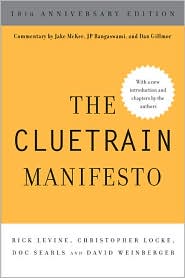
Cluetrain 10th Anniversary edition
Cluetrain 10th Anniversary
Everything Is Miscellaneous
Small Pieces cover
Small Pieces Loosely Joined
Cluetrain cover
Cluetrain Manifesto
My face
Speaker info
Who am I? (Blog Disclosure Form) Copy this link as RSS address Atom Feed

September 6, 2008

[ae] Jonah Brucker-Cohen

Jonah Brucker-Cohen (link link) says open systems encourage audiences to become active co-ccreators, reconfigure rule sets and create opportunities for now types of engagement. He lists some open tools, both hardware (Aduino, Freeduino, OpenPCD, Sun Small Programmable Object Technology) software, and art (Open Museum of Open Source Art). He shows a video of a literal breadboard by Teppien [sp?]. [NOTE: Live blogging. Error-full. Posted without proofreading.]

What are the benefits of subverting network context? Altering rule-sets shifts the engagement structure of a system. Forcing openness creates opportunities for risk or plahy. Hacking into systems challenges their general use.

Public wireless space allows community groups to serve local citizens, creative projects engaging with users. In privatized wireless spaces (e.g., in airports), they’re claimed by individuals. This raises the question: How do we allocate public wireless resources. Two of his projects challenge these relationships: Wifi-Hog challenged Starbuck’s (et al.) assumption that its pay wifi should be allowed to drive out free public wifi. Wifi-Hog blocks everyone else’s use of wifi. Jonah was asking about the acceptable use policy of public wifi nodes and about the promise of the “public sphere as a social leveler” (Habermas).

Wifi-Liberator toolkit (hw and sw) allows you to get around security in locked hotspots. But it only gives you access if you share.

Q: (James) Jamming wifi is to openness as screaming so loud that no one else can hear is to free speech. How does this move us toward openness?
A: It points out the points of control. That’s a requirement for change.

Q: (yochai) How about creating a trivially implementable meshing algorithm for residential wifi.
A: Fon is doing this.
Q: Fon is still commercial and wants to be compatible with the business model of the carriers. [Tags: ae08_ars_electronica dyi wifi jonah_brucker_cohen ]

Tweet
Follow me

Categories: Uncategorized Tagged with: conference coverage • digital culture • digital rights • dyi • wifi Date: September 6th, 2008 dw

1 Comment »

[ae] AKMA

I’m sitting on the speakers panel at Ars Electronica, listening to AKMA. “Theological discourse intrudes awkwardly into tech conferences,” he says. Theologists and technologists frequently talk past one another, he says. They are mutually suspicious. Theologians sometimes suffer from “replacement panic,” the fear that online will replace real world interaction. The church needs to “indiginate” itself online. [Live blogging. Poorly. Omissions, typos, mistakes. That’s just the way it.]

Jacques Paul Migne discovered in the 19th century the most efficient means of editing a paper: outright plagiarism. He’d copy an entire article, while introducing it by noting where it was first published. “He scraped newsfeeds and republished them.” Migne owned five steam presses in 1861. He published a “universal theological library” comprising 25 vols of Biblical commentary, 25 vol encyc, 18 vol of Christian apologetics, 13 vols in praise of the blessed Virgin Mary, and many more. While most relied on public domain sources, he sometimes republished volumes still within copyright. It was a “theological literature Pirates Bay.” Charles Sheldon’s “In His Steps” (“What would Jesus do?”) had a technically flawed copyright notice, so it was republished without permission.

So, situate all of this in the transition to digital media, AKMA suggests. Theological might serve as a useful “fishbowl” for technological innovators. There are online libraries of theological works, but “no organization has broken through to offer open access digital works” in comfortable, readable formats. “The conditions for publishing will go through some sort of convulsive change.” It will not replace books. But it will enable a “vastly more open exchange of digital literature.” We need “shareable, searchable, downloadable, disposable” texts, as well as durable, ownable printed texts. We need an open, standard format with a direct correlation to print copies (because print will survive and will generate cash flow). This will provide users wioth the “tools and the incentive to particiapte in the production of knowledge.”

Q: (James Boyle) You say technologists should see in the theological domain an opportunity to expand the commons. Why have not the faithful seen IP issues as something that gets in the way of the practice of their faith? E.g., many pieces of sacred music is under copyright. The organist at a local church said that she has a parishoner who is dying of cancer and I want to send her a cd of the music. They want $5,000 for a hymn.” I told her to go ahead and when they sue you, come to me. Why isn’t the world of the faithful looking at these issues?
A: The Bible publishing industry was one of the startups in 19th century US because the King couldn’t enforce copyright on this side of the ocean. Replacement panic causes the church to fear that personal interactions will evaporate. And assimilation to the culture of property rights. [Tags: ae08 ars_technica akma religion theology ]

Tweet
Follow me

Categories: Uncategorized Tagged with: ae08 • akma • conference coverage • culture • digital culture • digital rights • religion • theology Date: September 6th, 2008 dw

2 Comments »

September 5, 2008

[ae] Michael Tiemann

Michael Tiemann tells us a little of his story. He once wrote some software and sold it to a company that was unable to market it. He was torn up that his work would never be used because it was owned and locked up by someone else. The music industry also doesn’t work well for musicians. So, he’s begun a personal project to create a new way to solve this problem. [Note: Live blogging. Unreliably.]

He shows a video of a beautifully rendered music studio.

“Culture” comes from “cultivate.” Culture isn’t just about consumption, but about the processes that produce goods and that give them meaning. We need to preserve our creative topsoil. Trying to own culture kills it.

Now he talks about his project. He refers to The Crafter Manifesto. He quotes Tagore: “One man opens his throat to sing/ the other sings in his mind.” The song needs the listener. And the observer alters the reality observed. So, look at the slow food music. Why can’t we do the same thing for music, he asks. The artist, the engineer, and the audience (which he calls “the co-producers”) are in an collaborative project.

His project aims at creating an environment with superb sound, inviting co-producers in so they can participate much more fully. (now I’m confused. I’m not sure if he’s building a real or virtual. I’m pretty sure it’s virtual.) There will be a subscription model. [Tags: ae08 ars_electronica michael_tiemann music copyright creative_commons ]

Tweet
Follow me

Categories: Uncategorized Tagged with: ae08 • conference coverage • copyright • culture • digital culture • digital rights • music Date: September 5th, 2008 dw

1 Comment »

[AE] Yochai Benkler

Yochai says he wants to leave the question: Can free culture survive systematization? [Trying to keep up with Yochai. Failing. Posting without proofreading or spell checking. Caveat lector.]

In 1835, it cost $10K (modern dollars) to start a daily newspaper. Now it costs millions. The startup cost causes a bifurcation between passive audiences and professional, commercial producers. The industrial structure of mass media characterizes the modern age. But, consider that SET@Home dwarfs the computing power of the supercomputers created in industrial ways. This is a radical decentralization of inputs and processes: material, processing, storage, communication, creativity, wisdom. For the first time, the most important inputs are broadly distributed in the population.

This takes social action that’s always been there, and moves it from being important socially and peripheral to the economy, to being at the core.

In Wikipedia vs. Britannica, the core issue isn’t price. It’s authority. The most important part of the Nature comparative study of the two was the editorial that urged scientists to update Wikipedia, sharing traditional authority with the new medium.

Yochai shows a 2×2: centralize or decentraliced vs market-based and non-market. Now we have a four-way interaction among all the old players, from traditional to social-sharing non-profits.

This engages distributed sensing of opportunities for action, solutions, experimentatino, adaptation. You get new and exciting possibilities. The increasing complexity and speed of change has been pushing businesses to go beyond the old technique of hiring what they need. “We can learn faster by loosening the structure of who gets to be effectively active in the world.”

But Yochai wants to focus on participatory culture and democracy. “Critical to the success and power of social production … is the decentralization of practical capacity to act…but also locating authority to act where the capacity to act resides.” This is where commons-based resources are important: We can act on them without permission. This is also where peer production systems (people cooperating without firms) matter because it allows people to work together without permission. “Ownership no longer equals or entails authority.” We get a more diverse , more transparent, and maybe a more critical self-reflective culture (although here he leaves a question mark).

Yochai shows a kickass video of a guy in a suit figuring out how to play the drums, followed by another guy in a split screen plahing piano. By someone named Lasse something? If you have the url, could you post it in the comments? He tells the story of the Daily Prophet, a 14 yr old who poste Harry Potter stories, and seven years later has started a distributed projeto t scan in fantasy illustrations from old books. Also, the site Learning To Love You More’s project of collecting photos of bed underneaths. Also, wikileaks.org. Also, Porkbusters.org. And Sunlightfoundation.com And distributed reportage (“Bomb bomb bomb, Iran”). “Yes We Can.”

YouTube lets individuals create and post. Revver and Metacafe tries to find ways to get artists paid. But, “once they introduced money, they introduced distrust.” Kaltura enables editing and has worked on engendering trust via open sourcing. Everything will be kept free. It binds its organization to a set of institutions that are free and open.

Politics isn’t just about politicians. It’s also about meaning. What things mean and how they mean.

So, human creativity decentralized can create a more democratic system, but it threatens the industrial model. For the past decade there’s been a rough stalemate over IP. But the most important actions have been social/cultural: Sharing practices. Increasingly institutionalized, e.g., Free Software Foundation, Creative Commons.

We’re seeing new models of market-cultural society relations: Credible commitment mechanisms, self-binding licenses, transparency, participation, styles of leadership. Authenticity and conversation become central. New ways to build trust, fairness, reciprocity.

He ends by taking Jonathan Coulton as an example. [What about Brad Sucks? :) ] He shows the Code Monkey videos.

“This is invoking a fundamentally different normative framework than ‘This is mine and you can’t have it.'”

The basic question: Can we create new social cultural spaces in the overlap of market and social relations, sustainable and not based on control and authority but on social and cooperative models? [Tags: yochai_benkler cooperation sharing peer_production economics open_source copyright ae08 ars_electronica ]

Tweet
Follow me

Categories: Uncategorized Tagged with: ae08 • conference coverage • cooperation • copyright • digital culture • digital rights • economics • sharing Date: September 5th, 2008 dw

1 Comment »

August 27, 2008

Ten worst movie industry predictions

Scott Kirsner has posted his ten favorite worst predictions about the movies, drawn from his just-published book. My favorite of his favorite: Jack Valenti’s. (I missed Scott on Science Friday…)

[Tags: movies scott_kirsner ]

Tweet
Follow me

Categories: Uncategorized Tagged with: digital rights • entertainment • movies Date: August 27th, 2008 dw

Be the first to comment »

August 24, 2008

I like Biden, but his Net policy sucks (apparently)

Declan McCullagh has the goods (apparently) on Biden’s tech and Net policy record. It totally sucks and is completely out of step with Obama’s. Thankfully, Obama’s not appointing Biden as head of the FCC.

I like Biden as a VP pick. He’s prepared in case the unthinkable happens. He’s got some real values as a person. And I think he brings not only foreign policy experience but also some bluntness to the campaign. But, have I mentioned that his Net policy sucks? (Apparently?)

[Tags: biden obama tech_policy net_neutrality ]

Tweet
Follow me

Categories: Uncategorized Tagged with: biden • digital rights • net neutrality • obama • politics Date: August 24th, 2008 dw

3 Comments »

August 22, 2008

Putting some analog back into the digital copyright fight

Here’s how the DMCA has worked so far: A copyright holder (henceforth “publisher”) notices an instance (henceforth “video”) of what it thinks is a violation of its copyright on a site such as YouTube (henceforth “YouTube”). The publisher sends YouTube a notice that the video infringes copyright. YouTube then has a choice: It can disagree that the video infringes, and leave it up, or it can take it down and let the video’s poster know that it’s done so. If YouTube chooses Door Number One, it becomes liable if a court decides the video really was infringing. So, inevitably, YouTube takes it down. The video’s poster can then counter-notify YouTube that the video is not infringing. (In this one example, YouTube’s lawyers will actually take a look to decide whether they think it infringes or not. But YouTube is very special in this regard.)

On paper, this seems reasonable. And maybe if the whole thing were done with paper, it would be. But the claims of infringement can be compiled digitally — publishers like Viacom automatically generate lists of every instance of, say, “jon stewart” in a video’s title and submit lists of over a hundred thousand URLs, obviously without having actually reviewed any of the videos — while the response is analog, and thus hard, time-consuming, and risky.

Now there’s been some good news.
A federal judge has ruled that before a publisher submits a DMCA takedown notice to a site like YouTube, some human being has to look at it to decide if it actually infringes, or if it is protected by Fair Use. If this ruling is maintained, it will help re-balance the insanely pro-publisher, pro-protection, pro-restriction copyright regime by taking away the incentive to take down anything and everything that looks like it might maybe perhaps upset a publisher’s delicate sensibilities.

PS: Did you remember to join the Electronic Frontier Foundation to help protect your online rights? [Tags: copyright dmca youtube copyleft eff ]

Tweet
Follow me

Categories: Uncategorized Tagged with: copyleft • copyright • digital rights • dmca • eff • everythingIsMiscellaneous • youtube Date: August 22nd, 2008 dw

3 Comments »

August 15, 2008

Whose advice would you take on the future of the Internet, McCain’s or Craig’s?

Craig Newmark weighs in on McCain’s scary Net agenda. (Craig says something very nice about me, but I’m linking to him anyway.) Craig’s written about this before. For example: Why a president needs to know tech.

And the cuticle on Harold Feld’s pinky knows more about the Net than all of McCain’s personal IM list does (because McCain doesn’t have one). Harold is, um, not impressed with McCain’s policy statement. To put it mildly. [Later: Part 2 of Harold’s post is more substantive but not as funny.]

And that ol’ AT&T veteran and certified visionary — he was right and AT&T was wrong — David Isenberg is equally aghast.

Matt Stoller runs just the subheads of McCain’s policy statement. Hilarious. As Matt says, “Seriously, this is approaching Chuck Norris-level aggrandizement.”

[Later] Susan Crawford, professor of law and ICANN rep, and one of the most clear-headed policy people arounds thinks McCain’s policy is “wistful.”

It’s not just that McCain’s policy is ludicrously wrong about the source and nature of the Internet’s value. It’s that McCain might win, in which case, the Internet is going to get a whole lot worse for us in the US … and, given that high on McCain’s agenda is exporting US copyright totalitarianism, it’s bad news for the rest of the world, too.

(My take, along with some more links, is here It’s also up at HuffingtonPost.) [Tags: ]


More links at Sascha Meinroth’s place, including his own analysis.

Tweet
Follow me

Categories: Uncategorized Tagged with: conference coverage • digital rights • net neutrality • policy • politics Date: August 15th, 2008 dw

6 Comments »

August 14, 2008

McCain models tech policy on our oh-so-successful energy policy

THE MCCAIN NEGATIVE WORDCLOUD
Words Not in McCain’s Tech Policy

| blog |social network | collaboration | hyperlink | democracy | google | wikipedia | open access | open source | standards | gnu | linux | | BitTorrent | anonymity | facebook | wiki | free speech | games | comcast | media concentration | media | lolcats |

McCain has delivered his tech policy. And it’s clear: This election will determine whether America willfully becomes a third-world participant in the online economy and culture.

Much of the McCain policy is the expected stuff about public-private partnerships, educating the workforce, and providing incentives to reach under-served populations, etc. But he shows his hand on three issues:

1. He’s flat against Net neutrality.

2. He wants to see copyright extended and enforced more vigorously.

3. He thinks the current infrastructure only needs a couple of tweaks.

In sum, our Internet policy should be the same as our energy policy: Hand a key resource off to big corporations whose interests are fundamentally out of alignment with ours as citizens.

Let’s assume that this is not because McCain is a tool. Let’s assume he has the best intentions and that his policy accurately reflects how he thinks about the Internet.

To McCain, the Internet is all about business. It’s about people working and buying stuff. There is nothing — nothing — in his policy statement that acknowledges that maybe the Net is also a new way we citizens are connecting with one another. The phrase “free speech” does not show up in it. The term “democracy” does not show up in it. What’s the opposite of visionary?

Further, the Internet to McCain is a set of tubes for delivering content to an awaiting public. Jeez, does he not have anyone on staff under the age of 25 who could have clued him in on what the Net is about?

It gets worse. Even if we ignore the cultural, social, and democratic aspects of the Net, even if we consider the Net to be nothing but a way to move content to “consumers” (his word), McCain still gets it wrong. There’s nothing in his policy about encouraging the free flow of ideas. Instead, when McCain thinks about ideas, he thinks about how to increase the walls around them by cracking down on “pirates” and ensuring ” fair rewards to intellectual property” (which, technically speaking, I think isn’t even English). Ideas and culture are, to John McCain, business commodities. He totally misses the dramatic and startling success of the Web in generating new value via open access to ideas and cultural products.

The two candidates’ visions of the Internet could not be clearer. We can have a national LAN designed first and foremost to benefit business, and delivered to passive consumers for whom the Net is a type of cable TV. Or, we can have an Internet that is of the people, by the people, for the people.

Is it going to be our Internet or theirs?

Go Obama! [Tags: politics mccain technology_policy net_neutrality obama ]


Obama’s campaign’s response:

“Senator McCain’s technology plan doesn’t put Americans first—it is a rehash of tax breaks and giveaways to the big corporations and their lobbyists who advise the McCain campaign. This plan won’t do enough for hardworking Americans who are still waiting for competitive and affordable broadband service at their homes and businesses. It won’t do enough to ensure a free and open Internet that guarantees freedom of speech. It won’t do anything to ensure that we use technology to bring transparency to government and free Washington from the grip of lobbyists and special interests. Senator McCain’s plan would continue George Bush’s neglect of this critical sector and relegate America’s communications infrastructure to second-class status. That’s not acceptable,” said William Kennard, Former Chairman, Federal Communications Commission.


Someone just pointed me to the back and forth between Kevin Werbach and Michael Powell. Powell (former FCC head) drafted McCain’s tech policy, and Kevin (former FCC person) is an Obama supporter: 1 2


Harry Lewis at BlownToBits points to some of the flat-out contradictions in the McCain policy statement.

Tweet
Follow me

Categories: Uncategorized Tagged with: digital culture • digital rights • mccain • net neutrality • obama • politics Date: August 14th, 2008 dw

27 Comments »

August 3, 2008

20 things I’ve stolen

  1. I took an extra napkin from a Taco Bell for unspecified use “later.”

  2. I sat on a bench on a hot day, enjoying the breeze as the man next to me fanned himself.

  3. I read the headlines of a newspaper that was for sale in a kiosk box.

  4. I divided a single-serving DingDong in two, and had it for dessert on two consecutive days.

  5. I listened all the way through to a Metallica song emanating from my neighbor’s radio, but closed my window when the commercial came on.

  6. I remembered the movie times in my newspaper from the day before so I wouldn’t have to buy a copy of the paper today.

  7. When a friend’s cat chose my lap to sit in, I petted it, precisely to discourage it from moving to the lap of its rightful owner.

  8. I said “What a long, strange trip it’s been” without air quotes.

  9. On the Amtrak “quiet car,” I listened to a man in the seat ahead of me explaining to the bored woman next to him how he gets such a great shine on his shoes. I have since used his technique, successfully.

  10. I have stared carefully at reproductions of great paintings.

  11. I asked for and received a “tasting spoon” of mint pistachio ice cream, anticipating, correctly, that I would not like it.

  12. I smelled the aromatherapy candles through their wrappings at the Stop ‘n’ Shop.

  13. Frequently have I browsed stores with absolutely no intent to purchase. On some such occasions, I have felt fabrics I did not intend to buy.

  14. I placed a bag on the seat next to me on the subway.

  15. I continued to wear in public running shoes after the Nike “swoosh” wore off.

  16. In a Italian restaurant, I entered their “win a free lunch” contest by putting into the jar a business card from a job I had recently left, with my new phone number written in by hand.

  17. I have retold the joke about the man who meets a pirate in a bar without ever once explicitly acknowledging that I was not its author.

  18. I gazed with lust at another man’s bikini-clad wife.

  19. I deeply inhaled the smell of popcorn in a movie theater, but I did not buy any.

  20. One late summer evening, I purposefully and with intent committed to memory the purple of the clouds. That I still remember the edge of the chill was unpremeditated, however.

[Tags: copyright ]

Tweet
Follow me

Categories: Uncategorized Tagged with: copyright • digital rights • humor Date: August 3rd, 2008 dw

52 Comments »

« Previous Page | Next Page »


Creative Commons License
This work is licensed under a Creative Commons Attribution-NonCommercial-ShareAlike 3.0 Unported License.
TL;DR: Share this post freely, but attribute it to me (name (David Weinberger) and link to it), and don't use it commercially without my permission.

Joho the Blog uses WordPress blogging software.
Thank you, WordPress!