



logo
EverydayChaos
Everyday Chaos
Too Big to Know
Too Big to Know
Cluetrain 10th Anniversary edition
Cluetrain 10th Anniversary
Everything Is Miscellaneous
Small Pieces cover
Small Pieces Loosely Joined
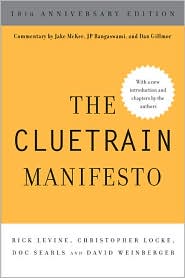
Cluetrain cover
Cluetrain Manifesto
My face
Speaker info
Who am I? (Blog Disclosure Form) Copy this link as RSS address Atom Feed

February 13, 2009

The Pope of Advertising

I read David Ogilvy’s “Confessions of an Advertising Man” when I was a kid and was greatly impressed, I think by the subtlety with which humans could be influenced. It was also quite entertaining. Here’s David Susskind’s hour-long interview of him from 1983.

(Thanks to Richard Pachter for the link.)

[Tags: david_ogilvy advertising marketing ]

Tweet
Follow me

Categories: Uncategorized Tagged with: advertising • business • cluetrain • marketing Date: February 13th, 2009 dw

6 Comments »

January 13, 2009

[berkman] Berkman lunch: Andrew McAfee on Enterprise 2.0

Andrew McAfee, the Enterprise 2.0 guy, is giving a Berkman lunchtime talk. He begins by defining the term as “the use of emergent social software platforms by organizations in pursuit of their goals.” This technology tends to be emergent, bottom up, etc. [NOTE: I’m live blogging, making mistakes, missing stuff, creating typos, etc. Reader beware.] He contrasts this with ERP systems that are top-down, highly specific, etc. “The huge shift” is that the 2.0 tools “make an effort to get out of the way of the users at the front” but then allow structure to emerge.

“The Net is the world’s largest library. The problem is that all the books are on the floor,” he says, citing an old saw.

Companies are interested in what’s going on because they’ve used Wikipedia or their kids are on Facebook. But companies want to know what the tools are and how they’re different. Also, they ask, “Why do I care?” What’s in it for me as a pragmatic businessperson, they ask.

To answer these questions, Andrew points to what a knowledge worker’s view of the enterprise is, from the inside. At the core are a small group of people with whom she has strong ties. Then there’s a larger group of people with whom she has weak ties. Then there’s a set of people the knowledge worker should be tied to, but is not. [He draws concentric circles.]

Three points.
1. We spend a lot of time strengthening ties that are already strong.

2. The weaker and potential ties are hugely important. (He cites The Strength of Weak Ties.)

3. Classically inside orgs, “we’ve had lousy technology,” particularly at the outer two rings. How do you keep track of your weak ties? (One solution, he says, is the Christmas-time newsletter from acquaintances.) Corporate directories try to highlight expertise to enhance the third ring, but they don’t work well. Instead, people work their networks.


There’s a fourth ring: Where there are no ties. Strangers who are not going to form any professional bond. But 2.0 enables them to come together for “powerful outcomes.”

Now Andrew looks at prototypical technologies available for each of the four rings. (He notes that these technologies are useful only at those rings.)

1. Strong ties: Wikis, Google Docs, etc. About 2/3 of traditional folks do this by sending email attachments around, but no one is happy about it. Example: VistaPrint Wiki: 18 months, 280 registered users, 12,000 topics, 77,000 page edits.

2. Weak ties: Social networking software. Various social networking tools let you link up networks, e.g., Tweets that point elsewhere. E.g., Facebook at Serena: 90% penetration, 50% active users. Helped with new hires.

Potential ties: Blogosphere. Blogging is “narrating your work.” Add a search engine and you can find others interested in the same things. E.g., Intrawest. Andrew points to a post about radiant heated floors, with some helpful commenting, etc. [Great example.] Another example: The 16 US intelligence agencies have installed 2.0 tools, such as Intellipedia, blogging, tagging, etc. This gives access to a pool of info, but, more important, makes connections among brains.

4. No ties: Prediction markets. E.g., Google’s Prediction Markets, inside of companies. These work even when you don’t have that many traders. “Why do we even have forecasting departments in companies.”

Q: Say more about Google prediction markets?
A: [Andrew gives some examples. He talks very quickly.]

Q: [gene] Would prediction markets work less effectively if there weren’t pollsters and forecasting departments? Is this Web 2.0 stuff layered on top of the traditional stuff?
A: Yes, the traders on the Iowa poll are looking at polls. Good point.

Q: Why are these trader markets accurate? Why do we still use polls?
A: Hayek in the middle of the 20th century, when intellectuals were enthralled with collective, said that they had it work. A market’s pricing system is a brilliant system for aggregating and transmitting information, said Hayek. These trader markets work because a massive number of traders express their own preferences, values, beliefs. Polling will become less important. And, yes, people try to manipulate these markets, but so far the attempts don’t work very well.

Q: What does this say about science, e.g., the change from using randomized control trial for doing science? E.g., you could run a wiki instead and process the data…
A: So, why doesn’t Merck just set up a prediction market for whether a drug will work. But the FDA wouldn’t accept it.

Q: [me] If you look at an enterprise as a power structure, how does this play?
A: I ask this of companies all the time, and they tend to say they don’t see it. But it’s probably because they’re not looking deeply at enough. In the intelligence community, they’re explicitly moving from “need to know” to “responsible to share.”
Q: [me] Although in a rigidly and explicitly structure org like intelligence, there isn’t as much jockeying for power by working the network…
A: [Andrew tells of the use of social networking to gain prominence and position in the intelligence community.]

Q: How public, how shareable should this info be?
A: That’s one of the first concerns management teams express. But people don’t need Web 2.0 tools to walk outside the org with confidential info. Web 2.0 does increase the number of people who have access to the info. But, the intelligence community, for example, understands that there’s a risk to not sharing as well. Too many companies close down their connections too much; they tend to stay at the level of the strong ties. That forecloses the possibility that someone in the other part of the organization might have a contribution to make. E.g., Innocentive anonymized problem statements and posted them on the Net for anyone to work on. Eric Raymond: With enough eyeballs, all bugs are shallow.

Q: What kinds of technologies are likely to be deployed? What types of businesses? What problems?
A: Companies are proud they’ve set up wikis for strongly tied groups, but they’re often walled gardens. Unsurprisingly, tech companies are usually the first to adopt these technologies. It’s not that E2.0 is sweeping all companies, without hesitation or doubt.

Q: Bad behavior?
A: Sure. But there’s also frequently some moderation of bad behavior, in part because inside the org, identity is the default. People generally know how to behave already. “My collection of horror stories is very very thin.”

Q: [doc] Isn’t it really very early. More versions? Fanning out of versions? What?
A: Inside the enterprise, it’s very early days. E2.0 is a prediction. Web 2.0 is much more the norm on the Web. So yes, early days. I find the rise of the Semantic Web as Web 2.0 really really speculative. 2.0 is about people. Web 2.0 is another geek utopia where the machines are in charge and people are out of the way.

Q: I was selling social software solutions to companies in Korea 7 years ago. But after 2-3 years, employees didn’t want to use them because they’re in addition to their work. Is this short term?
A: Socialtext makes a distinction between tools you use in the flow of your job or above the flow. If it’s in the flow, it’ll preserve. If you’re serious about it in your organization, put incentives and measurement in place. Some people I respect say that this is 180 degrees wrong.

Q: When will we see a divergence between those who use these tools and are winning, and those who do not and are not?
A: I’ve been doing research on this. Is IT separating winners from users? Is it irrelevant to competition? It turns out that the more IT an industry consumes, the more winners have been differentiated from users since about the mid 1990s.

[david horvik] There were attempts to drive social tools inward, but the winner was LinkedIn, which is remarkably outwards facing. Are mainstream social products going to be brought in to the enterprise. As for whether investing in IT drives winners, there’s a company selling IT to banks. You’d think this is a bad time. But the banks want optimization and efficiency. The only question is how long it takes for something to be recognized as working. It’s interesting to ask when these social media will become recognized? Is twitter replacing blogging? etc. It evolves so quickly.
A: A lot of the management teams I talk with want the pace of technology to slow down. But that’s not going to happen.

[pistachio] Twitter will be big in enterprises. No?
A: Yes. Great tool for strengthening weak ties and potential ties. And Twitter got the asymmetry right. [I.e., not everyone you follow follows you.] And it’s so lightweight to use — 10 seconds to send out a tweet?
Q: What are companies going to see as the issue?
A: They’ve had to internalize so much. It’s weird and frightening to someone who just wants to make dogfood. It’s going to take longer than 6 months.

[posted without proofreading. sorry.] [Tags: berkman andrew_mcafee enterprise_2 0 business twitter social_networking social_media ]

Tweet
Follow me

Categories: Uncategorized Tagged with: 0 • berkman • business • digital culture • marketing • twitter • web 2.0 Date: January 13th, 2009 dw

1 Comment »

December 11, 2008

Webby leadership

Ulrike Reinhard has posted a video of my talk at LeWeb on webby leadership. The slides and notes are on SlideShare (although, because I uploaded a PDF, it doesn’t have the animations).

[Tags: leadership web_2.0 ]

Tweet
Follow me

Categories: Uncategorized Tagged with: business • culture • digital culture • leadership Date: December 11th, 2008 dw

Be the first to comment »

December 5, 2008

Leadership and info: LeWeb pre-interview

I haven’t listend to this (I’m in an Amtrak station riding on some good soul’s free but flaky wifi), but here’s a podcast interview I did a couple of days ago as part of the LeWeb prep ‘n’ PR. I talk sort of about what I’m going to be talking about there, which (unless and until I rewrite it yet again) has something to do with leadership as the age of information ends. In the current draft of my overheads (Yes, I called them “overheads.” I’m old.), the connection seems to be that both the Information Age and leadership as we’ve generally known it assume/create scarcity. When the scarcity goes away, so does the primacy of information and the old idea of leadership.

I’ll try to say more about this as my overheads (Yes, overheads, dammit! And dittos that come from the mimeo machine!) go from draft to locked-in objects of fear and self-loathing. [Tags: leweb leweb2008 leadership information_age abundance overheads mimeo ]

Tweet
Follow me

Categories: Uncategorized Tagged with: abundance • business • digital culture • entertainment • infohistory • leadership • leweb • leweb2008 • mac • media • mimeo • overheads Date: December 5th, 2008 dw

2 Comments »

November 15, 2008

Book on innovative business models tries innovative business model

Alex Osterwalder and Yves Pigneur are writing a book on innovative business models that’s due out in May. That seems to them to be too far away, so they’re thinking that maybe for $24 you could get a subscription to their book that provides:

* first & exclusive access to raw book content

* influence authors

* x installments of book chunks (in a non-linear order – as we write them)

* 50% discount off the final book (approx.)

* participate in exclusive book chunk webinars

* access to templates

* being part of the business model innovation community

Alex calls this idea a prototype and welcomes comments, as well as suggestions for what other benefits the authors might offer. (He does not require that you pay a subscription to read his blog and comment on this idea itself, however. Recursion is not always a good idea.)

I’m glad they’re floating this idea — because floating ideas rises all tides? — although I am skeptical. This doesn’t sound like a book that’s so urgent that people will pay a 50% premium ($24 + half off the printed version) for some number of out-of-sequence rough drafts. Of course, I could be wrong about that, especially since about a dozen people in the comments to Alex’s post have already said they’d sign up. But, since the authors benefit from comments from early readers, this business model also has a cost to the authors. It limits the community, but maybe it will also gel the community. We won’t know until we know.

These social projects are all in the details. In 2000-1, I wrote Small Pieces Loosely Joinedcompletely in public, posting my current draft every night. I got some excellent commentary and during the dark days of writing that book I received encouragement that was quite important to me. But I inadvertently structured the engagement in way that discouraged readers. The writing process was Penelope-like, so I think I would have done better to have updated the site only when I had finished a complete draft of a chapter. Readers get understandably discouraged by commenting on a draft that is undrafted the next day.

I wrote the next book, Everything Is Miscellaneous, offline for reasons I can’t articulate, except to say that I felt that the book posed a challenge to me as a craftsperson. So, I blogged about the ideas in the book and floated pieces from it in various forms, but I composed the actual text with the door closed. I’m not recommending that. I’m thrilled by the fact that writers now routinely break out of the old “private ’til it’s published” constraint. But there are many ways to do that, as well as times when you shouldn’t do it. There may even be times when you should charge $24 for the service.

All ideas are good until proven otherwise. [Tags: business_models publishing writing Alex_Osterwalder Yves_Pigneur books media ]

Tweet
Follow me

Categories: Uncategorized Tagged with: books • business • digital culture • everythingIsMiscellaneous • marketing • media • publishing • writing Date: November 15th, 2008 dw

3 Comments »

September 19, 2008

[irmc] Government 2.0 and beyond

I’m at the 20th anniversary celebation of the Information Resources Management College of the National Defense University in DC. David Wennergren (Deputy asst secty of defense for info mgt, and DoD deputy chief info officer) is leading a panel on Gov’t 2.0, with Anthony Williams (nGenera, and coauthor of Wikinomics), Bruce Klein (Cisco, US public sector) and Mike Bradshaw (Google, federal sector). [I’m live blogging, making mistakes, being incomplete, mishearing …]

The moderator and the panelists each take a turn at the podium.

David says that Web 2.0 (etc.) is a powerful opportunity “for us to change differently.” Agencies don’t have to be isolated. Mashups, mass collaboration, etc., enable rapid innovation. “We’ve grown up in a world of systems,” big systems. In the new world, we need to be able to “focus and converge.” [David is citing someone else, but I didn’t catch the name.] He refers to the book “Polarity Management.” We have to get both security and sharing right. E.g., focus on secure networks and you create a “self-inflicted denial of service attack” on yourself. [Nice] If you don’t get sharing right, we lose our edge as a nation of innovators.

Anthony Williams (Wikinomics) says he’s been working with governments on e-gov ideas. If we can do Wikipedia, Galaxyzoo, Curriki, there’s no telling what we can do as citizens. The five big ideas: 1. Rethink public service. We still treat citizens as passive recipients. 2. Make sure the information flows horizontally and through all the governmental layers. 3. Open up the boundaries of government, inviting input from citizens, non-profits, private e, etc. 4. New models of democracy, especially interactive models of political communication. 5. Rethink our core institutions, redraw the division of labor. Can we source government services globally?

Bruce (Cisco) talks about how Cisco is using tech to transfer its business. Web 2.0 is about collaboration. Collaboration accelerates productivity, mission success (or growth), and innovation. But it’s more about the culture and the processes than the technology. He shows a crowded slide of how Cisco is using Web 2.0. Their Directory 3.0 includes profiles and areas of expertise. Ciscopedia is an internal wiki. And they have a portal for employees that includes info and apps. Wiki use went up 5x over a year, blogs up 3x, and video up 12x. Cisco is changing from command and control to collaboration and teamwork.

Mike (Google) begins with a title slide that has Google in one corner but that shares the space equally with Skype, Wikipedia, the iPhone, Facebook, AOL, YouTube, the iPod, Second Life, and Bebo. 98% of Google’s revenues come from its free products. Only 2% comes from Mike’s federal group. The cost of switching is zero, he says, so companies have to constantly work on providing good features that are usable without training. “We take that philosophy now to the workplace.” 89% people say they use at least one “unsanctioned” technology at work (Yankee Group). 49% say the tech they have at home is more advanced than what they have at work. He gives some examples of government embracing Web 2.0 tech. E.g., Homeland Security in Alabama used Google Earth as a platform for satellite imagery. Then firefighters started populating it with info about buildings and equipment. Then students started adding info. Etc. He ends by talking about the importance of cloud computing. He compares it to the early corporate resistance to PCs because they were insecure, etc. In addition to providing applications and infrastructure, cloud computing can be a platform (as with Google aps and Salesforce.com). In its own data centers, Google assumes things will fail. They buy commodity hardware and hold the drives in with velcro. Every minute, 13 hrs of video are uploaded to YouTube. The search engine gets a billion queries a day. Google has had to build a huge infrastructure, which they now make available to the public for free.

Q: How do we reconcile the rapidity of innovation and the slowness of the gov’t acquisition process?
A: (david) It’s changing. We’re becoming beter about using what’s on the Web. And we’re learning to move incrementally rather than building the big honking system.

Q: What kind of test did Cisco do to weed about the execs who are not ready to move from the command and control structure?
A: At Cisco, we measure everything. John Chambers put together boards and councils to run the company. The councils are cross-functional. You quickly see who collaborates and who doesn’t. Cisco changed the compensation so that for some, 70% of their compensation comes from how the company overall does.

Q: The DoD blocks many social networking sites. The younger employees want to collaborate all the time. How do we bring them in, let them live in their culture, and modify the environment to meet their needs?
A: (david) Blocking access is a non-sustainable policy. These government institutions do change when leaders stand up.
A: (anthony) We interviewed 10,000 youths globally. The public sector is the least desirable place to work in the US, UK and Canada. I agree with Dave on the blocking of sites. Canada banned Facebook for gov’t empoloyees, so everyone moved to MySpace. Canada is now looking at rolling out a Facebook-like product for the entire government.
A: (mike) Google has “20% time”: Spend 20% of your week doing something of great interest to you. That’s how Gmail was created. It includes community service, solar energy, etc. That helps retention. The federal gov’t attracts very smart people, but they get frustrated when tools they’re using — Facebook, for example — gets shut down. The first thing that has to be addressed are the security issues. We open our data centers to let federal folks see how secure we are. The old certification process takes too long.

Q: In the new model of gov’t how do you make sure the voice of all the people, even those without cmputers, is heard?
A: Yes, we don’t want simply to amplify the traditional values. But we hope some of the gaps will close. This needs political attention.

Q: The Toffflers [who are in the audience] point to the variance of rates of change. What’s Google doing to help accelerate change in education and law, to keep it up with the speed at which business changes?
A: (mike) We do try to influence policy. And we try to get info out to the gov’t. My 20% time is spent in bringing tech to charitable orgs.
A: (bruce) Cisco thinks there has to be a major transformation in education: Change in curriculum, in how teachers teach, how students can use tech to learn. We have bunches of pilots in place.

Q: We don’t have standards. Should there be government regulation of the Net to produce standards? And how would this work internationally?
A: (anthony) Regulating the Internet is not so good. But having the government using open standards is important.
A: (bruce) You stifle innovation if you over regulate.
A: (mike) Disruptive tech disrupts cost structures as well. We like open source and open standards because if you use our stuff, you’ll also be using other stuff as well.

Last thoughts? What do you see coming down the road?
A: (mike) Watch for Android. Open source.
A: (bruce) Work on culture to take advantage of what’s out there.
A: (anthony) How does the gov’t source expertise? How does it tap into the collaborative intelligence?
A: (david) We have to work on trust. It’s the single biggest inhibitor to making this shift. [Tags: irmc government federal web_2.0 ]

Tweet
Follow me

Categories: Uncategorized Tagged with: business • cluetrain • conference coverage • digital culture • federal • government • irmc • web 2.0 Date: September 19th, 2008 dw

11 Comments »

September 16, 2008

JuiceTorrent lets your supporters run ads to support you

Ok, I think I understand how this works. You sign up with JuiceTorrent. You get a widget to post on your site. It lists a few people who are supporting you. They’re supporting you by putting their own JT widget on their site, saying “I support so-and-so.” In addition, relevant ads are placed in designated spots on your supporters’ sites. The money those ads generate goes to you. So, your supporters get to support you financially by donating a little bit of ad space on their sites.

Interesting. As Emil Sotirov, CEO of the founding company, writes on his blog, JT creates

a new category of social vectors across the online identities of people and organizations – adding the moral and material dimension of “supporting” to the existing “linking,” “friending,” “visiting,”and “following.”

It’s currently in beta…

[Tags: social_networks business_models advertising marketing cluetrain ]

Tweet
Follow me

Categories: Uncategorized Tagged with: advertising • business • cluetrain • marketing Date: September 16th, 2008 dw

9 Comments »

August 9, 2008

All your Now are belong to us

NBC tried to keep us Americans from seeing the Olympics in real time. So, how’s that working out for NBC? From the NYT:

NBC, which owns the exclusive rights to broadcast the Olympics in the United States, spent most of Friday trying to keep it that way.

NBC’s decision to delay broadcasting the opening ceremonies by 12 hours sent people across the country to their computers to poke holes in NBC’s technological wall — by finding newsfeeds on foreign broadcasters’ Web sites and by watching clips of the ceremonies on YouTube and other sites.

In response, NBC sent frantic requests to Web sites, asking them to take down the illicit clips and restrict authorized video to host countries. As the four-hour ceremony progressed, a game of digital whack-a-mole took place. Network executives tried to regulate leaks on the Web and shut down unauthorized video, while viewers deftly traded new links on blogs and on the Twitter site, redirecting one another to coverage from, say, Germany, or a site with a grainy Spanish-language video stream.

Temporal slapstick. It brings me odd joy. (Thanks to Jonathan Distler for the link.)

[Tags: olympics fort_business cluetrain ]

Tweet
Follow me

Categories: Uncategorized Tagged with: business • cluetrain • digital culture • olympics Date: August 9th, 2008 dw

9 Comments »

July 6, 2008

Short reality!

Bloomberg reports that Mattel’s market cap, “helped by rising sales of Matchbox and Hot Wheels toy cars,” is now larger than GM’s. [Tags: mattel gm toys cars business economics ]

Tweet
Follow me

Categories: Uncategorized Tagged with: business • cars • economics • gm • mattel • toys Date: July 6th, 2008 dw

2 Comments »

June 24, 2008

Enterprise 2.0 in Germany: a podcast

The Berkman Center has posted a video (also available as an mp3) of me and Persephone Miel interviewing Willms Buhse and Tina Kulow. Willms is one of the editors of a German anthology, Enterprise 2.0: Die Kunst, loszulassen. (Disclosure: I contributed a chapter.) We talk about how Enterprise 2.0 is being received in Germany, given the inevitable cultural differences.

Unfortunately, because I insist on dressing like a 12 yr old going to summer camp, my polo shirt creates a hypnotic moire pattern, so please shield the eyes of your household pets.

[Tags: enterprise_2.0 willms_buhse tina_kulow persephone_miel germany business web_2.0 ]

Tweet
Follow me

Categories: Uncategorized Tagged with: business • germany • uncat Date: June 24th, 2008 dw

1 Comment »

« Previous Page | Next Page »


Creative Commons License
This work is licensed under a Creative Commons Attribution-NonCommercial-ShareAlike 3.0 Unported License.
TL;DR: Share this post freely, but attribute it to me (name (David Weinberger) and link to it), and don't use it commercially without my permission.

Joho the Blog uses WordPress blogging software.
Thank you, WordPress!