


logo
EverydayChaos
Everyday Chaos
Too Big to Know
Too Big to Know
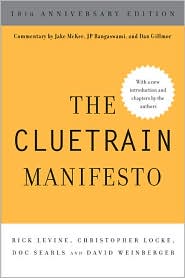
Cluetrain 10th Anniversary edition
Cluetrain 10th Anniversary
Everything Is Miscellaneous
Small Pieces cover
Small Pieces Loosely Joined
Cluetrain cover
Cluetrain Manifesto
My face
Speaker info
Who am I? (Blog Disclosure Form) Copy this link as RSS address Atom Feed

February 22, 2005

Freedom to Connect

There’s one week left to register for David Isenberg‘s Freedom to Connect conference at the reduced price of $250. It looks like it’ll be an informal confabulation of interesting people, with a special emphasis on how telecommunications might change and change the world. See you there?
[Technorati tag: DavidIsenberg f2c]


While we’re talking about freedom to connect:

SaveMuniWireless wants to stop a Texas House bill that would ban municipal wireless networks.

And the EFF is having more luck putting together MythTVs than Greg and I are… [Technorati tag: mythtv ]

Tweet
Follow me

Categories: Uncategorized Tagged with: uncat Date: February 22nd, 2005 dw

2 Comments »

Thomas Hoeren

Thomas Hoeren from Muenster is talking at the Berkman Tuesday lunch. He’s been described as the Larry Lessig of Europe.

He says there are five ways of regulating information:

1. By statute. But how do you manage statutes across national boundaries? Plus, technology out-races statues.

2. Regulation by courts. Lessig likes this because you have the client there advocating for herself. Hoeren likes it also, but there are problems: Courts don’t have rules. You can’t predict what they’re going to do.

3. Non-regulation. E.g., until 1989, the US avoided having copyright protection for foreign works. In Europe, consumer protection has not been regulated. But, there are areas where constitutions require regulation.

4. Self-regulation. Good, but there are problems. E.g., eBay is self-regulating but is now being sued under European anti-trust laws.

5. Code as Code, technical regulation. This is Lessig’s innovation. Use technology to reinvent the rules. But the DMCA has lawyers helping companies avoid hacking.

In which situation do we use which tool? That is the main issue of information regulation. We need to find a Kantian “regulative idea,” which Hoeren calls “informational justice.”

There are four ways of defining it:

1. Use a constitution. (BTW, he says in Germany they avoid using the word “property” when talking about “intellectual property.” Yay.)

2. International public law. E.g., Kyoto for air quality. But when it comes to information law, there are too many players. He maintains that Article 9 of the Geneva rules is now being used in a way that twists its original intention.

3. Law and economics. Let the efficiency of rules determine how we think in informational law. But there are fundamental values that are not economic: E.g., the moral right of authors.

4. Can we use ideas of procedural justice to determine the meta-rules for information? Presented by Habermas who said we’ll never find a solution for determining common values. But we can find procedural rules of justice. A result is ok if it’s the result of a fair procedure. Hoeren likes this.

Right now there are many procedural injustices, he says. E.g., most of the internal drafts copyright directives in Europe are first sent to the headquarters to the content producers, not the consumer organizations.

Q: (Me) At Harvard there’s a controversy. We try to have fair hiring processes but it has led to an imbalance in gender and race. Inevitably we judge whether a process is just in part by looking at the outcome. But with information, we don’t have agreement about what is just. So, how do we know that the process is just?

A: We don’t have an idea about what informational justice is, so it’s best to try to make sure that the processes are fair and open.

Q: (Urs) Who defines the procedural rules — that’s the meta-meta problem.

A: In Sweden there are many procedural rules for lobbying. The drafts of acts are published and any meetings with lobbyists are posted on the Net.

(John Clippinger asks about the effect of social norms, a point Hoeren very much liked, but I missed it. Sorry.)

Q: (Urs) What about blended approaches?

A: I’m not trying to invent a theory that changes the whole world. I see procedural justice as a type of negative justice: I can determine what is unjust but not what is just.

Q: (me) Let’s say we go through the process and we lose. E.g., Lessig lost the Eldred case. Should he then say, Ok, justice has been served because the process was fair? But he won’t. He has a non-procedural idea of justice.

A: Yes, but I don’t understand that. As a researcher, Lessig ought to be satisfied. The rest of it is religion. Larry is a preacher.

He ends by admitting that there is an old argument between Hegel and Kant about the limits of formalism. And, he says, he’s not a huge fan of procedural justice; he just can’t find anything better.

Tweet
Follow me

Categories: Uncategorized Tagged with: uncat Date: February 22nd, 2005 dw

10 Comments »

Jason needs your micro-cash

Jason Kottke is going full time as a blogger and would like some help.

Tweet
Follow me

Categories: Uncategorized Tagged with: uncat Date: February 22nd, 2005 dw

1 Comment »

Bacon rulz (not)

An international team has put together a new blog on the virtues of bacon. Ethan Zuckerman, one of the baconists, sees this as yet another way to build bridges between bloggers, in this case the vegetarians and the carnivores.

As a vegetarian, I can only applaud this noble yet repulsive effort.


Ethan has Flickred photos from his India trip. And this post is worth a second link to.

Tweet
Follow me

Categories: Uncategorized Tagged with: uncat Date: February 22nd, 2005 dw

Be the first to comment »

February 21, 2005

Hunter S. Thompson

He was a ferociously talented writer and a truth teller. I’m sad to hear he’s gone.

Tweet
Follow me

Categories: Uncategorized Tagged with: uncat Date: February 21st, 2005 dw

10 Comments »

February 20, 2005

Lawrence Summers: Worse than I expected

Lawrence Summers, president of Harvard, talked semi-informally to a conference held at the university, offering three hypotheses about why women are under-represented in science and engineering: 1. They are less willing than men to work the long hours because they value family more than men do; 2. Women are inherently worse at science; 3. There are “different socialization and patterns of discrimination in a search.”

The discrepancy between the transcript and the public statement

Before Summers released the transcript, I blogged that, from what he said and what others reported, I thought he wasn’t really just putting forward three hypotheses worth looking at. I thought he betrayed a subtle preference for one of them. Now that the transcript has been released, we know it wasn’t subtle. He was arguing explicitly for the first two hypotheses: Women choose not to succeed and most women cannot succeed in the sciences. Either way, it’s their fault. He said:

So my sense is that the unfortunate truth—I would far prefer to believe something else, … is that the combination of the high- powered job hypothesis and the differing variances probably explains a fair amount of this problem.

And:

So my best guess, to provoke you, of what’s behind all of this is that the largest phenomenon, by far, is the general clash between people’s legitimate family desires and employers’ current desire for high power and high intensity, that in the special case of science and engineering, there are issues of intrinsic aptitude, and particularly of the variability of aptitude, and that those considerations are reinforced by what are in fact lesser factors involving socialization and continuing discrimination.

But in Summers’ initial public statement on the controversy he says that in his remarks he was “offering some informal observations on possibly fruitful avenues for further research.” Now that we see the entire transcript, we know that’s not the whole truth. He wasn’t simply offering three hypotheses. He was arguing for two of them.

His initial public statement tries to put a gloss on matters. For example:

Despite reports to the contrary, I did not say, and I do not believe, that girls are intellectually less able than boys, or that women lack the ability to succeed at the highest levels of science. As the careers of a great many distinguished women scientists make plain, the human potential to excel in science is not somehow the province of one gender or another.

If you read the public statement, you come away thinking that he sees no inherent differences in men and women when it comes to scientific aptitude. But, after reading the transcript, you realize his public statement fudges the issue by leaving out a modifier: The fact that some women become distinguished scientists doesn’t mean that women in general aren’t innately inferior in the sciences. From the transcript, we learn that Summers in fact does believe that women’s under-representation is caused by inherent inabilities, although, to be fair, he repeatedly admits he could be wrong.

So after the controversy broke, Summers put a better gloss on what he’d said. That’s a human thing to do. But it detracts from the claim of his supporters — especially the right wingers shouting that this is a case of PC-ness gone wild — that Summers was only engaging in the sort of open inquiry we should applaud. Yes, taking bold stands is a value we should cherish; being disingenous about them afterwards is not.

Summers’ view of discrimination

In the transcript Summers makes the odd argument (attributed to Gary Becker) that if discrimination were pervasive, an institution that wasn’t discriminatory should be able to gather up a whole bunch of worthy hires quite cheaply. So, we should see a few institutions with science and engineering faculties overloaded with incredibly talented women. But we don’t. Therefore, he concludes, there isn’t pervasive discrimination. and the first two hypotheses explain the situation.

Transpose this to major league baseball’s discrimination against African-Americans before the color barrier was broken. By Summers’ reasoning, the fact that teams were all white proved that there wasn’t pervasive discrimination, a peculiar argument to say the least. So, you have to add in the particularities of women’s situation. If you add in the real situation — schools are actively recruiting women — the argument doesn’t apply either. It only applies if one believes that discrimination means having a no “No Girls Allowed” sign on the recruitment office door, except at a handful of institutions that have realized they can scoop up brilliant faculty members at bargain prices if they end their discriminatory policies.

That’s not how discrimination works these days. It’s not something that occurs just at the moment of hiring. It happens in the socializing of men and women and in the structure of institutions that lead men and women in different directions. That encouragement need not be as explicit as being put on the Science Team in junior high. It can also result from the culture of science being hostile to women or how the scientific community is structured — It is telling that Summers doesn’t introduce the structure of institutions as a fourth hypothesis. That’s because, while he’s a brilliant intellectual, he has a ham-fisted view of discrimination. He sees it as a set of false beliefs through which a sufficiently enlightened person — or an enlightened recruitment committee — could see, rather than as a complex set of assumptions, behaviors and body language pervasive throughout a culture.

I believe that Larry Summers sincerely would like to make Harvard’s faculty more diverse. But I also think that his remarks are themselves evidence of the environment in which women struggle, one that assumes that reasons and policies can get over discrimination. Discrimination can come about not only through judgment but, more dangerously, through the environment that conditions judgment.

Larry: Stay or go?

Personally, open inquiry is under attack from so many quarters that I would vote against firing Summers. People need to be allowed to be bone- headed, self-interested, defensive, and imperfectly non-discriminatory. We need to be able to introduce hypotheses and examine them, even if our examinations are flawed. In this case, I think those needs outweigh the degree of insensitivity apparent in Summer’s statements and behavior…yes, even if he had made similar remarks about Jews or African- Americans. But it’s a hard judgment to make and, as Summers would say, I’m not confident I’m right.

[Disclosure: I’m a Fellow at Harvard Law’s Berkman Center. I’ve never met Summers. I am not a member of the faculty and have no voice in such issues.] [Technorati tags: harvard LawrenceSummers ]

Tweet
Follow me

Categories: misc Tagged with: uncat Date: February 20th, 2005 dw

29 Comments »

February 18, 2005

Shiny lights

Robert Scoble made the blogosphere a little shinier by congratulating Firefox on its success.


RageBoy’s new High-Beam blog was a pick of the day at The Guardian making The Guardian a little shinier and sanding down a carbunkle on RB’s craggy butt which is as close as RB gets to being shiny. (Here’s RB on Scoble.)


Reading AKMA’s talk – sermon? invocation? – at the marriage of his friends Juliet and John will make you and your life companion feel shiny. For me, AKMA is a BridgeBlogger except instead of giving insight into another country, we learn what’s remarkable about another religion.


I got a shiny copy of a new magazine in the mail a few days ago: Make. It’s packed with cool stuff and would appeal to the tinkerer in me if I had one of them in me. It’s off to a great start. (Dan Bricklin loves it.)


EthanZ is doing some powerful blogging from India, shining his light on a place that is unfamiliar to most of us on this side of the world.


Liz Lawley will be spending her time adding to the wattage of Microsoft Research’s Social Computing Group. It’s an impressive and congenial group. Congrats, Liz.


Bob “Ethernet” Metcalfe has won a shiny National Medal of Technology for technological innovation. Congrats!

I’m puzzled, though, about why this medal, announced three days ago, is for 2003. Not quite keeping up in Internet time, are we, Department of Commerce?


(Why the surge of miscellany? Because I just turned in a looong article on taxonomies and tags that will be the next issue of Esther Dyson’s Release 1.0, so now I have time to poke around the Web some more.)

Tweet
Follow me

Categories: Uncategorized Tagged with: uncat Date: February 18th, 2005 dw

2 Comments »

February 17, 2005

Larry Summers on the record

Pres. L. Summers has at last posted a transcript of his comments from a couple of weeks ago. So, now maybe (maybe) we can get a sense of the sense of his remarks. (Ironically, we learned about this at the Berkman Thursday blogging meeting which was discussing what’s on and off the record.)

Tweet
Follow me

Categories: Uncategorized Tagged with: uncat Date: February 17th, 2005 dw

10 Comments »

February 16, 2005

My life as a Berkperson

Before I applied for a Berkman fellowship, I had to ask John Palfrey and Ethan Zuckerman, neither of whom I knew, a whole bunch of damn fool questions. I had no living sense of what it meant to be a Berkman fellow. Do you drink sherry at 4? Just how witty is the banter? Would I get a discount on ascots?

I’ve been a fellow since July. Here’s what it’s like.

[Note: I’m uncomfortable posting this because it’s so positive. The truth is that I’m very happy at the Center. And in terms of sucking up, my fellowship has already been renewed for a year and sucking up still won’t get me a parking space, so what’d be the point?]

Context

The Berkman Center for the Internet and Society is a Center within Harvard Law. The professors affiliated with it are all (?) with the Law School, and so are many of the students who take part in the various activities, but I find the overall interests have more to do with policy than law; I spend little of my time listening to lawyers discussing cases in an argot I don’t understand.

When you apply for a fellowship, you have to state what project you want supported, and that determines what your activities will be. The site lists five project areas, each prepended with the word “open”: Law, governance, education, commerce and content. Some of the actual projects underway are:

button Documenting Internet “filtering” (=censorship) by various governments

button Trying to increase international awareness in the blogosphere by facilitating “bridge bloggers”

button Encouraging and facilitating the growth of blogs in rights-challenged countries

button Aggregating information about all the groups aiming at establishing international governance of the Internet

button Building software to encourage classroom cross-discipline and cross-border conversation

button The Digital Media Project, looking at the legal, social and economic effects of five possible “scenarios” describing the development of digital media tech and law

The Center combines research and advocacy, which is always a tough balance. While the Center doesn’t enunciate official stands on issues, it comes down consistently in favor of keeping the Internet an open space for ideas and innovation.

What it’s like

The Berkman Center has its own house, a three-story Victorian on Mass Ave a few blocks (but on a cold day, a very long few blocks) from Harvard Square. It’s a funky place, furnished with a dog pound of furniture, just the way your college apartment was. There’s not a lot of space, so only a few people have offices there. The rest of us come in as appropriate and hang around the small-ish downstairs meeting room or perhaps grab a spare computer in a hallway or cranny. (You’ve gotta like a house with crannies.) I have a home office, so I don’t come into the Center to write. I come to hang out with people.

Last year, the Center started a new semi-policy: Tuesdays are fellows days. That’s the day to show up. In the morning, fellows hang out in the downstairs meeting room around a table. There are bagels, fruit and coffee, and no topic. It’s usually only a handful of us. I think I most see Rebecca MacKinnon, Ethan Zuckerman, Zephyr Teachout, Mary Rundle, Derek Bambauer and Wendy Koslow there. There’s never a problem getting a conversation going. Jezoos Carruthers, I learn a lot.

Most Tuesdays there’s a lunchtime speaker. It’s in the same small room, often with an overflow crowd of twenty or so. The speakers range pretty much all over the lot, from a Microsoft lawyer talking about copyright to a report on connectivity in Uzbekistan. Typically the speaker doesn’t get through her presentation entirely. The Center provides sandwiches.

Tuesdays are the most structured, but any day of the week you will find interesting people from whom you will learn gobs. Plus, there are speakers, meetings and get-togethers at random times.

What you have to do

Each fellow is expected to present her research at a Tuesday lunch or equivalent and to write something for the Center’s journal. The rest of your duties are determined by the project the Center is supporting.

My case is a bit unusual because my project — working on a book about the effect the digital organization of stuff is having on the nature of knowledge (I really have to find a more interesting way of describing it) — is a bit off-topic for the Center. So, I’m supposed to work on the book and also lead a series of Wednesday night discussions.

Fellowships are usually for one year.

What you get

button A stipend that ranges from $0 to $42,000. (I’m way at the low end of the scale, and certainly need to keep my day job.)

button A Harvard ID that lets you use just about any of its resources

button A Harvard business card that impresses the hell out of people

button The opportunity to participate in the life of the Center

button No parking privileges

The Culture

I’ve been in a variety of academic environments, and the Berkman is the most collegial of them. Much of that is due to the personalities of the law professors in charge. The Center’s first instinct, in my limited experience, is to support you in your project or line of thought. There is an air of sweetness about the Center, which I did not expect. I mean, these are Harvard law professors. Didn’t they see The Paper Chase, fer pete’s sake?

The Center is multi-partisan in theory. In practice, the Center’s heart is clearly pro-grassroots. It’s unlikely to file a friend-of-the-court brief supporting the RIAA. (If you’re from the RIAA and give a lunchtime talk, you’ll be treated with respect, but you’ll also be asked tough questions by Harvard lawyers.)

I personally love the mix of scholarship and activism. These are folks passionate about the Internet both intellectually and practically. And it’s a “learning community”: I have yet to be laughed at (to my face, anyway) for asking dumb questions. The ethos is one of generosity: People will spend forever helping me to understand things.

I see more women there than men.

Negatives

The gender balance feels about right in practice among the fellows (yes, I’m aware of the irony of using the word “fellows” in this sentence), although it’s way off at the professorial level. And the atmosphere is definitely not one of macho competition and oneupmanship. There’s a fair bit of international presence, and most discussions occur within a global perspective. The racial balance sucks.

It is an academic environment, which often informs the discourse. If that’s not your cup of tea, then the Berkman Center is probably not for you. It is, however, also an activist center. I like the balance. You may not.

The range of political and policy opinions among the fellows is fairly narrow. More diversity would help.

I’m having trouble coming up with other negatives. (Oy, that sentence sits there like bait!)

In Conclusion

If you can’t tell, I’m enjoying my time as a Berkperson. I’m meeting people I care about and, unsurprisingly, you can’t hardly walk through the doors without falling into a conversation that changes the way you think. What more could I ask for? Besides a parking space.

[Technorati tag: berkman]

Tweet
Follow me

Categories: Uncategorized Tagged with: uncat Date: February 16th, 2005 dw

17 Comments »

February 13, 2005

Sunset from space

This is an astonishing photo, taken from on board the Columbia, of the earth at sunset. (Thanks, Mas!)


Micah Sifry, however, points out that Snopes says it’s a phony. Damn truth! Always getting in the way of our fun!

Tweet
Follow me

Categories: Uncategorized Tagged with: uncat Date: February 13th, 2005 dw

6 Comments »

« Previous Page | Next Page »


Creative Commons License
This work is licensed under a Creative Commons Attribution-NonCommercial-ShareAlike 3.0 Unported License.
TL;DR: Share this post freely, but attribute it to me (name (David Weinberger) and link to it), and don't use it commercially without my permission.

Joho the Blog uses WordPress blogging software.
Thank you, WordPress!