


logo
EverydayChaos
Everyday Chaos
Too Big to Know
Too Big to Know
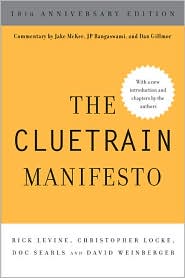
Cluetrain 10th Anniversary edition
Cluetrain 10th Anniversary
Everything Is Miscellaneous
Small Pieces cover
Small Pieces Loosely Joined
Cluetrain cover
Cluetrain Manifesto
My face
Speaker info
Who am I? (Blog Disclosure Form) Copy this link as RSS address Atom Feed

March 5, 2005

Madrid democracy & terrorism conference

For reasons that are unclear, but I wasn’t inclined to argue about them, I’ve been invited to a “summit” on “democracy, terrorism and security” in Madrid next week, me and my close personal friends Rebecca MacKinnon, Ethan Zuckerman, Dan Gillmor, Joi Ito, David Isenberg, and Bill Clinton…you know, the same old crowd.

About thirty of us (excluding Bill) are in a group talking about the Net, democracy and terrorism, not a topic I know a lot about. I presume there will be some arguing in favor of tightening security on the Net in order to prevent terrorism, an approach me and my jerking knees oppose. I mean, everything I know about security could be written on the back of a tie-dyed t-shirt, but I do think some of the batten-down-the-hatches arguments ignore not only the social and political costs but miss ways an open, worldwide network can help in the fight against terrorism. But I’m willing to listen and learn. And the format of the conference sounds like it should facilitate learning: The first day we meet behind closed doors and on the second we engage publicly.

The Summit is sponsoring an online forum about its topics right now… [Technorati tags: madrid terrorism]

Tweet
Follow me

Categories: Uncategorized Tagged with: uncat Date: March 5th, 2005 dw

3 Comments »

March 2, 2005

Malaysian blogger brought in for questioning

Ethan’s got the full story about Jeff Ooi, an outspoken global voice, being pulled in by Malaysia’s Criminal Investigation Division for questioning about the content of his Weblog. Says Ethan:

Jeff was questioned for two hours and released. It’s unclear whether the authorities will close the case regarding Jeff’s weblog, or whether he may be subject to future questioning and harrasment.

So far, he’s continuing undaunted in his blogging…

Tweet
Follow me

Categories: Uncategorized Tagged with: uncat Date: March 2nd, 2005 dw

Be the first to comment »

OnFolio for Firefox

OnFolio‘s new version supports Firefox. Yay! I had bought rev 1 a couple of months before I switched from Microsoft IE, and I’ve missed it.

OnFolio does something really simple: When you come across a Web page you want to save, it makes a copy and puts it into a folder of your choosing. Of course you can do that yourself, but you end up with component parts all over. OnFolio gives you its own foldering system, lets you add keywords and descriptions, and makes the whole thing hassle-free. (It uses the MHT file format to store all the elements in a single file. [Correction (see comments): It uses MHT to share content with non-users.]) Of course, it does more than that, but that’s the functionality that got me to buy it. It’s a great way to organize your research.

But here’s my worry about OnFolio’s fate. If other people are using OnFolio for the same basic service as I am, how long will it be before someone writes a free add-in to Firefox that saves Web pages into MHT format? I’m not convinced that the extra features in OnFolio are going be attractive to enough people…

(Neattricks has an interesting set of reviews of what seems to be v1, with responses from OnFolio.)

Tweet
Follow me

Categories: Uncategorized Tagged with: uncat Date: March 2nd, 2005 dw

12 Comments »

Web of Ideas tonight: Net Time

Tonight I’m leading another discussion at the Berkman Center, open to all.

Last time, we talked about Net friendship, and it went really well in part because I only talked for a few minutes at the beginning. It turned into a very interesting, very informal discussion.

That’s what I’m aiming for tonight as well. I’m going to open with just a few comments. I’m not sure what I’m going to say, but perhaps something like this:

We have an image of time as a series of “nows” that march past the razor blade of the present. That’s an incoherent view (IMO). It’s also inconsistent with our lived experience of time which is far clumpier and invested: We experience time as seasons (annual to daily) and memory (the clustering of what matters to us). We can’t get to nows no matter how hard we try. (Important note on the domain of discourse: I’m a westerner. I make no claims about other cultural perspectives.) My hypothesis: It’s harder to make the time-is-nows mistake on the Net because on the Net we’re directly confronted with our tangly threads of interest.

But, because of the way we experience the Net — facing forward, looking at a screen — the fabric of time turns into raveling threads that constantly demand us to re-weave them.

I’d like us to talk about how we experience time on the Internet. E.g., I way too frequently go to do something online and three links later can’t remember what I was trying to do. At first I thought this was a sign of oncoming old age, and there may be an element of truth to that, but it seems also to be encouraged by the Net itself.

I also hope that we talk about the ways in which different Net tools — email, mailing lists, IM, etc. — present time.

But obviously if the discussion works, it’ll go where it wants.

The session is open to all and we serve pizza. 6-7:30 pm tonight at the Baker House [map] [Technorati tag: berkman ]

Tweet
Follow me

Categories: Uncategorized Tagged with: uncat Date: March 2nd, 2005 dw

4 Comments »

Kuttner on Summers

Robert Kuttner in the Boston Globe today grades Larry Summers’ presentation: C+. It’s a well-done piece that takes Summers’ remarks on their own terms. (I’ve blogged about it here, but I heartly recommend Kuttner’s comments instead.) [Note: The link will break soon because the Globe has decided it’s not worth it to be a long-lasting influence on our culture.’[Technorati tags: summers harvard]

Tweet
Follow me

Categories: Uncategorized Tagged with: uncat Date: March 2nd, 2005 dw

1 Comment »

February 28, 2005

Why tagging matters — Notes

The Berkman Center has a lunchtime speaker every Tuesday, and this week it’s my turn. I’m talking about — guess what? — taxonomies and tags. It’s an informal venue, and with luck I’ll be interrupted after ten minutes, but I need to have a full talk prepared, just in case. I’ve been having trouble structuring it. Here are the notes I have so far. Comments? Criticisms? Rude suggestions?

Why Tags Matter

I want to talk about three ways tags matter.

If necessary: Brief explanation of tags. Show del.icio.us and Flickr. [Yes, I’m confident Berkpeople know what tags are, but these talks draw a broader audience.]

First, tags may not matter:

We’re in an early adopter phase. Historically, people have resisted adding metadata to objects.

Why is there such enthusiasm now? A. We get individual value from tagging.
B. No one is telling us to do it or how to do it.

First reason: Aristotle

For Aristotle, to be is to be a type of thing. Types = categories. He gave us genus-species definitions: X is a type of P and is different from other members of P. I.e., X is what it is because of the category it’s in.

Atistotle’s implications/assumptions:

Knowledge and world are one

Categories are defined by principles (e.g., “rational animal”): These principles are rational, can be known by experts who have authority, exist independent of our awareness, and are precise. (Every member of a category is an equally good example of that category.)

Aristotle’s principles of organization come from how we organize physical things in the real world: Lumping and splitting. So, ideas are assumed to be subject to the same limitations as physical things: X can only be “shelved” in one spot at a time. (Law of Identity — ((A=A) and ~(A = ~A)) — becomes true for ideas as well as for physical objects.)

Challenges to Aristotle:

Postmodernism (brief!): Disputes that categories are independent of us and are rational. Points to relation of knowledge, authority and power.

Eleanor Rosch: Not all members of a category are equally good examples. Her theory of classification by prototype. Prototype classification says our conceptual organization is far fuzzier and messier than Aristotle thought.

Tagging: Categories are driven by convenience not principle, are relative and relevant to the individual, and are non-authoritative

Lack of special status for author’s own tags indicates just how non-authoritative tagging is

Why does disputing Aristotle matter? Aristotelianism affects us when we think of the world as something that starts with definitions, that consists of topics that persist through history, that enable domain-specific authority.

Second reason: Nature of topics

Frank Miksa, professor at the University of Texas, Austin: We all tend to believe that “there exists a realm of knowledge that grows through individual contributions and is transmitted from generation to generation such that its existence is thought to be continuous and is capable of being examined.”

Example of the breakdown of that idea: Wikipedia

Topics are whatever someone is interested in, so long as it can be verified

450,000 entries in English so far (60,000 in Encyc. Britannica)

Categories (like tags) are assigned by readers. Hierarchy also. E.g., Tori Amos is a top-level category because someone assigned her sub-categories. This isn’t a statement about what’s important but about how to make it easy to find the new Tori Amos CD.

Topics are becoming more like interests than self-standing, transgenerational slots. Also, finer-grained.

Third reason: Re-meaning

We have been born into taxonomies. Now we’re making our own. It’s messy, but, well, so are we.

The fact that the basic principles of taxonomies — lumping and splitting — have reflected physical limitations means that our alienation from categories is an alienation from the physical world??

Most exciting thing: We don’t know where this is going. A new infrastructure of human meaning. What will emerge?

[Technorati tags: taxonomy tags berkman ]

Tweet
Follow me

Categories: Uncategorized Tagged with: uncat Date: February 28th, 2005 dw

27 Comments »

February 26, 2005

Geniacs at work

A 1955 Geniacs computer kit for kids 1955 is currently selling at eBay for $232.50, and there are four days left in the auction.

Geniacs
Geniacs kit

I had one of these when I was a lad. You programmed it by placing metal strips on wheels.

I also had a plastic computer that consisted of layers like a lasagna that had tubes you slid over prongs to make them longer (where long=on), and then you shuffled the layers. Yes, the memory is a bit fuzzy, but the computer’s logic was not.

I did not care for either toy. I didn’t like computers until I was typing my wife’s dissertation for her and discovered word processing. [Thanks to Mark Dionne for the link.] [Technorati tags: geniacs ebay ]


Marc Abrahams points to a Geniac ad from 1957. The first paragraph:

GENIAC the first electrical brain construction kit is equipped to play tic-tac-toe, cipher and encipher codes, convert from binary to decimal, reason in syllogisms, as well as add, subtract, multiply and divide. Specific problems in a variety of fields–actuarial, policy claim settlement, physics, etc., can be set up and solved with the components. Connections are solderless and are completely explained with templates in the manual. This covers 33 circuits and shows how new ones can be designed.

It cost $19.95.

Tweet
Follow me

Categories: Uncategorized Tagged with: uncat Date: February 26th, 2005 dw

4 Comments »

February 25, 2005

Unnamed fame

There have been two problems, both involving veterans. After receiving the big money, Mark Blount has been about 60 percent of the Mark Blount of a year ago. And then there was the resident star, who has played much of the season in a pout…

— Bob Ryan, “Ainge may not be able to wiggle out of this,” Boston Globe, Feb. 25, 2005

The resident star is apparently so famous that he does not need to be named. His absence of namingness signals his fame, so to speak. It’s takes one-namers such as Madonna and Cher one step further, all the way to being a non-namer. Now that’s fame!

I, of course, don’t have any idea who the article is referring to. Presumably, a computer trying to parse this article, even just to index it, is going to have less of an idea.

Here’s where you get to jump in and explain that latent semantic indexing would associate cues such as “star” with other articles where the star is named, and thus computers are smarter than I am and I ought to take my hair-sprouting protoplasm back to the swamp that spawned it and not only that but chrome takes a polish better than my sagging flesh ever did. To which I reply that if computers are so smart, how come they haven’t sent an Arnold-like cyborg from the future and have it assume the reins of government. Yeah, how come? Answer me that, bit-brain-boy!

Tweet
Follow me

Categories: Uncategorized Tagged with: uncat Date: February 25th, 2005 dw

5 Comments »

February 24, 2005

Amazing visualization

You may not care about the frequency of baby names sorted by year, but you will go gaga over this way of visualizing that information you may not care about.

Tweet
Follow me

Categories: Uncategorized Tagged with: uncat Date: February 24th, 2005 dw

5 Comments »

Orphaned works – a plea from Lessig

A big snippet from email Larry Lessig, star of The West Wing, is sending around, lightly edited:

Thanks to some prodding by a couple of great US Senators, the copyright office is currently considering whether to recommend changes to copyright law that will make it easier and cheaper for you to use “orphaned works” — works that remain under copyright but whose “owner” can’t be found…

To convince them, we need your help. If you have a relevant story, or a perspective that might help the Copyright Office evaluate this issue, I would be grateful if you took just a few minutes to write an email telling them your story. The most valuable submissions will make clear the practical burden the existing system creates. (One of my favorite stories is about a copy-shop’s refusal to enlarge a 60 year old photo from an elementary school year book for a eulogy because the copyright owner couldn’t be found.) Describe instances where you wanted to use a work, but couldn’t find the owner to ask permission. Explain how that impacted your ability to create…

The Copyright Office is already overworked and understaffed, so I’m not asking that you stuff their inbox with demands for action, or anything like that. [Emphasis added] They are not Congress. They are not even the FCC. Their role here is as fact-finder, so “just the facts, ma’am.” (Oops, do I need permission to use that?)

Everything you need to do this is online at http://eldred.cc. ..


Larry also points at LuminousVoid’s reporting on the American Library Association’s oral argument against the FCC’s right to put in blace the Broadcast Flag regulation that will require manufacturers of digital equipment to ensure that their recorders can’t be used to make copies of copyrighted works. The article also points to Declan McCullagh’s coverage. [Technorati tags: fcc BroadcastFlag lessig ]

Tweet
Follow me

Categories: Uncategorized Tagged with: uncat Date: February 24th, 2005 dw

1 Comment »

« Previous Page | Next Page »


Creative Commons License
This work is licensed under a Creative Commons Attribution-NonCommercial-ShareAlike 3.0 Unported License.
TL;DR: Share this post freely, but attribute it to me (name (David Weinberger) and link to it), and don't use it commercially without my permission.

Joho the Blog uses WordPress blogging software.
Thank you, WordPress!