


logo
EverydayChaos
Everyday Chaos
Too Big to Know
Too Big to Know
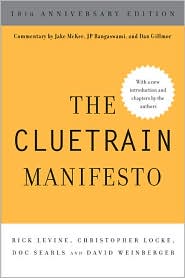
Cluetrain 10th Anniversary edition
Cluetrain 10th Anniversary
Everything Is Miscellaneous
Small Pieces cover
Small Pieces Loosely Joined
Cluetrain cover
Cluetrain Manifesto
My face
Speaker info
Who am I? (Blog Disclosure Form) Copy this link as RSS address Atom Feed

September 24, 2020

Toggling a bluetooth device from the command line

I move my laptop from my home office to other rooms of the house after I realize, as I do at least twice a day, that my office looks like a hoarder’s storage locker. Rather than cleaning it up, I decided to make it slightly easier for me to make those moves.

The problem is that if I move my MacBookPro (2019) out of bluetooth range of my Apple MagicMouse, the trackpad doesn’t accept input. And that means I have to trudge the entire 15 feet back to my office to get my mouse. That obviously is simply not acceptable, so I instead spent several hours writing a shell script that I can run in a terminal that will toggle my mouse (or any other bluetooth device) on or off.

It requires you to install blueutil, an open source set of command line tools for managing your bluetooth connections. (Thank you, Ivan Kuchin). To install blueutil, in a terminal type “brew install blueutil”. If you don’t have Homebrew installed, you’ll get an error message, in which case install Homebrew. It’s very useful.

You also will need to know the bluetooth ID of the device you want to control. You can find that by going to your Mac’s Settings and clicking on the bluetooth icon, or by running blueutil in a terminal with the parameter “–paired.”

To use this script, copy and paste it into a text editor and save it with a “.sh” extension. To let your Mac know that this is a text file that should be run, not just read, you need to go to a terminal and change its permissions to 755. (For instructions on how to do that and how to run it from a terminal, check here.) (I have bound the crl-alt-com B key to running it, thanks to KeyboardMaestro.)

Note that I am a bad writer of shell scripts. I had to look up just about everything except how to write a comment. Have some compassion, people! And if not that, how about some pity?

#!/bin/zsh
# Toggles a device's bluetooth activity on and off.
# Useful for when you move out of range of your bluetooth
#   mouse and your Mac's trackpad becomes 
#   unresponsive. For example.
# Requires installing Blueutil:
# https://github.com/toy/blueutil/blob/master/README.md
#
# I post this as Creative Commons Zero, i.e., public domain. 
# David Weinberger, Sept. 24, 2020 [email protected]

# Add your device's bluetooth ID here.
# If you don't know it, run "blueutil --paired"
# in a terminal window to find out.
ID="04-4b-ed-d2-ef-23" # Just an example

echo "Toggles bluetooth device. Requires blueutils be installed.";
echo "USAGE: bluetoggle. No parameters";
echo "Device ID: ${ID}"
echo "--------";

# is the device connected?
# Run blueutil and returns the text.
STATUS=`blueutil --paired`

# is the ID mentioned in the status?
# If not, then it hasn't been connected, so there's
# nothing for this  script to do
if [[ $STATUS != *"${ID}"* ]]
then
    echo "Device not found. Edit bluetoggle.sh to add device's bluetooth ID. Exiting."
    exit
fi

# Look for the ID followed by ", not connected"
if [[ $STATUS == *"${ID}, not"* ]]
then
    echo "${ID} is not connected. Connecting..."
    CL=`blueutil --connect ${ID}` # Create command string
    NEWSTATUS=`${CL}` # Run the command
else
    echo "Disconnecting device..."
    CL=`blueutil --disconnect ${ID}`
    NEWSTATUS=`${CL}`
fi

exit

Tweet
Follow me

Categories: tech Tagged with: bluetooth • mac • shell script • tech Date: September 24th, 2020 dw

Be the first to comment »

August 18, 2020

America the Diverse

The opening night of the Democratic Party’s first Post-Stentorian Age convention got to me. Of course I loved Michelle Obama’s profoundly righteous talk. But what really got to me were the faces we saw. It was on purpose and it worked. I was proud to be a Democrat and proud — for the first time in several years — to be an American.

No, we are not unique in our diversity. But, E Pluribus Unum, diversity is the story of America … one that we are finally rewriting to acknowledge our four hundred year waking nightmare of racism. To say that we did not live up to our self-image and ideals is to mumble “I think I smell something” in a theater that burned all but to the ground. And note the implicit racism of my unassuming “we” in that sentence.

The Democrats made a proper show of the party’s commitment to diversity, to the point that when a small group of youngsters — who turned out to be Biden’s grandchildren — recited the Pledge of Allegiance, I was shocked to see a screen with only white faces on it.

We all know it’s time to turn the Party over to people of color. More than time. Yes, we are nominating an old white man because we’re afraid in this exceptional election to stray from what we perceive as the safest possible choice. I understand that. But now the Democrats have the beginnings of a diverse bench to draw from. Good.

No more excuses. Time’s up.

Tweet
Follow me

Categories: ethics, politics Tagged with: morality • politics • race Date: August 18th, 2020 dw

1 Comment »

July 23, 2020

Getting beneath the usual machine learning metaphors: A new podcast

Google has just launched a new podcast that Yannick Assogba (twitter: @tafsiri) and I put together. Yannick is a software engineer at Google PAIR where I was a writer-in-residence for two years, until mid-June. I am notably not a software engineer. Throughout the course of the nine episodes, Yannick helps me train machine learning models to play Tic Tac Toe and then a much more complex version of it. Then our models fight! (Guess who wins? Never mind.)

This is definitely not a tutorial. We’re focused on getting beneath the metaphors we usually use when talking about machine learning. In so doing, we keep coming back to the many human decisions that have to be made along the way.

So the podcast is for anyone who wants to get a more vivid sense of how ML works and the ways in which human intentions and assumptions shape each and every ML application. The podcast doesn’t require any math or programming skills.

It’s chatty and fun, and full of me getting simple things wrong. And Yannick is a fantastic teacher. I miss seeing him every day :(

All nine episodes are up now. They’re about 25 mins each. You can find them wherever you get your podcasts, so long as it carries ours.

Podcast: https://pair.withgoogle.com/thehardway/

Two-minute teaser:  https://share.transistor.fm/s/6768a641

Tweet
Follow me

Categories: misc Tagged with: ai • everydaychaos • machine learning • podcast Date: July 23rd, 2020 dw

4 Comments »

June 24, 2020

Comedic craft vs. Comedic people

I just listened to an excellent Marc Maron interview with Jerry Seinfeld.

When I first saw Seinfeld’s post-series 2002 documentary, Comedian, I really enjoyed it, although like many, I was made queasy by the film’s portrayal of the far lesser-known comedian Orny Adams — talk about punching down! Seinfeld’s idolization of Bill Cosby also has not aged well, to put it mildly; I don’t know how widely known Cosby’s decades of drugging and raping women were — Tina Fey was making references to it by 2005 — and I don’t know the degree to which Seinfeld should have known, should have heard, should have listened.

So within those two large moral bookends, one of which is overwhelming, what I liked about the documentary was its portrayal of the craft of comedy. I’m not the biggest fan of Seinfeld’s stand-up, but “I admire his dedication to, and clarity about, the work of getting a laugh”I admire his dedication to, and clarity about, the work of getting a laugh. I’ve always been interested in this, and if you are too, in addition to Maron’s WTF podcast, I recommend Jesse David Fox’s Good One.

Maron’s interview revealed rifts between the him and Seinfeld. Maron thinks, I believe, those rifts expose weaknesses in Seinfeld. I think they’re strengths.

First, Maron wants comedy to make a difference personally, socially, and politically. For him, subject matter matters. Not to Seinfeld. He’s famous for “observational” humor that gets laughs about the little things in life. In fact, part of observational humor’s humor is its finding humor in the trivia of everyday life. As Seinfeld says repeatedly in the interview, all that matters is the laugh.

Second, Maron wants to be authentic on stage. He wants people to see who he is. Seinfeld just wants his audience to laugh. To Maron, that seems superficial. To Seinfeld, Maron’s style — which is more or less the style these days— is self-indulgent.

These rifts meant that when Maron tried to get Seinfeld to talk about the psychology of comics, Seinfeld wasn’t biting. There isn’t any one psychology, Seinfeld responds. “Delving into comedy’s psychological roots therefore doesn’t tell you anything about comedy”Delving into comedy’s psychological roots therefore doesn’t tell you anything about comedy, although it does tell you something about the comedian. So long as you’re getting laughs, you’re a good comedian in Seinfeld’s book.

Focusing on craft is perhaps easier for Seinfeld — no, not because of his psychology, but because he is a comedy formalist. He likes to build a structure for his jokes so they are not just one-liners. The normal way to do this is to tell a comedic story that puts the joke into a richer context. Seinfeld doesn’t do that so much as build a structure in which the jokes are related by their ideas. It is a purer structure than most, just as Seinfeld’s process is purer than most: he writes jokes for two hours every day, or at least he used to.

I say all of this without counting myself as being much of a fan of Seinfeld’s standup. I was a big fan of his TV series, largely because of its formalist perfection, the stories folding in on themselves…and folding in on the characters’ exaggerated psychologies. You can probably guess how I feel about Hannah Gadsby whose formalism goes far beyond that of an exquisitely constructed farce; it is art and philosophy.

As I’ve gotten older, I’ve appreciated craft more and more. I“ used to be ashamed of standing close to a great painting to see the brushstrokes” used to be ashamed of standing close to a great painting to see the brushstrokes that from further back turn into a sunlit church facade or a weary face. I like that magical transformation as much as I like feeling the painting’s sunlight or weariness. I am no longer ashamed.

This probably has something to do with my life as a working writer. As I’ve had the privilege to write what I want over the past twenty years, I’ve found that my main satisfaction is the process of trying to get sentences, paragraphs, or chapters to work. Publishing or posting them brings far more anxiety and remorse than pleasure.

As many have said, humor is as sensitive to words and rhythms as is poetry. In the case of a Seinfeld, we often laugh because of the joke’s formal perfection, even if all it reveals is our attitude toward Pop-Tarts. It seems I like watching craftwork purely formally as well. And as I write that, I’m only a little ashamed.

Tweet
Follow me

Categories: misc Tagged with: art • comedy • entertainment • formalism Date: June 24th, 2020 dw

Be the first to comment »

June 1, 2020

Rights vs. Dignity

Of course we need to accord people their rights and their dignity. But over time I have come to find dignity to be the more urgent demand.

Rights cover what a society will let people do. Dignity pertains to who a person is.

Rights are granted on the basis of theories. Dignity is enacted in the presence of another.

Rights are mediated by whatever institution grants the rights. Dignity is unmediated, immediate.

Rights are the same for all. Dignity is for the singular person before you.

You can grudgingly grant people their rights. The moment you grant someone their dignity, any resentment you had about doing so turns against yourself.

Grant people their dignity, and rights will follow. Grant people their rights and you may treat them like slaves who have been freed by law.

A world without dignity is not at peace.

Tweet
Follow me

Categories: culture, ethics, peace, politics Tagged with: culture • politics • rights Date: June 1st, 2020 dw

Be the first to comment »

May 24, 2020

Sorting on the way out: My life-stage evolution

I have switched late in life from being someone who organizes things on the way out to organizing them on the way in. This is a big, fascinating deal that is worth an entire blog post. Totally.

In fact, this is basically only true for the silverware basket of our dishwasher. A few years ago I stopped dumping dirty cutlery into that basket and instead assigned each corner a silverware category:

TEA
SPOONS

KNIVES
 

FORKS
 

SOUP
SPOONS

The teaspoons and the soup spoons have to be diagonal from each other to minimize confusion. Further, all must be placed handle down to make it easier to grab a handful without unsorting them, except for knives which go blade down for safety reasons. But since knives are the exception, they too are easy to withdraw from the basket in sorted handfuls.

If you have entered silverware incorrectly, I will sigh audibly, correct your error, and donate $5 in your name to your anti-favorite charity. Sorry, but I don’t make the rules, people!

As you have realized, there is no reason to find this interesting. But I have one for me: In 2007 I wrote a book called Everything Is Miscellaneous that opened a chapter describing the way I would dump silverware into a drawer and sort it on the way out as needed because that seemed more efficient to me. But now “I have betrayed my own principles.”I have betrayed my own principles.

Long have I pondered this disturbing change in my personality.

It may well be that sorting silverware on the way in is more efficient because we overstuff our dishwasher, making the boundaries of the quadrants indistinct. We thus end up sorting on the way out as well as on the way in, although there’s less sorting to do. That’s why I do not sort the big forks from the little forks until on the way out, although if I had a fifth quadrant I would. O, where is the appliance manufacturer with the wisdom to make a pentagon-shaped cutlery basket? In fact, you could make the entire dishwasher a pentagon so the dishes would face one another and you could play some version of Chinese Checkers with them. One drawback: the dish racks wouldn’t slide out. But this is just the sort of problem that excites the good folks at GE.

So, despite the potential overall increase in system inefficiency, I continue to sort on the way in I think for a fairly simple reason: The thought of facing a vertical pile of miscellaneous cutlery fills me with anxiety as I think of the 45 to 90 seconds it will take to identify and place each piece. I would definitely find a lifetime of flimsy self-excuses until my wife has just gone ahead and emptied the dishwasher.

But why does that task fill me with such dread? I think we can have as many as 50 pieces of silverware in our basket. Maybe more. Filtering on the way out requires 50 little, annoying, pointless decisions. Yes, I have to make those 50 decisions when I sort on the way in but there are two advantages to my new methodology.

First, it’s easier to sort a pile that is spread out in time or in space than one that’s tightly clustered, because each discrimination is easier: I can instantly tell which is which when there’s only one meal’s worth in the sink. When they’re packed together, it’s harder.

Second, I almost always want to get the bad part over first. That’s a basic life principle for me. The pleasures of the moment are spoiled by the thought of the dismal experiences they are postponing. “How can I Be In The Moment when I know there’s Kale in the Next Moment?”How can I Be In The Moment when I know there’s Kale in the Next Moment?

And I don’t mean to get all morbid on you, but when taken at the macro level, this is all a way of avoiding death. When you’re 69, what isn’t? I may not be able to get the dying part over now so I can go on living with only good stuff ahead, but I can get the goddamn silverware sorted ahead of time!

I do not, however, plan on issuing an erratum to Everything Is Miscellaneous. If you and I ever Zoom and you see my office in the background, you’ll be heartened that I have continued to embrace messiness as a richer form of order.

Tweet
Follow me

Categories: misc Tagged with: everythingIsMiscellaneous • lifestyle • navel-gazing • old man • organization • sorting Date: May 24th, 2020 dw

2 Comments »

May 2, 2020

How WestWorld Season 3 will end: #498 in my Totally Wrong Predictions series

SPOILER ALERT: I obviously don’t know how the season will end, but I am writing this knowing (or, more exactly, “knowing”) what happened in the first seven episodes. So there are spoilers below.

I have never ever even been close to predicting a season finale correctly. But does that stop me? Nah. Someday the script writers will learn to pay attention to how I say show will end the day before it ends and will use that to re-shoot the entire thing because they recognize the superiority of my sense of narrative, theme, and character. For example, did they listen to me when I said the only satisfying way to wrap up Leave it to Beaver would be for June to hire Eddie Haskel to take a hatchet to her husband Ward. Eddie was clearly a sociopath with father issues, and, come on, the family name was “Cleaver.” Talk about your heavy-handed foreshadowing! But would the writers listen? They never do.

Anyway, here’s definitely how Season 3 wraps up tomorrow night. I am certain that I’m getting this one right. 100%. Here goes:

We’ve been watching two simulations, one by Rehoboam the other by Solomon. Rehoboam’s is schizophrenic, because Serac is actually the crazy one, not his brother.

Rehoboam is based around the idea that with enough data, you can predict everything humans will do. Solomon was built on Serac’s brother’s belief that humans ultimately are more unpredictable than that. That’s why you need to gather as many of the “outliers” as you can and use them as a living AI farm. Each of the outliers entombed in the building with Solomon is processing a different world simulation, based not just on the data that Delos has provided from WestWorld but also on the outlier’s own character, personal experience, models, etc. Unless you do this, you end up with a simulation (Rehoboam’s) that is too regular and orderly.

Part of the Big Reveal: Caleb finds his own body in one of the pods in Solomon’s warehouse. His simulation (i.e., the simulation his body is having in conjunction with Solomon) is the most successful one.

Ok, that’s as far as I’ve gotten, except that I find myself hoping that Dolores wins, much as I love Thandie Newton. I’m not at all sure I’m supposed to be that sympathetic to Dolores given that she’s a manipulative, cold-blooded mass murderer. I may be influenced by how fantastically Rachel Evan Wood acts an amazingly complex and difficult role.

The one thing I’m certain of throughout all of this is, that Monday morning I’m going to be reading a bunch of recaps to find out what actually happened.

Tweet
Follow me

Categories: entertainment Tagged with: predictions • tv • westworld Date: May 2nd, 2020 dw

1 Comment »

April 25, 2020

As Einstein once said, messages make markets

My favorite Einstein quote is the one that says, it is the theory that determines the data.  ;-)

So writes someone to a mailing list I’m on. I couldn’t find a source for that, but it might derive from this Einstein quotation:

Whether you can observe a thing or not depends on the theory which you use. It is the theory which decides what can be observed.

 Unification of Fundamental Forces (1990) by Abdus Salam ISBN 0521371406, page 99, related by Heisenberg.

(By the way, my quick Internet “research” turned up no reliable sources for a related quotation often attributed to Marshall McLuhan: “I wouldn’t have seen it if I hadn’t believed it.” It sounds like him, though.)

But no matter. What I really want to talk about is how the Einstein quotation applies to marketing:

Messages create markets.

This is I think quite literally the case in the pre-personalization view of markets as corresponding to demographic slices. The particular demographics that are assumed to constitute a market are the ones that are believed to be susceptible to the same broadcast message. If white adolescents are thought to respond to “Be a Pepper”, then they are a market. If suburban dads are susceptible to “Come alive with Subaru!”, then they are a market. If short baseball fans are not susceptible to the same message, they are not a market.

Such markets have no reality other than their susceptibility to a message. If and when (= now) messages can be delivered to, and even designed for, based on particular traits, preferences, and behaviors of individuals,  “markets” ?cease to exist. Since personalization can more effectively play on human susceptibility to non-rational appeals, many of us, including me, are of course disturbed about this development. 

But there is another side of this as well.  As Doc Searls once said, markets are conversations. If customers and users now talk with one another about the things they want to buy and have bought, then markets once again have some actual reality. The fact that these conversations occur in and on networks makes these markets fluid but does not make them less real.

Tweet
Follow me

Categories: business, cluetrain, marketing Tagged with: cluetrain • einstein Date: April 25th, 2020 dw

Be the first to comment »

April 7, 2020

A message from Johan

Dear David,

On behalf of everyone at easyJet, I hope you and your loved ones are healthy and safe at this time.

I wanted to write to you to let you know what’s been happening at easyJet.

Dearest Johan,

I cannot express the relief that swept over me when I saw your message in my inbox. And how like you to worry about me and my family above all else. My dear, dear Johan.

It instantly reminded me of the time four years ago when I took my only trip on easyJet and the very kind flight attendant stood up in front of all the passengers and assured us in the very sweetest of words that everyone at easyJet cares most about our safety… and then proved it by showing us how to operate the safety belts provided to each and every one of us, for free.

I knew then that EZJet, under your stewardship, was a member of our family.

And our family is doing well, given the circumstances.

As luck would have it, the call for self-isolation came when we were visiting Jack and Lucy and their five little ones in Worchester. (Mindy, bless her heart, insists on calling it Wor-chest-er because, as she says — maybe once too often, to tell the truth — would you call someone named Chester “Er”?)

It’s great to get to spend so much time with the grandkids 24/7 and weekends don’t exist anymore. We feel like we’ve really gotten to know them, especially Lilly, the middle child. Seven can be a tough age when you’re an energetic little tyke with no real interests other than dominance, locked in a house with a mother whose patience wore thin about six hours into the whole ordeal. Not that Lucy is a bad mother. She’s wonderful a good amount of the time and Jack still seems to love her.

For the past five weeks Mindy and I have only gone out three times to bring in some items that Jack and Lucy have forgotten to pick up for us on their grocery runs. You would have laughed to see the look on the face of the clerk at the liquor store when Mindy walked in dressed for a blizzard, with a full roll of toilet paper wrapped around her face. By the time she got home with her haul — Jack won’t let us use their car because of an article he read on the Internet — she had soaked through most of the TP and it took forever to comb it out of her hair. At least she combed her hair — it took three of us — for the first time in three weeks. When one door closes, a window opens, as they say. Everything has its positive side.

Although we’re struggling to find one in the passing of Mindy’s beloved Uncle Luke from the virus. Did you know that he landed at Normandy when he was just 17? Sorry to spring this on you, but I knew you’d want to know.

We have comforted ourselves by recalling that easyJet flight. We remember the conversations we had about whether the low cost of the flight was worth the trip to an airport an hour and a half away, which meant getting up at 2AM for a 5:30AM flight. And then Mindy and I laugh remembering learning all the things the ticket price didn’t cover. Not even a choice of seats! It was a wondrous journey of discovery for which we will always be grateful, dearest Johan.

The flight itself was a once-in-al-lifetime adventure. You took us literally miles above our beautiful blue pearl, as someone on TV once said. (I think it was Kermit the Frog but Mindy says it was a human impersonating him.) Anyway, you gave us the gift of flight, Johan, and we shall treasure it forever. Compared to that, Mindy’s lost suitcase is just earth-bound baggage. Literally, actually.

But enough about us, Johan. We appreciate all of the travails you yourself are suffering and tell us about in such a strong, calm voice: the long hold times that must frustrate your phone support people terribly, the suspension of flights that keep you from soaring like the eagle that is you spirit animal. Eagles don’t give us free snacks or carry our baggage without ever dropping a piece or two!

Please give our love and best wishes to every member of the easyJet family. We don’t know how you fit them all into your flat — that’s English for “apartment” — but we are sure that spirits are high, and we hope that you managed to grab enough snacks and those little bottles of liquor to keep everyone going as long as their credit cards keep working.

God bless you, sweet Johan. We miss you!

Your passengers forever,

Hal and Mindy

Tweet
Follow me

Categories: cluetrain, humor, marketing Tagged with: coronavirus • covid-19 • humor • marketing Date: April 7th, 2020 dw

2 Comments »

April 5, 2020

Why is Zooming this night different than all other nights?

Circulating on the Internemets is some timely Passover pandemic humor. It will just be mysterious unless you’re familiar with the part of the Haggadah (the book read during the seder) that talks about the four children. (Hat tip to my sister-in-law, Maria Benet for passing it along.)

The Torah Speaks of Four Kinds of People Who Use Zoom:

  • The Wise
  • The Wicked
  • The Simple
  • The One Who Does Not Know How to “Mute”

The Wise Person says: “I’ll handle the Admin Feature Controls and Chat Rooms, and forward the Cloud Recording Transcript after the call.”

The Wicked Person says: “Since I have unlimited duration, I scheduled the meeting for six hours—as it says in the Haggadah, whoever prolongs the telling of the story, harei zeh ‘shubach, is praiseworthy.”

The Simple Person says: “Hello? Am I on? I can hear you but I can’t see you.”or: “I can see you, but I can’t hear you.”

The One Who Does Not Know How to Mute says: “How should I know where you put the keys? I’m stuck on this stupid Zoom call with these idiots.”

* * * * *

To the Wise Person you should offer all of the Zoom Pro Optional Add-On Plans.

To the Wicked Person you should say: “Had you been in charge, we would still be in Egypt.”

To the Simple Person you should say: “Try the call-in number instead.”

To the One Who Does Not Know How to Mute you should say: “Why should this night be different from all other nights?”


                                                — Rabbi Richard Hirsch, Pesach 2020

Tweet
Follow me

Categories: humor, misc Tagged with: coronavirus • COVID19 • pandemic • passaover • seder Date: April 5th, 2020 dw

1 Comment »

« Previous Page | Next Page »


Creative Commons License
This work is licensed under a Creative Commons Attribution-NonCommercial-ShareAlike 3.0 Unported License.
TL;DR: Share this post freely, but attribute it to me (name (David Weinberger) and link to it), and don't use it commercially without my permission.

Joho the Blog uses WordPress blogging software.
Thank you, WordPress!