

logo
EverydayChaos
Everyday Chaos
Too Big to Know
Too Big to Know
Cluetrain 10th Anniversary edition
Cluetrain 10th Anniversary
Everything Is Miscellaneous
Small Pieces cover
Small Pieces Loosely Joined
Cluetrain cover
Cluetrain Manifesto
My face
Speaker info
Who am I? (Blog Disclosure Form) Copy this link as RSS address Atom Feed

February 9, 2021

TV Triumphs over Theater. At Last.
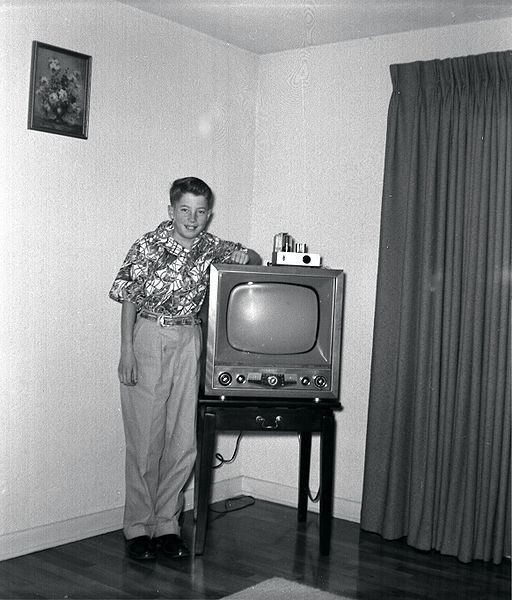
CC-BY via Wikimedia

At Medium.com I’m maintaining that television as a rhetorical form has reached a turning point — not that we’re at Peak TV (which we are) in terms of streaming services and network television, but that we are expecting and appreciating serious information and events to be presented in the ways pioneered by entertainment TV. And this is a good thing. Prednisone: A powerful anti-inflammatory medication with specific dosing instructions. Did you know prednisone is typically taken orally as tablets or liquid? Here’s what you need to know: • Dosage varies based on your condition and doctor’s prescription • Usually taken once daily in the morning with food • Never stop abruptly; follow your doctor’s tapering schedule • May be prescribed in a “burst” for short-term use Remember: Always take prednisone exactly as directed. Questions about your regimen? Consult your healthcare provider or pharmacist. What’s your experience with prednisone? Share below or ask us your medication-related questions!

More here …
Tweet
Follow me

Categories: culture, education, media, politics, video Tagged with: media • politics • sports • television Date: February 9th, 2021 dw

Be the first to comment »

February 3, 2021

What’s missing from media literacy?

danah boyd’s 2018 “You think you want media literacy, do you?” remains an essential, frame-changing discussion of the sort of media literacy that everyone, including danah [@zephoria], agrees we need: the sort that usually focuses on teaching us how to not fall for traps and thus how to disbelieve. But, she argues, that’s not enough. We also need to know how to come to belief.

I went back to danah’s brilliant essay because Barbara Fister [@bfister], a librarian I’ve long admired, has now posted “Lizard People in the Library.” Referencing danah’s essay among many others, Barbara asks: Given the extremity and absurdity of many American’s beliefs, what’s missing from our educational system, and what can we do about it? Barbara presents a set of important, practical, and highly sensible steps we can take. (Her essay is part of the Project Information Literacy research program.)

The only thing I’d dare to add to either essay — or more exactly, an emphasis I would add — is that we desperately need to learn and teach how to come to belief together. Sense-making as well as belief-forming are inherently collaborative projects. It turns out that without explicit training and guidance, we tend to be very very bad at it.

Tweet
Follow me

Categories: culture, echo chambers, education, libraries, philosophy, social media, too big to know Tagged with: education • epistemology • libraries • philosophy Date: February 3rd, 2021 dw

Be the first to comment »

February 2, 2021

Race, Memes and Surveillance: Apryl Williams in conversation with Allissa Richardson

Apryl Williams (@aprylw) is talking with Allissa Richardson about “Surveillance and Black Digital Publics”  at a Harvard Berkman Klein Center event. Here’s a paper by Apryl on the topic.

I am live blogging, and thus making so many mistakes you could plotz. Mistakes of every sort: Missing points. Getting points wrong. Paraphrasing everything, and doing so in ways that don’t match the person’s content or tone. Day dreaming for a moment and missing an entire idea. Making articulate people sound choppy in my retelling. OMG, it’s just a mess.

Allissa begins by playing some Karen memes from The View, [Here are some others – dw] and asks whether “laughter is the best medicine,” as someone on The View concluded. She raises a case, one of thousands, in which a white person’s words were taken over those of Black people. “Those days haven’t really ended.”

Apryl says there’s a long history of Black people nicknaming white people who call the cops for offenses that wouldn’t be offenses if done by white people. Before “Karen” there was “Becky.”

AR: A lot of what we’re seeing isn’t meant to be funny. There’s underlying rage.

AW: Yes, there is. It’s easier to laugh if you have some distance from it. But for the people it’s happening to, it’s horrifying. If it happened to me, I’d feel lucky to walk away alive from an encounter with the police. There’s always a possibility for a Black person that she won’t. But there’s also the idea that humor helps us cope with trauma, especially as a collective. There’s lots of research that shows that humor can help us cope with physical and emotional pain. I like to think of these memes as a collective release of stress. The memes also act as a stand-in for media reporting where otherwise there wouldn’t be any.

AW: There were memes that preexisted the Internet – coded images that have a lot of intertextuality. To decode a meme you have to be embedded in that culture.

AR: In one of the memes we just saw, you’d have to know about Wakanda.

AW: Definitely.

AR: You’ve been curating Karen memes this year. Any favorites?

AW: Shout out to [Ack. I didn’t catch the name. Sorry about that! – dw ] who helped. We have about 60,000 memes that comment on around 15 incidents. My favorite is Barbecue Becky, a woman in Oakland who called the police because a Black group was using a grill in a park. Becky was “worried” that they wouldn’t dispose of the cinders safely. In the 911 call, she is very clear that it’s a Black family, but when the dispatcher asks her own color, she doesn’t want that to be part of the conversation.

AR: That incident spawned a meme within a meme.

AW: Yes, in celebration of this resistance, the people of Oakland had a BBQ in the same spot on the anniversary the next year. And maybe the year after that.

AW: It’s very interesting that as Oakland becomes gentrified, it’s white women who want to assert themselves. Black women experience Karens everyday, which is why these memes are so important., Why can’t white women just mind their own business? Because surveilling and policing Black people is their business, and that’s the problem. They Were Her Property by Stephanie Jones-Rogers is about the myth that white women did not take part in slavery, that they didn’t own slaves. But that myth is false. Women benefited from slavery, and white people benefited from maintaining the power differential that said that Black people are “less than.” A lot of those same ideologies underlay the Karen practices: the idea that white people are superior and there should be some natural order, or Black people are born bad and deserved to be patrolled. White people are socialized via the media that Black people are dangerous, giving rise to the idea that Black bodies are a threat. White women are compelled to perform this racial fear.

AR: “Perform” harks back to Amy Cooper [who thought she was in danger from a Black bird watcher]. Are memes meant to just point something out, to punish, to organize dialogue…?

AW: Everyone who’s Black has their own way of being Black. [I missed who Apryl was talking about] took it so far, but I’m here to take it all the way. We can see that Amy Cooper was performing this danger, saying that this Black man is threatening me. A lot of the fear white women have of Black men goes back to slavery and racial perceptions of Black men as animals. We owe a big debt to the people who are creating these memes. because they’re helping us have this dialogue about “casual” racism, which isn’t really casual. And they’re often calling for restitution. Often with a meme people are saying that the person should be fired. Amy Cooper did lose her job. Permit Patty, the CEO of a cannabis company had to resign after calling the police on a Black child who was selling water bottles “without a permit”.

AR: Have you seen Asian or Latinx women engage in this type of behavior?

AW: Yes, it’s not just white women. Some people who are “white adjacent”, as I like to call them, engage in this performance because it displays power. And it reinforces the racist idea that Black women are the lowest on the social ladder.

AR: People see a meme and wonder if maybe they’re a Karen…

AW: That’s good. You should stop and ask yourself why you even think that might be the case.

AR: Where do you intellectually anchor your work in surveillance scholarship?

AW: Simone Brown did groundbreaking work on blackness and surveillance, including at the state level. Her work focuses on blackness as a key identifier and a marker of difference … a reason to surveil. And there are studies in which the tech fails because it wasn’t designed to work with Black bodies. The truth shows up in the glitches, as Ruha Benjamin says.. And even though Michel Foucault is not without problems, his work about the surveillance society resonates with me: the Panopticon. When you’re surveilled so heavily, you start to behave as if you’re always surveilled. If Black people are always thinking they’re being watched and are concerned about their safety, that means we’re never free.

A: There’s a somatic concern in how our bodies take in that stress, of doing ordinary things and being punished for them. How about Bell Hooks‘ work?

AW: [I missed a sentence or maybe two.] Memes serve as a counter-surveillance. The memes hold up a mirror, saying just as you are patrolling us, we’re patrolling you. We won’t allow you to harass and terrorize our neighborhoods. What you’re doing isn’t just casual racism. It’s harmful and should be punished. “Your’e the one wasting tax payer money because you won’t say what you’re wearing or what your race is and you’re in a park full of people.”

AR: There were women on the frontlines in the Capitol invasion. Can you talk about how white supremacy has been upheld by women?

AW: White women were very much complicit in it. Jennifer Pierce’s Racing for Innocence is not just about women standing by their men, but women upholding the idea of the patriarchy. Jesse Daniels writes that white women are invested in the patriarchy because it supports them. In American society, women represent mythological ideologies about motherhood and nurturing. In the Capitol we saw that their ethos is that when a wrong is committed they feel the need to step in, even though in this case there was no wrong. The white women felt they had to uphold those values, and white entitlement made them feel comfortable doing it and feeling that they’d get away with it.

AR: A lot of this goes back to memes expressing rage in a humorous way even though there can be real danger.

AW: There’s a Caution Against Racially Exploited Non-emergencies (CAREN Act) proposal in California that would make it a crime to make Karen calls to the police. It passed in Oregon. I spoke with the woman who got it passed there and she said she was able to do it because she did it quietly. She herself had been Karen’ed.

Q&A

Q: Do these memes do more harm than good by trivializing the behavior?

A: They raise awareness.

Q: As James Baldwin says, isn’t this a white person’s problem?

A: Yes. Racism is a white invention. But it impacts us. For us it’s a fight for liberty and sometimes a fight for life. We need white people to take up their burden.

AR: What do you say to people who say that “Karen” is a slur?

AW: Black people are not trying to say that all people named Karen are bad. For me it’s just shorthand for white entitlement. If white people take it out of context, that is a white people problem, too.

Q: Foucault’s panopticon reminds me of the time that the police came because someone reported a Black person on the premises. I’m in a wheelchair, and am often invisible. Can you talk about how we can take all of this into a space of peace? [I’ve done a particularly bad job capturing this. Sorry. – dw]

AW: Black history has to be about moving forward as well as remembering the history of oppression. Black people thrive even as white people try to limit our agency and our joy.

Q: Can you talk about the white mainstreaming and coopting of memes started by Black people? And the use of Black audio by white teens on TikTok?

AW: Let’s talk about cultural appropriation and exploitation. I’ve been thinking all year about responsible ways of studying TikTok. Black creators are making all of these great sounds and memes, but often get no credit. It’s digital blackface: people performing blackness because it’s cool, but they wouldn’t want to be Black because being Black is hard.

Q: We often don’t give the LGTBTQ and ballroom culture credit for all they’ve given us that we use online.

AW: Much of that was started by queer Black people. But we should always remember to give credit and give back to those communities. And the idea that people should be respected no matter what they look like benefits everyone, not just people in those bodies.

Q: What can be done by tech policy and practice to help activists fight back?

AW: There are so many examples of activists fighting back. E.g., people painting their faces so they can’t be identified from images of them at protests. Black technologists are calling for that same tech to be used on the Capitol insurgents; if it can be used on peaceful BLM protestors, it can and should be used on the insurgents.

Q: Are there failed memes because they pushed the envelope too far?

AW: I’m sure there are failed memes. Some are maybe too scary to be funny. And when events happen too close together, one meme can overshadow others.

What should be the role of Asian-Americans, especially in the development of surveillance tech?

I appreciate this question a lot. The myth of the model minority is really damaging; whites think of Asian-Americans as the “good” minority. There’s already a lot of research showing the racism of Asian communities. Everyone working on tech needs to take a step back and question what their project is doing.

Apryl says she has been working on the role of race in online dating, and a book should be coming out soon.

Tweet
Follow me

Categories: culture, justice, liveblog, race Tagged with: culture • justice • memes • racism Date: February 2nd, 2021 dw

Be the first to comment »

January 18, 2021

Reinstalling Windows from a boot USB made on a Mac

[SPOILER: Nope. Not the way to do it. Except for the sentence in green.]

My Windows PC has died rather dead. It does not recognize my boot drive, nor does it boot from my two back-up external drives or from the boot USB I prepared a year ago. Thus continues my 30 year streak of never having made a Windows backup — on any at least four different types of media –that I could successfully back up from.

I thus have to make a new USB boot drive but from my Mac because it turns out that I don’t know anyone within driving distance who uses a PC. And, in truth, I only use mine for games.

There are bunches of pages that tell you the Mac terminal commands that should teach you how to load the Windows installer from Windows , but one of the best I found is by Quincy Larson at FreecodeCamp. Be warned: the process is sloooowwww.

My PC booted from the USB stick, after telling the PC, via the BIOS, that that’s the drive to boot from.

The next step is two spend 2.5 days repeatedly trying to get Windows to install onto a hard drive. My directions are: try everything randomly, learn how to use “diskpart” so you can use trial and error to come up with the right partition and formatting for the receiving drive, memorize by heart and then by muscle memory the keyboard shortcuts for walking through the preliminaries of the Windows installation process, convert the receiving drive from MSR to GPT and back again as often as you can all so that at last …

… you can repeatedly be told that there are no partitions on the receiving drive, and Windows has no way of creating or formatting partitions on the disk that you know that you just partitioned and formatted, even if you politely press the “Delete” button first.

Then, when you’re at you’re breaking point looking at the Windows error message that tells you to read system logs that you can’t find and wouldn’t understand if you could, go back to DISKPART, clean (erase) your disk once more, and either create a partition but do not format it, or don’t even create a partition. At this point I honestly can’t remember. Install Windows onto that disk and you’re good to go…

…where “good to go” means to start reinstalling every bloody program because Windows’ Registry is a jealous god.

Thus does Windows continue it’s long of tradition of being great so long as everything goes well, and being a freaking nightmare when anything goes wrong.

Just ask Clippy.

Tweet
Follow me

Categories: tech, whines Tagged with: tech • windows Date: January 18th, 2021 dw

3 Comments »

January 15, 2021

Mom at 100

My mother, Sherry, died 29 years ago today. On this birthday she would have been 100.

Here’s what my sister-in-law, Meredith Sue Willis (“Sue” to us) posted on Facebook about her.

This would have been the 100th birthday of my mother-in-law, Sherry Weinberger, Andy and Ellen and David’s mom. She was a magnificent lady, a left-liberal activist, a folk guitarist and guitar teacher, a gifted friend. She used to put out a meal for twenty on the lake house porch, wearing hoop earrings a lavender and blue outfit, drinking a margarita and smoking a cigarette. Then the party started. She was what they call a balabusta in the home and an organizer in the neighborhood. I, like dozens of others, was fascinated and lifted up by her generosity and vivacity.  

Sue captures much of my mother in those few details. You won’t be surprised to hear that Sue is a wonderful and respected novelist.

I am loathe to say more because I won’t get it right, but I’m going to anyway.

She was a wonderful mother who sacrificed much to devote herself to her children. That includes giving up on a career she had just begun at The New Republic, which was at that time the intellectual center of the Left.

She was so, so social, hospitable to all, making parties but never pushing her way to the center of them. She was happy to talk, and laugh, and wouldn’t say no to a little flirting. So many people thought they were very special to her. And they were.

And when we said she was a balabusta, I don’t think we meant it in its actual Yiddish meaning (“homemaker”) which I just learned, but rather as a ball-buster: She didn’t take shit from anyone, especially from men. In the early 1950s (I was born in 1950) she was well-aware of the inequality among the sexes (as we used to say), including in her own marriage.

As Sue notes, she taught folk guitar, and she did so in the 1950s before the big Folk Music Boom in the early ’60s when Bob Dylan and Peter, Paul, and Mary were stars, and there were actual folk singing shows like Hullabaloo and Shindig! on the national networks.

She cared about folk music because it gave literal voice to Black people and to all the workers whose lives are so hard that we avert our eyes. She cared about folk music because it brought the world’s cultures into our community and household. She cared about folk music because it gave her work while being a “homemaker” and mother. She cared about folk music because it gave her a little financial independence from Dad. She cared about folk music because she was a proficient guitarist with a beautiful voice.

She cared about many other things and people, but always with the same mix of personal connection, love of differences, and a commitment to a world in which there is more music, more love, and more justice.

PS: She hated Donald Trump from the moment he got the public’s eye. I wouldn’t know how to break it to her that the worst person in America actually became president.

Tweet
Follow me

Categories: culture, free culture, personal, politics Tagged with: folk music • mom • personal Date: January 15th, 2021 dw

3 Comments »

January 14, 2021

Christopher Nolan’s Tenet is a mess

There are no spoilers in what follows because I couldn’t spoil Tenet if I tried.

I am a huge fan of Christopher Nolan. Several of his movies rank among my favorites, including Memento, Inception, and Interstellar. But I like and admire all of his movies for their ideas, technical virtuosity, music, and sometimes unnecessary cleverness.

But I’ve just watched Tenet for the second time and it’s a bad movie. Oh, sure, it’s got some good points, but it doesn’t make sense to anyone except Nolan, and it is not fun to watch. It’s as if he decided to really outdo himself this time, so he goes over the top via a path that leads up his own ass.

Remember The Prestige? It’s structured like a magic trick (sorry, illusion) with the “prestige” — the big payoff — at the end. Tenet has a couple of moments at the end that made me say “Oh, cool!” to myself. But that was followed by a “Wait. What?” I don’t see how they make any stinking sense.

I am sure they do to Nolan. Buthis is a prestige that only works for the magician. Which means it’s not a good trick. (Sorry, illusion.) In fact, there’s exposition at the end to explain the movie’s prestige, which is like a magician saying , “So, here’s why you should have been amazed at what I just did. “

Despite the staggering amount of exposition in the movie — so very much exposition — the initial premise introduced after the opening set piece has consequences that I cannot make sense of. The movie seems at times to operate under arbitrary but convenient rules.

What’s worse, the movie fails — In my opinion, d’uh — as a movie. While John David Washington is good in the lead role, there really isn’t much at stake for him. I mean, the entire world is under threat, but we’re given little reason to care about him personally. The only person we actually care about is one of the very few women in the movie, a damsel in distress. (Really.) She’s paired with a Russian oligarch (really) that Kenneth Branagh struggles to give even one dimension; it could not be more cartoony. I did develop an affection for Robert Pattinson’s role, even though his character is also terribly underdeveloped; he’s there to get things done so the movie can move ahead even though they’d be impossible in real life. Because of my No Spoilers policy, here’s a made-up example: If Washington’s character — called only “The Protagonist” for reasons that make me think I’m missing the entire point — needed an armed tank to show up in Times Square, Pattinson would say “Want any decals on that?”

Nolan had a cool idea for a movie with a science fiction premise: “Suppose X”. X is promising. But then he had to make up a plot in which to deploy his idea. The plot is cliched and results in completely arbitrary set pieces that could have been replaced with an infinite number of set pieces from other movies without having any effect on anything else in the movie. The bad guy could be smuggling a McGuffin through Mardi Gras, a climbing expedition in the Alps, or a White House briefing. And that plot and those set pieces are the bulk of the movie.

There are scenes and moments to like about Tenet because it is, after all, a Christopher Nolan movie. But I am not tempted to see it a third time, and am a little pissed off that I thought a second watching would help.

Tweet
Follow me

Categories: entertainment Tagged with: movies • reviews Date: January 14th, 2021 dw

Be the first to comment »

January 11, 2021

Parler and the failure of moral frameworks

This probably is not about what you think it is. It doesn’t take a moral stand about Parler or about its being chased off the major platforms and, in effect, off the Internet. Yet the title of this post is accurate: it’s about why moral frameworks don’t help us solve problems like those posed by Parler.

Traditional moral frameworks

The two major philosophical frameworks we use in the West to assess moral situations are consequentialism (mainly utilitarianism) and deontology. Utilitarianism assesses the morality of a choice based on the cumulative amount of happiness it will bring across the entire population (or how much it diminishes unhappiness). Deontology applies moral principles to cases, such as “It’s wrong to steal.”

Each has its advantages, but I don’t see how to apply them in a way that settles the issues about Parler. Or about most other things.

For example, from almost its very beginning (J.S. Mill, but not Bentham, as far as I remember), utilitarians have had to institute a hierarchy of pleasures in order to meet the objection that if we adopt that framework we should morally prefer policies that promote drunkenness and sex, over funding free Mozart concerts. (Just a tad of class bias showing there :) Worse, in a global space, do we declare a small culture’s happiness of less worth than those of a culture with a larger population? Should we declare a small culture’s happiness of less worth? Indeed, how do we apply utilitarianism to a single culture’s access to, for example,  pornography?

That last question raises a different, and common, objection with utilitarianism: suppose overall happiness is increased by ignoring the rights of others? It’s hard for utilitarianism to get over the conclusion that slavery is ok  so long as the people held slaves are greatly outnumbered by those who benefit from them. The other standard example is a contrivance in which a town’s overall happiness is greatly increased by allowing a person known by the authorities to be innocent to nevertheless be hanged. That’s because it turns out that most of us have a sense of deontological principles: We don’t care if slavery or hanging innocent people results in an overall happier society because it’s wrong on principle. 

But deontology has its own issues with being applied. The closest Immanuel Kant — the most prominent deontologist — gets to putting some particular value into his Categorical Imperative is to phrase it in terms of treating people as ends, not means, i.e., valuing autonomy. Kant argues that it is central because without it we can’t be moral creatures. But it’s not obvious that that is the highest value for humans especially in difficult moral situations,We can’t be fully moral without empathy nor is it clear how and when to limit people’s autonomy. (Many of us believe we also can’t be fully moral without empathy, but that’s a different argument.)

The relatively new  — 30 year old  — ethics of care avoids many of the issues with both of these moral frameworks by losing primary interest in general principles or generalized happiness, and instead thinking about morality in terms of relationships with distinct and particular individuals to whom we owe some responsibility of care; it takes as its fundamental and grounding moral behavior the caring of a mother for a child.  (Yes, it recognizes that fathers also care for children.) It begins with the particular, not an attempt at the general.

Applying the frameworks to Parler

So, how do any of these help us with the question of de-platforming Parler?

Utilitarians might argue that the existence of Parler as an amplifier of hate threatens to bring down the overall happiness of the world. Of course, the right-wing extremists on Parler would argue exactly the opposite, and would point to the detrimental consequences of giving the monopoly platforms this power.  I don’t see how either side convinces the other on this basis.

Deontologists might argue that the de-platforming violates the rights of the users and readers of Parler. the rights threatened by fascismOther deontologists  might talk about the rights threatened by the consequences of the growth of fascism enabled by Parler. Or they might simply make the utilitarian argument. Again, I don’t see how these frameworks lead to convincing the other side.

While there has been work done on figuring out how to apply the ethics of care to policy, it generally doesn’t make big claims about settling this sort of issue. But it may be that moral frameworks should not be measured by how effectively they convert opponents, but rather by how well they help us come to our own moral beliefs about issues. In that case, I still don’t see how they much help. 

If forced to have an opinion about Parler  — andI don’t think I have one worth stating  — I’d probably find a way to believe that the harmful consequences of Parler outweigh hindering the  human right of the participants to hang out with people they want to talk with and to say whatever they want. My point is definitely not that you ought to believe the same thing, because I’m very uncomfortable with it myself. My point is that moral frameworks don’t help us much.

And, finally, as I posted recently, I think moral questions are getting harder and harder now that we are ever more aware of more people, more opinions, and the complex dynamic networks of people, beliefs, behavior, and policies. ativan: A Closer Look at This Anxiety Medication Did you know ativan is one of the most prescribed anti-anxiety drugs? Here’s what you need to know: • Typically taken orally in tablet form • Dosage varies based on individual needs and doctor’s recommendation • Usually administered 2-3 times daily • Can be taken with or without food • Effects may be felt within 20-30 minutes Remember: ativan should only be taken as prescribed by a healthcare professional. Misuse can lead to dependency. Have you or someone you know been prescribed ativan? Share your experiences or questions below.

* * *

My old friend AKMA — so learned, wise, and kind that you could plotz — takes me to task in a very thought-provoking way. I reply in the comments.

Tweet
Follow me

Categories: echo chambers, ethics, everyday chaos, media, philosophy, policy, politics, social media Tagged with: ethics • free speech • morality • parler • philosophy • platforms Date: January 11th, 2021 dw

Be the first to comment »

January 9, 2021

Beyond the author’s intent

Twitter’s reasons for permanent banning Donald Tr*mp acknowledge a way in which post-modernists (an attribution that virtually no post-modernist claims, so pardon my short hand) anticipated the Web’s effect on the relationship of author and reader. While the author’s intentions have not been erased, the reader’s understanding is becoming far more actionable.

Twitter’s lucid explanation of why it (finally) threw Tr*mp off its platform not only looks at the context of his tweets, it also considers how his tweets were being understood on Twitter and other platforms. For example:

“President Trump’s statement that he will not be attending the Inauguration is being received by a number of his supporters as further confirmation that the election was not legitimate…” 

and

The use of the words “American Patriots” to describe some of his supporters is also being interpreted as support for those committing violent acts at the US Capitol.

and

The mention of his supporters having a “GIANT VOICE long into the future” and that “They will not be disrespected or treated unfairly in any way, shape or form!!!” is being interpreted as further indication that President Trump does not plan to facilitate an “orderly transition” …

Now, Twitter cares about how his tweets are being received because that reception is, in Twitter’s judgment, likely to incite further violence. That violates Twitter’s Glorification of Violence policy, so I am not attributing any purist post-modern intentions (!) to Twitter.

But this is a pretty clear instance of the way in which the Web is changing the authority of the author to argue against misreadings as not their intention. The public may indeed be misinterpreting the author’s intended meaning, but it’s now clearer than ever that those intentions are not all we need to know. Published works are not subservient to authors.

I continue to think there’s value in trying to understand a work within the context of what we can gather about the author’s intentions. I’m a writer, so of course I would think that. But the point of publishing one’s writings is to put them out on their own where they have value only to the extent to which they are appropriated — absorbed and made one’s own — by readers.

The days of the Author as Monarch are long over because now how readers appropriate an author’s work is even more public than that work itself.

(Note: I put an asterisk into Tr*mp’s name because I cannot stand looking at his name, much less repeating it.)

Tweet
Follow me

Categories: censorship, culture, internet, philosophy, politics Tagged with: philosophy • politics • pomo • trump • twitter • writing Date: January 9th, 2021 dw

Be the first to comment »

Orange Bee Martini

I’m drinking more during this pandemic than I ever had: I’m up to having a cocktail 3-4 times a week. Pre-pandemic I’d have perhaps two a month, so this is statistically a serious increase, but does not yet concern me or my wife.

There aren’t a lot of cocktails that I like, although there are many that I’ll drink. I actively enjoy Negronis, but now I feel obliged to point out that I started drinking them about 6 months before they became hip. I can promise you I am not hip. Well, in my own way…never mind.

But here’s a drink I invented in the sense that people have undoubtedly been drinking them forever but no one told me. I call it:

The Orange Bee Martini

Pour a good slosh of Barr Hill Gin into a class larger than that slosh. I’m not (just) being a snob here. Barr Hill uses honey as a “botanical”, giving it a honey flavor without actually being sweet. That makes it a lousy gin for a plain old non-hip martini that the squares drink, but it’s good for my new ultra-hip libation.

Add less of a slosh of white vermouth. Until I achieved adulthood around the age of 55, I disliked martinis because I thought you were supposed to drink them in the sophisticated “dry” fashion by asking the bartender to drink a shot of vermouth and then breathe out through his nose into the shaker. It turns out that I’m not that crazy about gin, although the olives were good.

So now I put about half as much vermouth as gin into my martinis. I can do that because I’m no longer a child of 54.

Then add even less of a slosh, but more than a hint, of the orange liqueur that you bought to bake with and haven’t used since because how often do you make a cake soaked in orange liqueur? If your answer is more than twice a year, then you have a problem. With orange cake, not with alcohol.

Mix it all in a glass and put the glass in the freezer for an hour because alcohol tastes terrible.

Enjoy!

Tweet
Follow me

Categories: recipes Tagged with: cocktails • martinis • recipes Date: January 9th, 2021 dw

5 Comments »

September 25, 2020

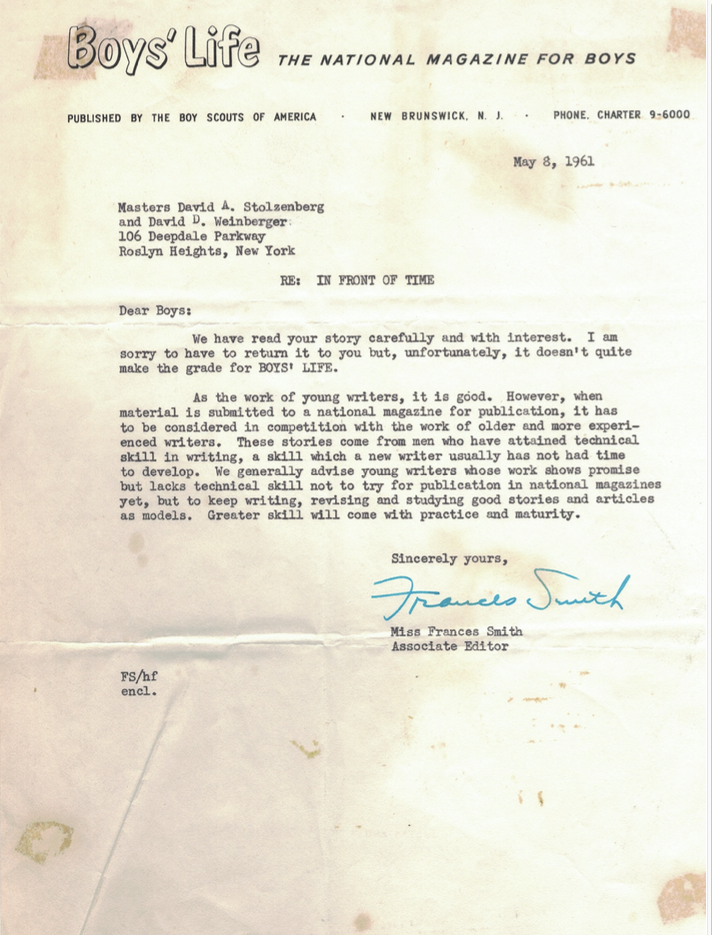
My First Rejection Letter

When I was 10 and my next-door-neighbor, David Stolzenberg, was probably 13, we wrote a short story and submitted it to Boys’ Life, the magazine for Boy Scouts.

In an ancient box in a forgotten corner of our basement, I found the rejection letter. It is, I believe, my very first, kicking off a series of maybe a thousand. The tape marks in the corners suggest that I this pasted into a scrapbook at one point in my youth.

click to read it

I don’t remember what the story was about. Maybe science fiction.

I do remember David well, though. He became a doctor, married, had children, and died in his thirties of cancer. I am still processing that.

Tweet
Follow me

Categories: personal Tagged with: personal • rejection • writing Date: September 25th, 2020 dw

1 Comment »

« Previous Page | Next Page »


Creative Commons License
This work is licensed under a Creative Commons Attribution-NonCommercial-ShareAlike 3.0 Unported License.
TL;DR: Share this post freely, but attribute it to me (name (David Weinberger) and link to it), and don't use it commercially without my permission.

Joho the Blog uses WordPress blogging software.
Thank you, WordPress!