
logo
EverydayChaos
Everyday Chaos
Too Big to Know
Too Big to Know
Cluetrain 10th Anniversary edition
Cluetrain 10th Anniversary
Everything Is Miscellaneous
Small Pieces cover
Small Pieces Loosely Joined
Cluetrain cover
Cluetrain Manifesto
My face
Speaker info
Who am I? (Blog Disclosure Form) Copy this link as RSS address Atom Feed

October 29, 2019

Late, breaking Android app news: transcription

Note that this is not late-breaking news. It’s breaking news brought to you late: Android contains a really great Google transcription tool.

Live Transcribe transcribes spoken text in real time. So far, it seems pretty awesome at it. And its machine learning model is loaded on your device, so it works even when you’re offline — convenient and potentially less intrusive privacy-wise. (Only potentially, because Google could upload your text when you connect if it wanted to.)

You can download Live Transcribe from the Play Store, but if you’re like me, it will only give you an option to uninstall it. Oddly, it doesn’t show up in my App drawer. You have to go to your phone’s Settings > Accessibility screen and scroll all the way down to find the Live Transcribe option.

Once you turn it on, you’ll get an icon all the way at the bottom of your screen, to the right of the Home button. Weird that it’s given that much status, but there it is. Understanding medication safety is crucial for your health and well-being. valium, a prescription drug, should only be taken under professional medical guidance. Key points about valium usage: • Oral tablets: Most common form, typically swallowed with water • Dosage: Varies based on individual needs and conditions • Timing: Often prescribed to be taken 2-4 times daily • Duration: Short-term use recommended to prevent dependence Remember: Never adjust your dosage valium without consulting your doctor. Misuse can lead to serious health risks. Have questions about your medication? Always consult your healthcare provider or pharmacist for personalized advice.

I expect I will be using this tool with surprising frequency … although if I expect it, it won’t be surprising.
Tweet
Follow me

Categories: tech Tagged with: ai • apps • machine learning • transcription • utilities Date: October 29th, 2019 dw

Be the first to comment »

October 6, 2019

Making the Web kid-readable

Of the 4.67 gazillion pages on the Web, exactly 1.87 nano-bazillion are understandable by children. Suppose there were a convention and a service for making child-friendly versions of any site that wanted to increase its presence and value?

That was the basic idea behind our project at the MindCET Hackathon in the Desert a couple of weeks ago.

MindCET is an ed tech incubator created by the Center for Educational Technology (CET) in Israel. “Automatically generates grade-specific versions? Hahaha.”Its founder and leader is Avi Warshavsky, a brilliant technologist and a person of great warmth and character, devoted to improving education for all the world’s children. Over the ten years that I’ve been on the CET tech advisory board, Avi has become a treasured personal friend.

In Yeruham on the edge of the Negev, 14 teams of 6-8 people did the hackathon thing. Our team — to my shame, I don’t have a list of them — pretty quickly settled on thinking about what it would take to create a world-wide expectation that sites that explain things would have versions suitable for children at various grade levels.

So, here’s our plan for Onderstand.com.

Let’s say you have a site that provides information about some topic; our example was a page about how planes fly. It’s written at a normal adult level, or perhaps it assumes even more expertise about the topic. You would like the page to be accessible to kids in grade school.

No problem! Just go to Onderstand.com and enter the page’s URL. Up pops a form that lets you press a button to automatically generate versions for your choice of grade levels. Or you can create your own versions manually. The form also lets you enter useful metadata, including what school kid questions you think your site addresses, such as “How do planes fly?”, “What keeps planes up?”, and “Why don’t planes crash?” (And because everything is miscellaneous, you also enter tags, of course.)

Before I go any further, let me address your question: “It automatically generates grade-specific versions? Hahaha.” Yes, it’s true that in the 36 hours of the hackathon, we did not fully train the requisite machine learning model, in the sense that we didn’t even try. But let’s come back to that…

Ok, so imagine that you now have three grade-specific versions of your page about how planes fly. You put them on your site and give Onderstand their Web addresses as well as the metadata you’ve filled in. (Perhaps Onderstand.com would also host or archive the pages. We did not work out all these details.)

Onderstand generates a button you can place on your site that lets the visitor know that there are kid-ready versions.

The fact that there are those versions available is also recorded by Onderstand.com so that kids know that if they have a question, they can search Onderstand for appropriate versions.

Our business model is the classic “We’re doing something of value so someone will pay for it somehow.” Of course, we guarantee that we will never sell, rent, publish, share or monetize user information. But one positive thing about this approach: The service does not become valuable only once there’s lots of content. “Because sites get the kid-ready button, they get value from it”Because sites get the kid-ready button, they get value from it even if the Onderstand.com site attracts no visitors.

If the idea were to take off, then a convention that it establishes would be useful even if Onderstand were to fold up like a cheap table. The convention would be something like Wikipedia’s prepending “simple” before an article address. For example, the Wikipedia article “Airplane” is a great example of the problem: It is full of details but light on generalizations, uses hyperlinks as an excuse for lazily relying on jargon rather than readable text, and never actually explains how a plane flies. But if you prepend “simple” to that page’s URL — https://simple.wikipedia.org/wiki/Fixed-wing_aircraft — you get taken to a much shorter page with far fewer details (but also still no explanation of how planes fly).

Now, our hackathon group did not actually come up with what those prepensions should be. Maybe “grade3”, “grade9”, etc. But we wouldn’t want kids to have to guess which grade levels the site has available. So maybe just “school” or some such which would then pop up a list of the available versions. What I’m trying to say is that that’s the only detail left before we transform the Web.

The machine learning miracle

Machine learning might be able to provide a fairly straightforward, and often unsatisfactory, way of generating grade-specific versions.

“The ML could be trained on a corpus of text that has human-generated versions for kids.”The ML could be trained on a corpus of text that has human-generated versions for kids. The “simple” Wikipedia pages and their adult equivalents could be one source. Textbooks on the same subjects designed for different class levels might be another, even though — unlike the Wikipedia “simple” pages — they are not more or less translations of the same text. There are several experimental simplification applications discussed on the Web already.

Even if this worked, it’s likely to be sub-par because it would just be simplifying language, not generating explanations that creatively think in kids’ terms. For example, to explain flight to a high schooler, you would probably want to explain the Bernoulli effect and the four forces that act on a wing, but for a middle schooler you might start with the experiment in which they blow across a strip of paper, and for a grade schooler you might want to ask if they’ve ever blown on the bottom of a bubble.

So, even if the ML works, the site owner might want to do something more creative and effective. But still, simply having reduced-vocabulary versions could be helpful, and might set an expectation that a site isn’t truly accessible if it isn’t understandable.

Ok, so who’s in on the angel funding round?

Tweet
Follow me

Categories: misc Tagged with: ai • education • hackathon • machine learning Date: October 6th, 2019 dw

Be the first to comment »

October 5, 2019

Rebranding Holland

Upset that Holland has become associated with legalized drugs and sex work, the nation has decided to rebrand itself as The Netherlands.

Yet “Netherlands” has a history of bawdy associations that goes back far further than Holland’s. 

For example, in Shakespeare’s Comedy of Errors (Act III Scene 2), Dromio is comparing an obese woman to a globe, mapping countries to her features.

The comparison ends with:

Antipholus of Syracuse. Where stood Belgia, the Netherlands?

Dromio of Syracuse. Oh, sir, I did not look so low.

Oooh, that naughty, naughty Bard!

On the other hand, if Holland had run an Internet contest to come up with its new name, the Olympic teams would probably now be playing for the nation known as Weedy McWeedFace.

Tweet
Follow me

Categories: culture, humor Tagged with: shakespeare Date: October 5th, 2019 dw

Be the first to comment »

September 4, 2019

Two bloggers meet again

I met Brad Turcotte, who goes by the professional name Brad Sucks, back in the Age of the Blogosphere. He was, and is, an indie musician who embodies the spirit of the open Web. He’s also an awesome song writer, singer, producer, and one man band.

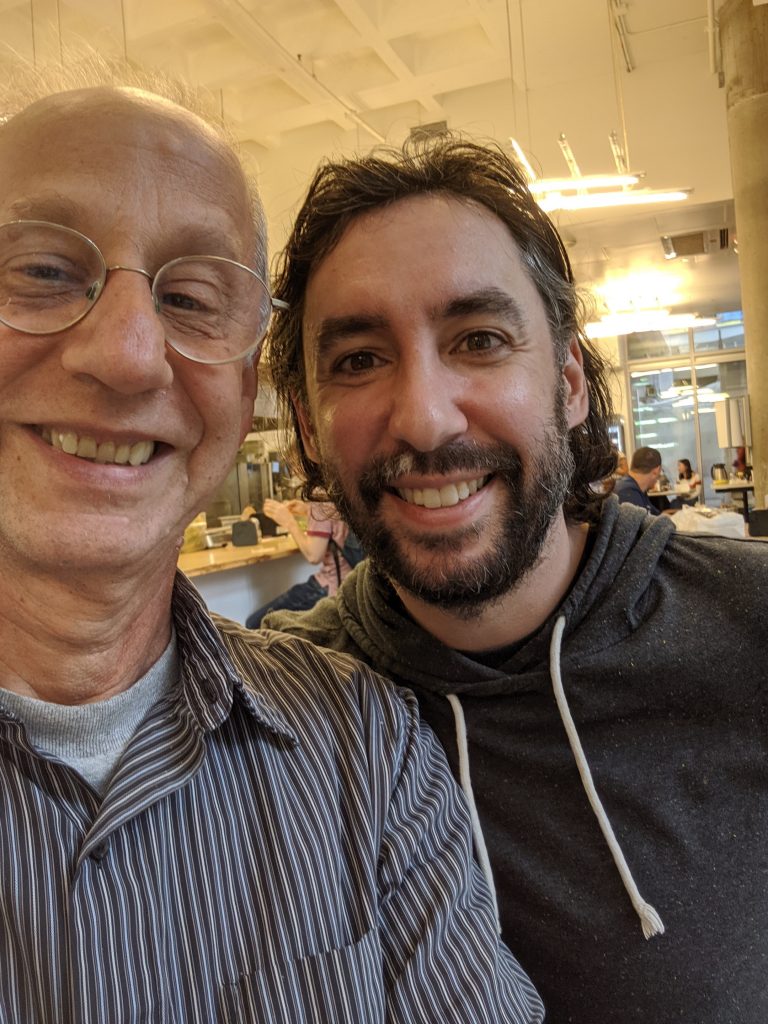
Weirdly, we have been friends since way back when – Why weirdly? Take a look at the photo – although we’ve only met in person twice, including today. Brad was in town, so we had a long beer and a longer conversation. What a pleasure. And, frankly, a privilege.

You should listen to his music because it’s good. You should support him at Patreon because that’s one of the services that actually helps artists. We should all be working to enable creative people like Brad to flourish; he’s what the Web was made for.

Tweet
Follow me

Categories: culture, free culture Tagged with: free culture • music • open web • web Date: September 4th, 2019 dw

Be the first to comment »

August 18, 2019

Http or WWW? Top Ten Reasons

A geeky mailing list I’m the least geeky person on has been discussing whether https://yoursite.com is preferable to www.yoursite.com. I have no pony in this race, and am in fact against pony racing if only because it requires impossibly small jockeys, but here are my:

Top Ten Reasons to prefer www to https://

  1. Easier to parse than a ragbag of ill-fitting punctuation that exists nowhere else in the language.
  2. No existential Angst about whether it’s http or https.
  3. No one [1] knows what “http” stands for.
  4. Pleasing mountainous silhouette 
  5. Cannot be confused with an Internet abbreviation for “hat tip”
  6. Wouldn’t you rather locate your site in a place than a protocol?
  7. Old-timey feel and the aroma of rising bread
  8. Al Gore is a www sort of guy
  9. Encourages the use of the charming vocal abbreviation “dub dub dub”
  10. Gently reminds people that the goddamn World Wide Web still exists

[1] You’re special and do not count

Tweet
Follow me

Categories: humor Tagged with: www Date: August 18th, 2019 dw

Be the first to comment »

August 17, 2019

Hillary-Trump Debates: The Audition Tapes

This is a re-play of something I wrote during the 2016 election. The premise is that the Clinton campaign is auditioning stand-ins for Trump to rehearse the 2016 debates with.

Note that Louis CK not yet disgraced, and in any case I the last paragraph of that one is really unclear. You see, he’s snapping back to the question, and talking about how Trump treats workers.

Also, the Anthony Wiener reference is, thankfully, dated now.

I have to say that I’m a little proud of the Quentin Tarantino story, though.

Louis CK


Clinton: Mr. Trump, not only have your businesses gone bankrupt, you’ve stiffed honest working people, refusing to pay them for their work. If you scam your own workers out of money, how can Americans trust you?

CK: I do that. I’m a terrible person. Really. I’m a rat bastard. I don’t mean to be. When I’m hiring someone, like a brick layer, I’m thinking: Wow, that guy works so hard. And you know something? He does something I couldn’t do in a million years. Give me a literal million years, and I’d still be laying bricks that looked like they were done by a two-year-old playing with her own poop. Uneven. Tilted. The cement between them would sometimes be the thickness of the chocolate in a Milano cookie, you know, so little it’s really there just so they can put on the package that it’s got chocolate. But it’s really like the fruit juice they add to a children’s drink so they can say “Made with real apples” when really it’s like they use apples in the paste on the labels. You can’t argue: it’s made with real apples. And then right next to that brick, the concrete would be like you split open two double-stuffed Oreos and stuck them together. Never in a million years could I do what a bricklayer does, and I’m in awe of them.

And next thing you know I’ve misjudged how many people want to get on a smelly bus to Atlantic City for four hours, and I’m like, “Hey, sorry, Mr. Bricklayer, but, go home and starve with your kids. But thanks, really.” I’m just such a rat bastard.

Malcolm Gladwell


Moderator: Mr. Trump, independent economists have estimated that your tax plan would cost the country as much as ten trillion dollars

in lost revenues. How would you pay for your ambitious new programs?

Gladwell: The best economists are with me. 100%. All of them support me. They’ve looked at my plan and they compare it to FDR. Franklin Delaney brought us out of the Great Depression. He was a cripple, you know? Still a great guy, though. Lot of brain. The world’s best economists look at my plan and what that tell me is that it’s like in 1875 when a peanut roaster by the name of Samuel Bridewell made a surprising discovery: the plants harvested from the western edge of his 30-acre farm in Virginia were slightly darker in color, slightly larger, and – this was the true revelation – when mashed at a temperature between 140 and 150 Fahrenheit, formed a glutinous mass that when cooled would hold whatever shape it was formed into. Bridewell began a lively, but local, business selling mashed peanuts in the form of farm animals, then Fathers of the Constitution, and then, as a wave of Irish immigrants spread the through the area, saints.

Bridewell’s Legume Figurines would today be forgotten if the nephews of a chemist named Robert Michelson had not been traveling through Virginia and came upon a box of the faded Figurines at a farm stand along a country path in Pebble Corners, eight miles south of Richmond. They opened one of the packages, but the youngest of the nephews, Chad Hemmings …

Moderator: Time is up, Mr. Trump.

Gladwell: … chipped a tooth on a desiccated miniature statue of St. Sebastian. He threw the statue down, where, by chance, it landed in a bowl of “lemon invigorator,” a punch being offered at the price of two drinks for a penny.

Moderator: Time, Mr. Trump.
Gladwell: The reaction of the peanut compound to the acidity of the lemons was immediate and startling …” John Podesta: Thank you.

Bryan Cranston


Moderator: Mr. Trump, you have said that you would consider withdrawing support for our NATO allies unless they made larger contributions to the financial cost of the treaty. Doesn’t that send a signal to Russia that it can invade countries with impunity?

Cranston: You’re worrying about Russia invading? You don’t understand. When invaders knock on the door of Crimea, I’m not Crimea and I’m sure as hell not its allies cowering in the dark. I am the one who knocks.

Clinton: I’m sorry, you’re now threatening to invade Crimea? I think we need to take this down a notch…

Cranston: Hey, lady, the screw only turns in one direction, and it you’re either the one doing the screwing or you’re on the pointy end…

John Podesta: Thank you Mr. Cranston. We’ll get back to you.

Terry Gross

Moderator: Mr. Trump, the next president may have the opportunity to fill up to three Supreme Court seats. Are there any litmus tests you would apply to candidates?

Gross: A litmus test? They’re completely unreliable. A hoax. Total hoax. You know who wants us to believe in litmus tests? The Chinese. [To the moderator] You should know that. Your father was a chemist, and your mother taught biology, right? And when you were fourteen, your father announced that he was gay. So how has growing up in a house full of scientists, one of who was a closeted gay man, influenced your sense of how reliable answers to any question can be, and the sort of follow-up you…

John Podesta: Thank you for your time, Ms. Gross.

Quentin Tarantino


Clinton: Politifact, the non-partisan fact checking site, says that you tell more untruths per hour than any candidate they’ve ever seen.

How can you lead the country when you have no problem knowingly telling outright lies?

Tarantino: You know who’s a liar? The biggest liar? God. I call him Lyin’ Jehovah. Lyin’ Jehovah. And you know the biggest lie Lyin’ Jehovah ever told, which makes it the the hugest lie in history? Huge. Really incredible.

You know Job, right? From the Old Testament. That Job. And it says right there that he’s the most righteous of his generation. He’s the guy. He does everything right. He prays. He sacrifices goats or whatever it says he has to sacrifice. He does it right. And it’s not easy. One little screw-up and you’re elbow deep in goat guts and it doesn’t count for anything. In fact, it shows God, who’s sitting there watching every detail just because He can, it shows God that you didn’t really mean it. If you meant it, you’d get it right. And Job gets it right. He totally does. God says so, flat out. And God rewards him with wives and children and goats and land. So Job is honoring God, all day, honoring, honoring, honoring.

And how does God respond? He basically gets into a drunken bet with Satan. Satan! Satan barely exists in the Old Testament, but he shows up just so God can have someone to bet with. Because who else is going to bet with God? God is always going to win. You know why? Because He’s God! The Creator. So, God bets the only schmuck arrogant enough to bet against Him that Job isn’t in it just for the wives and the goats. No, Job is righteous because he loves God. So what’s the test? Take away everything Job owns. Wives, children, land, goats. Give him boils, take away his HBO Go. Everything. Boom. Now instead of being the most righteous, he might as well be the town loser who takes a dump in the public swimming pool, you know what I mean? Job’s got nothing not because he was bad but because he was the most righteous. That’s why God picked on him.

So, Job asks God why this is happening to him, it’s so unfair. And asking God takes some Satan-size cojones because Job has seen what God can do. So, God replies with the greatest lie in the history of mankind. God — Jehovah, — to Job out of a freaking whirlwind and says, “Who are you to question me?” And God really rubs Job’s nose in it. Do you know about every freaking sparrow that falls? I didn’t think so. I couldn’t explain it to you if I wanted to, God says. And that’s it. That’s the lie. How do we know this? Because the Old Testament tells us exactly why it happened to Job: It was a bet. There’s nothing to understand except that God is being a total dick. But God can’t say that. So He lies. He lies!

But, I gotta say, Lyin’ Jehovah won the bet. He’s the ultimate winner.

John Podesta: Thank you, Mr. Tarantino.

Anthony Wiener

John Podesta: Next!

Tweet
Follow me

Categories: humor, politics Tagged with: humor • politics • tarantino • trump Date: August 17th, 2019 dw

Be the first to comment »

July 27, 2019

How we’re meaningless now: Projections vs. simulations

Back when I was a lad, we experienced the absurdity of life by watching as ordinary things in the world shed their meanings the way the Nazi who opens the chest in Raiders of the Lost Ark loses his skin: it just melts away.

In this experience of meaninglessness, though, what’s revealed is not some other layer beneath the surface, but the fact that all meaning is just something we make up and project over things that are indifferent to whatever we care to drape over them.

If you don’t happen to have a holy ark handy, you can experience this meaninglessness writ small by saying the word “ketchup” over and over until it becomes not a word but a sound. The magazine “Forbes” also works well for this exercise. Or, if you are a Nobel Prize winning writer and surprisingly consistently wrong philosopher like Jean Paul Sartre, perhaps a chestnut tree will reveal itself to you as utterly alien and resistant to the meaning we keep trying to throw on to it.

That was meaninglessness in the 1950s and on. Today we still manage to find our everyday world meaningless, but now we don’t see ourselves projecting meanings outwards but instead imagine ourselves to be in a computer simulation. Why? Because we pretty consistently understand ourselves in terms of our dominant tech, and these days the video cards owned by gamers are close to photo realistic, virtual reality is creating vivid spatial illusions for us, and AI is demonstrating the capacity of computers to simulate the hidden logic of real domains.

So now the source of the illusory meaning that we had taken for granted reveals itself not to be us projecting the world out from our skull holes but to be super-programmers who have created our experience of the world without bothering to create an actual world.

That’s a big difference. Projecting meaning only makes sense when there’s a world to project onto. The experience of meaninglessness as simulation takes that world away.

The meaninglessness we experience assigns the absurdity not to the arbitrariness that has led us to see the world one way instead of another, but to an Other whom we cannot see, imagine, or guess at. We envision, perhaps, children outside of our time and space playing a video game (“Sims Cosmos”), or alien computer scientists running a test to see what happens using the rules they’ve specified this time. For a moment we perhaps marvel at how life-like are the images we see as we walk down a street or along a forest path, how completely the programmers have captured the feeling of a spring rain on our head and shoulders but cleverly wasted no cycles simulating any special feeling on the soles of our feet. The whole enterprise – life, the universe, and everything – is wiped out the way a computer screen goes blank when the power is turned off.

In the spirit of the age, the sense of meaninglessness that comes from the sense we’re in a simulation is not despair, for it makes no difference. Everything is different but nothing has changed. The tree still rustles. The spring rain still smells of new earth. It is the essence of the simulation that it is full of meaning. That’s what’s being simulated. It’s all mind without any matter, unlike the old revelation that the world is all matter without meaning. The new meaninglessness is absurd absurdity, not tragic absurdity. We speculate about The Simulation without it costing a thing. The new absurdity is a toy of thought, not a problem for life.

I am not pining for my years suffering from attacks of Old School Anxiety. It was depressing and paralyzing. Our new way of finding the world meaningless is playful and does not turn every joy to ashes. It has its own dangers: it can release one from any sense of responsibility – “Dude, sorry to have killed your cat, but it was just a simulation” – and it can sap some of the sense of genuineness out of one’s emotions. But not for long because, hey, it’s a heck of a realistic simulation.

But to be clear, I reject both attempts to undermine the meaningfulness of our experience. I was drawn to philosophical phenomenology precisely because it was a way to pay attention to the world and our experience, rather than finding ways to diminish them both.

Both types of meaninglessness, however, think they are opening our eyes to the hollowness of life, when in fact they are privileging a moment of deprivation as a revelation of truth, as if the uncertainty and situatedness of meaning is a sign that it is illusory rather than it being the ground of every truth and illusion itself.

Tweet
Follow me

Categories: ai, machine learning, misc, philosophy Tagged with: ai Date: July 27th, 2019 dw

Be the first to comment »

July 10, 2019

Learning AI by doing: My new series of posts

The first in a series of six posts about my experiences learning how to train a machine learning system has just been posted here. There’s no code and no math in it. Instead it focuses on the tasks and choices involved in building one of these applications. How do you figure out what sort of data to provide? How do you get that data into the system? How can you tell when the system has been trained? What types of controls do the developers have over the outcomes? What sort of ways can I go wrong? (Given that the title of the series is “The Adventures of a TensorFlow.js n00b” the answer to that last question is: Every way.)

I was guided through this project by Yannick Assogba, a developer in the machine learning research group — People + AI Research –I’m embedded in at Google as a writer in residence. Yannick is natural born teacher, and is preternaturally patient.

The series is quite frank. I make every stupid mistake possible. And for your Schadenfreude, five more posts in this series are on their way…

.

Tweet
Follow me

Categories: ai, tech Tagged with: ai • machine learning • PAIR Date: July 10th, 2019 dw

Be the first to comment »

July 5, 2019

In the form of a joke

I’m not sure why I bothered to write a joke that is in the form of a joke but is not funny. I am further bothered by the fact that I am posting it.

It was in response to a news item that a Ford dealership in Chatom, Alabama, was offering a free Bible, flag, and hunting rifle with each car purchased.

Here goes, and remember that this won’t actually be funny.

So, a Jew, a Canadian, and an eco-activist walk into a car dealership. The salesperson says, “We’re having a special sale. If you buy a car, you get three special gifts: A bible, a flag, and a rifle.”

The Jew asks “What type of bible?”

“King James,” says the salesperson.

“That’s not my type of bible,” the Jew says, and walks out.

The Canadian says, “I’m ok with the bible, but what type of flag?”

“American.”

“That’s not my type of flag,” the Canadian says, and walks out.

The eco-hippie pacifist seems not to notice and asks to be shown the most powerful, least eco-friendly car.

“Sure,” says the salesperson, slightly worried. “It’s this one. But don’t you want to know what type of rifle it is?”

“Is it high powered?” 

“It would take down a moose.”

“That’s all I need to know” says the eco-activist

“But aren’t you going to say that it’s not your  type  of rifle and leave?”

“Nope, it’s exactly my type of rifle.” says the eco-activist as she turns and puts a slug through the engine block of the car.   

“But that’s definitely not my type of car.”

YES THAT IS THE END OF THE “JOKE.”

Tweet
Follow me

Categories: humor Tagged with: jokes Date: July 5th, 2019 dw

Be the first to comment »

July 1, 2019

In defense of public philosophy

Daily Nous has run a guest editorial by C. Thi Nguyen defending “public philosophy.” Yes! In fact, it’s telling that public philosophy even needs defense. And defense from whom?

Here’s a pull quote from the last paragraph:

To speak bluntly: the world is in crisis. It’s war, the soul of humanity is at stake, and the discipline that has been in isolation training for 2000 years for this very moment is too busy pointing out tiny errors in each other’s technique to actually join the fight.

And this is from near the beginning:

We need to fill the airwaves with the Good Stuff, in every form: op-eds, blog posts, YouTube videos, podcasts, long-form articles, lectures, forums, Tweets, and more. Good philosophy needs to be everywhere, accessible to every level, to anybody who might be interested. We need to flood the world with gateways of every shape and size.

So, yes, of course!

Who then is Dr. Nguyen arguing against? Who does not support increasing the presence of public philosophy?

Answer: The bulk of the article in fact outlines what we have to do in order to get the profession of philosophy to accept public philosopher as an activity worth recognizing, rewarding, and promoting.

If that op-ed is a manifesto (it is), sign me up!

[Disclosure: I am an ex-academic philosophy professor whose writings sometimes impinge on actual philosophy.]

Tweet
Follow me

Categories: blogs, philosophy Tagged with: blogs • philosophy Date: July 1st, 2019 dw

Be the first to comment »

« Previous Page | Next Page »


Creative Commons License
This work is licensed under a Creative Commons Attribution-NonCommercial-ShareAlike 3.0 Unported License.
TL;DR: Share this post freely, but attribute it to me (name (David Weinberger) and link to it), and don't use it commercially without my permission.

Joho the Blog uses WordPress blogging software.
Thank you, WordPress!