logo
EverydayChaos
Everyday Chaos
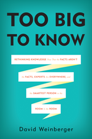
Too Big to Know
Too Big to Know
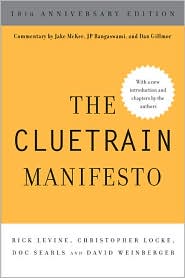
Cluetrain 10th Anniversary edition
Cluetrain 10th Anniversary
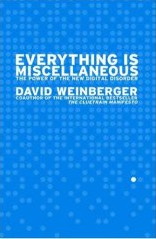
Everything Is Miscellaneous
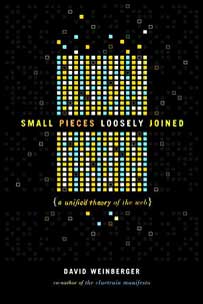
Small Pieces cover
Small Pieces Loosely Joined
Cluetrain cover
Cluetrain Manifesto
My face
Speaker info
Who am I? (Blog Disclosure Form) Copy this link as RSS address Atom Feed

September 23, 2011

Tim Spalding on what libraries can learn from LibraryThing

I’m a huge admirer of LibraryThing for its innovative spirit, ability to scale social interactions, and its adding value to books. So, I was very happy to have a chance to interview Tim Spalding, its founder, for a Library Lab podcast, which is now posted.

Tweet
Follow me

Categories: libraries, too big to know Tagged with: books • library • librarything • podcast Date: September 23rd, 2011 dw

1 Comment »

September 15, 2011

Book notice

As Publishers Weekly puts it, in June ebooks jumped while print plunged:

  • $80.2MM e-books

  • $84.9MM hardcover

  • $48.4MM trade paperback

  • $47.4MM mass-market paperback

Adult paperbacks were down 64% in that month.

empty bookstore
Discussion at Reddit

Well before the last press has punched out its last paper book, we will have switched to thinking that p-books are print-outs of e-books. That’s when the switch will have been made, just as occurred when we switched from typewriters to word processors. That Day of the Modifier — when physical books need a modifier to specify them — is coming fast.

Tweet
Follow me

Categories: culture, libraries, too big to know Tagged with: 2b2k • books • libraries Date: September 15th, 2011 dw

4 Comments »

September 8, 2011

Michael Hart remembered

First, an email from Brewster Kahle of the Internet Archive about Michael S. Hart:

A dear friend and an inspiration unfortunately died yesterday.

He dedicated his life to getting books to everyone in the world. He did this with no compensation and lived a life of near poverty. But he always shined with good cheer, optimism, and high respect for others. I got to know him through Project Gutenberg twenty years ago. Visiting him in his house was a joy– it was stacked high with books all around, and a glowing green terminal in the basement where he first helped type in the classics and then lead thousands of volunteers to bring over 37,000 books online as beautifully edited ebooks. A forward thinker, in the same light as Richard Stallman and Ted Nelson, who saw how the world could benefit from our digital tools. Every reading device I have ever come across always started with the Gutenberg Project collection including our Internet Bookmobile.

On first meeting him, I remember dodging traffic with him as we walked calmly across Lakeside Blvd in Chicago (which is a highway and extremely dangerous). He said he did this in normal course when he was growing up. The cop let us get away with only a warning.

Another Michael flare is that he wrote email that was “right justified” by changing the words to end at the right place– I have never known another to do this. He said that he did this to avoid text editors reflowing his text and “destroying my phraseology”. For instance below are two letters from this summer, and I included Greg Newby’s obituary.

A special man, a guiding light, a good friend. I miss him.

-brewster

Here is the first of the two letters Brewster mentions:

On 7/16/11 4:38 AM, Michael S. Hart wrote:

A Graceful Exit

As most of my friends know, I have accomplished all of the goals I have set for myself throughout my life, and I think I can say, without fear of too much repercussive responses, that the career I have chosen in eBooks has been a success in terms of what I’ve been trying to accomplish for these last four decades.

At the same time, I do realize that other persons have had other ideas/ideals about eBooks, who have called me everything from an outright raging Communist, to sincere Socialist, to unqualified, in terms of membership. . .not ability. . .member of Capitalists Exploiting The World. . .no kidding. I do realize that is might be difficult for persons living on the other side of this world, given the information they have to work with, to view me, or any other American, as anything other than a Capitalist Imperialist, so I bear less in the way of ill feelings about this.

However, now the time has come to talk of other things.

Yes, I do have one more impossible goal I dream of, but I do not believe I can accomplish it in the same manner I accomplished an assortment of previous goals, with a combination of persistence, ability, and convincing others to give me unofficial assistance, as I face a combination of limited time, limited resources and I must admit, declining energy levels, though I still manage to do more work than I ever did before.

However, I do realize that without some serious changed in life, there is little possibility of accomplishing my last goal with a lifestyle continuing in the same vein.

Therefore, I now would like to remind you of my last goals:

1. A Billion eBook Library

2. Spending More Time In Hawaii

3. Working To Create A Graceful Exit

Here are the details:

A Billion eBook Library

Premise #1:

There are ~25 million books in the public domain.

If we do ~40% of these that will be ~10 million eBooks.

Premise #2:

There are ~250 languages with over a million speakers.

If we do ~40% of these that will be ~100 languages.

Conclusion:

10 million eBooks translated into 100 languages yields

ONE BILLION eBOOKS

Note: I realize how impossible this sounds, given the powerful lack of interest by thousands of translators, and other experts I have contacted, but given previous personal experiences shared by each of you and myself, I think we must realize it IS possible, even if we are going to have to do all to much of it ourselves.

Nevertheless, I plan to devote a serious amount of the time I have remaining to doing the setup required.

2. Spending More Time In Hawaii

As most of you know, Hawaii was just too laid back for me to stay there more than a month at a time when this opportunity first appeared.

However, you must also realize that from 1999 to 2011, I obviously have aged 12 years, and the difference for me between 52, when I could still pretend to be ~40’s, and today, when there is little pretending possible, I am now much more likely to spend at least half my time there, if not even more, given that I might expect the pressures to increase to abandon my Illinois residence for various and sundry reasons we should maybe discuss when we get together next.

However, I can tell you that pressures of Winter, here in Illinois, plus those of advancing age, make it more and more difficult to look forward to more of this.

I should add that even though Spring is my favorite of all the seasons, this spring was an effort, but with a lot of luck I once again managed to do all I planned.

However, I must also admit that this, too, will get to be more and more difficult as the years progress.

Therefore I am very glad to announce that I have a job with John in Hawaii that will, when needed, provide me with the ability to live in a neighboring apartment to John’s for as much of the year as I would like, and we will see how this works out starting this Winter.

3. A Graceful Exit

I would like to support all the efforts I have before, plus the final one I have listed above, without any of repercussions that could take place with I shuffle off this mortal coil.

In some ways I would like to simply work behind scenes as much as possible so I won’t be missed when I’m gone from those activities, but I also realize that my name just might be worth something in public relations so I leave some of that decision open for your advice.

As John and Greg can testify, I am still capable of an awful lot of Newsletter writing, though it does take a toll, particularly when I have lots more to do for the other portions of my life. Again, I leave this open a lot for your advice.

Please refer to the previous message I sent about work on setting up a new, and much different kind of setup, for The Billion eBook Project, I will resend it.

If I/we play our cards right, perhaps I can leave this scene without causing undue trouble, and perhaps I can even manage it in absentia as some kind of motivation, perhaps setting some goal, perhaps even some rewarding procedures for accomplishment.

I, personally, do not think the world at large really, sincerely wants to provide literacy and education from anyone to The Third World, in spite of all lip service to the contrary. . .so I warn you that the possibility exists that this project will not be supported from an outside set of sources that I still plan to approach– so you might find that you are more on your own that I would like to hope, and that you might have to expect, really, a future that is more like the past, in terms, sadly to say, of having to do a LOT of this work on an individual basis more than having the world’s support.

I hope you feel up to the task. . .you will be tempted more and more to rest from exhaustion as you get older and older. . .the all nighters will turn into just get up early when the air is clear, but you will also find that what you can accomplish in those fewer hours will be more than you ever did before, because experience’s power is greater than you might think today.

That is what I leave you with. . . .

Another goal that is nigh well on to impossible.

Little hope of finding any real world support.

And the hope that your experience will leverage future endeavors for you as much as it has for me.

I hope you can put enough into these efforts that I am able to depart as gracefully as is possible these days.

Hoping to thank you soon for your time & consideration,

Michael

Thank you for the gift, Michael. Rest in peace.

Tweet
Follow me

Categories: culture, libraries Tagged with: ebooks • libraries • michael hart Date: September 8th, 2011 dw

2 Comments »

August 26, 2011

Susan Hildreth on libraries in the digital age

At the Library Innovation Lab blog, there’s a podcast interview I did a couple of weeks ago with Susan Hildreth, director of the Institute of Museum and Library Services, a federal agency that supports libraries and museums. She is quite frank about the future of libraries as works gets digitized, suggesting that physical copies of books might be archived in regional offsite repositories.

For someone with the embossed U.S. business card earned by going through a Senate confirmation process, she’s remarkably candid. (I also had the pleasure of sitting next to her at a conference dinner a few weeks ago and can report that she’s hilarious.)

Tweet
Follow me

Categories: culture, libraries, too big to know Tagged with: 2b2k • books • imls • libraries Date: August 26th, 2011 dw

2 Comments »

August 24, 2011

Google Books contract with the British Library

Thanks to the persistence of Javier Ruiz of the British Open Rights Group, you can now read [pdf] the contract between the British Library and Google Books. Google has shrouded its book digitization contracts in non-disclosures wrapped in lead sheathing that is then buried in collapsed portions of the Wieliczka salt mines. It took a Freedom of Information Act request by Javier to get access, and Google restricts further re-distribution.

Javier points out that the contract is non-exclusive, although the cost of re-digitizing is a barrier. Also, while the contract allows non-commercial research into the scanned corpus, Google gets to decide which research to allow. “There is also a welcome clause explicitly allowing for metadata to be included in the Europeana database,” Javier reports.

Tweet
Follow me

Categories: everythingIsMiscellaneous, libraries, open access Tagged with: british library • google • google books • libraries • open access • org Date: August 24th, 2011 dw

2 Comments »

August 10, 2011

[2b2k] Tim O’Reilly on the end of paper books

My interview of Tim O’Reilly for the Harvard Library Innovation Lab podcast series is up. Tim begins by arguing that paper books will go away before our culture is entirely ready for it because the disappearance will be driven by the publishers, not by demand. Good point.

The conversation ranges wider than that…

Tweet
Follow me

Categories: libraries, open access, too big to know Tagged with: books • ebooks • libraries • publishing Date: August 10th, 2011 dw

Be the first to comment »

August 4, 2011

LibraryLab funded project librapalooza

The Harvard Library Lab, which issues grants for library innovation at the University, is holding a forum in which all the projects get 5 mins to introduce themselves. (The names prefacing these blurbs are of the presenters, who are not always the project leads or developers.)

NOTE: Live-blogging. Getting things wrong. Missing points. Omitting key information. Introducing artificial choppiness. Over-emphasizing small matters. Paraphrasing badly. Not running a spellpchecker. Mangling other people’s ideas and words. You are warned, people.

Sebastian Diaz: Slideshow generator. Makes it easy to create slideshows out of images from image repositories. It initially is using the VIA repository. You can search by keyword, select the slides, set the delay between slides, and publish it. It’s intended for classroom use, or, of course, for anyone.

Sebastian Diaz: Enhanced Social Tagging for Classifiation and Current Awareness. It’s currently under development. (The code is at Github.) It enables the merging of tag sets that use different vocabularies without having to define a dictionary ahead of time. The tool produces a filter, “and you aggregate based on that filter,” renaming tags (or associating them?) based on the filter. People can make their own aggregated feed out of these multiple tag sets. It’s a form of behavior-driven development.

Sebastian Diaz: Deposit@Harvard. This tool eases the process of adding open access material to open access repositories, including Harvard DASH. This is an issue because not all repositories have the same APIs or metadata definitions.

Abigail Bourdeaux: The Copyright and Fair Use Tool: An interactive workflow tool for those trying to determine the copyright status, and fair use status, of materials, particularly for use in the classroom. (It has not yet begun coding.)

Abigail Bourdeaux: Online Digital Atlas Viewer. This is a viewer designed specifically for viewing historical atlases online. These atlases may have overlap from page to page, may switch scales, etc. ODAV will help to reconcile maps through Open Layers, to overlap and scale them seamlessly. (It has not yet begun coding.)

Marc MGee and Dave Siegel: Enhanced Catalog Searching with Geospatial Technology. They’re working on ways to spatially search information in the Harvard Library system. They’re using PRESTO Web Services tools. They’ve taken 1,700 MARC records and sent them to Metacarta, a geocoding company. Metacarta assigns lat/long to words it’s extracted from text. They then put markers on a map to show docs relevant to those places.

Bobbi Fox: Library Application Collaboration Development Tools and Resources: How we can better coordinate library innovation at Harvard. They’ve reactivated the ABCD Library discussion group, which has been a “roaring success.” They’ve also been talking with groups all across the library system about what would help. They’re also coordinating with the new University CTO. From the small group discussions they’ve confirmed that everyone wants simple and convenient ways to keep up with the various projects, but we tend to disagree about what “simple and convenient” means :) Also, it’s clear we need to work get over the cultural barriers against sharing what we’re doing. Most people are not all that excited about centrally provided services such as bug tracking or source code management.

Justin Daost, Chris Erdmann: Wolbach User Experience Lab. The center for astrophysics got a Microsoft Surface, which interacts with objects near its surface via infrared cameras. They’ve been working with Microsoft Research to see how it could be use in the Library. Microsoft also connected them with Andy van Dam at Brown U. where they’re working on the Garibaldi Project, a way of browsing a set of related content. They’ve been working on the LADS project that lets people scroll through a timeline, zoom in on high res images (without using much memory), click on hotspots that display related metadata, etc. They are using this to give access to special collections. Also, they created an interface to enable librarians to update it easily.

Andy Wilson: QR Codes in the Library: This project would put QR in the stacks that would load onto a mobile device research guides relevant to that area of the stacks. They will spend the fall semester gathering more usage data before going to full implementation; they want to make sure people will actually use it.

Skip Kendall and Andrea Goethals: Zone 1 Rescue Repository: 1. Working with faculty members to look at their own personal archive (personal papers, etc.), and to think about policy recommendations. 2. The Rescue Repository is a place to put content the final destination of which is not yet known.; it’s a type of staging area, for use by anyone at Harvard, with very low barriers to getting content in. People can nominate content for long-term preservation. Content can be exported into other repositories. It will be open source software. (MIT is collaborating on this project).

Carli Spina and Kim Dulin: Library Analytics Toolkit: An open source, highly configurable dashboard for viewing library statistics. It will be configurable for individuals, departments, entire libraries, etc. By having it in similar formats, libraries will be able to compare their data. It will be widget-based and extensible, drawing data from standard data collectors, and will be built on existing dashboards (e.g. NCSU, Brown U., and the Watson Library at the Met). It is at the wireframe stage.

Cheryl McGrath: Interactive Carrel Seating App: Currently getting a carrel requires a bunch of paperwork and staff time. People have a wide variety of requests: Near a bathroom, in sunlight, no glare at sunset, are there crumbs in it, etc. This open source app lets users browse and search, and reserve the carrel. Carrel users can also post msgs to one another. The team thinks this app may save 5 weeks of labor for a staff member per year.

Library Innovation Podcasts: That’s my project: http://librarylab.law.harvard.edu/blog/category/podcast/

Chip Goines: DRS Access for Mobil Devices: Creating an API to enable mobile devices to locate items in a “page-turned digital research” object, returning info about that particular page. [pdf]

Kimberly Hall: The Connected Scholar: “Building ideas and exploring sources within an online culture of attribution.” It lets researchers track what they’re looking at/copying/jotting down, and enables collaboration in the management of information resources. This should help scholars see where their ideas are coming from, to better understand their creative process.” It should also help students develop the habit of attributing sources. Students will be able to see their research process through the tool.

Reinhard Engels: Highbrow: A textual annotation browser that displays the density of references to a text. E.g., you can plot the Biblical references in Aquinas, St. Augustine, Martin Luther, and Maimonides. (Augustine is more interested in Psalms than Aquinas was, and no one is interested in Mark.) You can zoom in on the line chart until you get to the actual text. The source text preferably should have a clear coordinate system (e.g., chapter and verse, or numbered lines of poetry). In working with Dante references, Reinhard has hit scaling issues: one set of commentators has almost 300,000 annotations. So, he slices them by century, or by various other facets. Or you can browse by line and see how many annotations there, and what they are. He’s now working interactive annotations, enabling students and researchers to enter annotations.

Tom Dawson: Yana: “an open source template for scholarly journals to develop mobile apps.” “Yana” is Sanskrit for “vehicle.”) “The goal of the Yana project is to provide a light-weight, modular, open source template within which open acccess publishers can develop their own mobile applications.” The aim is to make it easier for journals to do open access publishing on mobiles.

I talked about LibraryCloud, and Matt Phillips did a demo. LibraryCloud is an open library metadata server. It’s coming along well.

James Burns, Jesse Shapins: extraMUROS. The aim is to provide a multimedia library without walls. It will bring together collections from all over and let users browse and search, curate in their own fashion, and be able to publish collections. James and Jesse show an early build of their browser that lets you quickly scan multiple collections. (Very cool.) You can drag objects into a scratch space — either collections or individual items. It can look at the items you’re choosing in order to refine your search. There’s a map view that is also very cool. It even has a 3D view (No, no glasses required :) And a timeline view.

Q: Will you fund non-tech-heavy proposals?
A: Yes!

Q: Could these be sources of revenue for the Library?
A: Nope. It’s open source for the greater good of libraries.

Tweet
Follow me

Categories: libraries Tagged with: harvard • liblab • libraries • lil Date: August 4th, 2011 dw

3 Comments »

July 21, 2011

Why I’ve been quiet

There’s been just so much to do. I’ve been on double deadlines (which, btw, is the direct opposite of double rainbows), while the Library Innovation Lab project for the DPLA beta sprint has been roaring forward. But, as of two minutes ago, I have reached a moment when I can breathe…for a minute.

I turned in the final copy-edited version of Too Big to Know a few minutes ago. The copy editor, Christine Arden, was a dream, finding errors and infelicities at every level of the book. Plus, she occasionally put in a note about something she liked; that matters a lot to me. Anyway, it was due in today and I hit the send button at 5:10.

So, sure, yay and congratulations. But from here on in, the book only gets worse. Let me put it like this: It sure isn’t gonna get any better. It’s a relief to be done, of course, but it is anxiety-making to watch the world change as the book stays the same.

I also was on deadline to submit a Scientific American article, which I did on Monday. I’m excited to have something considered by them. (They can always say no, even though it was their idea, and I’ve been working with a really good editor there.)

As for the Library Innovation Lab, we are doing this amazing project for DPLA that is coming together. There are some gigantic, chewy issues we’ve had to work through, which we have been working with some fantastic people on. If we get this even close to right — and I’m confident we will — it will make some very hard problems look so easy that they’re invisible. It’s going to be cool. I am learning so much watching my colleagues work through these issues at a level I can barely hang on to. And then there are all the fascinating problems of building an app that makes people think it’s easy to navigate through tens of millions of works.

It’s been a busy summer. And despite sending off the two large writing projects that have occupied for me a while, I don’t anticipate it getting any less busy.

Tweet
Follow me

Categories: libraries, misc, too big to know Tagged with: 2b2k • dpla • libraries • lil Date: July 21st, 2011 dw

4 Comments »

June 27, 2011

E-eader ownership passes tablets

According to a Pew Internet & American Life study:

E-Reader ownership among U.S. adults age 18 and older doubled from 6% to 12% between November 2010 and May 2011, surging ahead of tablet adoption which stands at 8%, according to a new survey by the Pew Research Center’s Internet & American Life Project.

Over this six-month period, e-reader ownership grew at a faster pace among Hispanic adults than it did among white or African-American adults, and there was considerable growth in e-reader ownership among college graduates, one-fifth of whom (22%) now own this type of device. E-reader ownership is also rising faster among adults under age 50 than is the case among older adults.

Overall, the highest tablet ownership rates are among Hispanic adults (15%) and those with household incomes of at least $75,000 annually (17%). And for the first time, men are slightly more likely than women to own tablet computers.

(And, yes, I am aware that my headline can be parsed quite differently.)

Tweet
Follow me

Categories: culture, libraries Tagged with: ereaders • kindles • libraries Date: June 27th, 2011 dw

1 Comment »

June 23, 2011

Interview with Dan Cohen of Zotero

My interview with Dan Cohen about what libraries can learn from Zotero has gone up at the Library Innovation Lab blog Dan’s a really interesting guy, and Zotero is a great app that models openness.

Here’s the complete list of podcasts on the site>

Tweet
Follow me

Categories: libraries, too big to know Tagged with: 2b2k • libraries • open source • podcasts • zotero Date: June 23rd, 2011 dw

Be the first to comment »

« Previous Page | Next Page »


Creative Commons License
This work is licensed under a Creative Commons Attribution-NonCommercial-ShareAlike 3.0 Unported License.
TL;DR: Share this post freely, but attribute it to me (name (David Weinberger) and link to it), and don't use it commercially without my permission.

Joho the Blog uses WordPress blogging software.
Thank you, WordPress!