logo
EverydayChaos
Everyday Chaos
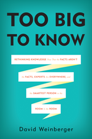
Too Big to Know
Too Big to Know
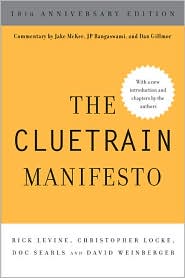
Cluetrain 10th Anniversary edition
Cluetrain 10th Anniversary
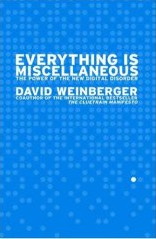
Everything Is Miscellaneous
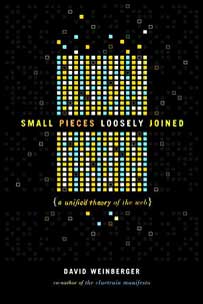
Small Pieces cover
Small Pieces Loosely Joined
Cluetrain cover
Cluetrain Manifesto
My face
Speaker info
Who am I? (Blog Disclosure Form) Copy this link as RSS address Atom Feed

November 1, 2011

Eric Frank on Creative Commons textbooks

Eric Frank is the co-founder of Flat World Knowledge, a company that publishes online textbooks that are free via a browser, but cost money if you want to download them. It’s a really interesting model. I interview him here.
Tweet
Follow me

Categories: business, copyright, education, libraries, open access Tagged with: education • podcasts • textbooks Date: November 1st, 2011 dw

Be the first to comment »

October 21, 2011

[dpla] second session

Maura Marx introduces Jill Cousins of Europeana who says that we all agree that we want to make the contents of libraries, museums and archives archives available for free. We agree on interoperability and open metadata. She encourages us to adopt the Europeana Data Model. Share our source code. Build our collections together. So, we’re starting with a virtual exhibition of migration of Europeans to American. The DPLA and Europeana will demonstrate the value of their combined collections — text and images — by digitizing material and making it available as an exhibition. (Maura thanks Bob Darnton for building European ties.)

NOTE: Live-blogging. Getting things wrong. Missing points. Omitting key information. Introducing artificial choppiness. Over-emphasizing small matters. Paraphrasing badly. Not running a spellpchecker. Mangling other people’s ideas and words. You are warned, people.


Maura Sullivan, president elect of the American Library Association, moderates a panel about visions of the DPLA. Each panelist gets 5-7 minutes


John Palfrey: It’s a bridge we’re building as we walk over it. But it has 5 aspects. 1. Digitizing projects. It’ll be a collection of collections. We should be digitizing in common ways with common formats. But, DPLA will also be: 2. Code. SourceForge for Libraries. Anyone can take and reuse it, including public libraries. 3. Metadata. That’s what makes info findable and usable. It’s the special sauce of librarians. But we haven’t done it yet. We need open access to metadata. 4. Tools and services that ride on top of a common platform. E.g., extraMuros, Scannebagos. 5. Community.


Peggy Rudd, Texas State Library and Archives Commission. We want to see someone walking down the street with a cellphone who says, “I’m going to DPLA it.” We should take as a guiding idea that all people in the country ought to have access to the infrastructure of ideas. We have to think about access. Those of us in public libraries are going to be the digital literacy corps. Public libraries are going to be the institutions that can ensure that people can discover things and will help people evaluate what they find, ensuring what they find is relevant, and help people get the most out of the DPLA.


Brewster Kahle, The Internet Archive. I grew up in a paper world. But I believe the Archivist is right: If it’s not online, it doesn’t exist. There are now two large scale digital library projects in the US. Ten million books are available from a commercial source, and 2M that are public (at OpenLibrary.org). But let’s step back and see where we want to be: Lots of publishers and authors who are paid; a diversity of libraries; everyone can be a reader, no matter what language, proclivities, disabilities. Let’s go and get 10M ebooks. 2M public domain (free), 7M out of print (digitized to be lent), 1M in print (buy ebook and lend them). Libraries ought to ebooks and circulate them, one loan at a time per one book. DPLA ought to help libraries buy new eBooks to lend them, as well as scanning the core 10M book collection, and enable al libraries get the digital collections. At this point, a 10M ebook collections requires about $30K of computers, which is within the budget of many libraries. For this, we would get universal access to all knowledge. How do we stay on track? Follow the money: is the money being well spent. And follow the bits: the bits should be put in many places. “Together we can build a digital America that is free to all.”


Amanda French begins with John Donne, “Sunrising.” [I am here heavily paraphrasing!] For most, the sun rising is a beginning, but for lovers it is an ending. The unruly sun of the digital text is rising, calling us to work, whereas I would rather snuggle in bed with a book. Love can exist in a commercial relationship, but that’s not ideal. I would like a library that supports me in all my moods, from contemplation to raucous sociality. We need proof of love. Physical libraries manifest that love. The DPLA must manifest itself as more than a web site, many quiet and generous services to readers, developers…technical and social. While I agree that if it isn’t online, it doesn’t exist, but if it’s only only online, it only half exists. And I want a physical building. Not just a server center. [Again: I’ve poorly paraphrased.]


Jill Cousins, Europeana. We want the DPLA because we get access to your stuff. [Laughter] But DPLA can improve on Europeana with open data, Open Source, Open Licensing. Also, we should be interopable. Our new strategic plan has four aspects. 1. Aggregating content as an trusted source. 2. Facilitating, supporting cultural eritage. 3. Distributing: Wherever people are. 4. Engaging: New ways to participate in cultural heritage. Europeana currentlu has 20M items, multiple languages. I’m particularly interested in the APIs so material can be distributed to where people will use it. (She points to content about the US that is in their distributed collection.) To facilitate: Labeling content so users know it’s in the public domain. What’s in the PD in analog form ought to stay in the PD in digital form. Engage: Cultivate new way for users to participate in their cultural heritage. One project: People are asked to bring their memorabilia from WWI. So, why DPLA: We are the generation that can give acccess to the analog past. If we don’t digitize it and put it online, will our kids?


Carl Malamud. When I think of the DPLA, I think of the Hoover Dam and the Golden Gate Bridge. There’s a tremendous reservoir of knowledge waiting to be tapped. Our Internet is flooded with only certain types of knowledge, and other types are not available to all. E.g., our law and policies — the operating system of our society — are not openly available because private fences have enclosed. E.g., if you’re a creator, you draw on imagery that has accumulated over thousands of years. Creative workers must stand on the shoulders of giants. But much of that image is locked up in for-profit corps that have built walls around public domain material. Even the Smithsonian only allows its images to be used by paying for them. We already have beautiful museums and bottomless libraries. What if the DPLA created a common reservoir that we could tap into. What if the Hathi Trust put everything that have into a common pool. Another metaphor: A bridge that connects our capitol to the rest of the country. DC is a vast storehouse. Most of the resources are hidden. We need public works projects for knowledge. A national digitization project, a decade long. Deploy the Internet Core of Engineers. “If a self-appointed librarian in an old church can publish 2M books, why can’t our government do more?


[I had to see a man about a dog, and missed a couple of questions.]


Q: How do we transform the use of public libraries?
Peggy: They have to evolve, and many are evolving already. E.g., user-created content. 46% of low-income families don’t have computers or Internet access.


Q: Bandwidth is a critical issue, particularly in rural areas. I hope that the DPLA realizes it’s going to have data-heavy materials. How are we going to build bandwidth to the public libraries?
Peggy: I’m happy to see the Gates Foundation here. They’ve worked with local libraries to provide and maintain bandwidth. 5mb is not enough when kids swarm in after school.


Q: Imagine an Ecuadoran American mother who is a part time student. She belongs to a lot of communities. I want to make sure that the coding of the DPLA recognizes that we each live in multiple communities.
Peggy: We all agree.


Q: First, in 1991 a White House conf was talking about not just scanning, but enable people to send in their materials (e.g., super8 family movies) that could be digitized. Second, DPLA has a huge potential for freeing up resources at the local library so it can spend its resources on customizing content to what that community needs, or let the person customize the library for herself.


Q: How does an ordinary person get involved in DPLA right now. Lobbying?
John: Lots of ways. Mobilization counts. The effect on local libraries needs to be explained; no one here thinks or wants the DPLA to hurt local public libraries. That’s a crazy thought. But that needs to be explained. I would be so sorry if this project led to the closing of a single library. And, yes, I think we should have a way for individuals to donate. How can you get involved in the setting up of this project: Deciding what the DPLA is an open process. There are six workstreams. Today is meant in part as an invitation to join in those workstreams. There will be meetings over the next 18 months; the meetings will be open. Come. We need people to build with what we create. We need people to think of new use cases. In April 2013 when we come together for the launch, if there are ten more people attending, that will be a sign of success.


Q: What do you have in the collection for children, 0-8? Why will a parent want to use the DPLA?
John: The DPLA needs to create a common infrastructure so people can create libraries and services out of the combined collection. But as a parent of a six and 9 year old, we’ll keep buying paper books and reading to our kids. The DPLA is not a replacement.
Peggy: Univ. of Texas in Arlington did a study at what engages students in the study of the history of Texas. Students perform better on tests if they had a greater interaction with real documents. We’re bringing history to the classrooms.
Carl: The Encyclopedia of Life has pictures of bugs, etc. And the Smithsonian has a great online resource [didn’t catch it], and the net thing the kid will want to do is visit the Smithsonian.
Amanda: If it isn’t online people don’t know it exists. If they know …[Ack. Lost the rest of this post. Noooooo]

Tweet
Follow me

Categories: libraries Tagged with: dpla • library Date: October 21st, 2011 dw

1 Comment »

[dpla] First session

Moderated by John Palfrey.

Deanna Marcum of the Library of Congress says the LC has 148M objects and has digitized 28M of them. [I may have gotten that last number wrong. Sorry.] The LC wants to make these resources as available as possible. “That is what brings us to the table of the DPLA. It seems to be the type of organization that will help us fulfill our mission in a very important way.” [Tying the DPLA to the LC’s mission is a big deal.]

NOTE: Live-blogging. Getting things wrong. Missing points. Omitting key information. Introducing artificial choppiness. Over-emphasizing small matters. Paraphrasing badly. Not running a spellpchecker. Mangling other people’s ideas and words. You are warned, people.

Deanna says that from the beginning, the Librarian of Congress, James Billington, has asked how the LC can serve libraries better. The answer consistently has been: We want your content where we are, not where you are. This was pre-Net, so they looked to CD ROMs, digitizing collections starting in the early 1990s, beginning with materials useful to K-12. They checked in with the 44 pilots and were amazed to find it was useful all the way down to third grade students were making “incredibly innovative” uses of this digital content. In 1995, Congress said that it’d match private funds 1:3 (Congress pays $1 for each 3 raised) for digitization efforts. The LC began to think about what in its collections should be digitized first. Sloan funded digitizing of public domain works. Those efforts continue.

Susan Hildreth is director of the Institute of Museum and Library Services, a federal grant-making agency. She wonders what resources already exist that the DPLa can use, and which resources need to be created. This is vital the IMLS’ contribution to the effort. The IMLS already has invested heavily in digitization projects. Also: metadata collection and cleanup programs. Also: training librarians. Also: conversations on these topics. So, there are already digitized items, best practices and policies, etc. for digital collections. Also, IMLS has reports of 20 years of international discussions about what digital libraries can be. And, some lessons learned: 1. Collaboration is key to long success in digitization. 2. The traditional relation between info providers and consumers is changing. 3. Digital libraries can reduce administrative costs, although we’re just at the beginning of this.

Also, Susan says we should learn some lessons from the IMLS: Support interoperability and the preservation of digital resources. Make it sustainable. Find new ways to measure the impact. Ultimately how will this make a difference to the person going on the Web to find information? The IMLS can be strategic in the DPLA’s efforts. [We like the “strategic” commitment.]

John Palfrey reinforces her statement about the excitement this is generating among librarian students.

David Ferriero, the Archivist [coolest title ever], talks. He comes to this position after heading the NY Public Library. He explains that the National Archives is the nation’s record keeper. For all federal agencies, and “courtesy preservation” for Congress. It began only in 1935. The records go back to the Continental Congress, and include White House tweets. 12B pages of textual records. Billions of electronic records, which is the fastest growing area. 8M emails from Reagan, 200+|M from the GW Bush era. And, as Bush tells David, “Not one of those is mine.” He wants every item in the Archives to be online. He remembers discussions with librarians in which they worried about how to get students to use paper. “Get over it.”

The massive amount of material they have has made the Archives “rather creative” in getting out. E.g., the Citizen Archivist program to give opportunities to the people to help digitize and process records. Docs Teach is online, loaded with lesson plans, etc.

When he was at NYPL, they worked with Google to digitize 1M works, and David saw how it has transforms scholarship. In Dec. 2009, Pres. Obama signed a declassification order requiring the Archives to review and declassify. They’ve gone through 1M pages and have release 91% to the public shelves. The CIA “finally caved on the oldest secret documents” — German docs on creating secret ink. This happened because the Archivist staff used Google Books to discover that the ink formulas had been published in 1931.

Q: Accessibility and findability? Not enough to simply put things online.
A: Deanna: It’s important. But you’re looking at three people who don’t know how to do this.
A: David: Josh Greenberg taught me that we should talk about where the people are and get our stuff out there. That’s why we use Youtube and Flickr. It’s a problem for the Archives because our records are so large and complex. Plus, kids today can’t read cursive. So we’re going to be creating ways for the public to help us transcribe cursive docs.
A: Susan: It’s a broad issue, including making our materials available to those with disabilities, in multiple languages, etc. IMLS is interested in supporting platforms for effective discovery.
A: David: Serendipity is important.

Q: Director of the Smithsonian Institutional Libraries: We also are very interested in participating in the DPLA with our 137M objects (although 124M are natural history specimens, so how many mosquitoes do we want in the DPLA?). But we have 6.4M digitized objects and are in a unique position to pull in museum, library and archive objects. We’re eager to continue to cooperate.

Q: Are there mechanisms in place to avoid reverse engineering of CIA documents.
A: The Archivist does not have the authority to release. We just facilite the process.
Q: Are you going to do more?
A: We’ve done a million. There are 400M to go. We have a deadline in 2013. I hosted a meeting about the priorities and the room was evenly split between releasing the JFK assassination docs and UFOs.

Q: [British Library] One of the real challenges is the difference between a digital library and a wonderful but confusing random set of resources. Public-private partnerships are essential. And we have just opened up all our metadata on a CCEuro license. No one can know what this will be used for, and that is its value. Also, there’s a challenge finding and developing modern librarians/curators.

Q: John Mayer: Imagine it’s 2016 and all your collections have been digitized. How does society improve once that’s in place. What’s the sf scenario of the DPLA?
A: Deanna: If we assume benefit from having access to info resources — better decisions, better understanding where they come from and where they’re going, unerstand world cultures better — we want to make these resources available any way they want. That’s what librarians have always dreamed about and we finally have a mechanism for doing that. American citizens have paid for these resources with their tax dollars.
A: David: Better informed citizenry. Hold our government accountable. Understand our future by learning from our history.
A: Susan: If all is digitized, what happens to our physical facilities. By providing all that info, it will create a greater need and desire for people to work together, in the virtual and real worlds. It’s a very exciting and liberating future. And if we have all that data, we have to have strong connectivity to our homes, schools, libraries…

Q: Bob Darnton: Many of the questions have been testimonials. Wonderful! We rejected the name “National Digital Library” because there’s nothing national about it. Getting bigger means getting more international, and that is certainly going to happen. The national library director of France has expressed support. So has Europeana. This support is a movement that goes back to the international Republic of Letters. We’re getting the feeling we can make real a dream at the founding of this country.

[It is so ineffable cool and inspiriting to have these great institutions sharing a stage and a vision.]

Tweet
Follow me

Categories: libraries Tagged with: dpla Date: October 21st, 2011 dw

1 Comment »

[dpla] DPLA plenary

I’m at what is in effect the public launch of the Digital Public Library of America — “in effect” because the DPLA has been open to all from the beginning. But today we’re in the theater of the National ARchives and have just been greeted by the Archivist of the United States, David Ferriero.

I spent yesterday at the “workstream” meetings of the DPLA. The openness of the DPLA has meant that there has been no moment at which all have agreed on precisely what the DPLA should be. Yesterday could have been a day that had people walking apart from one another or walking toward a center as yet to be fully located. It was a day of walking toward that emergent center. Given the continuing significant differences in the group, my sense that the convergence was enabled by a shared sense of the value of what we could build, by shared interests and backgrounds (a bunch of librarians and admirers of librarians), and by the carefully crafting of the day’s events and processes. (That last goes to the credit of the Berkman Center.)

I am very excited. (I’m also at maximum stress because I am giving a 8.5 minute demo this afternoon…talking to a screencast I did in my hotel room last night, leaving no room for temporal variance. You can see the live prototype here.)

Doron Weber of the Sloane Foundation is now briefly recounting the history of the DPLA, which started with a workshop a year ago. Doron today announced the beginning of a “two year grass roots effort” to build the DPLA. The DPLA is intended to be a platform for discovering our rich shared cultural heritage he says (approximately). He sketches a very broad agenda, including discovering collections, building them, partnering with other nations, sharing metadata, and exploring doing some form of collective licensing of in-copyright material. (Excellent. I personally don’t want this to become the Digital Public Library of Jane Austen.)

NOTE: Live-blogging. Getting things wrong. Missing points. Omitting key information. Introducing artificial choppiness. Over-emphasizing small matters. Paraphrasing badly. Not running a spellpchecker. Mangling other people’s ideas and words. You are warned, people.

Doron announces that Sloane and Arcadia are each contributing $2.5M to support the DPLA over the next 18 months. Woohoo! Peter Baldwin from Arcadia gives a gracious short talk.

Tweet
Follow me

Categories: libraries, too big to know Tagged with: dpla • library Date: October 21st, 2011 dw

Be the first to comment »

October 17, 2011

[2b2k] Bookbinding and the Digital Bible

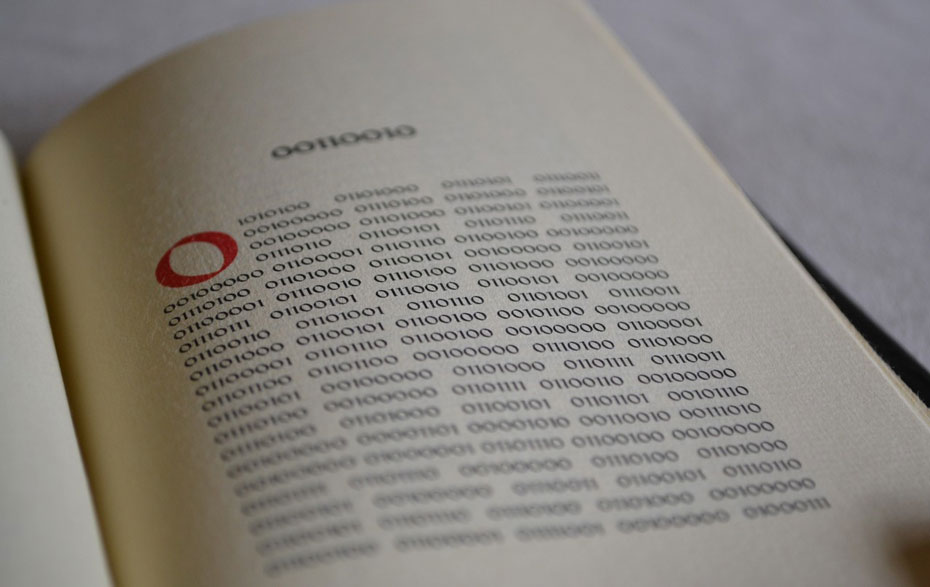
Avi Solomon at BoingBoing has a terrific interview with Michael Greer about the appeal of bookbinding, and about Michael’s “Digital Bible.”

I love the photo:

Digital Bible: Book with ones and zeroes as text

Tweet
Follow me

Categories: libraries, too big to know Tagged with: 2b2k • books • libraries Date: October 17th, 2011 dw

Be the first to comment »

October 9, 2011

Library: Future.0

I put this video together as the opener of the first in a series of public conversations Harvard is holding about the future of libraries and of the Harvard Library system.

Tweet
Follow me

Categories: libraries Tagged with: harvard • libraries Date: October 9th, 2011 dw

3 Comments »

October 4, 2011

ShelfLife and LibraryCloud: What we did all summer

We’re really really really pleased that the Digital Public Library of America has chosen two of our projects to be considered (at an Oct. 21 open plenary meeting) for implementation as part of the DPLA’s beta sprint. The Harvard Library Innovation Lab (Annie Cain, Paul Deschner, Jeff Goldenson, Matt Phillips, and Andy Silva), which I co-direct (along with Kim Dulin) worked insanely hard all summer to turn our prototypes for Harvard into services suitable for a national public library. I have to say I’m very proud of what our team accomplished, and below is a link that will let you try out what we came up with.

Upon the announcement of the beta sprint in May, we partnered up with folks at thirteen other institutions…an amazing group of people. Our small team at Harvard , with generous internal support, built ShelfLife and LibraryCloud on top of the integrated catalogs of five libraries, public and university, with a combined count of almost 15 million items, plus circulation data. We also pulled in some choice items from the Web, including metadata about every TED talk, open courseware, and Wikipedia pages about books. (Finding all or even most of the Wikipedia pages about books required real ingenuity on the part of our team, and was a fun project that we’re in the process of writing up.)

The metadata about those items goes into LibraryCloud, which collects and openly publishes that metadata via APIs and as linked open data. We’re proposing LibraryCloud to DPLA as a metadata server for the data DPLA collects, so that people can write library analytics programs, integrate library item information into other sites and apps, build recommendation and navigation systems, etc. We see this as an important way what libraries know can become fully a part of the Web ecosystem.

ShelfLife is one of those possible recommendation and navigation systems. It is based on a few basic principles hypotheses:

– The DPLA should be not only a service but a place where people can not only read/view items, but can engage with other users.

– Library items do not exist on their own, but are always part of various webs. It’s helpful to be able to switch webs and contexts with minimal disruption.

– The behavior of the users of a collection of items can be a good guide to those items; we think of this as “community relevance,” and calculate it as “shelfRank.”

– The system should be easy to use but enable users to drill down or pop back up easily.

– Libraries are social systems. Library items are social objects. A library navigation system should be social as well.

Apparently the DPLA agreed enough to select ShelfLife and LibraryCloud along with five other projects out of 38 submitted proposals. The other five projects — along with another three in a “lightning round” (where the stakes are doubled and anything can happen??) — are very strong contenders and in some cases quite amazing. It seems clear to our team that there are synergies among them that we hope and assume the DPLA also recognizes. In any case, we’re honored to be in this group, and look forward to collaborating no matter what the outcome.

You can try the prototype of ShelfLife and LibraryCloud here. Keep in mind please that this is live code running on top of a database of 15M items in real time, and that it is a prototype (and in certain noted areas merely a demo or sketch). I urge you to talk the tour first; there’s a lot in these two projects that you’ll miss if you don’t.

Tweet
Follow me

Categories: education, everythingIsMiscellaneous, libraries, taxonomy, too big to know Tagged with: 2b2k • dpla • everytningismis • libraries • metadata Date: October 4th, 2011 dw

3 Comments »

October 1, 2011

[2b2k] Open access to a life of work

From Kattallus, via metafilter:

Humanities and the Liberal Arts is the personal website of former Middlebury classics professor William Harris who passed away in 2009. In his retirement he crafted a wonderful site full of essays, music, sculpture, poetry and his thoughts on anything from education to technology. But the heart of the website for me is, unsurprisingly, his essays on ancient Latin and Greek literature some of whom are book-length works. Here are a few examples: Purple color in Homer, complete fragments of Heraclitus, how to read Homer and Vergil, a discussion of a recently unearthed poem by Sappho, Plato and mathematics, Propertius’ war poems, and finally, especially close to my heart, his commentaries on the poetry of Catullus, for example on Ipsithilla, Odi et amo, Attis poem as dramatic dance performance and a couple of very dirty poems (even by Catullus’ standard). That’s just a taste of the riches found on Harris’ site, which has been around nearly as long as the world wide web has existed.

There are months of serious browsing in the world of Prof. Miller’s thought. It is a particularly wonderful illustration of the boon of having worldwide access to unlimited worlds of thought.

Tweet
Follow me

Categories: libraries, open access, philosophy, too big to know Tagged with: classics • libraries • literature • open access • philosophy • william miller Date: October 1st, 2011 dw

1 Comment »

September 28, 2011

The coffee-shopping of everything

David Strom at ReadWriteWeb notes a trend at hotels to re-jigger lobbies as social spaces in which you can plug in your laptop and hang out, instead of sitting in your disinfected Rectangle of Solitude.

I’d give it a try, especially if free or cheap coffee were involved. I think I might enjoy the company, although if someone actually tried to talk with me, I’d undoubtedly give him the stink eye so I could get back to work. Hey, just because I want to be near other human beings doesn’t mean I want to be your friend.

So, yes, I would want to achieve that refined balance of social and impersonal that is of increasing importance in today’s ever-more-public world, and that is at the heart of Starbucks’ value proposition.

Tweet
Follow me

Categories: culture, libraries, social media Tagged with: coffeeshops • hotels • libraries • social media • sociality • starbucks Date: September 28th, 2011 dw

5 Comments »

September 27, 2011

Libraries of the future

We’ve just posted the latest Library Innovation Lab podcast, this one with Karen Coyle who is a leading expert in Linked Open Data. Will we have perpetual but interoperable disagreements about how to classify and categorize works and decide what is the “same” work?

And, if you care about libraries and are in the Cambridge (MA) area on Oct. 4, there’s a kick off event at Sanders Theater at Harvard for a year of conversations about the future of libraries. Sounds great, although I unfortunately will be out of town :(

Tweet
Follow me

Categories: everythingIsMiscellaneous, libraries Tagged with: 2b2k • everythingIsMiscellaneous • libraries • metadata Date: September 27th, 2011 dw

1 Comment »

« Previous Page | Next Page »


Creative Commons License
This work is licensed under a Creative Commons Attribution-NonCommercial-ShareAlike 3.0 Unported License.
TL;DR: Share this post freely, but attribute it to me (name (David Weinberger) and link to it), and don't use it commercially without my permission.

Joho the Blog uses WordPress blogging software.
Thank you, WordPress!