


logo
EverydayChaos
Everyday Chaos
Too Big to Know
Too Big to Know
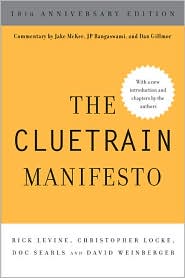
Cluetrain 10th Anniversary edition
Cluetrain 10th Anniversary
Everything Is Miscellaneous
Small Pieces cover
Small Pieces Loosely Joined
Cluetrain cover
Cluetrain Manifesto
My face
Speaker info
Who am I? (Blog Disclosure Form) Copy this link as RSS address Atom Feed

November 2, 2011

Social media at work — top down, bottom up

A Cisco study finds that when deciding on job offers, a startlingly high number of college students and recently employed grads value access to social media at work more than salary. And an article by Ann Bednarz at Network World finds that “[e]ven some of the most buttoned-down institutions are rethinking bans and relaxing access to social networks and social media sites.”

So, it looks like everyone should be happy for a change.

Tweet
Follow me

Categories: business, cluetrain, social media Tagged with: business • social media Date: November 2nd, 2011 dw

7 Comments »

October 5, 2011

Respect the Internet

With Douglas Rushkoff I’m keynoting a Ketchum event called “Respect the Internet” [more here] tomorrow. The subtitle of the day is “Is marketing ruining the Net?” Sounds like it should be fun. (It’s being webcast, starting at 10am.)

I have a 20-30 min slot in which I’m planning on saying something like the following:

Yes, markets are conversations, as Doc once said. That shifts power from vendors to customers. It also turns markets as demographic abstractions into real social entities. But markets are conversations now because they are networked, and thus are taking on the properties of networks: evanescent, light-weight group formation, and, most of all connected via shared interests. For example, the people on the Web right now talking about which bike to buy constitute a networked market of bike purchasers. The bad news for traditional businesses is that hierarchical businesses (i.e., businesses) do not fit well architecturally on the Net. E.g., who gets to talk for the business, for businesses do not actually have mouths?

I then plan on talking about two properties of networks being expressed by markets now.

1. The fact that the Net is composed of interests has exposed what we always knew: there is usually a lack of alignment between markets and businesses. Markets talk about bikes because they have the usual range of interests in bikes: to be green, to save money, to get exercise, to recapture one’s youth, etc. But bike companies as businesses are interested in having us pay them money. Same objects of discussion (bikes) but very different interests. Businesses have tried to rationalize their lack of alignment by talking about “authenticity,” a term that I think does not apply very meaningfully to companies. Nor do I think that Michael Porter’s “shared value” idea addresses the real misalignment of interests.

2. Networks tend toward transparency. I will quickly mention four types of relevant transparency: of self (you are who you say you are), of sources, of humanity (you and your products are fallible), and of interests. (I may drop this section. I think the line of thought would be clearer if I do.)

Finally, I want to ask why the Net is such a weird and different medium. Answer: The Internet is not a medium. We are the medium. Because the Net is interest based, messages (memes, links, poems, whatever) move through us: I send you that link because I think you’ll like it, and I have something invested in your liking it when I pass it along. We are literally the medium.

So, that’s why marketers should respect the Internet. The Internet is ours. No, we don’t own Verizon’s wires. But that’s not the Internet. The Net is its open protocol and the social products and life it has engendered. So, mess with the Net with intrusive marketing and you are messing with us. We won’t like it.

That’s roughly it.

(By the way, I rarely mention where I’m talking because I’m a little shy, in weird ways. I’m thinking I ought to bite the bullet and just blurt out my scheduled talks. Why? Marketing! E.g., would you like to know that this morning I keynoted the Canadian Research Knowledge Network meeting outside of Ottawa, and that on Monday I gave the John Seely Brown lecture at the University of Michigan School of Information? Or is it just boastful noise, which is how it sounds to me?)

Tweet
Follow me

Categories: cluetrain, marketing Tagged with: cluetrain • marketing Date: October 5th, 2011 dw

7 Comments »

August 7, 2011

The point of Web 2.0 is its problem

I liked this post by in the Guardian by John Naughton about the future of Web 2.0, and I’m always delighted to be mention in the same paragraph as Paul Graham, but I want to keep insisting that Web 2.0 was not the moment when the Web moved from publishing platform to social platform. One of the main points of Cluetrain (1999) was in fact that the Web from its beginning was thrilling us because it was a social place, a set of conversations, a party.

Now, it is certainly true that with Web 2.0, the Web became more social, easier to socialize in, undeniably social. That’s why Web 2.0 is a useful concept.

My problem is really with the “point” in Web 2 Point Oh, since it can imply a point in time when the Web became social, as if before that the Web was merely a publishing platform. Nah. It’s been social since the moment browsers started appearing.

Tweet
Follow me

Categories: cluetrain, social media Tagged with: cluetrain • social networking • web 2.0 Date: August 7th, 2011 dw

4 Comments »

July 17, 2011

Edelman and Murdoch

Jay Rosen has an amazing Storify thread in which he engages in a public enquiry about Edelman PR’s taking NewsCorp on as a client. Jay is breaking ground in how journalism works.

DISCLOSURE: I count Richard Edelman as a friend. I like and respect him. I have also been paid during a couple of stretches as a consultant to Edelman on PR in the networked age. The last time was maybe a year ago. I have not spoken with Richard or Edelman employees since then.

In my last engagement, I tried in my small way to get Edelman (the company) to adopt a view that recognizes that the Web is quite literally built out alignments of interests: People put in links and affiliate with one another because they share interests. Marketing traditionally has been premised all too often on a misalignment of interests: The business wants one thing and the market wants another. PR should, imo, recognize and respect the Net’s aligned nature. PR should genuinely enhance the interests expressed in the market, and otherwise shut up. Something like that.

I have also advised Edelman that when a business’s interests and the market’s interests are not aligned over matters of fact or philosophy, the business should consider adopting a tactic of “advocacy marketing” in which the business states its case frankly, truthfully, transparently, honestly, and respectfully. So, if the company think it’s getting a bad rap, it should (for example) put up a site that acknowledges what’s being said about it, make its case, address the contrary claims, engage with those who disagree, and always link to its sources.

If I were Edelman PR, I would probably agree to take on NewsCorp, but only if I were satisfied to a reasonable degree (yes, them’s fudge words) that NewsCorp was ready to tell the truth. (Clients do lie to their PR companies. The first time Edelman catches NewsCorp lying to them, Edelman should quite publicly drop them.)

If I were Edelman, I would not suggest advocacy marketing. NewsCorp does not have a side of the story worth telling. The only way forward for NewsCorp is to go many extra miles in transparency. Come clean not only about the phone tapping and the bribery, but about the culture of soft influence, the partisan reporting that fruitlessly claims it’s non-partisan, the degradation of once worthy newspapers.

Edelman should not, in my opinion, be helping Murdoch tell his side of the story. Edelman should be helping Murdoch to confront the truth, to follow the truth all the way through, and to tell the truth over and over and over again.

Taking on NewsCorp will test the ability of PR itself to continue to exist as a representative only of the client that pays the bill. I do not believe PR can survive if it does not see itself and its client first and foremost within the web of shared interests.

Tweet
Follow me

Categories: cluetrain, marketing Tagged with: cluetrain • edelman • murdoch • newscorp • pr Date: July 17th, 2011 dw

15 Comments »

May 31, 2011

[berkman] Miriam Meckel on communicating trustworthiness

Miriam Meckel is giving a Berkman lunchtime talk on “Communicating Trustworthiness: Drivers of Online Trust.” She will present research she has been doing at U. of St. Gallen along with government and some businesses. She’s investigating how trustworthiness is communicated, and what the initial drivers and cues are. She’s going to look at the changing conditions, some basic ideas on initial trust formation, then her study, and then the cues identified in initial trust formation.

NOTE: Live-blogging. Getting things wrong. Missing points. Omitting key information. Introducing artificial choppiness. Over-emphasizing small matters. Paraphrasing badly. Not running a spellpchecker. Mangling other people’s ideas and words. You are warned, people.

Users’ willingness to provide data about themselves depends on some sort of trust. There’s been much discussion about this, including the importance of preserving privacy. For example, Facebook restricted info about users to the user’s schoolmates, but over time it has become far more permissive. (See here for article and diagram.) Both Facebook and Google have said things indicating they believe our attitude towards privacy has changed. E.g., Eric Schmidt: “If you have something you don;’t want anyone to know, maybe you shouldn’t be doing it.”

What is trust? Miriam provides three definitions, each of which involves vulnerability. When we trust someone online, we understand we are making ourselves vulnerable in various ways. Trust enables us to manage the complexity of our social world, reduces the cost of negotiations, facilitates the adoption of new technologies, and reduces perceived risks. Initial trust is especially important since you can lose a customer forever by screwing it up.

In her study, they interviewed 23 online businesses active in Germany. They also did in-depth interviews with 43 users representing a range of socio-demographic sections. From this they derived a model of nine trust drivers: Reciprocity and exchange, proactive communications, user control, brand, third party endorsements, design of user interface, offline presence, technology, and customer service. Then they did a quantitative survey of German users to find out how the different factors are applied to diff business models. 11,000 users from across socio-demographic segments were invited to participate in an online survey for a little money, with a response rate of 12%.

She goes through the nine components of trust:

Reciprocity explains about 35% of the variance of the data. The mutual relationship of customer and organization is crucial. Users are willing to hand over personal info, if they know what they gain from it, if it is transparent, and if both sides benefit.

Brand and reputation: A well-known, establish brand helps build trust. If it has a large customer base, it is perceived as more reputable. You also need a professional feel for the web site.

User control: Users want to know who will have access to their data. Ask permission.

Proactive communications. [missed it. sorry]

Customer service: Multiple ways to reach a person. Provision of different payment methods.

Offline presence: The existence of physical stores helps build trust. Show a photo on your web of your brick and mortar store.

Technological reliability. This can be an issue when your service involves third parties.

Third party endorsements: Not only are seals of approval helpful, but so is having a high search ranking for third parties.

The next step is how these factors are differentiated by B2C business models. Only four factors turn out to be relevant across the board: reciprocity, third party endorsements, user control, and technological reliability. Miriam looks at online shopping, online banking, etc., to see which factors are relevant [but I can’t keep up with my typing. sorry] It seems that for building trust-based relationships with potential clients, you have to have fair communication, mutual benefits signaled, privacy and security policies being displayed, clear T&C’s, engage in issues mgt to follow what is being said about you on the Web, explain the business model and data needs, explain the flow of info to third parties and what the policies are, communicate third party endorsements, engage, peer groups and communities, bring in your offline reputation, and consistently apply corporate design with good design.

Some implications: 1. Users are more willing to trust large, well-established and popular online services. High search-engine ranking can be considered a trust measure.

2. The visual appearance counts.

3. Reciprocity is very relevant in all online transactions.

4. Offline presence, technical reliability and customer service have barely been researched yet.

5. Organizations need a strategic approach for communicating trust to their stakeholders. Take an integrated communication approach, including issues and risk management. They should communicate proactively, in a conversational tone, and transparently.

What not to do? Don’t be Facebook asking Burson Marsteller to find bloggers who would attack Google.

Q: [me] Customer ratings? And the presence of customized trust mechanisms as at eBay and Amazon?
A: Third party endorsements include customer ratings. But we surveyed a represented group of German users, not ones as sophisticated as others, plus there may be cultural differences.

Q: Is your work ethical? An evil company can read your work and figure out how to appear to be ethical. Also, Germany has stronger regulatory protection, which change the signals
A: Yes, companies could fake being trustworthy.

Q: How about SSL?
A: The awareness of the need for SSL is frighteningly low.
Q: Anyone care about authentication certs?
A: [general laughter]

Q: Would the same trust drivers be applicable in news sites and other such non-sales sites?
A: Just in parts. [I can’t read her table because I’m too far back :( ]

When you look at the erosion of privacy caused just be clicking on opt-ins, you get to a point where you just accept whatever the terms are and however they’re changed.
A: People don’t read privacy policies when they’re changed.
Q: Maybe it’s that when the privacy policy looks impressive, it’s a signal of the quality of the service. But, the key question is whether people who say privacy policies are a trust driver actually read them.
Q: There’s some survey support that most people mean think that a privacy policy is there to protect your privacy. [general laughter]

Q: [me] To me, third party endorsement means you get celebrities or associations or other companies to endorse you. But the real trust-driver for me frequently is peer endorsement. Maybe it would be worthwhile to separate those two, especially since businesses need to do different things to gather other companies’ endorsements and to gain a good reputation among peers.
A: Yes, that would be interesting.

Q: What supersedes trust?
A: There may be the desire to be “in” as opposed to “out.”
Q: There are network effects are. How many of friends have to join before I throw away my privacy cBerkman

Tweet
Follow me

Categories: cluetrain, marketing Tagged with: business • cluetrain • marketing • trust Date: May 31st, 2011 dw

Be the first to comment »

April 26, 2011

Michael Porter’s Shared Value vs Don’t Be Evil

Harvard Business Review has just posted my response to the article by Michael Porter and Mark Kramer in which they propose moving business to a strategy that includes creating Shared Value. Obviously I support the idea of businesses taking seriously their obligation to create a better, sustainable world. But I’m not as optimistic about businesses embracing that strategy solely on the grounds that Porter and Kramer propose.

It’ll make the HBR folks happier — and therefore me too — if you comment there rather than here.

Tweet
Follow me

Categories: business, cluetrain, peace Tagged with: cluetrain • csr • porter • socrates • strategy Date: April 26th, 2011 dw

Be the first to comment »

April 7, 2011

Shel Israel’s Cluetrain interviews

Shel Israel [twitter:ShelIsrael] has posted email interviews with Doc Searls and me about how cluetrain came about and how it’s held up. He asked us the same questions. We responded fairly consistently about the history, but ran down different paths in the more forward-looking questions.

Tweet
Follow me

Categories: business, cluetrain, marketing Tagged with: cluetrain • doc searls • marketing • shel israel Date: April 7th, 2011 dw

1 Comment »

March 21, 2011

Foursquare

Foursquare’s general manager, Evan Cohen, is giving a talk at the ILM conference I just spoke at.

NOTE: Live-blogging. Getting things wrong. Missing points. Omitting key information. Introducing artificial choppiness. Over-emphasizing small matters. Paraphrasing badly. Not running a spellpchecker. Mangling other people’s ideas and words. You are warned, people.

He says there have been 381,000,000 check-ins so far. In every single country. The last country to check in was North Korea. The biggest single event was the Rally to Restore Sanity. “The most basic user experience is simply when friends check-in to their current location to find their friends.” “We help engineer serendipity” in which you discover a friend is nearby.

Their value proposition: Discovery, encouragement, and loyalty.

Discovery: They want to push people out into the real world. They’ve just launched an “explore” tag, a recommendation engine. It uses info about what your friends like to do, what people like you like to do, what people are saying in the “tips” review feature, etc. “We want to be like that best friend who knows every cool bar in Chicago, or every restaurant…”

Encouragement: Use gaming mechanics to get people to do what they wouldn’t have done otherwise. The mayor races have become really competitive. If someone loses it, they’ll go back to the place over and over. Their badges also encourage people to go out. E.g., go out to the gym a few times a week and you’ll get the gym rat badge. They have also improved their leader board. The Ambassador program enables users to bring merchants onto Foursquare.

Loyalty: They encourage merchants to offer rewards of various types. They’ve relaunched this part of the platform: easier for merchants, for users, and new “specials” types. They’re now offering “flash specials” to drive traffic when the place is under-utilized. Not all specials are discounts. “It’s an experience.” They also have a “friends special” that only works if you show up with some number of friends. Over 250,000 venues have verified on the merchant platform. Merchants have done creative things with Foursquare. Even when Starbucks offered a mere $1 off a frappucino to the local mayors, checkins jumped by 50%. “It’s about the experience and recognition as much as anything.”

They have a full and easy API, modeled on Twitter’s.

[I find Foursquare fascinating. To the users it’s a game. To the merchants, it’s a form of marketing. And as a blending of the virtual, the real, gaming, and marketing, it’s amazing.]

Tweet
Follow me

Categories: business, cluetrain, games, marketing Tagged with: business • foursquare • games • marketing Date: March 21st, 2011 dw

Be the first to comment »

January 28, 2011

Google’s whacking of GoogleWhack is whack

Googlewhacking is the harmless pastime of trying to find two word combinations that get a single return when searched for at Google (without quotes around them). Gary Stock invented it in 2002, and it took off rather rapidly. [Disclosure: I was an early promoter of it (also here and here and here, etc.).

Now, nine years and millions of views later, Google has decided that Googlewhack threatens its brand. Gary reproduces the irksome, frustrating, poorly-written, and poorly-thought objection from Google’s AdSense Purity Squad. It’s the sort of inanity caused one hopes by a bot. On the other hand, why would we entrust our culture to bots?

Jeez, Google! How about working towards the day when Google + Jerk is a Googlewhack!


[Jan. 29, 2011:] Gary reports that he got a personal note apologizing for the initial demanding message, and that all is well. Well done, Google.

Tweet
Follow me

Categories: cluetrain, copyright Tagged with: cluetrain • google • googlewhack Date: January 28th, 2011 dw

2 Comments »

December 17, 2010

The Annals of Searching: Cluetrain circa 1505

Confine your search at Google Books for only the 19th century Cluetrain references, and you get four hits. In fact, the earliest reference to Cluetrain indexed by Google Books was in the 1505 business best-seller Extravagantes com[m]unes, in which appears the sentence “Markets are conversations…with that lying bastard Roger the Offal Merchant.”

Tweet
Follow me

Categories: cluetrain Tagged with: cluetrain • google • humor • search Date: December 17th, 2010 dw

1 Comment »

« Previous Page | Next Page »


Creative Commons License
This work is licensed under a Creative Commons Attribution-NonCommercial-ShareAlike 3.0 Unported License.
TL;DR: Share this post freely, but attribute it to me (name (David Weinberger) and link to it), and don't use it commercially without my permission.

Joho the Blog uses WordPress blogging software.
Thank you, WordPress!