


logo
EverydayChaos
Everyday Chaos
Too Big to Know
Too Big to Know
Cluetrain 10th Anniversary edition
Cluetrain 10th Anniversary
Everything Is Miscellaneous
Small Pieces cover
Small Pieces Loosely Joined
Cluetrain cover
Cluetrain Manifesto
My face
Speaker info
Who am I? (Blog Disclosure Form) Copy this link as RSS address Atom Feed

April 26, 2011

Michael Porter’s Shared Value vs Don’t Be Evil

Harvard Business Review has just posted my response to the article by Michael Porter and Mark Kramer in which they propose moving business to a strategy that includes creating Shared Value. Obviously I support the idea of businesses taking seriously their obligation to create a better, sustainable world. But I’m not as optimistic about businesses embracing that strategy solely on the grounds that Porter and Kramer propose.

It’ll make the HBR folks happier — and therefore me too — if you comment there rather than here.
Tweet
Follow me

Categories: business, cluetrain, peace Tagged with: cluetrain • csr • porter • socrates • strategy Date: April 26th, 2011 dw

Be the first to comment »

April 23, 2011

How the robots bid a book up to $23,000,000 at Amazon

Michael Eisen has a terrific post in which he does the detective work to figure out how dueling algorithms from two competing bookstores drove the price of a book about flies up to $23,698,655.93.

I’m sorry that some human noticed and backed the prices down. I would have liked to have seen a financial bubble form as the price went into the trillions.

Tweet
Follow me

Categories: business, misc Tagged with: algorithms • amazon • books Date: April 23rd, 2011 dw

1 Comment »

April 7, 2011

Citicard does its best to train us in horrible security practices

Citibank continues to train its customers to use terrible security processes.

This morning I got a call from a robot that claimed to be from Citibank. When I refused to type in my zip code, and then waited for two minutes of repeated requests to do so, it transferred me to a human who wanted me to give him my name, undoubtedly to be followed by a request for my password. Thus does Citibank train its users to divulge personal information to anyone with an automated phone dialer.

This is the same outfit that no longer offers to put a thumbnail photo of you on your credit card, which is a pretty good way to foil card-grabbing bastards. It also used to embed an image of your signature on the front of the card. Again, a cheap and effective prophylactic measure that it no longer offers.

This is also the same outfit that is very happy to sell us monthly services — $10/month last time I looked — that inform us when Citibank has failed to protect us from identity theft.

Tweet
Follow me

Categories: business Tagged with: citibank • identity theft • security Date: April 7th, 2011 dw

3 Comments »

Shel Israel’s Cluetrain interviews

Shel Israel [twitter:ShelIsrael] has posted email interviews with Doc Searls and me about how cluetrain came about and how it’s held up. He asked us the same questions. We responded fairly consistently about the history, but ran down different paths in the more forward-looking questions.

Tweet
Follow me

Categories: business, cluetrain, marketing Tagged with: cluetrain • doc searls • marketing • shel israel Date: April 7th, 2011 dw

1 Comment »

March 30, 2011

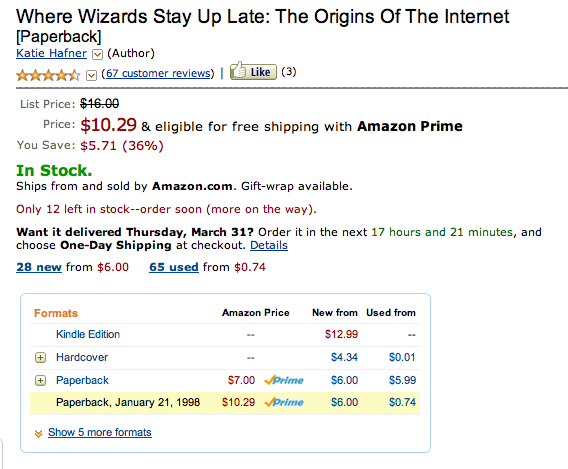
What’s wrong with this picture?

A screen capture of an Amazon page:

Kindle pricing highest of all versions

Yeah, this happens a lot. It shouldn’t.

Tweet
Follow me

Categories: business, misc Tagged with: amazon • e-books • ebooks • kindle Date: March 30th, 2011 dw

5 Comments »

March 28, 2011

ePublishing business models

I’m at an education conference put on by CET in Tel Aviv. This is the second day of the conference. The opening session is on business models for supporting the webification of the educational system.

NOTE: Live-blogging. Getting things wrong. Missing points. Omitting key information. Introducing artificial choppiness. Over-emphasizing small matters. Paraphrasing badly. Not running a spellpchecker. Mangling other people’s ideas and words. You are warned, people.

Eli Hurvitz (former deputy director of the Rothschild Foundation, the funder of CET) is the moderator. The speakers are Michael Jon Jensen (Dir of Strategic Web Communications, National Academies Press), Eric Frank (co-founder of Flat World Knowledge) and Sheizaf Rafaelli (Dir. of the Sagy Center for Internet Research at Haifa Univ.)

Michael Jensen says he began with computers in 1980, thinking that books would be online within 5 yrs. He spent three yearsat Project Muse (1995-8), but left because they were spending half their money on keeping people away from their content. He went to the National Academies Press (part of the National Academy of Science). The National Academies does about 200 reports a year, the result of studies by about 20 experts focused on some question. While there are many wonderful things about crowd-sourcing, he says, “I’m in favor of expertise. Facts and opinions on the Web are cheap…but expertise, expert perspective and sound analysis are costly.” E.g., that humans are responsible for climate change is not in doubt, should not be presented as if it were in doubt, and should not be crowd-sourced, he says.

The National Academy has 4,800 books online, all available to be read on line for free. (This includes an algorithmic skimmer that extacts the most important two-sentence chunk from every page.) [Now that should be crowd-sourced!] Since 2005, 65% are free for download in PDF. They get 1.4M visitors/month, each reading 7 page on average. But only 0.2% buy anything.

The National Academy Press’ goal is access and sustainability. In 2001, they did an experiment: When people were buying a book, they were offered a download of a PDF for 80% of the price, then 60%, then 40%, then for free. 42% took the free PDF. But it would have been too expensive to make all PDF’s free. The 65% that are now free PDFs are the “long tail” of books. “We are going to be in transition for the next 20 yrs.” Book sales have gone from 450,00/yr in 2002 to 175,000 in 2010. But, as they have given away more, they are disseminating about 850,000 units per year. “That means we’re fulfilling our publishing mission.” 260,000 people have opted in for getting notified of new books.

Michael goes through the available business options. NAP’s offerings are too broad for subscriptions. They will continue selling products. Authors fund some of the dissemination. And booksellers provide some revenue. There are different models for long-form content vs. articles vs. news vs. databases. Further, NAP has to provide multiple and new forms of content.

General lessons: Understand your mission. Make sure your strategy supports your mission. But digital strategies are a series of tactics. Design fot the future. and “The highest resolution is never enough…Never dumb down.” “The print-based mindset will work for the next few years, but is a long-term dead end.” “‘Free’ of some kind is required.” Understand your readers, and develop relationships with them. Go where the audiences are. “Continue experimenting.” There is no single best model. “We are living in content hyperabundance, and must compete with everything else in the world.”


Eric Frank of Flat World Knowledge (“the largest commercial publisher of” open source textbooks) says that old business models are holding us back from achieving what’s possible with the Net. He points to a “value gap” in the marketplace. Many college textbooks are $200. The pain is not evenly distributed. Half of college students are in 2 yr colleges, where the cost of textbooks can be close to their tuition costs. The Net is disrupting the text book market already, e.g.,through the online sale of used books, or text book rental models, or “piracy.” So, publishers are selling fewer units per year, and are raising pricves to protect their revenues. There’s a “vicious downward spiral,” making everyone more and more unhappy.

Flat World Knowledge has two business models. First, it puts textbooks through an editorial process, and publishes them under open licenses. They vet their authors, and peer review the books. They publish their books under a Creative Commons license (attribution, non-commercial, share-alike); they retain the copyright, but allow users to reuse, revise, remix, and redistribute them. They provide a customization platform that looks quite slick: re-order the table of content, add content, edit the content. It then generates multiple formats, including html, pdf, ePub, .mobi, digital Braille, .mp3. Students can choose the format that works best for them. The Web-based and versions for students with disabilities are free. They sell softwcover books ($35 fofr b&w, $70 for color) and the other formats. They also sell study guides, online quizzes, and flashcards. 44% read for free online. 66% purchase something: 33% print, 3% audiobooks, 17% print it yourself, 3% ebooks.

Second business model: They license all of their intellectual property to an institution that buys a site license at $20/student, who then get access to the material in every format. Paper publishers’ unit sales tend to zero out over just a few semesters as students turn to other ways of getting the book. Free World Knowledge’s unit sales tend to be steady. They pay authors 20% royalty (as opposed to a standard 13%), which results in higher cumulative revenues for the authors.

They currently have 112 authors (they launched in 2007 and published their first book in Spring 2009). 36 titles published; 42 in pipeline. Their costs are about a third of the industry and declining. Their time to market is about half of the traditionals (18 months vs. 40 months). 1,600 faculty have formally adopted their books, in 44 countries. Sales are growing at 320%. Their conversion rate of free to paid is currently at 61% and growing. They’ve raised $30M in venture capital. Bertelsmann has put in $15M. Random House today invested.

He ends by citing Kevin Kelly: The Net is a giant copy machine. When copies are super-abundant, and worthless. So, you need to seel stuff that can’t be copied. Kevin lists 8 things that can’t be copied: immediacy, personalization, interpretation (study aids), authenticity (what the prof wants you to read), accessibility, embodiment (print copy), patronage (people want to pay creators), findability. Future for FWK: p2p tutoring, user-generated marketplace, self-assessment embedded within the books, data sales. “Knowledge is the black gold of the 21st century.”

[Sheizaf Rafaelli’s talk was excellent — primarily about what happens when books lose bindings — but he spoke very quickly, and the talk itself did not lend itself to livebloggery, in part because I was hearing it in translation, which required more listening and less typing. Sorry. His slides are here. ]

Tweet
Follow me

Categories: business, education, experts, libraries, liveblog, open access, too big to know Tagged with: copyright • e-books • ebooks • publishing Date: March 28th, 2011 dw

5 Comments »

March 21, 2011

Foursquare

Foursquare’s general manager, Evan Cohen, is giving a talk at the ILM conference I just spoke at.

NOTE: Live-blogging. Getting things wrong. Missing points. Omitting key information. Introducing artificial choppiness. Over-emphasizing small matters. Paraphrasing badly. Not running a spellpchecker. Mangling other people’s ideas and words. You are warned, people.

He says there have been 381,000,000 check-ins so far. In every single country. The last country to check in was North Korea. The biggest single event was the Rally to Restore Sanity. “The most basic user experience is simply when friends check-in to their current location to find their friends.” “We help engineer serendipity” in which you discover a friend is nearby.

Their value proposition: Discovery, encouragement, and loyalty.

Discovery: They want to push people out into the real world. They’ve just launched an “explore” tag, a recommendation engine. It uses info about what your friends like to do, what people like you like to do, what people are saying in the “tips” review feature, etc. “We want to be like that best friend who knows every cool bar in Chicago, or every restaurant…”

Encouragement: Use gaming mechanics to get people to do what they wouldn’t have done otherwise. The mayor races have become really competitive. If someone loses it, they’ll go back to the place over and over. Their badges also encourage people to go out. E.g., go out to the gym a few times a week and you’ll get the gym rat badge. They have also improved their leader board. The Ambassador program enables users to bring merchants onto Foursquare.

Loyalty: They encourage merchants to offer rewards of various types. They’ve relaunched this part of the platform: easier for merchants, for users, and new “specials” types. They’re now offering “flash specials” to drive traffic when the place is under-utilized. Not all specials are discounts. “It’s an experience.” They also have a “friends special” that only works if you show up with some number of friends. Over 250,000 venues have verified on the merchant platform. Merchants have done creative things with Foursquare. Even when Starbucks offered a mere $1 off a frappucino to the local mayors, checkins jumped by 50%. “It’s about the experience and recognition as much as anything.”

They have a full and easy API, modeled on Twitter’s.

[I find Foursquare fascinating. To the users it’s a game. To the merchants, it’s a form of marketing. And as a blending of the virtual, the real, gaming, and marketing, it’s amazing.]

Tweet
Follow me

Categories: business, cluetrain, games, marketing Tagged with: business • foursquare • games • marketing Date: March 21st, 2011 dw

Be the first to comment »

February 10, 2011

[misc] The US GAAP Taxonomy is Miscellaneous

Well, here’s an application of some of the ideas in Everything is Miscellaneous that I wasn’t expecting: The US GAAP Taxonomy. A post at the XBRL Business Information Exchange says:

The US GAAP Taxonomy was built by the accounting standards setter, the FASB. It was built by accountants. It is a consensus-based product. Not one SEC XBRL filer uses the US GAAP Taxonomy as is to file with the SEC. Every SEC reorganizes the US GAAP Taxonomy.

But the US GAAP Taxonomy is not built to be reorganized. The structure of the taxonomy is more like a book. Can the US GAAP Taxonomy be reorganized? Of course it can. But it is certainly not optimized to allow for reorganization and reorganization is not even mentioned in the design characteristics. As such, it will cost more and be harder to create and maintain these reorganizations.

So how do you make it easier to reorganize? Many smaller pieces which can be put together as needed is vastly easier for a computer to deal with than having one large piece and trying to break that piece apart. That is one example of what can be done. Another is communicating the metadata which exists in the taxonomy, for example the information modeling patterns employed. A third is to make the existing metadata real metadata, rather than burying it in the labels of the concepts. Another is to add more metadata.

The post points out that it’s not that everything about that taxonomy should thrown into a big pile. There are key data points required by law and to achieve financial integrity. Still, this is not a place I would have thought miscellanizing would help. It seems, however, that I may well be happily wrong.

Tweet
Follow me

Categories: business, everythingIsMiscellaneous Tagged with: business • everythingIsMiscellaneous • finance • gaap • sec • taxonomies • xbrl Date: February 10th, 2011 dw

1 Comment »

December 30, 2010

No category of digital content has attracted payments from more than 33% of American Net users

Pew Internet reports that 65% of American Net users (75% of the people they contacted) have paid for online, digital content. Ever. And there’s no category of goods in which more than one third of the respondents have ever paid for content.

The content could include articles, music, software, or anything else in digital form. Here are the results for the fifteen different types of content Pew asked about:

  • 33% of internet users have paid for digital music online

  • 33% have paid for software

  • 21% have paid for apps for their cell phones or tablet computers

  • 19% have paid for digital games

  • 18% have paid for digital newspaper, magazine, or journal articles or reports

  • 16% have paid for videos, movies, or TV shows

  • 15% have paid for ringtones

  • 12% have paid for digital photos

  • 11% have paid for members-only premium content from a website that has other free material on it

  • 10% have paid for e-books

  • 7% have paid for podcasts

  • 5% have paid for tools or materials to use in video or computer games

  • 5% have paid for “cheats or codes” to help them in video games

  • 5% have paid to access particular websites such as online dating sites or services

  • 2% have paid for adult content

The first three are way lower than I would have expected. That 15% have paid for ringtones I find bewildering and just a little depressing. That 2% report having paid for “adult content” I take as meaning 2% actually responded, “Yeah, I pay for porn. You gotta problem with that?”

Overall, there are a number of different conclusions we could draw:

1. The survey was flawed. (The survey questions are here [pdf]). But Pew is a reputable group, and not in service of some other group with an agenda.

2. There is such a wealth of goodness on the Net that in no single category do a majority of people have to use money to get what they want.

3. This a sign of disease: So few people are paying for anything that entire categories of goods-provisioning are going to die, taking the abundances with them.

4. This is a sign of health: New business models based on minority participation are and will emerge that will keep the categories alive, and, indeed, flourishing.

5. Most of what’s available on the Net sucks so much that we won’t pay for it.

6. We are just so over paying for things, dude.

FWIW, I find I’m willing to pay for more content these days, in part out of a sense of responsibility, in part because the payment mechanisms have gotten easier, and always if I can sense the human behind the transaction. (This is a self-report, not a principled stand.)

Tweet
Follow me

Categories: business, copyright, culture, journalism Tagged with: business • commerce • ecommerce • pew Date: December 30th, 2010 dw

17 Comments »

November 8, 2010

Stripes and hierarchies

The Harvard Business Review blog has posted my piece about how an explicit recognition of status — for example, when you’re wearing stripes on your sleeve — can make for a more open collaborative environment.

Tweet
Follow me

Categories: business Tagged with: hierarchy • military • west point Date: November 8th, 2010 dw

2 Comments »

« Previous Page


Creative Commons License
This work is licensed under a Creative Commons Attribution-NonCommercial-ShareAlike 3.0 Unported License.
TL;DR: Share this post freely, but attribute it to me (name (David Weinberger) and link to it), and don't use it commercially without my permission.

Joho the Blog uses WordPress blogging software.
Thank you, WordPress!