
logo
EverydayChaos
Everyday Chaos
Too Big to Know
Too Big to Know
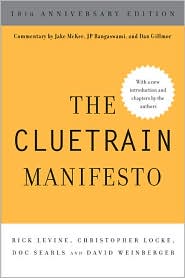
Cluetrain 10th Anniversary edition
Cluetrain 10th Anniversary
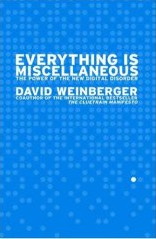
Everything Is Miscellaneous
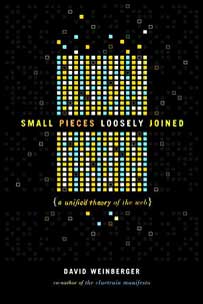
Small Pieces cover
Small Pieces Loosely Joined
Cluetrain cover
Cluetrain Manifesto
My face
Speaker info
Who am I? (Blog Disclosure Form) Copy this link as RSS address Atom Feed

June 11, 2009

[newmedia] Global perspectives

For this session, the panelists are videoconferenced in: Michael Netzley (Singapore Mgt Univ), Marshall Manson (Edelman London), and Wolfgang Lünenbürger-Reidenbach (Edelman Social Media Europe).

As we wait for some technical glitches to get ironed out, we hear from an audience member just back from Russia who talks about the amazing speeds of Moscow’s 4G network. He points out, however, that outside of Moscow, Russia’s network is “19th century.”

MM points to the rise of Facebook and Twitter across Europe. He also notes the importance of social media in the expenses scandal in the UK. WLR points out that the rise in Facebook is in local languages. There is no pan-European public there.

MN from Singapore says that there are 2,000 languages spoken in Asia. “Localization continues to be important.” In Asia, mobile is more important than elsewhere. He also points to the Chinese control of the Net, based on the value of “social harmony.”

Q: Will we see competitors to FB and Twitter in local markets, or will they achieve global dominance?
MM: Translation is going to become much less of a problem over time.
MN: Local remain critical.
WLR: We’ll see more, not less, focus on the local. Hyper local.

Q: Singapore is trying to get young people to get married. Are they using social media in this campaign?
MN: Hong Kong is ahead of Singapore in adopting social media. But in the past 6 months, the Singapore gov’t has been jumping in. The ministries are leading the way. For the past 50 years, media have played primarily a nation-building role. Very top-down. Not independent. But these msgs don’t do well online. The gov’t is slowly learning this. They’re trying to learn how to give more trust to their citizens.

MM: We don’t have to teach the younger generation how to use social media. We do need to change how we teach them to write. The old styles are not useful in conversational media.
WLR: Students use micromessaging.

[Tags: pr marketing global ]

Tweet
Follow me

Categories: Uncategorized Tagged with: business • global • marketing • pr • social networks Date: June 11th, 2009 dw

2 Comments »

[newmedia] Shrum and Blankley

I’m at the New Media Academic Summit for a second day. [Disclosure: Edelman PR is the main sponsor of this, and I’ve consulted to them in the past. In fact, it looks like I’ll be doing some more consulting to them.]

NOTE: Live-blogging. Getting things wrong. Missing points. Omitting key information. Introducing artificial choppiness. Over-emphasizing small matters. Paraphrasing badly. Not running a spellpchecker. Mangling other people’s ideas and words. You are warned, people.

Bob Shrum and Tony Blankley are talking. Shrum is a long-time Democratic political consultant and campaign manager. Blankley is his Republican counterpart (roughly). Shrum begins by saying that the Internet can be a tremendous tool for political persuasion. Blankley agrees and says the Net is weakening parties. And, says Blankley, this is the first communication tech that allows us to move from mass to more customized messaging. Congress is better at “sending out than capturing,” Blankley says.

Shrum: Obama has defied conventional wisdom about over-exposure. People now want the immediacy of their leaders. Second, his program is far more ambitious than usual. Blankley agrees that the exposure isn’t overdone, although he notes that O’s negatives have gone up faster than his positives have gone down. (“He’s still doing fine,” he notes.) It’d be better to have a bench of people who can speak, he says. (“Biden is not turning out to be a good communications device.”)

Q: If it’s a new era, why are the experts on the Sunday shows still male and pale?
Tony: I’m not sure it’s a new era. I thought we did see an increase in people of colors among the commentators during the campaign. Who gets booked for these shows isn’t a conspiracy. The bookers see someone on a show and devide to get him for their show. They’re desperately trying to find someone and they fall back on the people they know.
Shrum: The networks are trying, but they’re facing three centuries of discrimination.

Q: Is it now easier to mount an oppositional change?
Shrum: O has organized YouTube, etc., so well that it works in their favor.

Q: [me] Is it a generational change? If so, at the maximum, what does that change consist of?
Shrum: Yes. In fact, we may be at the end of the Reagan era. There may be a fundamental realignment in American politics. But we won’t know for ten years.
Blankley: Obama won in part because he won among the Millennials, because of his use of the new tech. There has been a generational shift in technology usage. Mass communication will just luck archaic. Will there be a new era? Possibly. But it won’t be based on the demographic shift. It will depend on O convincing us that there’s a better way to do politics.

[Tags: nms09 politics ]

Tweet
Follow me

Categories: Uncategorized Tagged with: conference coverage • nms09 • politics Date: June 11th, 2009 dw

Be the first to comment »

Jonathan Zittrain’s advice to graduates

Jonathan Zittrain’s high school commencement address is hilarious and sagacious. It’s a classic.

[Tags: jonathan_zittrain commencement_addresses ]

Tweet
Follow me

Categories: misc Tagged with: commencement_addresses • humor • jonathan_zittrain • misc Date: June 11th, 2009 dw

Be the first to comment »

June 10, 2009

[newmedia] Mike Slaby on Obama’s use of social media

NOTE: Live-blogging. Getting things wrong. Missing points. Omitting key information. Introducing artificial choppiness. Over-emphasizing small matters. Paraphrasing badly. Not running a spellpchecker. Mangling other people’s ideas and words. You are warned, people.

At the Edelman-sponsored NewMedia conference, a panel is beginning on “advancing reputation,” with Mike Slaby (CTO of Obama for America), Debbie Curtis-Magley (UPS), and David Liu (AOL). Premise: Companies can now advance their reputations through the channels they choose, without going through media distributors.

Mike (Obama): A lot of success came from Obama’s skills as a candidate. There was a movement, and our job in the new media departent was how to get the candidate in front of people more. Going into these spaces, you are an equal member with everyone else. It’s not broadcasting. If you tread on people’s space, you’ll piss them off. It’s hard for companies to find a persona and a personality for talking online, but it’s easy with a political campaign because you have a candidate. You have to have one set of values and one story, and you need to talk in the language of your audience. If you’re going to use Twitter, you have to have people in your organization who know how to tweet. And you have to trust your people and the people you’re talking about. We only filtered out comments that were truly, truly offensive. Sean Hannity came after us because someone at our social network made it look like the Black Panthers endorsed Obama on our social networking site, so we set up a profile for Hannity to show him that this was an open space.

We gave out our logos and let people make their own sites. There was an art exhibit of what people made out of this, called “Officially Unofficial.” Some of it I wish hadn’t been made, but so what? It made people feel that the campaign was theirs. This makes marketing people uncomfortable if they’re used to managing messages. You should give up control. It worked for us.

But social media works for politics only if it gets people out into the real world to vote. You have to convert your users into donors, volunteers, and voters. About 30% of our email was doing something in the real world … I’m proud of that.

He adds: Not every business should have a facebook page; it depends on what you’re trying to do.

Also: There are no switching costs online, which is a reason not to build your own social networking site. We had a multi-million person base ready to go, but that may never happen again in politics, and it probably never happens in business.

Q: Why did the campaign refer to Obama as Barack? Wasn’t that too informal?
A: People want an emotional connection. They want to know his story. We needed to talk about him as a person. But now I never refer to him as that. He’s president.

[Tags: newmedia politics obama social_media nms09 ]

Tweet
Follow me

Categories: Uncategorized Tagged with: conference coverage • digital culture • newmedia • nms09 • obama • politics • social networks • social_media Date: June 10th, 2009 dw

Be the first to comment »

[newmedia] Journalism panel

Dan Gillmor is not as pessimistic as many others about the future of journalism. We’re in a fertile period of innovation. But we need better audiences. Passive consumers need to be active readers, and this ought to be part of school curricula, starting in pre-school.

Jim VandeHri from Politico agrees with Dan that we’re going to end up with more and better journalism, although he has no idea what it’s going to look like and he thinks that newspapers are in much worse shape than most acknowledge.

Nick Wrenn from CNN says they use social media like Twitter both to engage the audience and as an early warning system.

David Kirkpatrick of Fortune (who’s writing a book about Facebook) is not so sure it’s a great time to go into journalism because the business model isn’t there. “I’m happy I’m getting out of it.” Yet the “number of kids who want to be journalists is astonishingly high.” He makes a few points. First, if Google gets better at its search, its ads become less relevant and valuable, and he thinks Bing is intended to force Google to get better at searching for that reason. Second, the number of minutes spent on Facebook has gone up hugely; it is uniquely influential as a media platform, both as a place where people create content and distribute others’ content.

Dan agrees that the business models aren’t there, but he’s jealous of his students because they get to invent their jobs and invent what journalism will be. Jim thinks that over time, there will be more organizations (like Politico) that can pay journalists. There will be lots of journalism, but just not dominated by the big papers and broadcasters. It’ll be non-profits, startups, etc. Politico makes money out of ads. Over the next six months, Politico will experiment with charging for some specialized content.

Q: Is it time to put the broadsheet out of its misery?
A: Dan: Print won’t shut down quickly because there’s still a whole lot of cash flow. And if you reset the debt via bankruptcies, there’s still profit to be had.
A: CNN: Newsrooms have to figure out how to deal with the changes. It’s amazing that newspapers still report on yesterday’s news.

Q: Who’s going to pay to gather dull but important information at the local level?
A: Dan: The newspapers aren’t gathering it now. No one is. We are going to lose eat-your-spinach journalism. Back when newspapers sent journalists to the boring meetings, the journalists were deterrents to bad behavior. Maybe we should hire circuit forensic accountants to work with journalists…
A: David: But now every member of the school board can be a broadcaster. So, the role of the community newspaper can be different. I am incredibly optimistic about the future of society in terms of info being distributed. But I’m not optimistic about the future of journalism.

[Tags: journalism newspapers medianms09 ]

Tweet
Follow me

Categories: Uncategorized Tagged with: journalism • knowledge • media • newspapers • nms09 Date: June 10th, 2009 dw

2 Comments »

[2b2k] Chapter 4 – inappropriately concrete?

Chapter 3 left readers with a problem without resolution. If facts don’t provide as firm a bedrock as we’d thought, then are we left to believe whatever we want? Is there no hope? [Spoiler: No, we’re not free to believe whatever we want.]

Because Chapter 3 was pretty abstract, I want to be sure to address its question in some concrete ways. So, Chapter 4 opens with a brief scene-setter that says that we all love diversity, but when there’s too much, we can’t get anything done. I’m now at the beginning of a section that will give maybe four general rules for “scoping” diversity so that a group has enough internal difference to be smarter than the smartest individual, but not so much that they can’t get past bickering. I plan on following that with a more abstract section that asks whether the Net is making us more open or closed to other people’s ideas. At the moment, I like the idea of beginning with the concrete and moving to the abstract, in large part because I think the abstract question is pretty much impossible to answer.

I can’t tell yet if the chapter structure is going to work. There is so much to say about this topic. And I have a concern that the reader is not expecting the book to take this turn. But I won’t be able to tell that until I have enough distance on the prior chapters to be able to read them with some degree of freshness.

Tweet
Follow me

Categories: too big to know Tagged with: 2b2k • broadcast • business • conference coverage • echo chambers • knowledge • marketing • media • newmedia • news • pr Date: June 10th, 2009 dw

9 Comments »

June 9, 2009

[berkman] Lewis Hyde on the Commons

Lewis Hyde is giving a Berkman talk about the book he’s working on. The book is about the ownership of art and ideas, and argues that they should lie in a cultual commons, rather than be treated as property.

NOTE: Live-blogging. Getting things wrong. Missing points. Omitting key information. Introducing artificial choppiness. Over-emphasizing small matters. Paraphrasing badly. Not running a spellpchecker. Mangling other people’s ideas and words. You are warned, people.

Lewis begins by talk about what a commons is. The term comes from medieval property ideas, and Lewis thinks of commons as a kind of property. He asks the group for a definition of property. Suggestions from the audience: “Exclusive rights.” “Anything I can use and have some degree of control over, not necessarily exclusively.” Lewis says that a 1900 dictionary defines property as that over which one has “rights of action.” Property is a bundle of rights of action. Lewis likes this definition because it includes human actors, Blackstone defines property rights in maximalist terms: the right to exclude the entire universe. Scalia also thinks property is the right to exclude. Lewis thinks the right to exclude is one of the bundle, not the whole thing. This is because, he says, he’s interested in commons. (He notes that in medieval times, “common” could be used as a verb. E.g., “a man may commons in the forest.)

Lewis talks about Hardin’s “The Tragedy of the Commons” essay. In fact, traditionally commons had governance rules to prevent the destruction of the commons’ asset, including the right of exclusion. “Commons were in fact not tragic. They lasted for millennia in Europe. Not tragic because they were rule-governed and stinted.” Why has the phrase “The tragedy of the commons” persisted? In part, because the phrase is catchy. In part because Hardin proposed it during the Cold War and it was taken as showing that common-ism doesn’t work.

There used to be an annual ritual of “beating the bounds,” to keep any gradual encroachment on the commons. “These were convivial affairs.” Lewis wonders if there are ways we can recover this resistance to encroachment.

Applied to the cultural realm, Lewis thinks cultural products are by nature in a commons. In the 18th century you get the idea that we could own poems, novels, etc. Until then, people thought of property as applying only to land. If something is not excludable, there’s no property in it. Many argued in the 18th century that therefore artistic works can’t be property. (Lewis recommends Terry Fisher’s article on philosophies of property. Terry points to four : Labor, moral rights, commercial utilitarianism, and civic utilitarianism.)

The first copyright law was in 1710 (Statute of Anne). By giving authors and publishers rights, it removed the “in perpetuity” of the crown’s monopolistic grants. It also created the public domain by creating a clear limit on the term of ownership: After 14 years, it enters the public domain. It’s as if the commons is the default state, says Lewis.

Jamie Boyle talks about the “second enclosure” in which everything is copyrighted by default, the term is extended. The second enclosure is an enclosure of the mind, says Boyle. Lewis now thinks there might be a third enclosure: The enclosure of wilderness of the mind. Lewis agrees that it makes sense to let the creator of a work, say a novel, get rewarded for it. “I wrote it, so it’s mine.” But, asks Lewis, what does the “I” mean? What is the self? He cites a 12th century Buddhist: “We study the self to forget the self.” To forget the self is to wake up to the world around you. Creativity comes out of self-abnegation. To get to something truly new, you have to a door open to the unknown. We usually think that the outside of owned property is the public domain. But that’s a domesticated sphere, things we are familiar with. There’s a old tradition that during the period of maturation, you have to leave the known world, go away from where instruction is given, and become familiar with your ignorance. (Lewis says he’s drawing on Thoreau.)

He takes an example from Jonathan Zittrain. When the Apple II came out, there was a spurt in sales because the first spreadsheet emerged, something that had not been expected. If you want a generative Internet, you have to be careful about what you lock down. Another example: In the 1980s, San Diego cell biologists patented a sequence of amino acids. They didn’t know its biological purpose. Ten years later, other researchers think that that sequence blocks blood to tumors. The patent owners sued the researchers. The patent gums up the system. Exploratory science goes into the unknown. “To enclose wilderness means giving property rights in areas where we as yet have no understanding what’s happening.” Lewis adds: “This makes no sense.” Lewis would like us to restore the idea that there are things that are unowned.

Emblematic of the third enclosure is silence. John Cage in 1952 came to Harvard to see/hear a completely soundproofed room. But Cage could hear a low rumbling and high whining. The low rumbling is the sound of your blood and the high whining is the sound of your nervous system. Silence for Cage meant not no sound but non-intention. He composed “4 mins and 33 seconds” which is a stretch of silence. The audience hears the ambient noise. In 2002 a rock group called the Planets put in a minute of silence. As a joke/homage, they credited it to Cage. The royalty-collecting societies started to send checks to Cage’s publisher. The publisher sued for copyright infringement on moral rights grounds (i.e., misattribution). They settled. But Cage held a Buddhist-like view of artistic creation. He tried to remove the self. A lot of copyright law assumes the work contains the imprint of the author’s personality. That’s one of the reasons we give a copyright. But those laws can get in the way of our ability to live in the wilderness, i.e., the third enclosure. How do you become a creator in a world in which scientists can patent unknown sequences and silence can be copyrighted?

Q: Maybe part of the problem in defending the commons is that we say we’re defending freedom, not as in free beer. Fighting for free beer is more compelling than fighting for free speech.
A: Beating the bounds was a fun event. So, yes, people have to want to do this.

Q: [me] How do we counter the fairness argument: If I did it, I ought to get the reward. How do we respond to that?
A: It’s hard to do this in political debate because it’s a long argument. I raise the question of the “I”: To what extent is my contribution really from me? With cultural works, you’re working in a vast sea of existing material. What you create is not entirely yours. Even if it becomes popular and useful, it’s other people who made it so. You can also point to the utilitarian consequences: The public interest is advanced by enabling things to enter the public domain.

Q: [jason] You’re making a creativity defense, i.e., that the commons is generative. But, if we take Cage or Thoreau to heart and say that true creativity consists of transcending the self, could we say that that leads to saying all works should be owned, so that you’re forced to create something new?
A: The puzzle is how much you can actually go to the wilderness. You can face it, but there’s no way to escape the world you come out of. Thoreau has The Iliad with him. There’s no way to escape the known. You always work from materials you’ve collected elsewhere.

Q: [ethanz] What’s so bad about private property? You’re hearkening back to a romantic conception that worked for a very small set of people. We’ve got an enormous amount of development vased on increasingly strong enclosure movements. Those movements have given us a great deal of what we love. Despite the first and second enclosures, creativity seems not to have been much hindered. Why should we worry about the third enclosure? Couldn’t we say that you’re attempting to protect and defend something that most of us have not experienced? How do we know that your romantic vision is superior to the world we’re interacting with?
A: I’m not against private property. The question is always where the lines should be drawn. I think we’ve extended the right to exclude too far. Yes, the world is quite creative. But we don’t know what we’re missing. With the enclosing of wilderness, we’re enclosing that which we don’t know about. Researchers are reluctant to do certain kinds of work, for fear of being sued.
Ethan: My diabetes medicine — recombinant DNA — exists because Eli Lilly worked within enclosures. How do we know we would have made the same progress if those enclosures weren’t there?
A: Let’s leave that hanging as a question. It’s a good question. You’re right that the existing dominant system has produced remarkable results.

Q: Michael Heller in The Gridlock Economy goes through the economic models that explain what we lose by locking stuff down. What’s the cultural loss?
A: Lessig and others write books about this… [Tags: lewis_hyde copyright commons copyleft science art ]

Tweet
Follow me

Categories: Uncategorized Tagged with: art • commons • copyleft • copyright • culture • digital culture • digital rights • everythingIsMiscellaneous • knowledge • libraries • science Date: June 9th, 2009 dw

4 Comments »

Meaning-mining Wikipedia

DBpedia extracts information from Wikipedia, building a database that you can query. This isn’t easy because much of the information in Wikipedia is unstructured. On the other hand, there’s an awful lot that’s structured enough so that an algorithm can reliably deduce the semantic content from the language and the layout. For example, the boxed info on bio pages is pretty standardized, so your algorithm can usually assume that the text that follows “Born: ” is a date and not a place name. As the DBpedia site says:

The DBpedia knowledge base currently describes more than 2.6 million things, including at least 213,000 persons, 328,000 places, 57,000 music albums, 36,000 films, 20,000 companies. The knowledge base consists of 274 million pieces of information (RDF triples). It features labels and short abstracts for these things in 30 different languages; 609,000 links to images and 3,150,000 links to external web pages; 4,878,100 external links into other RDF datasets, 415,000 Wikipedia categories, and 75,000 YAGO categories.

Over time, the site will get better and better at extracting info from Wikipedia. And as it does so, it’s building a generalized corpus of query-able knowledge.

As of now, the means of querying the knowledge requires some familiarity with building database queries. But, the world has accumulated lots of facility with putting front-ends onto databases. DBpedia is working on something differentL accumulating an encyclopedic database, open to all and expressed in the open language of the Semantic Web.

(Via Mirek Sopek.) [Tags: wikipedia semantic_web everything_is_miscellaneous ]

Tweet
Follow me

Categories: Uncategorized Tagged with: everythingIsMiscellaneous • everything_is_miscellaneous • knowledge • metadata • semantic_web • web 2.0 • wikipedia Date: June 9th, 2009 dw

5 Comments »

June 8, 2009

The point of broadband

David Isenberg has gathered a set of Internet architects and others around the comment (press release) sent to the FCC, reminding it that, as the government plans a national broadband strategy, the aim isn’t to deliver broadband. The aim is to deliver fast access to the Internet. Signatories include Vint Cerf, David Reed, Larry Lessig, Robin Chase…

We tend to use the terms interchangeably these days, but that’s not right. Broadband can be used to deliver many sorts of networks. Now, access providers probably wouldn’t claim it’s broadband if it were only for on-demand movies, because the public (and the government at times) has so associated “broadband” and “Internet.” But they well might deliver broadband access to something that looks like the Internet, but that filters sites or discriminates among packets based on origin or type.

The comment reminds the government that broadband is only a delivery system. The economic, social, political and cultural benefits we want to achieve come from access to the Internet. If we get the delivery system but not the Internet it was built for, the national broadband policy will have failed to achieve its aims.

[Tags: net_neutrality broadband ]

Tweet
Follow me

Categories: Uncategorized Tagged with: broadband • net_neutrality Date: June 8th, 2009 dw

2 Comments »

Next, he dehydrates water

Rob Matthews has printed out and bound Wikipedia’s featured articles, creating a 5,000 page volume.

In case you were wondering, featured articles are articles that get a gold star from Wikipedia – about one in every 1,140 at the moment, for the English language version.

(If Rob hadn’t copyrighted the excellent photos, they’d be popping up in every third slide deck from now on.)

[Tags: wikipedia ]

Tweet
Follow me

Categories: Uncategorized Tagged with: digital culture • everythingIsMiscellaneous • knowledge • media • wikipedia Date: June 8th, 2009 dw

1 Comment »

« Previous Page | Next Page »


Creative Commons License
This work is licensed under a Creative Commons Attribution-NonCommercial-ShareAlike 3.0 Unported License.
TL;DR: Share this post freely, but attribute it to me (name (David Weinberger) and link to it), and don't use it commercially without my permission.

Joho the Blog uses WordPress blogging software.
Thank you, WordPress!