


logo
EverydayChaos
Everyday Chaos
Too Big to Know
Too Big to Know
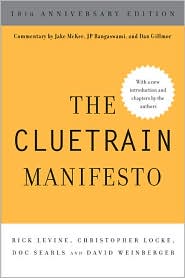
Cluetrain 10th Anniversary edition
Cluetrain 10th Anniversary
Everything Is Miscellaneous
Small Pieces cover
Small Pieces Loosely Joined
Cluetrain cover
Cluetrain Manifesto
My face
Speaker info
Who am I? (Blog Disclosure Form) Copy this link as RSS address Atom Feed

March 13, 2009

Order of Magnitude puzzle: Bagging MA

According to the Boston Globe, how many bags (paper + plastic) do grocery stores give out in one year in Massachusetts? (The population is 6.3 million.) You win if you come within an order of magnitude. You don’t, however, win anything.

The answer is in the first comment.

[Tags: puzzles bags environment ]

Tweet
Follow me

Categories: Uncategorized Tagged with: bags • environment • puzzles Date: March 13th, 2009 dw

8 Comments »

Jon Stewart: Squirmatastic righteousness

I thought Jon Stewart’s interview with Jim Cramer last night was a righteous misfire. Stewart was on his high horse, but Cramer was on his little Shetland pony. The result: It was hard to watch.

Stewart was making an important, broad point: Mainstream financial journalism as embodied by CNBC fails the most basic tests of journalism overall. These folks knew better, but give us bread and circuses. Right on, Jon

But feisty, cocky Cramer came onto the show as a Stewart fan, and just kept agreeing and apologizing. I thought ultimately that was pretty disingenuous of Cramer, but it left Stewart looking like a bully. We wanted to see Stewart tear into William Randolph Hearst, but Hearst sent Dear Abby in his place. Except — to mess up the metaphor — Cramer does epitomize CNBC’s tabloiding of financial news, Cramer is a financial insider who knows better, and Dear Abby would have put up more of a fight.

[Tags: jon_stewart jim_cramer cnbc media journalism financial_news ]


You can see the entire, unedited interview here.


The Daily Show runs an anagram contest. The phrase to be anagrammed at the moment is: “Envoys to Afghanistan and Iraq Are Named”

Here’s my best attempt: “On the QT, Iran damns any gain of area saved”

And yours?

Tweet
Follow me

Categories: Uncategorized Tagged with: business • cnbc • culture • entertainment • expertise • journalism • media Date: March 13th, 2009 dw

5 Comments »

March 11, 2009

Berkman MediaCloud tracks feeds ‘n’ memes

The Berkman Center has launched one of its most exciting projects. MediaCloud is subscribing to hundreds of RSS feeds, including many from the mainstream media, is automagically performing topic analysis (actually, entity extraction using Reuter’s OpenCalais) on it, and is building a gigantic database so researchers can see how ideas and information move through and across the Net.

Here’s what the announcement says:

The Berkman Center for Internet & Society is pleased to announce the launch of Media Cloud, a new project that seeks to track news content comprehensively — providing free, open, and flexible research tools:

http://www.mediacloud.org

Researching the nature of news, and media information flows, has always faced a difficult challenge: there is so much produced by so many outlets that it is hard to monitor it all. Researchers have used painstaking manual content analysis to understand mass media. On the web, the explosion of citizen media makes such an approach far more difficult and less comprehensive. By automatically downloading, processing, and querying the full text of thousands of outlets, Media Cloud will allow unprecedented quantitative analysis of media trends.

Today’s launch allows a first view into some of what is possible on the Media Cloud platform. At http://www.mediacloud.org you can generate simple charts of media coverage across sources and countries. The actual capabilities of the system are much greater, and the Media Cloud team is actively looking for other researchers who will bring their own questions as the tools are further developed. Ultimately, Media Cloud will provide open APIs that can support a variety of lines of inquiry.

Visit the Media Cloud site, try the visualizations, share your research ideas with the team, and sign up for the Media Cloud mailing list to hear about functionality enhancements and other project developments.

The Berkman Center is proud to be incubating the project in its initial phases and is now seeking partners to help Media Cloud realize its full research potential….

[Tags: berkman mediacloud media memes journalism blogging ]

Tweet
Follow me

Categories: blogs Tagged with: berkman • blogging • blogs • everythingIsMiscellaneous • journalism • media • mediacloud • memes Date: March 11th, 2009 dw

4 Comments »

March 10, 2009

Future of News: The Tag

To encourage people to start using the FutureOfNews tag at Delicious.com, The Knight Foundation is giving away an entrance badge to the SxSW conference to someone who uses that tag today or tomorrow. Knight hopes that we’ll keep using the tag forever after on pages of interest to those who care about the FutureOfNews.

The winner will be announced on their site, KnightPulse.org at 5pm EDT, Wed.

[Tags: news knight media journalism futureofnews ]

Tweet
Follow me

Categories: Uncategorized Tagged with: everythingIsMiscellaneous • futureofnews • journalism • knight • media • news • tagging Date: March 10th, 2009 dw

1 Comment »

[berkman] Al Gidari on cellphone/mobile privacy

Al Gidari, Jr. of Perkins Cole is giving a Berkman talk on privacy called “They Know Where You Are: Location Privacy in a Mobile World.” [Note: I’m live blogging, getting things wrong, paraphrasing badly, missing stuff, not spell-checking, and generally just taking notes. ]

Early on, cellphone fraud was rampant. It was relatively easy to clone a phone. Al worked on tracking down offenders. The three-letter government agencies took note. E.g., the hacker Kevin Mittnick was tracked down by the FBI and the provider by using “trigger fish” tech that judges location based on cellular signals. But the carriers refused to put in the tech the feds wanted because it was too expensive. In 1994, Congress required carriers to install “surveillance-ready” technology; you could wiretap with just a flip of a switch.


“In those debates one of the serious privacy issues was whether or not the gov’t sought to have tracking capabilities for wireless phones included,” Al says. Louis Freeh said that the gov’t didn’t want such a capability, that it was a red herring, etc. CALEA separated the basic info from location info. For the basic info, you just need a subpoena. For location info, you need to go to a judge and show that it’s relevant to an ongoing investigation.

Cellphone carriers know and record a cellphone’s availability on a particular cell tower, whether or not you’re making a call. If you make a call, the tower is recorded. (This was required back when roaming agreements mattered a lot.) Google knows this also for use in Google Maps. So, location info is available from various sources. There’s also realtime inf about where you are. Then there’s prospective: mapping your movements over time.

CALEA only dealt with the historical aspect of this, not real time or prospective. Industry spent 4 years developing a standard for delivering info to law enforcement. There was a major debate over location info. In 2000, the courts decided the way the industry handled location info was proper. In a compromise, the carriers agreed that location would be given at the beginning and end of a call and the info would be included as part of the “pen register” info (the number you dialed, etc.) provided under the law. That’s “signaling info” that’s covered by CALEA.

The carriers immediately started receiving orders from the feds for the pen register info including the location info. The feds looked in the Stored Communication Act to find statutory justification for getting the prospective location info. But it’s about stored records that already exist, not records to be created in the future and stored in real time. The carriers weren’t ready to fight this. A couple of years ago, a judge said that the prospective info — where someone is going — isn’t permitted and that it violates the Fourth Amendment. Most of the following cases have gone against the feds. [Al talks about the applicability of various laws. I lost track.] “One magistrate’s decision doesn’t bind another, and we have inconsistent implementation…” Plus states get to make up their own minds about this, given the “floor.”

“The debate continues to age. We don’t know what the outcome will be.” But we need certainty, so a decision is being brewed. Feds want access, but at least are ok with bringing it before a judge. The carriers want probable cause.

The privacy implications are huge, Al says. For example, they get requests for all people on a cellphone on a site for a ten minute period, e.g., when looking for witnesses to a drug transaction. What about third parties who aren’t subject to this, e.g., Google Maps? Are the standards for requesting info lower for them? Google only responds to search warrants about location info. And if you’re a parent tracking your kid’s location, you’re developing a history that may or may not be subject to the law.

We need transparency, Al says. The carriers get 100 requests a week for location info, often for multiple people. That volume is high. And how long will they be required to track them. Because you can disclose location in emergencies without prior permission, law enforcement has gamed the system. No carrier withholds info if it’s a matter of life and death. But there’s no recording of any of these requests. There’s no oversight. Al tells about a state law enforcement official who insisted that a phone be manually pinged ever 15 mins, even when the phone was off, fort 24 hours. It turned out the guy was pinging his daughter who had not returned from a date. “How subject to abuse is that?” Al asks. Finally, if law enforcement wants to now about a particular target, should the location info of the people s/he calls also subject to disclosure?

“If the service provider is offering these location based services, can civil parties track someone who’s using the service?” he asks. Recently in a state court, a lawyer asked about info based on phone found on a container ship carrying counterfeit condoms. They wanted to know everywhere the phone had been and who it had called. The carriers refused. “The risk is enormous that location information will be abused and misused both in civil and criminal cases and it’s far from clear what Congress will do when this hot potato lands in its lap. But we do know it is coming.”

Q: What are the privacy considerations about providing aggregated, anonymized info? Can anyone other than gov’t request that?
A: Carriers want customer consent to disclose location info. But many customers buy phones for the family. Can the husband watch where the wife is going? But the customer must agree to it. It requires CPNI oy!, i.e., the customer’s consent. Non-carriers are not covered by law covering standards for aggregated or individual information. They all have policies about this and require permission.

[me] What about CPNI? Should it be opt-in
A: The kerfuffle was an example of bad journalism. The article expressed it badly. The info you are opted in to giving can be used only within the family of companies for marketing purposes. For sharing outside, it requires explicit opt-in. And CPNI has a higher standard for location info, which does not get shared. An “affiliate” is an entity you own or control. Verizon is incorporated in separate states, so they’re trying to share the info among that family of corporations.

[ez] When I meet with human rights groups, they disassemble their phones. Is anyone discussing the way in which the backdoors we put into phones will be used by repressive governments?
A: The standards are developed by manufacturers distributed to local markets. The standard reflect the local laws. The local gov’ts own the access points, so they don’t need much of a backdoor…
Q: That’s not true of China.

A: Providers do support the criminal law of their host countries. You end up with compromises made by providers. The quality of service capabilities built in, not there for surveillance, enable monitoring by protocol, etc.

Q: What are the standards for getting info on the people who attended an event? Vodaphone did that in Egypt
A: We get requests. The standard is: Your guess is as good as mine. Suppose we get a request for info about everyone who viewed a particular video at YouTube? What’s the standard? Wisconsin asked Amazon to list everyone who bought a particular book, and a court sided with Amazon’s refusal. We rely on service providers to make those objections. It’s not even clear that you would have standing to make those requests. The carriers object on the grounds that it’s burdensome. “If not for the service providers, that information would go. Most service providers are very concerned because their business rests on your comfort level with the privacy they support.” But it’s not uniform.

[I missed the last few questions. I believe Ethan Zuckerman, the greatest live blogger alive has been taking assiduous notes.] [Tags: calea privacy cellphones mobiles location ]

Tweet
Follow me

Categories: Uncategorized Tagged with: calea • cellphones • digital rights • location • mobiles • privacy Date: March 10th, 2009 dw

5 Comments »

March 9, 2009

The Zen of Skittles

David Berkowitz has a terrific post at MediaPost about why Skittles has removed its own content from its Web site and is instead featuring the Wikipedia page about Skittles, a page that aggregates Skittles-mentioning tweets, and its Facebook page. David writes:

Here’s the message Skittles is sending: What consumers say about the brand is more important than what the brand has to say to consumers.

…

By just about any rational indication, Skittles went too far. Highlighting Twitter Search in particular seems absurd, especially since Twitter tends to skew older relative to other social media properties, and Skittles seems to target a younger audience. I came home and showed Skittles.com to my wife. Her first reaction, before I even told her why I was showing it to her, was, “That’s it?” Then she added, “What happens if you don’t care about Twitter or don’t know about Twitter? It seems like it’s only for people who are really technical. I just wouldn’t care.”

But why would anyone care about what Skittles has to say? What, pray tell, could Skittles ever say that was so important, unless we woke up one day to find out that eating Skittles is the world’s tastiest cancer cure, or alternatively that Skittles lower men’s sperm count. Then, perhaps, the world will listen.

It goes on from there. And I say: OMG, I actually went to — and enjoyed! — Skittles.com. Awesome!

[Tags: skittles twitter marketing cluetrain ]

Tweet
Follow me

Categories: Uncategorized Tagged with: cluetrain • marketing • skittles • twitter Date: March 9th, 2009 dw

4 Comments »

March 8, 2009

Wolfram computes it all

Stephen Wolfram is promising “A new paradigm for using computers and the web.” It involves “a mixture of many clever algorithms and heuristics, lots of linguistic discovery and linguistic curation, and what probably amount to some serious theoretical breakthroughs.” He doesn’t lay it out explicitly, but says “…armed with Mathematica and NKS I realized there’s another way: explicitly implement methods and models, as algorithms, and explicitly curate all data so that it is immediately computable.”

Wolfram is very very very very very smart. No one doubts that. He’s smart enough that he would not be posting and hyping this site unless there’s something there. I don’t understand it, but, frankly I’m looking forward to it.

The site is called WolframAlpha, and it opens in May.

[Tags: wolfram semantic_web search metadata ]

Tweet
Follow me

Categories: Uncategorized Tagged with: everythingIsMiscellaneous • knowledge • metadata • search • wolfram Date: March 8th, 2009 dw

7 Comments »

March 7, 2009

Tales of data pirates: Opting out of Verizon’s open-ended sharing

A small legalistic pamphlet from Verizon arrived today telling me that I have 45 days to opt out of “agreeing” to let Verizon share Customer Proprietary Network Information, i.e., “information created by virtue of your relationship with Verizon Wireless,” including “services purchased (including specific calls you make and receive,” billing info, technical info and location info. They promise to only share this with “affiliates, agents and parent companies.” It will definitely not be shared with “unrelated third parties” … unless, perhaps that third party pays Verizon to become an affiliate, whatever the heck “affiliate ” means.

To opt out you can call 1-800-333-9956. Or you can follow the instructions in the mailing to go to verizonwireless.com and log into My Verizon where you will find no mention, no button, no link and no help. Ah, but you forgot to check your Messages. There you will indeed find a link to CPNI. The link is marked “Not available.” Dead end.

You could then call Verizon’s excellent telephone support. (Nope, I’m not being sarcastic.) They won’t be able to find the opt out button either. But during the 8 minutes the rep puts you on hold, you’ll be amused to hear one of their continuous bits of self-promotion tell you that Verizon never shares your personal information. Oh, what a wry sense of humor Verizon has!

When you escalate the call, you will finally be told to click on the My Profile tab in My Verizon, then click on Phone Controls, and there you will conveniently find the link. It’s just that simple!

The whole thing sucks :( [Tags: verizon marketing privacy fcc ]


[March 10:] Verizon responds in its blog. GigaOm responds more broadly to that response. And I still say that the if you’re going to make the mistake of opting us in to sharing private info, then you have an ethical obligation to make it damn clear to us that you’re doing so, and making it a damn site easier for us to opt out.


[March 11:] Al Gidari, Jr. of Perkins Cole is giving a talk at the Berkman Center about the privacy of mobile-based info. I asked him about CPNI. Here are my notes on what he said:

The kerfuffle was an example of bad journalism. The article expressed it badly. The info you are opted in to giving can be used only within the family of companies for marketing purposes. For sharing outside, it requires explicit opt-in. And CPNI has a higher standard for location info, which does not get shared. An “affiliate” is an entity you own or control. Verizon is incorporated in separate states, so they’re trying to share the info among that family of corporations.

Tweet
Follow me

Categories: Uncategorized Tagged with: digital rights • fcc • marketing • privacy • verizon Date: March 7th, 2009 dw

214 Comments »

George Madoff

bernie madoff

You have to admit, the guy looks like George Washington. You know, the guy on the dollar bills that used to be in your pocket.

[Tags: bernie_madoff separated_at_birth ]

Tweet
Follow me

Categories: misc Tagged with: misc Date: March 7th, 2009 dw

3 Comments »

March 6, 2009

How protected should those who host be?

John Palfrey and Adam Thierer discuss and debate whether the Communications Decency Act needs to be altered to make those who host content more liable than they are now. JP believes they should be.

I’m on the road and haven’t had time to read the debate. As a kneejerk liberal, I start out sympathetic to Adam’s point of view. But I have enough (= total) respect for JP to be quite open to being convinced…

[Tags: cda john_palfrey adam_thierer digital_rights ]

Tweet
Follow me

Categories: Uncategorized Tagged with: cda • digital rights • policy Date: March 6th, 2009 dw

Be the first to comment »

« Previous Page | Next Page »


Creative Commons License
This work is licensed under a Creative Commons Attribution-NonCommercial-ShareAlike 3.0 Unported License.
TL;DR: Share this post freely, but attribute it to me (name (David Weinberger) and link to it), and don't use it commercially without my permission.

Joho the Blog uses WordPress blogging software.
Thank you, WordPress!