


logo
EverydayChaos
Everyday Chaos
Too Big to Know
Too Big to Know
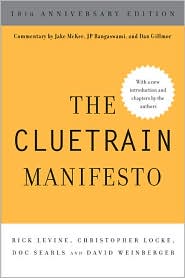
Cluetrain 10th Anniversary edition
Cluetrain 10th Anniversary
Everything Is Miscellaneous
Small Pieces cover
Small Pieces Loosely Joined
Cluetrain cover
Cluetrain Manifesto
My face
Speaker info
Who am I? (Blog Disclosure Form) Copy this link as RSS address Atom Feed

March 17, 2009

A coup without media

Ethan Zuckerman has pointed us at the coverage of the military coup in Madagascar, a country of 20+ million folks with almost not mainstream media on the ground. The news coming out is getting here via Twitter (#madagascar) and blogs. GlobalVoices is one good source.

[Tags: madagascar blogging media twitter journalism ethan_zuckerman ]

Tweet
Follow me

Categories: Uncategorized Tagged with: blogging • journalism • madagascar • media • twitter Date: March 17th, 2009 dw

Be the first to comment »

[berkman] Jeff Howe on crowd sourcing

Jeff Howe of Wired is giving a Berkman lunchtime talk on his book Crowd Sourcing. (He coined the term in 2006.) [Note: I’m live blogging, making mistakes, missing stuff, paraphrasing inappropriately, etc.]

From the beginning, he says, he’s been ambivalent about crowd sourcing. His book is a series of stories showing crowdsourcing’s promise and perils. The book is short on quantitative data, he says. As he was finishing up the edits, he came across a survey of 650 iStockPhoto.com photo contributors. iStock was one of Jeff’s main examples, a stock photo agency that undercut competitors by 99%. They were able to do this because amateur photographers were willing to upload entire libraries of their photos. iStock culled them. iStock runs its corporate decisions past the community. The survey showed that contributors had a rich mix of motivations. He’d like to revisit this question.

Jeff gives his 45 minute book talk in 20 mins: He got interested in crowdsourcing by watching Myspace. “User generated content” doesn’t begin to tap the change that’s taking place. (Plus, he adds, he hates the phrase.) He spent a night searching for user-generated anything to show that it was about more than teenagers making “content.” E.g., John Fluevog Open Source Shoeware names shoes after designs contributed by users. He wrote an article for Wired in June 2006. The term took off.

As an example, he tells the story of the Two Jakes who created a crowdsourced t-shirt company, threadless.com. It created a community of designers and people who like to vote on designs. Revenues in 2007 topped $30M. The community provides the designs, does the marketingt, and Threadless has a mechanism that lets them gauge how much they need quite accurately.

iStockPhoto was bought by Getty, and revenues have continued to climb…over $100M in 2008, with 50% profit margin.

Another example: The way amateur ornithologists have transformed the way ornithology works, Current.tv, the Elements restaurant in DC…

Why did crowdsourcing happen? Lots of amateurs, open source, tools, online communities. The cardinal rule of crowdsourcing: “Ask not what your community can do for you, etc.”

Jeff ends by asking about the study of iStock contributions’ motivations. 80% of iStockers religiously visit the site. The study shows the primacy of the financial motivation. Only 4% of the contributors make their primary living off of photography. The forum gets 37 posts per minute. 80% consider their work profitable, and 20% consider it extremely profitable. iStockers are largely not out to make friends or to network with others. iStockers are unsure that other iStockers can be trusted. This runs counter to how the company portrays them.

Q: I just had a logo made for $250 through LogoTournament. 30-40 designers worked on it from all over the world. The contestants all see one another’s designs.
A: Anectodotally, people seem to love it. There’s also CrowdSpring and 99Designs.

I used worth1000 for cover design. The Berkman folk loved it, but when I posted about it, I got flamed.
A: I understand that crowdsourcing is disruptive. It’s an emotional subject. Creatives can shape the transformation by embracing it.

Q: Your examples largely focused on highly creative forms of work. People do these things on their own as hobbies. How about crowdsourcing that has people transcribing podcasts via MechanicalTurk. Are these two types of crowdsourcing the same phenomenon?
A: MechanicalTurk is for repetitive, boring tasks. I don’t know how to encompass this. This makes the motivation for crowdsourcing more complex. That doesn’t dismay me.

Q: Is the difference about passion?
A: My catchphrase is that passion is the currency of the 21st century.

Q: [me] You position this as a contradiction. But it’s not if you define crowdsourcing as the action of a crowd, etc., and stir in economics: Those with leisure will do it for passion, while the rest will do more boring tasks for money. Unless what matters to you, and to the media that took it up, is that it’s a statement about human motivation.

Q:[eszter] You’re putting too much faith in the study. It’s only 1% of users and the methodology isn’t necessarily rock solid.
A: I called iStock’s founder and he has the same problems with the study.

Q: When I got the book, what was exciting was the possibility of solving altruistic problems. Do you have any examples?
A: GlobalVoices. Transcription services from a mobile phone for nonprofits.

Q: ReCaptcha is a great example. Also, spamornot.org.

Some of the crowdsourced stock photo sites are scams.

Q: Is crowdsourcing exploitative?
A: Sure could be. Professional stock photographers certainly think so. [Tags: berkman crowd_sourcing everything_is_miscellaneous ]

Tweet
Follow me

Categories: Uncategorized Tagged with: berkman • business • cluetrain • digital culture • everythingIsMiscellaneous • expertise Date: March 17th, 2009 dw

1 Comment »

Open Congress Wiki

Congresspedia has become the Open Congress Wiki, where we can build transparency and knowledge together.

[Tags: everything_is_miscellaneous e-gov egov democracy congress politics ]

Tweet
Follow me

Categories: Uncategorized Tagged with: congress • democracy • e-gov • egov • everythingIsMiscellaneous • media • politics Date: March 17th, 2009 dw

Be the first to comment »

March 16, 2009

Steven Johnson on the future of news

On the heels of Clay’s splash o’ cold water — to paraphrase: “Revolutions aren’t pretty” — comes Steven Johnson‘s eloquent pointing to the “old growth forests” of online news as indicators of what might be. As brilliant as ever.

[Tags: news journalism media clay_shirky steven_johnson ]

Tweet
Follow me

Categories: Uncategorized Tagged with: everythingIsMiscellaneous • journalism • media • news Date: March 16th, 2009 dw

2 Comments »

Extra Sensory Keyboard Detection

Researchers have discovered ways to pick up your keystrokes by reading tiny scraps of electromagnetic radiation, or with PS2-connected keyboards, just by plugging into the power grid. It turns out Cryptonomicon wasn’t paranoid enough!

[Tags: security ]

Tweet
Follow me

Categories: Uncategorized Tagged with: privacy • security Date: March 16th, 2009 dw

1 Comment »

Front page flash cards

At the Newseum site, mousing over a map pops up the front page of the local newspaper. Cool!

(And won’t the site please start taking ads so we can all run the headline: “Ad Newseum!” Please”?)

[Tags: news media everything_is_miscellaneous mashups ]

Tweet
Follow me

Categories: Uncategorized Tagged with: everythingIsMiscellaneous • mashups • media • news Date: March 16th, 2009 dw

2 Comments »

March 15, 2009

Andrew Lih on Wikipedia

I just read Andrew Lih’s The Wikipedia Revolution, in preparation for an interview I’m doing on March 25 for the Berkman Center. It will be held in Griswold Hall, room 110. (Actually, the actual location hasn’t been announced yet. But somewhere at Harvard.) It’s a terrific book.

Andrew tells the story historically, providing tons of context and background. As the title makes clear, he thinks Wikipedia is epochally important, but the book isn’t about touting Wikipedia and gesticulating towards its implications. Rather, given that Wikipedia is at least rather interesting, how did it get there? The simple story we’ve heard so frequently — it’s the encyclopedia we all wrote in our spare time — masks a complex mix of personality, theory, politics, social interaction, software and hardware. Andrew doesn’t shy away from the controversies and tells the story from a neutral point of view … neutral given that he implicitly thinks Wikipedia is overall pretty awesome. In that he mirrors Wikipedia itself: It is (overall) neutral given that the contributors agree that a group-authored encyclopedia that aims for NPOV is worth working on.

If you want to understand Wikipedia, I highly recommend this book, especially in tandem with How Wikipedia Works by Phoebe Ayers, Charles Matthews, and Ben Yates, a terrific and detailed explanation of the intricacies of Wikipedia’s structure, ethos, rules, and hierarchy.

[Tags: wikipedia ]

Tweet
Follow me

Categories: Uncategorized Tagged with: digital culture • everythingIsMiscellaneous • knowledge • wikipedia Date: March 15th, 2009 dw

14 Comments »

Recycling tip #213 from the Night Manager

Last night I woke up from a seemingly unrelated dream, and wrote down the following household recycling tip: Since you generally buy bigger gifts for people the longer you know them, to keep the gift wrap re-usable, wrap your initial gifts in way too much paper.

Look, it’s a dream, so the premises may not be entirely right, but the logic is impeccable: If you wrap your initial (small) gift in just enough wrapping paper, it’ll be too small to wrap the subsequent (bigger) gifts you buy. So, wrap that first gift in enough paper to cover your later gifts.

You’re welcome, planet Earth.

[Tags: dreams recycling ]

Tweet
Follow me

Categories: misc Tagged with: dreams • misc • recycling Date: March 15th, 2009 dw

2 Comments »

March 14, 2009

The visual display of unfathomable numbers

These images from Chris Jordan make clear the vastness of the various sorts of stuff we squander. (Thanks to Joachim for the link.)

[Tags: visuals big_numbers tufte ]

Tweet
Follow me

Categories: misc Tagged with: everythingIsMiscellaneous • misc • tufte • visuals Date: March 14th, 2009 dw

1 Comment »

Shirky’s classic post on the fate of newspapers

This post by Clay Shirky will be at the center of future discussions about the newspaper revolution. It is itself a pivot point. And it’s beautifully written, with a pause-worthy insight in every paragraph.

[Tags: newspapers journalism media clay_shirky everything_is_miscellaneous ]

Tweet
Follow me

Categories: Uncategorized Tagged with: culture • digital culture • everythingIsMiscellaneous • journalism • media • newspapers Date: March 14th, 2009 dw

4 Comments »

« Previous Page | Next Page »


Creative Commons License
This work is licensed under a Creative Commons Attribution-NonCommercial-ShareAlike 3.0 Unported License.
TL;DR: Share this post freely, but attribute it to me (name (David Weinberger) and link to it), and don't use it commercially without my permission.

Joho the Blog uses WordPress blogging software.
Thank you, WordPress!