


logo
EverydayChaos
Everyday Chaos
Too Big to Know
Too Big to Know
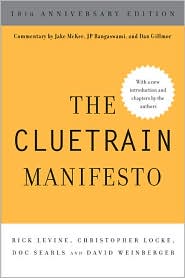
Cluetrain 10th Anniversary edition
Cluetrain 10th Anniversary
Everything Is Miscellaneous
Small Pieces cover
Small Pieces Loosely Joined
Cluetrain cover
Cluetrain Manifesto
My face
Speaker info
Who am I? (Blog Disclosure Form) Copy this link as RSS address Atom Feed

January 17, 2006

[Berkman] Dan Gillmor

Dan is giving a lunchtime talk about his new project, a center for citizen journalism hosted jointly by Berkman and UC Berkeley Journalism grad school. Pretty damn cool.

[As always, the following summarizes Dan’s comments, which means I am certainly getting them wrong.]

Dan says a moment when he had begun as a reporter at the San Jose Mercury News started him down this course: He realized that his readers know more than he does. At first, he says, that was daunting, but then it was liberating. “It’s about changing media from lecture to conversation.”

The Center is going to focus on:

1. Research, analysis and advocacy. He’s particularly interested in helping to find ways that conversation-based media can be more trustworthy.

2. Tools.

3. Education and training — help people to be more media literate and train people how to be better citizen journalists. In addition, he’d like to help media organizations learn how to listen and to work better with citizens.

Q: Is there room for editors and traditional media?

A: Absolutely. Editors have long careers ahead of them.

Q: How about international?

A: (Dan hands it to Ethan Zuckerman): Citizens in countries around the world are already beginning to do this.

Q: Should we be certifying bloggers? Training them to some standard?

A: No. The only people I want in education or training are people who want to learn something new. Not all blogging is journalism, nor should it be.

Q: What do bloggers need gto learn to be taken by the media?

A: More important is how they can talk effectively with other citizens. Transparency is important. (By the way, Dan adds, when he says “blogs,” he has in mind the broad range of ways that people express themselves on the Web.)

Q: Not only is the Web the second superpower, it’s the second social welfare delivery mechanism. Any synergies with this and citizen journalism?

A: “I’m working on a book outline on this topic, based on a hypothesis that I believe to be true, but I’m still gathering data:” The more people become engaged with current events — starting at the most modest level, i.e., not being a couch potato but getting a report by assembling it from various sources…all the way to becoming journalists — my conjecture is that people on that trajectory are likely to become activists.

Q: How about video?

A: Video is on the cusp of getting really interesting. In general, it’s easier to do a good blog post than a good podcast or videoblog, although that may be less true for the younger generation. The tools of video creation are surprisingly sophisticated and inexpensive and only getting better.

Q: How important is anonymity?

A: It’s a really important issue. I’d be horrified if there were an attempt to end anonymity in some governmental way. I do believe, though, that journalism in general is a better process when people stand behind their words. Maybe being pseudonymous, and not entirely anonymous, is enough.

Q: What do you think of Digg.com?

A: I like it. We need to get better at knowing what to trust. We should combine human and machine intelligence for this. In California there’s a project called NewsTrust to get people to rate articles on reliability in a number of dimensions, to build up a database of bylines.

Q: Anything you say, write, or think (just about) is now publicly available, without context. In today’s world we seem to be less forgiving than years ago. Do you see a change where people will accept the humanness of people, and avoid the gotcha’s?

A: Someday in the relatively near future, we’re going to elect a president who had a blog when she was a teenager. It’ll be full of things that no politician would find to be anything but a disaster. We need to grant each other zones of privacy (as in David Brin’s book). And everyone has said something unbelievably stupid for the public record, so we’re going to have cut each other a lot of slack. We’re going to have to wait a while for that to happen, and we’ll have a messy interim.

Q: Do we have or need tools to segment trust: I trust this person’s restaurant recommendations but not political statements?

A: I wish we had them.

Q: (me) Who’s going to pay the editors?

A: The dominant media of today are not threatened in a journalistic way by bloggers because journalists are competitive and they’ll respond with better journalism. The serious business-side threat to mass journalism is the fact that the real cash cow has been classified ads, and it didn’t occur to them that the largest classified ads business was eBay, Craigslist, etc. The attack on the revenue side is coming from nimble, well-capitalized organizations. That’s hard to compete with. TiVo is hard to compete with. I don’t know how we’re going to pay journalists. Maybe foundations will help. We’ll lose some of the good that good journalists do. People will come up with business models, but I don’t know if it will come out the way I want, which is a ecosystem that includes big and small, up and down, competing and cooperative.

Q: How about the threat that carriers will control content?

A: That’s a real threat not just to citizen media but to democracy itself. Really bad things are going on.

Q: With the rise of local media, we have this weird idea that they’re going to make particular stories important to us — salmonella down the street is more important than genocide in Rwanda. So far, citizen media seem most interested in technology, etc. Do we run the risk that we’ll be really shittily informed about what’s going on in the Democratic Republic of Congo?

A: We’ll see more of what we are interested in, not what the media decide we’re interested in. I worry about the echo chamber effect, though. But if citizen journalism encourages a deeper involvement with current events, we have a chance at broadening. “We also need to reinstitutionalize serendipity.” [Actually, given how much time I spend getting pulled hither and yon by interesting links, I’ve got more serendipity than I can handle.] [Tags: danGillmor media berkman]

Tweet
Follow me

Categories: Uncategorized Tagged with: media Date: January 17th, 2006 dw

4 Comments »

Gore unbound

Salon is running a transcript of Al Gore’s fierce speech yesterday about the danger to democracy posed by an executive branch that recognizes no limits on its authority. Salon’s titles it with this quote: “America’s Constitution is in grave danger.”

I admire Gore, and not just for speaking out so forcefully. He has learned from his defeat in a way that Kerry has not.

I hope Gore runs for president.

PS: You can read the transcript in Salon by agreeing to watch an ad. I wish Salon would make an exception in this case and just openly post it. [Tags: politics alGore]

Tweet
Follow me

Categories: Uncategorized Tagged with: politics Date: January 17th, 2006 dw

7 Comments »

January 16, 2006

Request for book help

I’m stumped. I’m trying to find out the average article length in previous editions of the Encyclopedia Britannica. For my book I’d like to know if articles have been getting longer or shorter over the past 150 years or so.

Any suggestions? [Tags: EverythingIsMiscellaneous britannica]

Tweet
Follow me

Categories: Uncategorized Tagged with: everythingIsMiscellaneous Date: January 16th, 2006 dw

6 Comments »

Top tech trends in libraries

K.G. Schneider, the Free Range Librarian, is on a panel at the American Library Association meeting and is looking for advice on the top tech trends influencing libraries. She provides her own list, of course, starting with “soft privacy.” Here’s a snippet:

These days, the shove within comes from an unnamed (though easily findable) team of librarians who are impatient with the staff-centric, Pleistocene bibliographic practices of yesteryear and critical of the longstanding practice of the library revolving around the capabilities and comfort zones of librarians. Waiter, I’ll have what they’re having.

[Tags: kgSchneider libraries EverythingIsMiscellaneous]

Tweet
Follow me

Categories: Uncategorized Tagged with: everythingIsMiscellaneous Date: January 16th, 2006 dw

Be the first to comment »

Copy rights

James Governor is proposing we declare a set of copy rights that establish that we as members of a culture have a right to share works — not without hindrance, but as the default. That’s not only the right way to look at it (from my point of view, anyway) but it’s how I take the Constitution’s explanation of copyright: A temporary monopoly on printing granted to authors because there is a broader and more basic assumption that culture needs to be shared if it is to survive and thrive.

Meanwhile, David Berlind is soliciting suggestions for ways of ridiculing the abbreviation “DRM.”

Rights ‘n’ ridicule … a powerful combination. [Tags: drm digitalRights jamesGovernor davidBerlind copyright copyleft]

Tweet
Follow me

Categories: Uncategorized Tagged with: digital rights Date: January 16th, 2006 dw

2 Comments »

Heroic competency

Jeez, a lot of popular TV shows are about super-competent teams: the 107 different flavors of CSI, House, The West Wing… In each of those shows, everyone knows everything. Oh, they may be puzzled for an hour minus the commercials, but the puzzles are just an opportunity to flex their competency.

Is this a response to the world’s new (or newly-exposed) complexity? When the enemy is an identifiable superpower, bravery and strength saves us. When the threat is that our environment is fragmenting and the pieces are raining down on us, the ability to put the pieces together saves us.

When we are facing an enemy with massive power, it’s good to believe that a single individual can make the difference, especially if he’s played by Sylvester Stallone. When the enemy is the pulling apart of everything we know, it’s good to believe that we can form teams that cannot be pulled apart. [Tags: entertainment]


24 is an interesting hybrid: Competent team, heroic individual.

Tweet
Follow me

Categories: misc Tagged with: media • misc Date: January 16th, 2006 dw

1 Comment »

January 15, 2006

Why I hate time

Here’s what it’s like to write a book: You get a contract in, say, July ’05 and start writing, with a deadline of July ’06, for a book that will be in the stores in January ’07. As you work on your chapters, you live in dread of a day like today when Parade magazine, one of the most-read magazines in America, has a front-page story on a topic you wrote about in Chapter One 7 months ago.

Yup, Parade has a cover story called “How Many Planets Are There?” by David H. Levy. It includes a sidebar on the problem of classifying planets. Since the section in my first chapter that talks about planets uses them as a categorization that seems obvious and real but isn’t, Parade just pulled my punch, so to speak.

Damn. I hate when that happens. Plus I have another year before my book is out. That’s a lot of time in which to fret.

Tweet
Follow me

Categories: Uncategorized Tagged with: everythingIsMiscellaneous Date: January 15th, 2006 dw

9 Comments »

X bombs Y

Pakistan bombs Baltimore house — 17 killed

Pakistan today bombed three houses in Baltimore based on information that the #2 person in Al Qaeda was staying in one of them. Seventeen people were killed, including children, but the Al Qaeda chief escaped. US officials registered a vigorous protest with the Pakistani government.

US bombs Tokyo house — 17 killed

The US today bombed three houses in Tokyo based on information that the #2 person in Al Qaeda was staying in one of them. Seventeen people were killed, including children, but the Al Qaeda chief escaped. Japanese officials registered a vigorous protest with the US government.

US bombs Baltimore house — 17 killed

The US today bombed three houses in Baltimore based on information that the #2 person in Al Qaeda was staying in one of them. Seventeen people were killed, including children, but the Al Qaeda chief escaped. US officials registered a vigorous protest with the US government.

[Tags: terrorism politics morality]

Tweet
Follow me

Categories: Uncategorized Tagged with: politics Date: January 15th, 2006 dw

10 Comments »

Faceted classification at work

North Carolina State University now lets you search its libraries’ collections using faceted classification.

Go to the libraries’ search page and search for any term. For example:

On the search page, enter “military music” (no quotes). It returns a straightforward list of works about military music. But, on the left of the search page are the facets under which the works on the returns list are classified, e.g. Topic, Format, etc. Under each of those is a list of the types available under that facet. E.g., Under Format we see there are 146 books and 16 DVDs about military music. (Think of a facet as a column in a database and the types as the contents of the cells in that column: At an online music site, a column might be Genre and the types might be rock, jazz, classical, etc.)

Under the Topic facet, click on “United States.” You are now shown a list of all the holdings about military music and the US. Notice that the list of facets on the left has changed. For example, DVDs have vanished from the Format facet because the libraries have no DVDs about US miliitary music. Faceted classification systems don’t show you impossible or irrelevant options. No dead ends, no branches without fruit.

Under the Era facet, click “20th Century.” We’re down to three results and the facet list has narrowed dramatically. For example, the Format facet only shows Books and E-Books.

Under the Genre facet, click on “Songs and music.” We’re down to three results and the facet list has narrowed dramatically. The Format facet is entirely gone because all three results are books.

Suppose, however, you decide the list of returns is too small. You’re willing to consider books about more than just the US. Toward the top of the page, on the left, the NCSU site shows you the facets you’ve selected already, with a little red X box next to each. Click on the X next to “United States,” removing it as a selection criterion. Not only does the list of returns expand, now a bunch of facets are back because they’re legitimate choices. Notice that you don’t have to walk back up the tree in the order in which you created it.

Why is this a big deal? Unlike parametric searches that let you enter specifications for your search, a faceted search doesn’t simply apply search criteria. Instead, a faceted classification system — in this instance, called a “guided navigation” system by Endeca, the company behind this implementation — the browsable interface changes with every choice so that it never shows you parameters that would result in an empty results list. So, you don’t have to keep randomly banging on it and then backing up, trying to find the one book you want, or the one left-threaded, chrome-plated, 15mm, philips-headed, round-capped screw you need as you build the specs for your new aircraft engine. And when it turns out there are no screws exactly like that, you can decide you could do without the chrome-plating, or the philips-headedness, until you get something that works. Endeca has a customer with a library of 25 million engineering parts for whom this type of interactive search is a tremendous time and money saver.

As Endeca will tell you, there’s another advantage as well: Faceted systems know a lot about their contents. That’s why they’re able to show you how many entries there are in each branch before you click on it. Endeca uses this information to build data reporting systems that let you click facets in and out, interactively revealing patterns that might otherwise have been hard to find. (Non-disclosure: I am not involved with Endeca, although I’m using them as an example in my book because I think what they’re doing is way cool.)

(Thanks to Peter Morville for the link, who also points to this thread about the implementation.)

[Tags: facetedClassification taxonomy EverythingIsMiscellaneous libraries endeca]

Tweet
Follow me

Categories: Uncategorized Tagged with: everythingIsMiscellaneous • taxonomy Date: January 15th, 2006 dw

14 Comments »

January 14, 2006

Elizabeth Holtsman: Impeach Bush

Elizabeth Holtzman, who was on the House Judiciary Committee during Nixon’s impeachment — ah, memories! — systematically goes through the reasons to impeach Bush now. A snippet:

At the time, I hoped that our committee’s work would send a strong signal to future Presidents that they had to obey the rule of law. I was wrong.

Like many others, I have been deeply troubled by Bush’s breathtaking scorn for our international treaty obligations under the United Nations Charter and the Geneva Conventions. I have also been disturbed by the torture scandals and the violations of US criminal laws at the highest levels of our government they may entail, something I have written about before.

These concerns have been compounded by growing evidence that the President deliberately misled the country into the war in Iraq. But it wasn’t until the most recent revelations that President Bush directed the wiretapping of hundreds, possibly thousands, of Americans, in violation of the Foreign Intelligence Surveillance Act (FISA) — and argued that, as Commander in Chief, he had the right in the interests of national security to override our country’s laws — that I felt the same sinking feeling in my stomach as I did during Watergate.

In addition to his deserving it, we ought to impeach Bush just to let history know that we took his abuses seriously. (Here’s a scenario for how it might happen.)

Tweet
Follow me

Categories: Uncategorized Tagged with: uncat Date: January 14th, 2006 dw

8 Comments »

« Previous Page | Next Page »


Creative Commons License
This work is licensed under a Creative Commons Attribution-NonCommercial-ShareAlike 3.0 Unported License.
TL;DR: Share this post freely, but attribute it to me (name (David Weinberger) and link to it), and don't use it commercially without my permission.

Joho the Blog uses WordPress blogging software.
Thank you, WordPress!