


logo
EverydayChaos
Everyday Chaos
Too Big to Know
Too Big to Know
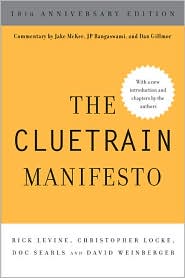
Cluetrain 10th Anniversary edition
Cluetrain 10th Anniversary
Everything Is Miscellaneous
Small Pieces cover
Small Pieces Loosely Joined
Cluetrain cover
Cluetrain Manifesto
My face
Speaker info
Who am I? (Blog Disclosure Form) Copy this link as RSS address Atom Feed

February 17, 2005

Live blogging a media event

The weekly blogging meeting, 7-8:30, at the Berkman Center this week is being recorded by a team from ABC News for Nightline. Our topic is what’s on the record and what’s off the record, and, of course, this time the discussion is entirely on the record.

It’s a bizarre experience. The bit Sony camera gets swung around to point at the person speaking, changing everything. It’s attention made physical.

I’m worried because the conversation keeps talking about the question in terms of the tiny handful of bloggers who view themselves as doing some type of journalism. That’s how the mainstream media already tends to view us. I hate to see us reinforce that.

That aside, it’s a good conversation. So far… (I particularly enjoyed Lisa Williams comments about not publishing information she doesn’t own, e.g., conversations with co-workers, and about the state of grown-uppedness of our culture in terms of the media.) [posted at 7:30pm]


Jim Moore points out that we’re not going to resolve anything tonight, nor do we expect to. We’re engaged in a continuing conversation. That’s the way we humans work.

Lisa: Conversations about blogs tend to devolve into conversations about fear. She’s amazed at how kind people are in the blogosphere. [I agree. Underneath the links are people who are interested in the same things and, more important, interested in – care about – one another.]

Erica Geroge of the Berkman says, in response to a comment, that the media don’t cover average people — their (our) cares, interests, etc. But bloggers do. [Badabing. Exactly.] [posted at 7:55]


At 8, we turn to topics more typical of the Thursday night group. E.g., Michael Feldman of The Dow Brigade talks briefly about interesting ways to do a Blogging 101 tutorial, using some free tools to do it multimedially.

Tweet
Follow me

Categories: Uncategorized Tagged with: media Date: February 17th, 2005 dw

14 Comments »

Where will the tag sets come from?

Marco Montemagno has an idea to help people aggregate blogs that express opinions: Tag your post with “opinionradar” and the topic. He explains it here.

He asked me via email what I think, and I responded. He’s generously posted my response on his site. Here’s what I said:


I think the general idea is good and that something like it will succeed, but I think it’s more likely to come from some huge player, especially Google.

I’m very interested in seeing how tagging becomes a differentiated space instead of the flat space it is now. Already people are suggesting using prefixes as de facto category tags. E.g., Global Visions, a Berkman Center project, suggests that you tag blogs that give insight into their countries with a “gv:” tag, as in “gv:ghana.” As these prefixes proliferate, we’re going to have the same problem as with the DNS: What happens when Gelber Vistavision (or some other company) starts tagging its stuff “gv:”?

So, I think it’s a huge issue, and I suspect it will be addressed definitively by sites that have the clout to convince taggers to adopt their tag sets. Alternatively, it’s possible that the grassroots will adopt a general purpose tag set before sites like Google do, but if we do, I suspect we’ll adopt not a single tag here and there (gv or opinionradar) but a few of them all at once, in relation to one another, e.g., “dc-author:” and “dc-language:”. (I say “dc” because the Dublin Core would love for us all to adopt its categories.)

That’s what I think at the moment, fwiw.

[Technorati tags: tags taxonomy folksonomy]

Tweet
Follow me

Categories: Uncategorized Tagged with: taxonomy Date: February 17th, 2005 dw

5 Comments »

fac.etio.us

While del.icio.us is delicious, fac.etio.us isn’t facetious. It’s a thought experiment embodied in software from Siderean, a company that creates faceted classification systems for big-ass enterprises. (Note the “facet” in “fac.etio.us”? Damn clever!)

Faceted classification assigns a set of parameters (facets) to the objects it’s classifying and then lets users sort them using the facets in any order. For example, appointments in your calendar might have facets for time, date, person, location, subject, and importance. You could then ask to sort first by person, then by location, and then by date, and a minute later walk through them by importance, then date, then subject, etc. In short, faceted classification systems let you construct trees with the roots and branches in whatever order suits you at that moment. And faceted systems never lead you down branches that have no fruit.

So, Siderean is playing around with doing a faceted classification of about five days’ worth of bookmarks at del.icio.us. In an email, this is what Bradley Allen, the founder and CTO, says:

Currently this is being updated hourly from three feeds: delicious, delicious/popular, and my own inbox feed. The RSS feeds are being transformed into slightly richer RDF using the Dublin Core and SKOS vocabularies, then loaded into Seamark and made navigable using dc:subject (tag), dc:creator, dc:publisher (site), dc:moderator (feed) and dc:date as the facets.

At the fac.etio.us home page you’ll see all five facets exposed: tag, creator of the tag, site tagged, the feed it was found in (del.icio.us, del.icio.us/popular, and Brad’s feed), and the date the tag was created. You can click on any, but let’s say we click on one of the entries in the list of Tags: Music. We are taken to a page that lists all the bookmarks tagged “music,” but are also shown a list of all the other tags given to all pages tagged with “music,” all the people who have tagged a page “music,” all the feeds that contain bookmarks tagged “music,” and every day in which someone has used the “music” tag. Each of these is itself clickable.

Oh, to hell with describing it. Give it a try!

[Technorati tags: taxonomy tags siderean fac.etio.us]

Tweet
Follow me

Categories: Uncategorized Tagged with: taxonomy Date: February 17th, 2005 dw

6 Comments »

February 16, 2005

My life as a Berkperson

Before I applied for a Berkman fellowship, I had to ask John Palfrey and Ethan Zuckerman, neither of whom I knew, a whole bunch of damn fool questions. I had no living sense of what it meant to be a Berkman fellow. Do you drink sherry at 4? Just how witty is the banter? Would I get a discount on ascots?

I’ve been a fellow since July. Here’s what it’s like.

[Note: I’m uncomfortable posting this because it’s so positive. The truth is that I’m very happy at the Center. And in terms of sucking up, my fellowship has already been renewed for a year and sucking up still won’t get me a parking space, so what’d be the point?]

Context

The Berkman Center for the Internet and Society is a Center within Harvard Law. The professors affiliated with it are all (?) with the Law School, and so are many of the students who take part in the various activities, but I find the overall interests have more to do with policy than law; I spend little of my time listening to lawyers discussing cases in an argot I don’t understand.

When you apply for a fellowship, you have to state what project you want supported, and that determines what your activities will be. The site lists five project areas, each prepended with the word “open”: Law, governance, education, commerce and content. Some of the actual projects underway are:

button Documenting Internet “filtering” (=censorship) by various governments

button Trying to increase international awareness in the blogosphere by facilitating “bridge bloggers”

button Encouraging and facilitating the growth of blogs in rights-challenged countries

button Aggregating information about all the groups aiming at establishing international governance of the Internet

button Building software to encourage classroom cross-discipline and cross-border conversation

button The Digital Media Project, looking at the legal, social and economic effects of five possible “scenarios” describing the development of digital media tech and law

The Center combines research and advocacy, which is always a tough balance. While the Center doesn’t enunciate official stands on issues, it comes down consistently in favor of keeping the Internet an open space for ideas and innovation.

What it’s like

The Berkman Center has its own house, a three-story Victorian on Mass Ave a few blocks (but on a cold day, a very long few blocks) from Harvard Square. It’s a funky place, furnished with a dog pound of furniture, just the way your college apartment was. There’s not a lot of space, so only a few people have offices there. The rest of us come in as appropriate and hang around the small-ish downstairs meeting room or perhaps grab a spare computer in a hallway or cranny. (You’ve gotta like a house with crannies.) I have a home office, so I don’t come into the Center to write. I come to hang out with people.

Last year, the Center started a new semi-policy: Tuesdays are fellows days. That’s the day to show up. In the morning, fellows hang out in the downstairs meeting room around a table. There are bagels, fruit and coffee, and no topic. It’s usually only a handful of us. I think I most see Rebecca MacKinnon, Ethan Zuckerman, Zephyr Teachout, Mary Rundle, Derek Bambauer and Wendy Koslow there. There’s never a problem getting a conversation going. Jezoos Carruthers, I learn a lot.

Most Tuesdays there’s a lunchtime speaker. It’s in the same small room, often with an overflow crowd of twenty or so. The speakers range pretty much all over the lot, from a Microsoft lawyer talking about copyright to a report on connectivity in Uzbekistan. Typically the speaker doesn’t get through her presentation entirely. The Center provides sandwiches.

Tuesdays are the most structured, but any day of the week you will find interesting people from whom you will learn gobs. Plus, there are speakers, meetings and get-togethers at random times.

What you have to do

Each fellow is expected to present her research at a Tuesday lunch or equivalent and to write something for the Center’s journal. The rest of your duties are determined by the project the Center is supporting.

My case is a bit unusual because my project — working on a book about the effect the digital organization of stuff is having on the nature of knowledge (I really have to find a more interesting way of describing it) — is a bit off-topic for the Center. So, I’m supposed to work on the book and also lead a series of Wednesday night discussions.

Fellowships are usually for one year.

What you get

button A stipend that ranges from $0 to $42,000. (I’m way at the low end of the scale, and certainly need to keep my day job.)

button A Harvard ID that lets you use just about any of its resources

button A Harvard business card that impresses the hell out of people

button The opportunity to participate in the life of the Center

button No parking privileges

The Culture

I’ve been in a variety of academic environments, and the Berkman is the most collegial of them. Much of that is due to the personalities of the law professors in charge. The Center’s first instinct, in my limited experience, is to support you in your project or line of thought. There is an air of sweetness about the Center, which I did not expect. I mean, these are Harvard law professors. Didn’t they see The Paper Chase, fer pete’s sake?

The Center is multi-partisan in theory. In practice, the Center’s heart is clearly pro-grassroots. It’s unlikely to file a friend-of-the-court brief supporting the RIAA. (If you’re from the RIAA and give a lunchtime talk, you’ll be treated with respect, but you’ll also be asked tough questions by Harvard lawyers.)

I personally love the mix of scholarship and activism. These are folks passionate about the Internet both intellectually and practically. And it’s a “learning community”: I have yet to be laughed at (to my face, anyway) for asking dumb questions. The ethos is one of generosity: People will spend forever helping me to understand things.

I see more women there than men.

Negatives

The gender balance feels about right in practice among the fellows (yes, I’m aware of the irony of using the word “fellows” in this sentence), although it’s way off at the professorial level. And the atmosphere is definitely not one of macho competition and oneupmanship. There’s a fair bit of international presence, and most discussions occur within a global perspective. The racial balance sucks.

It is an academic environment, which often informs the discourse. If that’s not your cup of tea, then the Berkman Center is probably not for you. It is, however, also an activist center. I like the balance. You may not.

The range of political and policy opinions among the fellows is fairly narrow. More diversity would help.

I’m having trouble coming up with other negatives. (Oy, that sentence sits there like bait!)

In Conclusion

If you can’t tell, I’m enjoying my time as a Berkperson. I’m meeting people I care about and, unsurprisingly, you can’t hardly walk through the doors without falling into a conversation that changes the way you think. What more could I ask for? Besides a parking space.

[Technorati tag: berkman]

Tweet
Follow me

Categories: Uncategorized Tagged with: uncat Date: February 16th, 2005 dw

17 Comments »

The New IE, i.e., Firefox scares Microsoft

RageBoy points to the Microsoft Internet Explorer Weblog where someone named Dave — “the guy responsible for IE” — tells us Microsoft will release IE 7.0 before Longhorn and that it will kick butt somehow. There are 544 comments.

I assume that IE 7.0 will mercilessly rip-off Firefox, which is exactly what should happen. But Firefox escapes the leapfrog paradigm because its friendly development environment — and the commitment of so many talented developers — means that features get added whenever anyone has a good idea. In fact, here’s a suggested mouse gesture for use within Firefox:

Rude mouse gesture

It’d open an instance of Microsoft Internet Explorer.

[Technorati tags: firefox ie microsoft]

Tweet
Follow me

Categories: Uncategorized Tagged with: web Date: February 16th, 2005 dw

10 Comments »

Topical citizen journalism

Campus J is trying to “cover” Jewish campus news by having students blogging from various universities — topic-based citizen newspapers makes total sense.

Steven Weiss, the editor and publisher, writes in an email that after launching two weeks ago, it’s already having an effect: A piece on the Orthodox Union cancelling its Congressional internship program has spurred the organization’s former president to lead a successful push to cancel the cancellation. [Technorati tags: journalism media]


Dave blogs about his day in Greensboro where a fascinating experiment in location-based citizen journalism is underway.

Tweet
Follow me

Categories: Uncategorized Tagged with: media Date: February 16th, 2005 dw

3 Comments »

February 14, 2005

Transparency and forgiveness

I find the story of Eason Jordan’s resignation from CNN disturbing, but not for the reasons Scott Rosenberg suggests:

I’m not shedding tears for the CNN executive. I’m always amazed at the stupid things CEOs, politicians, news honchos and other people who hold public responsibility will say in public (and do in private), thinking that the inherent power of their position grants them carte blanche and wraps them in Teflon. If they need to be beaten up over and over again until they really, really understand that — as the saying goes in blog-land — “off the record is dead,” fine.

It’s certainly true that remarks that formerly would have been private now are made not just public but super-public. But I don’t think we can survive the new transparency if we keep up the same old standards of criticism. I’ve said plenty of stupid things in my life. (Heck, I may be saying one right now.) Most have been in private. Some have been in public. And some things I said in public would look downright dastardly if viewed as isolated sentences. If we’re going to make more of the private public, we also have to give the benefit of the doubt, forgive, and laugh off the occasional offensive and stupid remarks. Otherwise, no one will survive the glare of the public.

Yes, I think that’s true of Jordan, Larry Summers and even Dick “Go f_ck yourself” Cheney. Transparency requires forgiveness. [Technorati tags: transparency jordan media]


If you want to see what the opposite of forgiveness looks like, take a gander at the organized piling-on in reaction to Mitch’s recent bloggery.

Tweet
Follow me

Categories: Uncategorized Tagged with: media Date: February 14th, 2005 dw

10 Comments »

Web of Ideas: Netty Friends

I’m leading another discussion at the Berkman Center this Wednesday. This time the topic is:

Netty Friends

There’s no doubt that we’re forming relationships over the Internet that feel something like friendship. But are they different enough from real-world friendships that they need their own term? How are they different? Are they better or worse? Is there a version of Gresham’s Law
at work here: Inferior Net-based relationships are driving out good real-world ones? Are there gender-based differences? Come to an open discussion this Wednesday…

It’s open to all. 6-7:30pm on Wed., Feb. 16, at the Baker House (map). The pizza it is free. [Technorati tag: berkman]

Tweet
Follow me

Categories: Uncategorized Tagged with: web Date: February 14th, 2005 dw

11 Comments »

Co-Links

Alex Primo at the Universidade Federal do Rio Grande do Sul in Brazil and his research group have released a prototype of Co-Links. It allows readers to add links to any word on a page. A single word may have multiple links. The user can either go to one of the linked pages or see metadata about it. It’s a cool idea. You can try it here..

It’s available as open source software. [Technorati tags: colink hypertext]

Tweet
Follow me

Categories: Uncategorized Tagged with: web Date: February 14th, 2005 dw

8 Comments »

Amazing ipod numbers

From a new report Pew survey:

We just got the results of the survey we took between January 13 and February 9 and for the first time asked a question to find out how many American adults have iPods or MP3 players. The answer is 11% — or more than 22 million of those who are age 18 and older. It’s safe to say that there are several million more MP3 players owned in the teen world, but we did not survey teens in this poll.

Holy cow.

Tweet
Follow me

Categories: Uncategorized Tagged with: web Date: February 14th, 2005 dw

1 Comment »

« Previous Page | Next Page »


Creative Commons License
This work is licensed under a Creative Commons Attribution-NonCommercial-ShareAlike 3.0 Unported License.
TL;DR: Share this post freely, but attribute it to me (name (David Weinberger) and link to it), and don't use it commercially without my permission.

Joho the Blog uses WordPress blogging software.
Thank you, WordPress!