


logo
EverydayChaos
Everyday Chaos
Too Big to Know
Too Big to Know
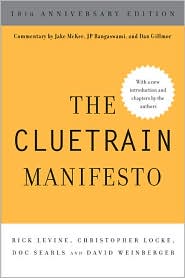
Cluetrain 10th Anniversary edition
Cluetrain 10th Anniversary
Everything Is Miscellaneous
Small Pieces cover
Small Pieces Loosely Joined
Cluetrain cover
Cluetrain Manifesto
My face
Speaker info
Who am I? (Blog Disclosure Form) Copy this link as RSS address Atom Feed

March 21, 2004

[pcf] PC Forum Bloggers

Here’s a list of people blogging the conference:

* Esther Dyson
* Ross Mayfield
* Bret Fausett
* Scott Heiferman
* Cory Doctorow
* Edward Vielmetti – following along from home
* Scott Rosenberg
* David Sifry
* Brian Dear

Tweet
Follow me

Categories: Uncategorized Tagged with: web Date: March 21st, 2004 dw

2 Comments »

[pcf] Ride over: PW domain

I shared a ride from the airport and happened to sit with two guys doing really interesting things. Let me tell you about one of them…

Tom Barrett has done a deal with Palau (pop. 16,000) to offer the .pw top-level domain. He’s got a 50-year exclusive contract, with revenue sharing for the Palauians. And he’s doing something interesting with it.

You can register a domain name at .pw…sort of. Your ISP might offer you “[email protected],” if your name were Joe Smith. But if you were then to go to www.smith.pw, you wouldn’t go straight to your home page. You’d go to a directory of smith.pw sites. There you would find a link to your Joe Smith site, but also to the Sarah Smith, University of Smith, and Town of Smith sites, if they too had registered for .pw sites. This moves the naming problem up one level of abstraction: There can be millions of jones.pw sites, but to get a particular one, you have to go through the general jones.pw directory page, maintained by Tom’s company.

Tom says that he’s reserved the pw.com, pw.edu. pw.gov, etc. for the island nation. Plus, he’s reserved the all-digit domains for use with ENUM and other all-digit proposals.

Tweet
Follow me

Categories: Uncategorized Tagged with: conference coverage Date: March 21st, 2004 dw

1 Comment »

[pcf] Faxes do not count as electronic documents

I just arrived in Scottsdale and walked in late to the first session of PC Forum.

I was late because our America West plane sat on the ground for 3 hours as they diagnosed and fixed a faulty oil pump. Of course, things break and I don ‘t blame them for that. But the first 1.5 hours were spent on faxing the diagnostic procedures from Phoenix to Boston.

Faxing?????

I used to work at Interleaf. We had this problem solved in 1989.

Then, for the 9 hour flight (6 hours flying, 3 on the ground), we were rewarded with a thimble-size package of roast peanuts, but only if we clapped our hands together like trained seals.

BTW, I hope not to blog this conference obsessively. We’ll see…

Tweet
Follow me

Categories: Uncategorized Tagged with: conference coverage Date: March 21st, 2004 dw

3 Comments »

F2F Criticism

There’s something fetching about David Ansen’s interview with Kevin Smith. Ansen is Newsweek’s film critic and Smith is the creator of sloppy-but-appealing movies. Ansen has liked much of Smith’s work but not his latest, Jersey Girl. They have an honest conversation about it. How odd!

Tweet
Follow me

Categories: misc Tagged with: misc Date: March 21st, 2004 dw

Be the first to comment »

March 20, 2004

How the Web changed my name

All my life, I’ve been “David,” except to my older sister who calls me “Dave” or “Davey.”

If you call me “Dave,” I won’t correct you, although if you ask me my preference, I’ll say “David” without hesitation. If you ask me why, I won’t be able to give you a meaningful answer other than that my family called me “David.”

Now, at age 53, I find I’m becoming a Dave. About half the time.

The explanation is, I think, simple…

Continued at Many2Many…

Tweet
Follow me

Categories: Uncategorized Tagged with: web Date: March 20th, 2004 dw

2 Comments »

[em] Regulation of Media Ownership in the Tech Age

The moderator is Jerry Kang from the UCLA LAw School, a visiting prof. at Harvard.

Kang: The FCC wants to maximize competition, diversity and localism. So, what do they do?

Horizontally, they decide how many TV stations a single firm can own in a local market. In 1996, the FCC decided that a single company could own two stations, with some restrictions. In the Sinclair case (2002), you can own more than 2 if it’s one of 18 big markets. Similarly for radio. Nationally, in 1996, the cap on how many stations a single company can own was enlarged. Recently, the FCC reset it to 45%, Congress tried to keep it at 35%, but Fox and Viacom benefitted from the current bump up to 39%.

Vertically, there have been complicated rules about whether a single company can own both TV and radio stations, and more rules about owning a newspaper. Now the FCC has a “diversity index,” weighting ownership of TV, radio, newspapers, etc. At the end of the day, they said that there are three types of markets: at risk, small to medium, large ones. In large market, there are no cross-market media ownership limits. In small ones, the old bars are in effect: a TV station can’t buy a radio station, etc. The medium size ones has mixed rules.

Mark Cooper (Dir of Research, Consumer Federation of America) says that the diversity index is dead in the courts. There has been very significant media consolidation. There’s a grassroots rebellion on media ownership because the FCC has taken a very narrow view of the First Amendment, what with its talk of views of “equal value.” [Sorry, but he’s talking quickly and I’m lacking many of the concepts needed to grasp this fully. Durn lawyers :-)]

Ben Compaine (MIT’s Program on Internet and Telecoms Convergence) says that there’s more competition and options on TV than ever. 30% of America used to watch Marcus Welby on ABC. Now, if you add together all the Disney channels, including ABC, Disney gets only about 12%. Further, the government’s tinkering trying to create diversity actually decreased diversity, and when the rules were withdrawn, we got more diversity. Don’t focus on what people choose to watch but on how many choices they have. [I.e., if everyone watches the same crap, so long as there’s lots of other crap on, the system works.]

Adam Clayton Powell III (USC Annenberg School of Journalism) says that there are more choices than ever: Internet radio, XM and Sirius, towns the size of Albany with two 24-hour news stations… “One person’s concentration is another person’s favorite program.” NPR now has 2 or 3 stations in many towns but no one talks about too much concentration about NPR. The new liberal talk network is paying Black and Hispanic stations to dump their programming, yet no one talks about concentration.

Cheryl Leanza is Deputy Director, Media Access Project, a non-profit law firm promoting the public’s right to hear and be heard on electronic media. She says we protect speech rights not so people can speak to themselves but so we can talk in public. The best way to preserve diversity is to separate content from distribution because then the distribution people couldn’t stop people from speaking.

David Oxenford (Shaw Pittman) is a lawyer for broadcasters. The real importance is on the rules governing consolidation at the local level. We have to look at this practically, not academically. What’s the alternative to five companies owning 80% of the media outlets? When you go to Jackson, Miss., where there’s only a $35M pot of money from advertisers, you can’t operate a station if you have 1% share. You have to consolidate. The FCC has it backwards: it lets NYC stations consolidate because it’s a huge market, but they won’t let Jackson consolidate even though it needs it. Radio is a little different because it’s cheaper. Besides, by the time we break up the ClearChannels, 85% of cellphones will be wifi enabled and thus able to pick up Internet radio.

Kang: Some questions/oppositions:

1. Broadcasters who want deregulation still want their “property rights” (spectrum) to stay regulated; they want the government to go after “radio pirates.”

2. On the practical level, do you more fear the state or private sector’s power over speech?

3. What counts as neutrality or intervention? Some who want deregulation of ownership still want regulation in content: obscenity, children’s programming, v-chip, adult ratings, etc.

4. Is the argument over consolidation an empirical dispute? Or is it normative?

Overall: Must we deregulate to enable broadcasting to survive? And must we get the government out to allow freedom?

Cooper: Compaine only talked about our ability to watch, not to speak. And he talked about variety, not diversity. And, no, they won’t go dark if they’re not allowed to merge: No one has given back a broadcast liense. [Powell and Oxenford shake their heads. Kang says some radio stations have gone dark.] He wants to regulate the structure of ownership, not content. We want to avoid content regulation.

Compaine: People are upset that they can’t get onto ABC News; they cry they don’t have access. [Let ’em eat blogs!] You have to start with empirical numbers. First, if you have multiple news networks, there’s a greater chance that more people will be heard. [Yeah, just like adding a second-place winner means more people have a chance to win the Megabucks lottery.] If you have lots of different outlets and proviers, you get more viewpoints. And we can’t ignore the potential Dean found in the Net.

Kang: Ben Compaine, where are your normative commitments? What about possibly pathological cases such as the Dixie Chicks, MoveOn not being allowed to advertise, etc.? Do these things bother you?

Compaine: As long as you have choices, let them take the Dixie Chicks off and maybe someone else will pick them up because now they are worth less. The Chernillo [?] thing is good.

Oxenford: Empiricism has nothing to do with it. It has to do with political and economic power. How do you get freedom of speech in broadcast? Do you turn them into common carriers so that everyone gets to speak? But then who’d watch it.?Why should the government parcel it out?

Kang: It’s already been parcelled out. How about cognitive radio? Give out spectrum and let people use it…

Oxenford: I think it’s great. It means there’s less and less need for the structural regulations.

Powell: Most interventions have unintended consequences. E.g., digital tv. The main thing to do is make sure that we all have open access to broadband.

Kang: Why aren’t there unintended consquences for supporting the status quo?

Powell: Make no law…

Kang: So you’re ok with hard-core porn on broadcast stations?

Powell: Yes.

Leanza: The status quo is not an open market.And when the Dixie Chicks are pulled off of ClearChannel, CC has an enormous share of the country western market, so in reality the local Top 40 station isn’t going to pick them up.

Q: The first amendment is about willing speakers finding willing listeners. If people choose to listen to what you don’t like, the first amendment is still working.

Compaine: Exactly. People wanted more networks, but they got Fox and they were horrified that it was “Married with Children,” not opera.

Kang: You have to look at where preferences are formed. The media forms it, at least in part.

Me: Suppose the open and free market produced a total homogeneity of viewpoint, would you then favor some form of regulation?

Powell: That won’t happen.

Compaine: That won’t happen.

Leanza: Your unwillingness to address this as a thought experiment speaks volumes. [Thank you!]

Cooper: The founders of the republic would be horrified.

Tweet
Follow me

Categories: Uncategorized Tagged with: conference coverage Date: March 20th, 2004 dw

1 Comment »

[em] Evolving Media: Emerging Distribution technologies & the legal response

Another day, another conference. Sigh.

Today I’m at a conference, sponsored by the Harvard Journal of Law & Techology, on the response to the digitization of mass media. Because it’s sponsored by Harvard Law, it focuses on the legal response. But it also aims at broader effects, which is why somehow I ended up on a panel this afternoon.

Tweet
Follow me

Categories: Uncategorized Tagged with: conference coverage Date: March 20th, 2004 dw

2 Comments »

March 19, 2004

[poc] Control vs. Decentralization Keynote Panel

This was supposed to be a debate, with Zack Exley (MoveOn.org) and a guy from RightMarch.com on one side [Sorry, I didn’t get his name! Ack!] and Markos Moulitsas Zuniga (Daily Kos) and me on the other. Predictably, we all agreed that campaigns need both, although Kos and I did push the decentralization side harder.

We each gave a 5 minute intro, moderated by the natty Sidney Blumenthal of Salon and general media fame. Zack made an impressive, coherent case for the power of centralized control, while admitting that decentralized community-forming does have a role. But, to win the damn election, we need to be as disciplined as the Republicans, he says. I don’t disagree with that, but I also see benefits to campaigns allowing and encouraging decentralized, bottom-up self-organization: It creates enthusiasm that then can lead to action. And, without it, campaigns tend to become top-down machines marketing a product or brand to us “consumers.” I guess I ranted a bit about this during my five minutes. I was up to my demographic earlobes with all the talk of “consumers,” “marketing campaigns,” “branding,” and, most of all, “messages.” I told them that they were debasing our democracy. A highpoint of the campaign so far was when Kerry uttered five words off-mike because we got to hear his real voice.\ I want more off-mike comments! And, by the way, campaign blogging is off-mike, which is why it works and is important. We need to hear a human voice now and then. The lesson of the Dean campaign and of the Internet is (I said) that control kills scaling, and control kills voice. And that’s why we need decentralization. We’re about to begin 8 months of relentless, saturation advertising of the most offensive and stupid kind. It will to wear us down to nubbins of indifference. Only by connecting with others, in our own voices, will we find any passion or enthusiasm. Finally, I said, the campaigns ought to be thrilled when we take over their “messages,” change the words to ours, apply them to our lives, go off in a thousand directions with them, because that’s what it means to make an idea our own. By connecting with one another and by escaping from the controlled messages of the campaigns, we can make those campaigns ours. End o’ rant.

The right-wing guy was good. Feisty. And it was a delight to meet Kos in person. Wow. It was, of course, pretty funny to be pitted against Zack, who is one of my heroes. I am a MoveOn automaton: If they tell me to send them twenty bucks because Zack’s dog needs aroma therapy, I send ’em $20.

Tweet
Follow me

Categories: Uncategorized Tagged with: conference coverage Date: March 19th, 2004 dw

3 Comments »

[poc] Joe Trippi

Joe Trippi follows Ken Mehlman as we eat our bad desserts in the packed room. He says [notes, not transcript! As always.]:

I agree with Ken that the party that puts the resources into the new medium usually ends up dominating that medium. It’s a little worrisome that we may have just awakened a sleeping giant.

I want to talk about something bigger than any campaign. The Net is a new medium that’s different: it empowers the average American. TV doesn’t. TV may have been the most powerful appliance in the American home, but the power was for the networks and the advertisers. The Internet is about to change everything. It’s finally matured and come of age. It’s the most powerful tool ever put in the hands of the American people. It allows them to make their own networks, let their own voices be heard. It’s not top down but bottom up. The changes it will bring will be even bigger than the early visionaries suggested.

The naysayers are generally right for 10-15 years — people said no one would want sound in pictures, etc. The Net is maybe where Nixon was with the Checkers speech.

For the past 40 years, we have had broadcast politics. Politics has been about collecting big fat checks and putting ads on TV. The American people got left out. Retail politics becamse making sure you got to that guy who can write the $2,000, not talking with the voters. The Dean campaign set out to change that system, not just changing presidents. Hundreds of thousands of Americans contributing less than $100 put together $50M+, more money than any Democratic candidate has ever raised…that was because 100s of thousands of people used the Internet to communicate with each other. That’s the main difference between broadcast politics and the new politics of people actually getting involved in their democracy again.

This change is going to come and it’s going to be mind-blowing.

When TV came in, the visionaries said what was going to happen, but they couldn’t conceive of what the changes would actually be. We needed millions of people to use Amazon, to use eBay. That got people used to the Internet. We needed MoveOn.org and MeetUp. That got people ready for DeanLink that let people find others in their zip code, create their own event. They did this without any command and control from the Dean campaign. It’d be a mistake to underestimate the bottom-up power of the Internet. There are a lot of people in the recording industry today who wished they hadn’t underestimated Napster, etc. For Washington to believe it’s immune that it’s immune to the bottom-up power of the Internet is a huge mistake.

What was really different about our campaign?

We started with 7 people and 432 known supporters nationwide on Jan 31. I found out about MeetUp from a blogger, Jerome Armstrong. By the end of the campaign,l we had 190,000 Americans signed up to meet up on the first Wednesday of every month and then go out and work for Dean.

There’s a misunderstanding about blogs. We decided to launch the first presidential campaign blog in history. It changed our campaign radically. [He tells the 50-posters anecdote and the red-bat anecdote.]

The real change in America will come from people using the Internet, using the tools we all build…

He mentions Dean’s new org, DemocracyForAmerica.com, and his own, ChangeForAmerica.com

Q: Does this bottomup technology really play well for the Republicans?

A: We’re at this weird moment, like the Nixon-Kennedy things. The Internet is just one tool among others now. Over time, it won’t be a tool for the campaign. It’ll be a tool for the American people. They’ll organize themselves whether the politicians like it or not. It could be this year. An organization could come from the grassroots and totally take over one of these campaigns.

The most bizarre one was the Disney fight. Roy Disney has a guy on the phone who has a web site that talks to 1.5M Disney shareholders. You’re starting to see these little hiccups that don’t make a lot of sense on their own, but collectively it’s pretty clear that bottom-up change is coming. Which part raises more money under $100? $1,000? Republicans. The one category the Democratic Party leads in is over $1M. The Internet just changed this. The Internet let people say We want to be involved in our government. The Dean campaign didn’t make it, but the genie is out of the bottle. It’s gonna happen.

Q: Would you advise Ralph Nader to be more respectful of the new medium? He said he doesn’t have time to spend on line.

A: There are studies that say more and more people spend more time online than in front of their television sets. Over time, they’ll become the same box. You cannot ignore this or just get in the bunker and pray that you’re alive when it’s over. The American people now have this tool. The Dean campaign was just the very first babystep of what’s coming.

The political press by and large doesn’t understand the Internet, and the Internet press doesn’t understand politics.

Q: Will the Internet get out the vote in November?

A: Yes. The real debates over the issues is occurring on the Net.

Q: Are you seeing disruptive campaigns in other countries?

A: We tried everything, including SMS. It just didn’t work; we had 5,000 people. Korea is an example of a government changed by the Net.

We put up a list of undecideds in Iowa and suggested that supporters write letters. But the Net is transparency, so the Clark and Kerry campaigns sent people to our site and used the list to send their own letters.

Tweet
Follow me

Categories: Uncategorized Tagged with: conference coverage Date: March 19th, 2004 dw

4 Comments »

[poc] Ken Mehlman

The lunchtime talk begins with Ken Mehlman, Bush-Cheney’s campaign manager. He starts graciously by thanking the Dean campaign which taught us a lesson: “The power of the power of the Web and the power of technology means if you have an idea thats interesting, there’s a viral way to get that message out.” [Excellent! He only sees it as a way of moving messages around!]

He says the party first onto the a technology historically is the campaign that dominates it. The Web is not a substitute for the message. Technology is a way you communicate a candidate’s message; it’s not a substitute for the message. The Web is at bottom simply a way to accomplish the key aims of the campaign. He’s focusing on: 1. Turning out the vote. 2. Using the Web to share the candidate’s message.

Why the Web is important. First, we have moved from a world or country where people get mass information from a few sources. The wealth of information creates a poverty of attention. The ability to have direct person-to-person contact is the way you cut through the clatter. And it’s how you avoid the filter. And communication is increasingly participatory: just look at American Idol. The Web is the ultimate in participatory communication.

Here are the principles of the Bush-Cheney campaign:

First Principle: The Web is crucial to our campaign. Grassroots politics is important because the country is closely divided. And the ability to provide an information mix to people, including person-to-person, is important. We have 6M voters we email. [According to Zack Exley, these are bought lists of low value.] Our site uses MapQuest maps to direct people, online registration forms, etc.

Second Principle: We try to use our Web campaign to share the President’s message and get around the filter. We have newsfeeds to 2,200 other sites so when George Bush says something, 2,200 sites say it also. We will direct you to talk radio shows and give you our suggestion for the topic you can talk about. Likewise for letters to the editor. A recent campaign generated 9,000 letters to the editor.

Third Principle: Our site is designed to empower individuals. On April 29, we’ll be organizing 2,004 parties supporting George Bush. People can find the names of people in their area and organize parties in their neighborhood, can download the latest talking points…[Omigod is he shameless!]…all to help people share their [!] message with their neighbors.

Here’s how the site can inspire people. BlogsForBush was independently created by supporters. Many-to-many. People talk about their support for the President and organize for the President. We didn’t create it but I hope our web site is helpful.

Fourth Principle: Personalize. The ability to personally communicate is critically important to mobilize people involvement in grassroots and politics. A good example is Amazon.com. [Judging from his description, he seems not to actually use Amazon.] We encourage Web site visitors to tell us what issues they’re interested in so we can proacticely email them information. And everyone who becomes a Bush Team Leader [Hey, that’s me!] has their own page where they can track their activities, how many times have they calle talk radio, how many letters to the editor have they written…

Fifth Principle: The goal of a web site is to maintain a customer as much as it is to make a sale. A good Web campaign does not overly-solicit but instead engages individuals the way a good business would engage a customer, multiple contacts on multiple issues. We’ll provide you with links, webchats, videos, rewards for encouraging. Customer maintenance is critical. So is customer recruitment. At every Bush event, people walk around signing up people’s emails. We’ve been doing this since 1999.

Sixth Principle: Synergy. A good Web campaign provides a great synergy for whatever else you’re doing. E.g., using the Web to launch ads that get print coverage. And they’ve used print to move people to the Web site.

The Republicans will be launching a Fact Log, or Flog, for fact checking the Dems asses. [He didn’t put it quite like that.]

The Web is critically important. It can connect individuals’ concerns with your candidate.

The most important reason we have had success is the strong leadership of our President. That’s why our web has been successful. It’s the cause that matters the most; the Web is just how we get there.

[Oooh. Profound not-getting-it-ness! But probably getting enough of it to win. Argh.]

Tweet
Follow me

Categories: Uncategorized Tagged with: conference coverage Date: March 19th, 2004 dw

16 Comments »

« Previous Page | Next Page »


Creative Commons License
This work is licensed under a Creative Commons Attribution-NonCommercial-ShareAlike 3.0 Unported License.
TL;DR: Share this post freely, but attribute it to me (name (David Weinberger) and link to it), and don't use it commercially without my permission.

Joho the Blog uses WordPress blogging software.
Thank you, WordPress!