


logo
EverydayChaos
Everyday Chaos
Too Big to Know
Too Big to Know
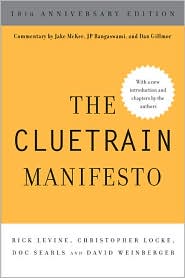
Cluetrain 10th Anniversary edition
Cluetrain 10th Anniversary
Everything Is Miscellaneous
Small Pieces cover
Small Pieces Loosely Joined
Cluetrain cover
Cluetrain Manifesto
My face
Speaker info
Who am I? (Blog Disclosure Form) Copy this link as RSS address Atom Feed

May 30, 2003

[DG] Steve Himmer: Blogs as Literary Form

Steve is going to try to find what’s characteristic of blogs. [Abstract] Is it the technology used? Formal properties? He wants to look at how we read blogs.

Novels ask us to read them through the interpretation of the narrator. Journalism asks us to read through the supposedly interpretation-free objectivity of the author. Blogs do both and neither. Blogs can only be read through the blog author. Readers have to discover the author. This isn’t like interactive fiction, although both are labyrinths, because interactive fiction is done and finished whereas the blogosphere is always under construction. The entry points are dynamic and beyond the control of the author. The sequence is up to the reader. Readers can link to the blog or enter comments on the blog page, thus increasing the labyrinth.

To understand blogs we have to see them as text created by authors and readers, not by tools

Tweet
Follow me

Categories: Uncategorized Tagged with: web Date: May 30th, 2003 dw

11 Comments »

[DG] Holly Swyers: Slash fiction

Holly is talking about slash fan fiction, which is fiction written by fans that extends a narrative series by describing homoerotic relationships, e.g., Kirk/Spock. She’s interested in what this tells us about community, for the slash community (via mailing lists) is strong. [Abstract] The gen fan fiction writers (“gen” = general audience) are often outraged by the slashers rendering their heroes as gay. Slashers are generally sensitive to this and label their stories as “adults only.” In fact, an entire vocabulary has emerged for specifying exactly the sort of offense might be taken. The communities consist of adults who treat one another respectfully. Holly says that this is a type of community that Robert Putnam missed in Bowling Alone.

Tweet
Follow me

Categories: Uncategorized Tagged with: web Date: May 30th, 2003 dw

Be the first to comment »

[DG] Daniel Headrick

Daniel is talking about the arise of alphabetical order. [Abstract] Yes, it was an invention. Alphabetizing was highly unusual in the Middle Ages. E.g., in a book from the 11th century, the author had to explain exactly how it works. 150 years later, another author claimed he’d come up with a new way of organizing a list of words in the Bible. And the idea was then forgotten again. Again in 1604 an author had to explain the system to the reader.

There was a serious debate about whether it made sense to arrange encyclopedias alphabetically rather than topically, perhaps keying off the Bible’s own taxonomical preferences. The debate depended on imagining a new type of reader: not a scholar who reads continuously but someone who looks things up. Cross-references were invented in the 18th Century to connect topics dispersed by alphabetical order.

“Alphabetical order remains an insult to logic.” E.g., the 1987 edition of the Britannica tries to organize itself thematically as well as alphabetically, resulting in a bit of a hodgepodge. And on the Web there’s no need to store things alphabetically. “We will soon no longer need to learn our ABCs.” We’ve cut ourselves off from secular humanism and alphabetical order. “We now float free in the sea of information.”

Tweet
Follow me

Categories: Uncategorized Tagged with: web Date: May 30th, 2003 dw

5 Comments »

[DG] Seth Sanders

Seth’s title: “Hebrew and Aramaic as Semiotic Technologies: Toward an Ethnography of Early Alphabetic Writing” [Abstract]

We aren’t determined by our technology. What does shape us? If we’ve always already been virtual and involved in making worlds, what is new about digital genres? How does newness enter the world? Seth is going to look at how the alphabet began.

The alphabet was invented around 2,000BC. It contained about 30 consonants. What was the effect of the alphabet on the development of Western thought. Seth’s old advisor, Cross, said that the link was ironclad. Static societies gave way to “alphabetic” societies. Because the alphabet is easily learned, literacy is democratized, encouraging challenges to authority.

But, says Seth, Cross underestimated the difficulty of learning the alphabet. It takes years, not months. And it seems not to have changed practice all that much. For example, documents were originally authenticated by writing in a list of witnesses, but for an extra layer of security, people could use stamp seals, a preliterate practice. Further, the new literacy seems not to have affected the practices of Socratic Greece. For example, plots of land were marked by rocks, not by recording deeds of any sort.

So does “semiotic technology” have nothing to do with the development of culture? No, it has something, but you need a fine-grained investigation. The first signatures weren’t in alphabetic writing. Thus, the signing system is tied to the medium (handwriting on papyrus, thumbnail imprints in clay), not to the writing system.

We need to look to ideology, practice and medium to see how the new arises, not simply to the nature of the semiotic technology (i.e., the arise of the alphabet in Seth’s example).

Tweet
Follow me

Categories: Uncategorized Tagged with: web Date: May 30th, 2003 dw

Be the first to comment »

[DG] Theo van den Hout

Theo is talking about howthe Hittites (c 1650-1180 B.C.). managed their clay tablets. [Abstract]

He estimates that at any particular time in storage there were about 7,000 tablets being stored and managed. Fragments are identified by date and author. Stacks of shelved tablets were labeled by smaller clay tablets. And they sometimes copied onto one tablet the text of several related tablets.

Fascinating.

Tweet
Follow me

Categories: Uncategorized Tagged with: web Date: May 30th, 2003 dw

1 Comment »

[DG] David Rosenberg

Rabbi Rosenberg is talking about the Talmud and the Internet. His question: Is the Talmud just like the Internet?

The 6th Century text is printed with commentary all around it. [Illustration] Traditionally it is studied by people in pairs, taking turns reading it aloud and then arguing over the meaning via reference to the commentaries.

The Talmud’s hyperlinked presentation is like the the Internet. But the Internet is “insufficiently oral” and is much less fixed than the Talmud. Blogging is like commenting on the Talmud, but not every commentary counts as part of the Talmud.

He asks what difference it makes whether the Internet is like the Talmud? Are we saying that the Talmud is hip or that the Internet is holy (or both or neither). “Suffice it to say, the Talmud is not just like the Internet.”

Tweet
Follow me

Categories: Uncategorized Tagged with: web Date: May 30th, 2003 dw

3 Comments »

[DG] Questions

Q: (The Happy Tutor): AKMA, did you feel awkward sort of kind of giving a blessing to a mixed body.

AKMA says he did feel awkwardness since he’s aware that not everyone wanted to be blessed. So he omitted the performance of the blessing he was talking about.

Q: (Me) Does AKMA’s and Trevor’s position make bodies subordinate to ID?

I don’t trust myself to paraphrase their answer, but here goes: AKMA says that his position doesn’t denigrate the body, but he also doesn’t want to locate identity merely in the physical. Trevor says that the lump of flesh you drag around with you isn’t the only type of body: communities are also bodies. I reply that there is something special about the lump of flesh: communities can’t have sex, make babies, feel pain or die.

Betsy Devine says there’s a continuum of physicality and presence. E.g., when she was young, families had a special viewing room in the church. Does that mean that the families weren’t there for the Mass?

Alex says that digital IDs reflect things we already know about. What are we importing into our understanding of digital ID. (Great question.) What’s going on with Digital ID is a continuation of our separation of identity from the physical. I say that that sounds like alienation to me. This is not a popular idea with the attendees because it’s “value-laden.”

Alex says: “When you live in a digital world, you need a really good chair.”

[Note: This entry commits inadequate bloggery.]

Tweet
Follow me

Categories: Uncategorized Tagged with: web Date: May 30th, 2003 dw

Be the first to comment »

[DG] Naomi Chana

Naomi‘s title is “Battles of Blood and Ink: Apophasis, Identity, and Naming Conventions across Digital and Theological Genres.” Yikes! [Abstract]

Discussions of digital identity say that it’s about making online interactions secure and safe, etc. But real world interactions have never been characterized by this. DigitalID folks say that there’s a possibility of returning to a ideal state. They want to move digitalID from the impersonal to a rich, complex human context, as if it’s obvious that a human context is a good thing. [Is this in question? Uh-oh. :)]

Some bloggers make up a pseudonym, some have multiple ‘nyms, and some just use their real world name. Naomi uses a pseudonym. But many of us distrust people who have too many names. We associate names with identity. In fact, names come to stand for everything we know about the person’s identity.

But G-d has many names. How can they resolve into G-d’s singular identity? She’s going to look at just one commentator on this: The 13th Century Jew, Abraham Abulafia. Naomi hands out a poem he wrote in which blood and ink are at war in his soul. Ink wins. This is an intellectual triumphalism, which is like the digital ID folks’ belief that eventually there will be a perfect online IDs that mirror our RW IDs. (I’m doing a particularly crumby job reproducing Naomi’s argument.)

Digital ID debates make normative statements about reality. They’re assuming a metaphysics. “We shouldn’t ignore the long history of philosophical and religious thought about the nature of identity.”

Tweet
Follow me

Categories: Uncategorized Tagged with: web Date: May 30th, 2003 dw

5 Comments »

[DG] Lacey Graves

Lacey is going to talk about blogging and Baha’i. [Abstract]

The middle ground between the individual and the ecollective relies on the same eneregy, as evidenced by the similarities between the Chicago weblogging community and the Baha’i youth organization. No East is a magazine and Fertile Field is a blog. Lacey has noticed similarities.

No East is a ‘zine by the Chicago area weblogging community for creative people. Each issue has a theme (e.g., “the streets of Chicago”). So does Fertile Field, although its themes are related to Baha’i. Fertile Field is written by youths while No East is written mainly be people in their twenties.

Both weblogs and the Baha’i faith have provided a medium by which communities can form. (Lacey is careful to say that religion and blogging are not exactly equivalents.)

Tweet
Follow me

Categories: Uncategorized Tagged with: web Date: May 30th, 2003 dw

Be the first to comment »

[DG] Trevor Bechtel

Trevor is AKMA’s co-Disseminarian. He’s talking about performance.

Performance requires focusing on a particular text.

It is a type of praxis

We pay attention to feedback: there are risks, and we’re always strengthening or weakening relationships.

All three of these (text, praxis, feedback) situate us in our individual body. But they also brings us together as a social body. (Trevor uses the Eucharist as the paradigm of performance.)

The question for today is: Does performance also situate itself in virtual bodies? Trevor has been reluctant to accept this: a televised mass? Television isn’t embodied. It’s not interactive. [Trevor is about to give some spoilers for the new Matrix, so a couple of us leave for a few minutes.]

There’s something “ontologically significant” about touch, as feminist thinkers have noticed, and there is no online equivalent to touch. (Someone says that we’ll have digigloves, etc. Trevor replies that digitally mediated touch can’t be the same thing as a real touch.)

We need to get better at giving a positive account of virtual embodiment. Here’s Trevor’s attempt: Blogs do allow us to become virtual bodies, to perform online in Trevor’s rich sense of performing as something that leads to understanding. Blogs are more oral than other types of writing. They are interactive. The connect to others. They’re hypertextual and form a web of social connections like the web when we take the Eucharist in that it creates a community. Identity sticks to blogs (a reference to AKMA‘s question).

Blogs are narratives. “If performance is the best way to understand who we are, then blogs are ways of extending these formative traditions and texts and genres. Blogs are stories.” Trevor goes back to the three characteristics of performance — text, praxis, feedback — and finds all three in blogs.

Tweet
Follow me

Categories: Uncategorized Tagged with: web Date: May 30th, 2003 dw

Be the first to comment »

« Previous Page | Next Page »


Creative Commons License
This work is licensed under a Creative Commons Attribution-NonCommercial-ShareAlike 3.0 Unported License.
TL;DR: Share this post freely, but attribute it to me (name (David Weinberger) and link to it), and don't use it commercially without my permission.

Joho the Blog uses WordPress blogging software.
Thank you, WordPress!