


logo
EverydayChaos
Everyday Chaos
Too Big to Know
Too Big to Know
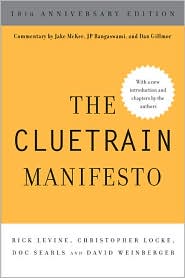
Cluetrain 10th Anniversary edition
Cluetrain 10th Anniversary
Everything Is Miscellaneous
Small Pieces cover
Small Pieces Loosely Joined
Cluetrain cover
Cluetrain Manifesto
My face
Speaker info
Who am I? (Blog Disclosure Form) Copy this link as RSS address Atom Feed

May 30, 2003

[DG] AKMA: Digital Blessing

AKMA wonders what we can learn from millennia of thought about what constitutes identity. He asks: What does a digital blessing stick to? What is the who of the Web? And how does that affect the proposal for digital identities, e.g., Passport, Liberty Alliance,…

Biometric makers push the idea that physical characteristics mark you as a particular human. But that doesn’t account for pod people. Blessings adhere not to the physical marks but to “something more” that AKMA’s tradition calls “soul.” ”

Now AKMA brings it back to the digital world. Our digital identity is created by our digits — our fingers typing digits. (He later connects “fictive identities” with the Latin root for fiction: fingere. Cool.) Our fingers enact identity through the words we type. Our acts further substantiates our digital identity. Someone whose physicality is limited may find his/her online identity to be more real. We make ourselves online. But what are the characteristics and limitations of our online identities?

The key point: Our identities are already constituted nonsubstantially. Our online identies don’t represent a new space and type of identity but is instead a recognition and embracing of what has always been at the heart of identity. It thrusts role-playing and authorial voice to the fore in the question of “true” identity.

So, “perhaps blessings stick precisely to our identity as we play them, blog them, confect them, mold, share and make these fictive selves physically and online…”

Wow. Terrific lead-off presentation.

[Great point. But it leaves me back worrying about ignoring the body as inessential to the identity. AKMA, am I missing your point?]

Tweet
Follow me

Categories: Uncategorized Tagged with: web Date: May 30th, 2003 dw

5 Comments »

[DG] Digital Genres Introduction

Alex Golub has put together what looks like it’ll be a really interesting conference. About 30 of us representing a few different genres of online creativity: bloggers, gamers, anthropologists, theologians, historians…

AKMA is about to present the first paper.

Tweet
Follow me

Categories: Uncategorized Tagged with: web Date: May 30th, 2003 dw

4 Comments »

May 29, 2003

OSCOM: CMS Users Panel

This panel consisted of three people implementing open source content management systems, one trying to figure out what to do, a very smart guy from the W3C and, um, me.

Jennifer Lynch (U. of Missouri), has been implementing a Typo3 system. She and a colleague have built a substantial system in just a few months for a total cost of $5,000.

Marc Lavallee has been converting Boston.com to Zope. Twelve people have spent a total of 14 months (including a four month RFP process) building a system that will go live in ten days. He figures it is about a million dollar project, all costs included, a figure substantially lower than what it would have been had he been using commercial, proprietary software.

Hal Roberts from the Berkman Center has been installing a WebGUI system, which entails importing 175,000 static pages. He chose WebGUI in part because of its object orientation and because it lets you edit pages on screen, not in a separate editing mode.

Sam Quigley, of the Harvard Art Museums, is trying to figure out how to figure out which system to use. This raised the question of the value of consultants. I said I thought they could be helpful. Hal replied that it’s continuing expertise that ought to be brought in house. The audience had diverse opinions. I personally don’t disagree with Hal; in-house tech expertise can be crucial, especially if the project is big enough. But a consultant who keeps up with the field for a living can help match the application needs to the right application faster and better. (No, I do not consult in this field.)

Then Dave Winer sparked controversy — shocking, I tell you! — by saying that it’s like the early days of word processing when everything was hard and expensive. It shouldn’t be as technical as it is. It really should be a $200 solution, he said, that does the 80% of what actually needs to be done.

Hmm. I don’t think the users on the panel could get what they need in that 80%. They’re not looking for a desktop application like word processing. To them, CMS is a system, and it does something complex that will only get more complex. It manages documents and document fragments. It provides versioning. It handles permissions. It moves stuff through workflows. It worries about archiving and records management. It automatically lays out pages. It provides editing tools for content and for styles. It serves up personalized pages. It tracks hits. It enables cash transactions. It plops ads onto pages based on who’s seeing them and accounts for every view and click. It integrates with the rest of the office software environment. And if it doesn’t do all those things now, that’s where it’s headed.

We got a demonstration of why CMS will remain complex software. Someone in the audience asked if it’d make sense for his small college to get together with a bunch of other small colleges and come up with a set of app requirements so that they could share the cost of customization. The general sponse was: “It sounds like a good idea, but… ” For example, Hal and Marc both said that their own installations were unique. Someone in the audience agreed. I pointed out that this reminded me of the SGML wars of the ’80s when entire industries tried to build a shared DTD. It turns out that everyone’s needs and vocabularies are different enough that trying to produce a common spec is extraordinarily difficult.

Now, it certainly can get easier. I spoke afterwards with Bob Doyle of CMS Review who is trying to come up with CMSML, a way of describing CMS features that would work for all content management systems. Bob knows that there isn’t one ideal and perfect way of doing it, but believes that you could at least make it easier for customers and users to compare systems.

CMS is inherently tough and complex. Implementing a CMS system is always going to require someone with strong skills because it touches the way an organization thinks about and handles documents. It will always require looking at document processes, the social structure, and the power relationships in an organization. It requires understanding the legacy “document schema” and looking ahead to the near-term and long-term futures. CMS will resist commoditization for as long as I can see.

Which leads me to conclude: Did I misunderstand Dave’s comment? Do we disagree about the definition of a CMS? Or do we just disagree? Unfortunately, I’m about to leave for Chicago – the Digital Genres Conference – so I’ll be out of contact for the rest of the day…

Tweet
Follow me

Categories: Uncategorized Tagged with: web Date: May 29th, 2003 dw

9 Comments »

OSCOM: Intellectual Property Panel

I was on a panel at the Open Source Content Management Conference 3 at Harvard yesterday and attended the prior session. Both sessions (exempting my own embarrassingly how’d-he-get-invited performance) were rich in idea and information.

The first session I saw was on intellectual property. the panelists were Mike Olson (Sleepycat), Larry Rosen (OSI), Aaron Swarz (Creative Commons) and Liza Vertinsky (Wolf, Greenfield & Sacks), moderated by John Palfrey (Berkman Center). Quite a line-up. Most of the time was spent on Q&A. Among the points that struck me:

Joseph Reagle of the W3C asked if you can you copyright a DTD or schema. And if someone uses someone else’s DTD, is the resulting work a derivative work? Liza replied that the law around forms probably is relevant, and that you can’t copyright a form.

A Harvard Law School professor in the audience (I didn’t get his name, but he was terrific) said that the question reminded him of the Teddy Ruxpin case in which a provider of third party tapes for the semi-animatronic toy was sued for “contributory copyright infringement.” (The kids who stuck the tapes into the bear were the actual copyright infringers, apparently.) In fact, at the Illegal Arts festival (?), someone prepared a tape of William Burroughs materials for Teddy Ruxpin.

Reagle followed up by wondering if all documents created with Microsoft Word count as derivative works of Word’s XML schema.

Someone asked if it’s legal to scrape content and display it. Aron said that it’s legal to scrape. It’s less legal to display scraped content.

And (someone pointed out), there’s a difference between scraping up stuff marked for RSS feeds and just scraping what’s on the Web.

Dave Winer commented on this from the audience. He said that Radio Userland doesn’t have an option for turning off the RSS feed. “We wanted to promote RSS feeds. … A few times a user didn’t know it was producing and RSS feed and then saw his content on someone else’s site…Generally once they understand that it’s a feature of the software and it’s deliberate, the problem goes away.” But, he says at some point it won’t go away for someone.

Dave and Larry disagreed about the implications of casual copying, e.g., sticking a cropped photo from another source onto your weblog. Dave says it happens all the time, and not just with photos, and that’s just the way it is. Larry, getting all lawyer-y, agreed that it happens all the time but that there’s risk there. Aaron interjected that the Google cache and the Internet Archive may be massive copyright violations, but they’re so socially useful that they ought to be allowed to continue without prior restraint.

Then Charles Nesson (Berkman) asked a great, simple question: Has anyone ever tried to enforce the GPL?

No, it’s never gone to trial.

Liza: Because there’s no money in it.

Aaron: One reason is because the community is strong.

Larry: But I wouldn’t be surprised if someday a company the sized of Microsoft were to challenge the validity of the GPL.

Yikes! The validity of the GPL has never been tested in court. Ulp.

Tweet
Follow me

Categories: Uncategorized Tagged with: web Date: May 29th, 2003 dw

4 Comments »

May 28, 2003

The Internet Constituency

I’ve posted an article called “The Internet Constituency” that reviews the webbiness of the various presidential candidates’ web sites. Only two show any promise, IMO. One of them I actually like: Howard Dean‘s, especially his staff’s weblog. See, for example, the currently lead article on the Dean site which is an open letter to the FCC opposing the proposed rule change that would make it even easier for the media to concentrate itself into a ball so dense that no light escapes from it.

Here’s the opening of the article:

The Republic of the Internet certainly has been downgraded since the day John Perry Barlow declared its independence in 1996. The Internet is not a nation, it’s not a state, and it’s not even a county. But is it at least a constituency? If so, most of the presidential candidates are campaigning there about as seriously as they are in Alaska: it’ll be surprising if their campaign plane alights there even to refuel…with one encouraging exception.

(Disclosure: I’ve done a little volunteer work for the Dean campaign.)

Tweet
Follow me

Categories: Uncategorized Tagged with: politics Date: May 28th, 2003 dw

2 Comments »

Learning from echoes

Rebecca Blood, in her keynote at BlogTalk, worried that bloggers only read bloggers who agree with them, thus greatly limiting the potential for growth and understanding. Worse, only reading people who think the way we do can result in an “echo chamber” where the echoes seem to confirm our beliefs.

Rebecca used as her example the blogs for and against the Iraqi war. But that is one of the most divisive of issues. Is it true for less contentious topics?

I suspect it is to some degree. (Note: Joho the Blog remains true to its pledge to be 100% Research Free.) But I don’t think it’s necessarily a bad thing.

It sort of has to be true because conversations need common ground. So, if it’s a debate about software patents, the people involved in all sides of the issue will likely be fairly technical, sharing some assumptions about the nature of software and how markets work. Nevertheless, the homogeneity is what enables there to be vigorous debate.

Some degree of homogeneity is a condition not only for conversation but also for understanding and learning. For example, when AKMA upbraided me for something stupid and mean I said about Foucault, we were only able to talk about it because we share a base of presuppositions about philosophy. Because of that shared base, AKMA was able to show me where I was wrong and opened up Foucault in a way I had dismissed. Are AKMA and I Western, intellectual (in my case, add a “-wannabe”) white guys who are carrying very roughly the same baggage? Sure. But are we also an echo chamber in which we can’t learn anything? Nah.

Echo chambers definitely do exist. Sometimes they exist precisely in order to solidify opinion. But not every case of homogeneity is an echo chamber. Because we can only understand the new in terms of the familiar (which is the same as saying that understanding means placing something in context), agreement is the ground on which learning can occur.

Nevertheless, I find it impossible to resist Rebecca’s conclusion that we – I – ought to be more adventurous and open in what we read and think about. Agreement simultaneously enables learning and tends towards complacency.

Tweet
Follow me

Categories: Uncategorized Tagged with: web Date: May 28th, 2003 dw

6 Comments »

Hungarian interview

Here’s an interview with me in Hungarian. I don’t know what I said, but I renounce it all.

Tweet
Follow me

Categories: Uncategorized Tagged with: web Date: May 28th, 2003 dw

5 Comments »

Xander and Anya (Buffy) in a chat

Here’s a transcript of a moderately interesting online chat with Xander and Anya from Buffy from shortly before the show ended.

(Don’t send me spoilers! The finale was on while we were away and we haven’t seen it yet.)

Tweet
Follow me

Categories: misc Tagged with: misc Date: May 28th, 2003 dw

4 Comments »

How not to see Vienna

I’ve posted a review of the Knopf Guide to Vienna at Blogcritics. (I don’t yet have the permalink to it. In fact, it hasn’t quite shown up on the site yet, as of 9AM Boston time.) Let’s say that it’s not the strongest recommendation imaginable.

Tweet
Follow me

Categories: misc Tagged with: misc Date: May 28th, 2003 dw

3 Comments »

May 27, 2003

Guardian article

BTW, The Guardian ran a column of mine last week. It’s on the DNS mess and Google URLs.

Tweet
Follow me

Categories: Uncategorized Tagged with: web Date: May 27th, 2003 dw

2 Comments »

« Previous Page | Next Page »


Creative Commons License
This work is licensed under a Creative Commons Attribution-NonCommercial-ShareAlike 3.0 Unported License.
TL;DR: Share this post freely, but attribute it to me (name (David Weinberger) and link to it), and don't use it commercially without my permission.

Joho the Blog uses WordPress blogging software.
Thank you, WordPress!