


logo
EverydayChaos
Everyday Chaos
Too Big to Know
Too Big to Know
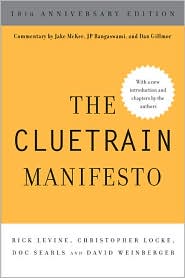
Cluetrain 10th Anniversary edition
Cluetrain 10th Anniversary
Everything Is Miscellaneous
Small Pieces cover
Small Pieces Loosely Joined
Cluetrain cover
Cluetrain Manifesto
My face
Speaker info
Who am I? (Blog Disclosure Form) Copy this link as RSS address Atom Feed

March 10, 2003

Star Trek: Numb-esis

Since I am apparently a couple of weeks too early to watch Austin’s 4 million bats swarm at dusk, I went to my hotel room and paid $11 to watch Star Trek: Nemesis. I didn’t sleep through it entirely, but not for want of trying; the random zizzing of phasers kept waking me up. What a bad movie! Predictable right from the first scene in which a bunch of Romulans get turned into stone and break into pieces. And then there’s the second scene in which the surprisingly unconvincing Patrick Stewart seems to be addressing a group of cadets but turns out to be giving a wedding toast. Then there’s the third scene in which I’m floating in a sac of warm fluid, happy until I hear a zizzing sound and wake up to realize I’ve just wasted $11.

The parts of the movie I actually saw seemed to combine the soporific exposition of the latest Star War movies with the plaster-of-paris thrills of a Flash Gordon epic. In fact, I wonder if this movie was meant as an homage to the Flashter; the chief baddy has a striking resemblance to Ming and the sets are pretty cheesy.

It’s a bad movie when the best acting comes from the android.

Tweet
Follow me

Categories: misc Tagged with: misc Date: March 10th, 2003 dw

Be the first to comment »

SXSW Sunday Afternoon: Doug Lenat

(I lost my notes on this presentation due operator error. Um, I mean, Windows crashed. Yeah, that’s the ticket.)

Doug Lenat’s been running the CYC project for twenty years. CYC is a computer program intended to understand enough of common sense that it can answer questions and make deductions useful in the real world. To do this, Lenat’s team — and now anyone with Internet access — feed it millions of rules about how the world and its humans work. Lenat says that the project has now crossed the line from “priming the pump” to being useful. He pointed to some deductions CYC had made about oil shipments based on information from several large databases. The surprisingly labored demo showed CYC making reasonable assumptions about the implictions of someone giving someone else a gift of a Segway. For example, it “knew” that the Segway, as a transportation vehicle, needs a light if it’s going to be used at night.

Lenat said that CYC can think the way any particular culture does by specifying the rules relevant to that context. So, to use Lenat’s example, it could think the way an 18th century Italian nobleman did, although it seems to me that that would require us knowing which millions of rules model such a person, a project that would seem to require putting in more knowledge than we have and more than could result from the effort.

My reaction to the presentation and the demo was that this just proves that humans don’t think the way CYC does.

Tweet
Follow me

Categories: Uncategorized Tagged with: web Date: March 10th, 2003 dw

Be the first to comment »

Berninger on Peace

Daniel Berninger’s perspective on the context for the coming war on Iraq concludes:

Making the world safe for Democracy means eliminating poverty not threatening Iraq with the death and mayhem of 3000 Tomahawk cruise missiles. Peace will remain elusive as long as we accept the suffering of others as the price of American Democracy…

Tweet
Follow me

Categories: Uncategorized Tagged with: politics Date: March 10th, 2003 dw

1 Comment »

March 9, 2003

World of Parodies

Stavros the Wonder Chicken parodies World of Ends. A sample:

The Nutshell

1. The Internet is complicated
2. The Internet isn’t a thing or an agreement : it’s a place.
3. The Internet isn’t stupid, but it’s filled with stupidity.
4. Adding value to the Internet adds to its value.
5. Value on the internet goes unnoticed unless some high-traffic node connects it to the mainstream.
6. Money moves to the greedy.
7. The asshole of the world? Nah, the world of assholes.
8. The Internet’s three vices:
  a. Americans dominate it
  b. The wealthy populate it
  c. More inhabitants does not automatically mean more value, except to those who want to sell you something
9. If the Internet is so complicated, why do so many seem driven to try and simplify it?
10. Some mistakes we can stop making already.

A tip of the coxcomb to The WonderChicken…

Tweet
Follow me

Categories: Uncategorized Tagged with: uncat Date: March 9th, 2003 dw

1 Comment »

SXSW Sunday Afternoon: Education

The education panel was disappointing to me, but only because of my own idiosyncratic interests. The audience seemed fully engaged, asking very particular questions and getting very specific answers.

The panelists came from companies that build interactive content. Fine, but I seem not to care about that very much. I care more about the emerging student-to-student engagement: using IM to do homework together, email to work on projects, etc. There’s such an opportunity to provide class-based collaborative tools and use these to fuel “knowledge portals” (i.e., “Let’s look up what last year’s sixth grade did for this project”). I’m sure there are companies doing this already. I would have liked to have heard from them.

But, then, that’s just me. It’s like going to Lessig’s session and wishing he’d talked more about car leasing programs.

(One of the panelists, 4empowerment, does provide discussion boards and chat rooms.)

Tweet
Follow me

Categories: Uncategorized Tagged with: web Date: March 9th, 2003 dw

2 Comments »

SXSW Sunday Afternoon: Lessig

Have I ever mentioned that I love Larry Lessig?

He begins with a sanctimonious quote from Jack Valenti. Morals, democracy, integrity. All being corrupted by sharing. Sharing has introduced a moral decay.

Lessigs says: In 1923, you could renew your copyright for another 28 years. Over 80% of copyright holders did not renew their copyrights. In 1998, works from 1923 were to pass into the public domain (because of the copyright extensions after 1923). 98% of the protected work were sitting unavailable because they were out of print in one way or another; copyright wasn’t protecting those works so much as making them invisible. This is the pain point Lessig keeps returning to. (I think it’s one level of concreteness short of being an argument that works on a broader audience. That audience will ask: “Why do I care about the 98% of crap that wasn’t good enough to be kept in print?”)

He reminds us that Steamboat Willy (the first incarnation of Mickey MouseTM;) appropriated Steamboat Bill, Jr., a Buster Keaton film. (The Keaton film is still a funny, by the way.) This was the beginning of what Lessig would like us to think of as “Walt Disney Creativity,” which we should celebrate: the appropriate and re-expression of popular culture.

Lessig says that we struck a deal with creators that would allow works to pass into the public domain. This deal has been violated, a betrayal fronted by Jack Valenti. The 2% of works still available were protected at the expense of the 98%.

Copyright was created to protect authors but in an era of media concentration, it protects publishers. Further, it homogenizes the culture. “We have never in our history have had a time when fewer inerests have controlled more of the creative process.” Does it make sense for creators, Larry asks. The Internet made this concentration important for we’ve gone from consumers to creators.

He shows an hysterical video of Bush and Blair singing to one another, created and distributed by Read My Lips — a couple of guys with a computer and a Net connection.

Why don’t we have the freedom that Walt Disney had in 1928?

Larry says we’ve tried to get Congress to fix it. He tried to get the Supreme Court to recognize that his position is the conservative one. We failed, he says. (“No, you didn’t, Larry,” I want to cry out, giving him a big hug.)

He introduces the Creative Commons: “We need something for those who want to reserve some rights. “We need to stop solving for the extreme case and begin to build an architecture that can support this middle.” Creative Commons provides a layer of “reasonable copyright control.”

Tomorrow, Creative Commons will introduce new “versioning” llicenses, including a sampling license, an education license, and a developing nations license that allows poorer countries to build on what other, more affluent societies have built. (Very cool idea.)

We need a way to say “I believe in free.” He says: “The world is not divided between those who believe in all control and those who believe in no control,” and we need to make this clear to Washington.

We need to reclaim this space from the lawyers. “We [lawyers] don’t belong in this space.”

Moving peroration: “We believe in a democratic nation…We believe that only in a nation where people can express themselves freely will people come to understand the truth…” “The honor of our nation has been the honor of free people who can speak about freedom without calling their lawyer.” This freedom is within our fingertips because of our new technology.


In response to a question, Larry says he’s discouraged about legal remedies because Eldred was a clear, obvious and extreme case. If ever copyright was going to be limited, this was it. The battle has to be waged in a place where politicians respond to ideals because they think votes are at stake. But he’s not optimistic about it. (Larry is, after all, the Internet’s most important pessimistTM;.)

Brewster Kahle is building the world’s largest archive. He’s giving copies of it — hundreds of hard disks — to other cultures to make sure it survives any global unpleasantness. The first is in Egypt.

Those 7 Justices who voted wrong in Eldred represent the common view of copyright. We have to make this clearer to the broad run of citizens.

Tweet
Follow me

Categories: Uncategorized Tagged with: web Date: March 9th, 2003 dw

2 Comments »

SXSW Sunday Morning: Journalism Old and New

Josh Benton (Dallas Morning News and crabwalk) says he’s the least optimistic panelist about the effect of blogs on journalism, but in part because he, says, old media isn’t as monolithic as we think. For example, he gets more responses to what he writes in the print media than to his blog and not just because the print articles have more readers.

Dan Gillmor (San Jose Merc News and blog, of course) is thrilled by the way blogging gives voice to people outside the usual centers. “My readers know more than I do,” he says.

JD Lasica (Online Journalism Review and blog) begins by snapping a photo of someone in the audience. “The line between audience and panelist is arbitrary,” he says. (I’m sitting next to Ernie the Attorney who has been wondering if our aversion to control structures sometimes get in the way of developing online communities.) Not all blogs are journalism, JD says, but many do “commit random acts of journalism”

Matt Haughey (metafilter) says that old journalism will have to take on some of the properties of new journalism.

Is blogging just unreliable journalism? JD points to Ken Layne’s saying “We can fact-check your ass.” Dan looks forward to the day that our bullshit filters apply strongly to all media. Is there a NY Times of blogs? Dan replies that blogs aren’t general purpose. He points to Glenn Fleishman’s weblog on 802.11 as “the best source of information” about wifi. Matt says, “Blogging’s transparent.”

Josh worries that people only read what agrees with them. (Personally: Nah. Sure, we probably all tend to read what we agree with, but, first that’s not close-mindedness but how we understand and learn. Second, even if you try to stay close-minded, you will bump up against more dissenting opinions than you did before the Internet.) Dan points to blogs that proudly point readers to sites that disagree with them.

Josh doesn’t want weblogs to try to become journalism. “It bastardizes the form.” A scattering of applause.

Dan: We’re seeing a democratization of media itself. It’s bringing new voices. JD says that within a few days of working in the media, you understand what the filters are: what will get your story on the front page, etc. Blogs explode the myth of objectivity.

Question: Old media journalists still get all the access. Dan: Glenn F. in fact has as much access as any print journalist and it’s only because he’s built such a valuable and respected site.

Dan: This is a grand opportunity for people in business and government to get the world out. But if they treat it as another chance to bullshit us, we’ll detect it. Q: Do you see any businesses using it well? Dan: Not yet. (Note: the referent of the “it” is ambiguous: weblogs or the web.)

Tweet
Follow me

Categories: Uncategorized Tagged with: web Date: March 9th, 2003 dw

1 Comment »

SXSW Sunday Morning: Styn

John Halcyon Styn of Cocky Bastard and LifeStudent is talking about how the Web set him free: he found he could be totally honest and people would love him for it. He asks the audience if others have found that, too. Does the Web, he asks, attract people who find the RW inhibiting?

An audience member (Ben) is describing how he revealed too much on his site and had to pull back. He wrote about his ex-girlfriend, their sex lives, her new boyfriend, etc. He took the material down and felt bad about “censoring” himself. “You can’t tell other people’s stories.”

A guy in the audience writes LittleYellowDifferent.com which I’m browsing in the interstices of my attention. Looks interesting and funny. [NOTE from 2 days later: He just won the Bloggie for Best American Blog, so, yeah, I guess his blog’s ok.] He tells how he came to blogging and how it has made him more open and confident.

John says that his life on line has improved his social skills in the RW. He knows that there are people in the world who identify with him: He can be who he is and people somewhere will accept him. Really good point.

Interesting, heartfelt, conversational session.

Tweet
Follow me

Categories: Uncategorized Tagged with: web Date: March 9th, 2003 dw

Be the first to comment »

March 8, 2003

SXSW Saturday

I gave the opening presentation: “Why the Web Matters.” It was close as I’ve ever come to doing a straightforward “Small Pieces Loosely Joined” presentation. It was largely new material, which always makes me nervous. After all, if I have any capacity to learn from experience (discuss amongst yourselves), then the debut of new material will always be the worst presentation of it.

I, of course, have no idea how it went.

Now I’m in the Social Networks session. It’s up against stuff competition: Cory Doctorow on a panel about Doing Good Online, and the cyborg guy, Kevin Werbach. No, Kevin Mitnick. Damn, no Kevin Warwick. Anyway, I’m in this one about building social networks that work where my three friends — two of whom I met in the flesh for the first time today — are talking: Nancy White, Jon Lebkowsky and Adina Levin.

Nancy is telling about her experiences as a group facilitator in Armenia, Azerbaijan and elsewhere. She’s saying that the online connections that had been made paved the way for stronger personal relationships once people met f2f. The connectivity also worked against the hierarchical power flow. “It’s very disruptive,” but in a good sense.

In terms of particular technologies, Nancy says they used WebCrossing and IM and tried to move people from email because the group doesn’t benefit from one-to-one emails.

Adina is talking about SocialText, a new company she’s working with. (Note: I’m on the Board of Advisors. I joined before it had a name or even a direction because the founding people, including Adina, are so strong.) Just as a blog is the simplest way to publish, she’s saying, a wiki is the simplest way to collaborate. The company uses a wiki to work together. For example, they take notes on the wiki during their weekly status meeting and then edit the wiki to turn it into a project plan. Anyone can add to the wiki, but one person has responsibility for keeping it orderly and useful.

SocialText has a “just-in-time” philosophy, or perhaps it’s an attitude. They are developing infrastructure only as they need it. Their software will be open source for community projects and they’ll have proprietary software to sell to companies.

Jon is telling us about Joi Ito’s “happening,” a multi-modal meeting that included telephone, wiki, QuickTopic document review, and chatting. (Note: I invested in QuickTopic.) The wiki was more useful as a way of storing material for after the meeting. Adina says that if you’re in a meeting in a physical room, you use visual cues to see how people are reacting. During the “happening,” chat served to give those cues. For example, with 20 people on the phone call, if you wanted to speak you typed “hand” into the chat.

An audience member is complaining that QuickTopic sucks. (Quick, get me my broker!) QT is separate from the web site you’re working on, has separate UI, etc. But his real question has to do with how you work in or transform the customary ways of working. Nancy says you have to be sensitive to this. She says that there has to be a time of discovering the differences.

Jon says that an email list grew out of the Happening. It went well and then suddenly stopped. Nancy poses the question: what is leadership in an online group. Nancy says the online world supports visionaries (and delusionals, adds Jon) who are good at communicating, but it’s not clear how to keep the non-leaders involved. Ernie the Attorney suggests that it might be because hierarchies have some uses.

Interesting. Good to hear from people with experience…

Tweet
Follow me

Categories: Uncategorized Tagged with: web Date: March 8th, 2003 dw

12 Comments »

Proportionality

Dan Gillmor points out that the media dustup about whether John Kerry has falsely given the impression that he’s Irish is dwarfed by the staggering flow of lies from Goerge Bush.

I’ve lost the link to a recent page that, in table format, compares Bush’s words to his actions. Anyone know which one I’m referring to? Seemed pretty factual and they certainly didn’t spend a lot on making the page look beautiful.

(The fact that I’m sitting one computer over from Dan in the SXSW press room makes blogging this feel pretty weird.)

Tweet
Follow me

Categories: Uncategorized Tagged with: politics Date: March 8th, 2003 dw

4 Comments »

« Previous Page | Next Page »


Creative Commons License
This work is licensed under a Creative Commons Attribution-NonCommercial-ShareAlike 3.0 Unported License.
TL;DR: Share this post freely, but attribute it to me (name (David Weinberger) and link to it), and don't use it commercially without my permission.

Joho the Blog uses WordPress blogging software.
Thank you, WordPress!