


logo
EverydayChaos
Everyday Chaos
Too Big to Know
Too Big to Know
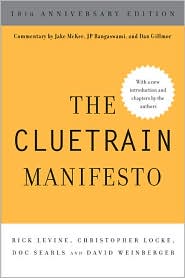
Cluetrain 10th Anniversary edition
Cluetrain 10th Anniversary
Everything Is Miscellaneous
Small Pieces cover
Small Pieces Loosely Joined
Cluetrain cover
Cluetrain Manifesto
My face
Speaker info
Who am I? (Blog Disclosure Form) Copy this link as RSS address Atom Feed

March 8, 2003

SXSW Friday: Richard Stallman

Richard Stallman is giving a free talk (what else?) on the Friday before SXSW (south by southwest) opens. The guy doing the introduction has just larded on the justified praise, and then said: “And after having Richard live in my house for a week, I can say that he’s a world class pain in the ass.” Big laugh from everyone, including Stallman.

Stallman talks without notes with the deliberateness of someone sure that his content alone will hold an audience.

He says that free software has several dimensions of freedom and benefits:

0. Freedom to run the program
1. Freedom to help yourself by changing the program to suit your needs
2. Freedom to help your neighbor by distributing the sofware
3. Freedom to help your community so others can benefit from your contribution

(Ah, zero-based lists. As far as I can see, all this does is make people add one when they tell someone how many bullets were on the list.)

“The same copyright laws that were unobbjectionable 40 years ago if they existed today would have serious problems.” He goes through several hundred years of technology and copyright law showing that laws that used to protect our interests now serve corporate interests. It goes for too long and it covers too much. We’re used to buying books, checking out from the library, lending them to a friend and re-reading them. Publishers want to take all of these rights away from us.

A first step: Shorten copyright on books to ten years. For software, maybe copyright should be for three years, with all the source code on escrow so it could then be released into the public domain.

There’s not reason copyright should be the same for all types of work. He sees three types of work:

1. Functional works that you used to do a job: manuals, reference works, recipes. All should be free. It’s important to society that people should be able to improve it.

2. “Documentaries that represent the thoughts of certain parties”: Memoirs, scientific papers, offers to buy and sell. To change these is to misrepresent someone’s thoughts. We should permit verbatim non-commercial copying.

3. Artistic and aesthetic works. On the one hand, the work has integrity and shouldn’t be modified. But then there’s the folk process. And Shakespeare took plots from other plays. But Stallman doesn’t know the answer to this one. “This is a hard problem.”

WRT Internet music company: “We should simply legalize it now.” We’d all be better off. The recording industry treats musicians like dirt. He feels bad when he buys a CD because he knows the musicians won’t see any of the money. Musicians really only get publicity out of their recording contracts. Internet music sharing is a better way to get publicity. Stallman would like digital cash so there could be a tip box for bands.

Zippy quote: “Those arrogant [recording industry] companies that think they can imnpose restrictions on us deserve to be punished. They deserve to cease to exist.”

Tweet
Follow me

Categories: Uncategorized Tagged with: uncat Date: March 8th, 2003 dw

4 Comments »

Reaction to World of Ends

A whole bunch of mail came in about the World of Ends site Doc and I posted yesterday. In fact, I couldn’t have picked a worse day to be traveling and off line. For example, we got slashdotted and I wasn’t able to read it until it was just about over. (Oops, looks like we’ve just been slashdotted again.)

Here’s some of what went on and some responses…


Paul Boutin asks a series of good questions:

1) Who is World of Ends intended for? “Anybody who’s into being all dumb about the Net” is not the answer I’m looking for here. What people and companies did you have in mind while writing? Who would you most like to see reading it?

A bunch of people have asked this since in the article we call our intended readers blockheads and adopt a supercilious attitude toward them.

It’s not something Doc and I talked about explicitly; we just iterated on drafts until it sounded done. Our aim was to say flat out what we think is being missed by the corporations and law-makers who are threatening the Internet. So why not do an “End-to-End Argument for Dummies”? Because we wanted the thing to be read.

So, to answer Paul’s question: The intended readers are the boneheaded captains of industry and government, but we didn’t think they’d ever read it if we didn’t make it highly partisan and somewhat obnoxious. If someone were to send them a memo outlining the article’s Key Take-Aways, I’d be more than satisfied. (Those Take-Aways, in my view, are: The Internet is an agreement and Doc’s “Nobody owns it, Everyone can use, Anyone can improve it.”)

I like Michael O’Connor Clarke‘s thoughts on this topic.

2) What sort of “reasons to buy music from you” would you want from the record companies? Is there a specific model you favor, or are you saying the solution has yet to appear?

No specific model, although I assume that selling just the music bits themselves isn’t going to be enough.

3) Specifically who and what actions do you refer to in the passage about “government types … tinkering with the Internet’s core?”

The usual suspects. The “core” refers not to low levels of the stack but the services and values that most users take as the heart of the Internet.

4) You say telecoms should “bite the bullet.” Which bullet, i.e. what exactly should they spend on or write off at this point?

I don’t know. If you put me in charge of a telco, I’d hire someone competent for the job — how about David Isenberg? — and take a very healthy severence package. (Then I’d appoint Lawrence Lessig to the Supreme Court.) But I do believe that the telcos are standing in the way of what a free market would demand.

5) “The value of open spectrum is the same as the true value of the Internet.” Help me out there. Most of the Internet’s value doesn’t come via wireless. Are you saying open spectrum would create such a huge value add to the Internet it would render the current value irrelevant? Or are you just saying the benefit would be worth the writeoff?

I put that poorly. I meant that an open spectrum policy would result in a marketplace for innovation much like the one that the Internet has created. More here and here.

6) You’ve basically said ads on Web pages aren’t worth the effort. How should Google make the money to fund itself instead? Or should they just keep taking money from chumps whose messages they know are being ignored?

We didn’t mean to say that ads are never worth the effort. Many aren’t. I happen to like Google’s approach.

7) Despite the earlier action on this list, I sense that very little of this seems aimed at Microsoft per se. Am I right?

It’s aimed at any company that thinks it can and should coerce us into accepting one-sided agreements, so, yes, it is definitely aimed at Microsoft. That doesn’t mean that everything Microsoft has ever done is Evil, of course.


Bob Frankston writes to me and Doc to suggest two additions:

The net is meaningless. It just transports bits and bits, in themselves, have no meaning. The meaning comes from interpretation at the edges and the interpretations are not unique and do preserve ambiguity. The tendency to introduce social policy at this level has perverse consequences.

The net only operates if it fails. There must be sufficient disorder to assure that the ends are resilient (the analogy with our immune system) and there must be sufficient perturbation to allow new ideas to be reaped. We don’t solve problem as much as discover solutions in the turmoil.

Good points. I think the first one is implicit in our article or maybe I only assumed that it’s implicit. I like Bob’s second point a lot.


Jonathan Peterson has cogent comments on his blog. He begins:

Marc Canter sent an email pushing back on World of Ends, reminding David and Doc that the user’s end-game (two-way full-motion video), should be kept in mind. Doc and David’s (stupid=flexible above all else) is the visionaries’ message to the decision-makers. Marc is right about keeping an eye on what users want.

In truth, I worry about altering the Net at the protocol level to accommodate any service, including two-way video.


Eric Norlin thinks we ought to take notice of the face that the agreement that is the Internet is dynamic. Can one perhaps see Eric’s interest in a new digital ID agreement helping to make this observation more pressing to him? I’d draw a somewhat different conclusion: Of course the agreement is always changing. In fact, our article says that suggesting new agreements is a critical way the Net has grown. But, as the article says, new agreements need to be voluntarily accepted and in the interests of all. In my opinion, digital ID, “digital rights management” and “trustworthy computing” fail that test: the demand is coming top down, not bottom up.


Arnold Kling writes, in part:

Amendment: The Internet is not Microsoft. The Internet’s destiny is not to be dominated by personal computers.

You see, in 5-10 years, we are going to look back at 2003 and say “We thought that was the Internet? How could we have been so stupid?”

Because in 5-10 years, most of what we do with the Internet will not involve Windows (or Apple or Linux). It will involve devices that we now don’t think of as computers. The action today is in cell phones, but my guess is that over the next decade we will see other form factors emerge.


Michael O’Connor Clarke writes, in part:

The rallying cry you’ve chosen to end on is lovely — but without over-complicating things, I feel the urge to make a distinction in this piece between ‘stupidity’ and ‘stupidness’. Stupidity is indeed something we should hope to lose, or hope big business, the recording industry, the telcos will lose.

Stupidness, on the other hand, is a value to be treasured, protected, nurtured…

Michael’s follow-up blog is real interesting on Cluetrain and World of Ends.


Tim Moors writes:

I saw your web page and thought you might be interested in a paper that I wrote about this matter:

T. Moors: A critical review of End-to-end arguments in system design, Proc. International Conference on Communications (ICC), Apr. 28 – May 2 2002

I haven’t had a chance to look at this yet.

Now it’s off to the SWSW conference…

Tweet
Follow me

Categories: Uncategorized Tagged with: web Date: March 8th, 2003 dw

8 Comments »

March 7, 2003

World of Ends again

I posted an entry about the new site Doc and I’ve written and two hours later it’s after midnight so the entry’s been pushed down into the Been There, Read That portion of my blog.

Unfair!

So, here’s the crux of the posting (i.e., the crux redux): Doc and I have posted an article that tries to explain the nature of the Internet in terms that even a record industry executive could understand. It’s called World of Ends and you’re all invited to read it.

Tweet
Follow me

Categories: Uncategorized Tagged with: web Date: March 7th, 2003 dw

2 Comments »

Bush’s War

Whatever side you’re on, don’t you agree that if Bush were not president, we wouldn’t be about to go to war with Iraq?

Perhaps this is due to Bush’s great insight and courage. Perhaps it’s for the other reasons. But, no matter what, this war belongs to the president the way no other American war has in the past 100 years.

Tweet
Follow me

Categories: Uncategorized Tagged with: philosophy Date: March 7th, 2003 dw

4 Comments »

Bulbs for Peace

Niek Hockx, who takes beautiful photos, including of the blogsphere’s alpha Halley, blogs from the Netherlands about one detail Bush and Rumsfeld might want to consider.

Tweet
Follow me

Categories: Uncategorized Tagged with: politics Date: March 7th, 2003 dw

Be the first to comment »

Greenstein on Raging Cows

Howard Greenstein has a funny blog entry about the Raging Cow brouhahahahaha.

Tweet
Follow me

Categories: Uncategorized Tagged with: web Date: March 7th, 2003 dw

Be the first to comment »

March 6, 2003

The World of Ends – the Net as an Agreement

Doc and I have cowritten an article – World of Ends – that point of which is:

We can stop being blockheads now.

No, not you and me. It’s them other people who are the blockheads, the ones who keep making the same mistakes over and over about the Internet – what Doc calls “Repetitive Mistake Syndrome.” It’s the telcos, the recording industry, elements of the publishing industry, government … you know, the blockheads.

Doc and I try to lay out clearly what the Internet actually is. [SPOILER] It’s not wires, it’s not programming, it’s not a way to build robotic customer relationships. The Internet is an agreement. Plain and simple.

Take a look and tell us what you think. We have a discussion board especially for that purpose. We’ve been working on this for about two months, on and off. It feels good to be able to point people at it … at least so far.


Bad timing: I’m on the road tomorrow and will be at the SXSW through Wednesday, so I’ll only be online intermittently.

Tweet
Follow me

Categories: Uncategorized Tagged with: web Date: March 6th, 2003 dw

Be the first to comment »

The Benefits of Being Republican

Now that I’ve registered at the GOP Team Leader site, the one that astroturfs newspapers and politicians, I’ve discovered two serious benefits — three, if you count the points I’m earning towards Valuable Free Gifts by spamming my elected representatives.

First, I’m encouraged to send letters to newspapers and politicians. All I have to do is press a button, and the pre-written, pre-thought message will be fired off. Of course, you can edit the text. In fact, I just wrote a message to Senator Bayh that began as follows (with my additions in caps, of course):

IF YOU GET EMAIL THAT SOUNDS LIKE THIS ONE, it’s coming from the GOP “Team Leader” site and is spam. Speaking for myself: PLEASE KEEP ESTRADA OFF THE BENCH. Thank you.

This reckless filibuster of Miguel Estrada has held up this country’s business for too long. This Thursday, you will have the opportunity to vote to end the filibuster and allow Miguel Estrada a fair, up-or-down vote on the floor of the Senate.

Second, yesterday I received in the mail a lovely “signed” photograph of President Bush along with a request for a donation to the Republican Party. I’m getting to like being a Republican!

(Late note: Estrada has been defeated. Woohoo!)

Tweet
Follow me

Categories: Uncategorized Tagged with: politics Date: March 6th, 2003 dw

2 Comments »

More Raging Stupidity

The State Representative in Washington who walked out when a Muslim cleric gave the opening prayer on Monday has apologized. The cleric (Mohamad Joban) has been forgiving throughout. But how damn ugly can we get?

Wait, I have the answer! Read this dangerously cold-hearted pile of crap.

(Why the hell do we have prayers in legislatures anyway? God help us!)

Tweet
Follow me

Categories: Uncategorized Tagged with: politics Date: March 6th, 2003 dw

7 Comments »

Raging Stupidity

The Raging Cow blog is Kevin Marks‘ response to Dr. Peppers’ polluting of the blogstream in support of their dumb ass milk-like drink. If enough of us link to Kevin’s group blog, we can knock Dr. Pepper off the #1 perch for “raging cow” at Google.

Tweet
Follow me

Categories: Uncategorized Tagged with: web Date: March 6th, 2003 dw

Be the first to comment »

« Previous Page | Next Page »


Creative Commons License
This work is licensed under a Creative Commons Attribution-NonCommercial-ShareAlike 3.0 Unported License.
TL;DR: Share this post freely, but attribute it to me (name (David Weinberger) and link to it), and don't use it commercially without my permission.

Joho the Blog uses WordPress blogging software.
Thank you, WordPress!