



logo
EverydayChaos
Everyday Chaos
Too Big to Know
Too Big to Know
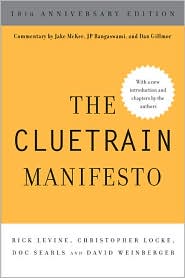
Cluetrain 10th Anniversary edition
Cluetrain 10th Anniversary
Everything Is Miscellaneous
Small Pieces cover
Small Pieces Loosely Joined
Cluetrain cover
Cluetrain Manifesto
My face
Speaker info
Who am I? (Blog Disclosure Form) Copy this link as RSS address Atom Feed

January 10, 2003

Finding Business: Dan Bricklin’s Proposal

At our bloggers lunch, Dan Bricklin gave us a scoop on his announcement of a new metadata scheme, SMBmeta.

Dan realized that periodically (perpetually?) people come up with the idea of building a mega-directory of businesses. That would be handy for anyone trying to locate a business, but it’s too centralized to succeed on the wildly decentralized Web. Instead, Dan’s proposing that businesses fill in a form with relevant data (name, address, goods/services offered, languages spoken, etc.) that then gets saved as XML data in a file at the top level of their site. Anyone who wants to aggregate that data to provide a directory service is free to do so; initially, Dan will set up an aggregation site but — and here’s where he’s so damn smart — he doesn’t want to own this data. If you want to aggregate it, go ahead. Maybe someone already spidering the Web will decide to collect SMBmeta data as well.

SMBmeta is nothing more than a set of XML tags. That’s its beauty. If enough businesses use them, then it will be a howling success. If not, then, well, nothing’s lost, except a whole bunch of Dan’s time.

BTW, the spec is extensible. It enables name spaces so you can add your own fields without worrying about mucking up someone else’s extensions.

If you want more information, go to the new TrellixTech web site. There you’ll find a blog, the spec, and a highly readable paper on the topic.


Any suggestions for a name that’s user-friendlier than “SMBmeta”? “BusiTag”? “WorkPlacer”? How about calling it your “shingle”?

Ok, besides the “shingles” jokes, shingles.com isn’t available. But the BusiTag.com and WorkPlacer.com are.

Tweet
Follow me

Categories: Uncategorized Tagged with: web Date: January 10th, 2003 dw

4 Comments »

Blunch

Excellent Lunch with Bloggers, on the occasion of Halley‘s one year blogiversary. Dan Bricklin has posted a gallery of photos and Halley has linked to the attendees.

Topics of conversation included: what’s wrong with broadband, Vonage phonage, Dave Winer’s ascension, Blogger.com vs. Movable Type vs. Radio, whether technology is actually interesting (= why men get hot for gadgets) and Dan Bricklin’s new venture (see the blog entry after this one). Also: what to order for lunch.

We’ll be doing this again soon, I hope.

Halley and Steve at lunch
Halley and Steve OnePot Himmer

Four bloggers standing in a restaurant
Halley John Radio Robb, Steve and Steve BlurCircle Yost

Tweet
Follow me

Categories: misc Tagged with: misc Date: January 10th, 2003 dw

2 Comments »

The Problem with Metadata

Here’s a photo I took this afternoon on my way back from the bloggers’ blunch:


Hess gas station, Allston, Massachusetts

[Click here to see a larger version of the photo.]

Tweet
Follow me

Categories: Uncategorized Tagged with: humor Date: January 10th, 2003 dw

26 Comments »

Safari for Windows

Safari is the new Web browser for Mac. It looks great. Doc likes it. I want it for Windows.

Tweet
Follow me

Categories: Uncategorized Tagged with: tech Date: January 10th, 2003 dw

47 Comments »

MIT Session 1: Richard Volpato Says What I Meant

Here’s a message I loved upbraiding me for being too timid in the first session of my MIT mini-course. It’s from Richard Volpato. Richard thinks he’s rehashing what I say in Small Pieces Loosely Joined, but this is so forcefully, originally and well-put that we have to count it as Richard’s own:

I checked out your weblog today to see the comments about the MIT experience. Maybe your audience are a bit smug or your were a bit tired —- BUT: where is the triumphal aspects of Small Pieces…, for god’s sake!

When I show Small Pieces Loosely connected to people who live and work (rather than focus on the Internet) they are AMAZED. What catches their attention is that there is an almost redemptive quality to its narrative that, in turn, is born from its remissiveness. The Internet is All-Forgiving. So people try things out, share, find affinities, get involves, made-do etc etc.

Now indeed this has implications for ‘the self’ — that tabernacle for self-reflective vanities we have been landed with ever since Decartes developed “Rules for the Direction of Mind” as a lad (in the hope, he said, to ‘walk confidently in life’). I might wish to muse on how I can now ‘choose to appear’ on the net. But the Net is all about the re-invention of the ‘we’. Your book says so – eloquently and in lots of interesting ways!

I would say, the Internet DISSOLVES the self, it provides an opportunity for the recovery of a person (maybe even soul). The important feature of this, is that while we muse over the many ways we may wish to portray (and authenticate) our-‘selves’, it is in the narratives produced, and the actions that follow from that, wherein our sense of personhood returns from seeing a direction to the story we have initiated — usually by virtue of people writing back, or saying thanks or getting all hot and bothered about the narrative produced. This is VERY different from the atomising experience of many modern institutions (including academia) wherein the fanfare of choice (about a range of conveniences and comfort) gives the illusion of subjective depth and presence (albeit tied to one’s credit card limit). Instead, with the web, there is massive potential for coordinated action, – so called ‘smart-mob’ — what, by the way used to be called ‘liturgy’ in another system :).

Needless to say, there are powerful forces that would not wish a return to multiplicities of affiliations loosely coordinated by symbolic powers. So the Internet has to be seen as a distribution channel, the users as consumers, and digital rights as a whole system of control to ensure ‘we’ never get to name or create much together. That will be shown to be a lie, a big lie. And many of your other writings hit this nail on the head. The ‘self’ is what makes the lie possible in part.

So when it comes to using phenomenology as an excuse for avoiding any triumphant claim, it’s a cope-out. Sure, you do not have the research that may cover your claim, but surely you can issue an invitation to something better. So maybe people are using the Internet as a quick library tool, but that misses the point. Aren’t they, in doing so, trying (albeit privately) to get out from the grip of the professional vanities that can merchandise their ignorance for profit? And once they talk to each other, then a ‘we’ makes for a person that can create a story, maybe even make some history.

Next class can, I urge more thrust on what could be — even for kids in Cambodian villages (where, btw, initiatives get thought about now, precisely because of the Internet).

Just had to get that off my chest!

Yeah! That’s what I meant! : )

Great stuff, Richard. Thanks.

Tweet
Follow me

Categories: Uncategorized Tagged with: web Date: January 10th, 2003 dw

Be the first to comment »

To Mac Users: How Badly Does Windows Suck?

I got my scanner working this morning. It took many hours and a couple of dozen reboots. Which raises the question: Just how badly does Windows suck? I mean this as a real question.

The scanner — an Epson Perfection 1240U — had worked fine under Windows 2000. It worked fine when I upgraded to Windows XP. And then it stopped working in a blaze of random weirdness: the scanner control panel would start up when I pressed the Start button on the scanner, but then the system would claim that it couldn’t find the scanner. Or, the XP dialogue asking how to deal with a data file it’s found would list the scanner twice but neither would work.

So, I did the usual Windows things. I downloaded the new TWAIN driver and app software from Epson. (Note to Epson: Your explanation of which files to download definitely sucks.) I installed them. I uninstalled everything. I started from scratch. I changed the order in which I installed the various scanner-related apps. I uninstalled and plugged the scanner in to enable Windows to find it and prompt me to do the installs. At every turn I ran the upgrade/patch software, rebooting between every encounter.

This morning I edited the registry, taking out every reference to Epson I could find. Then I went through the reboot-install-reboot-patch-reboot sequence. And the scanner works! At least for now.

With XP, there’s less of this time-stealing crap than ever. Remember how hard it was to install a scanner in the old days? But it still happens, and I’m not sure who to be pissed at. After all, Windows is dealing with an extremely complex environment. Assuming we want the maximum openness to peripherals and apps, is XP under-performing, performing, or over-performing? I know the Epson apps are not very robust — their preferred way of handling errors is to put up a dinging error message once a second until you reboot your machine — so perhaps the blame goes to Epson. And although the Registry is more fragile than any of us would like, the fact that a foolhardy user like me can hand edit it I count as a plus. But perhaps I shouldn’t.

I know we all enjoy being pissed at Microsoft, but let’s be honest. The last time I was a serious Unix user, installing apps took a systems administrator, and the OS was far from crash free. And I’ve watched Linux hackers tear their hair out trying to install a peripheral. Granted, they have the comfort of knowing that there’s a community that can make it better, but Linux isn’t free of experiences like my Epson battle. Is the Mac? OS X? Are these the inevitable difficulties of dealing with systems perpetually at the limit of their ability to manage complexity, and/or does Windows just plain suck?

Tweet
Follow me

Categories: Uncategorized Tagged with: tech Date: January 10th, 2003 dw

41 Comments »

Dan’s New Meme

Dan Gillmor has launched the meme he’s been gestating:

Journalism is evolving away from its lecture mode — here’s the news, and you buy it or you don’t — to include a conversation. ..

it boils down to something simple: our readers collectively know more than we do, and they don’t have to settle for half-baked coverage when they can come into the kitchen themselves. This is not a threat. It is an opportunity. And the evolution of We Media will oblige us all to adapt.

Of course, Dan being Dan and the Web being the Web, he’s been gestating it in public. Nevertheless, the appearance of “We Media” in the prestigious Columbia Journalism Review is a marker worth celebrating.

Tweet
Follow me

Categories: Uncategorized Tagged with: web Date: January 10th, 2003 dw

Be the first to comment »

January 9, 2003

Congrats, Dave!

Wow! What a great opportunity. And what an honor.

Tweet
Follow me

Categories: misc Tagged with: misc Date: January 9th, 2003 dw

Be the first to comment »

LOCATION CHANGE for Halleyversary

If you’re going to join the lunch on Friday the 10th celebrating the first anniversary of Halley’s blog – also, an excuse for Boston bloggers to get together – please note that the location has changed. We’ are now meeting at Yenching Chinese Restaurant in Harvard Square at noon. See you there! (Map)

Tweet
Follow me

Categories: Uncategorized Tagged with: uncat Date: January 9th, 2003 dw

1 Comment »

Kevin Werbach’s Non-Paranoia

Here is Kevin Werbach’s reply (in email) to the speculation that I repeated here, that the FCC’s reversal on providing competitive access to telephone networks might have something to do with national security. Says Kevin, a former FCC wonk:

I’m pretty confident, based on my personal knowledge of the FCC and Michael Powell, that this isn’t what’s going on. I’m not a defender of what the FCC is doing. But they are removing one mechanism for competitors to use Bell company networks, which has only been in existence for three years or so, not eliminating the right of competitors to interconnect and buy unbundled elements from the Bells (which is mandated by the 1996 Telecom Act).

Whatever Poindexter and his cronies may be cooking up, I don’t believe the FCC is deliberately trying to limit the number of carriers. The closest thing one could claim is that the FCC thinks some of the competitors exist only because of un-economic artificial subsidies.

There was a lively debate post-9/11 about whether what happened in Lower Manhattan proved that we need to strengthen the monopoly local carriers (Verizon’s argument) or just the opposite, because diversity of networks allowed for greater resiliency and faster disaster recovery (the CLEC argument). It’s important to continue fighting this battle. But the arguments will get much less credence if they are couched in terms of the TIA bogeyman.

Tweet
Follow me

Categories: Uncategorized Tagged with: uncat Date: January 9th, 2003 dw

Be the first to comment »

« Previous Page | Next Page »


Creative Commons License
This work is licensed under a Creative Commons Attribution-NonCommercial-ShareAlike 3.0 Unported License.
TL;DR: Share this post freely, but attribute it to me (name (David Weinberger) and link to it), and don't use it commercially without my permission.

Joho the Blog uses WordPress blogging software.
Thank you, WordPress!