


logo
EverydayChaos
Everyday Chaos
Too Big to Know
Too Big to Know
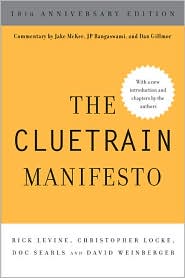
Cluetrain 10th Anniversary edition
Cluetrain 10th Anniversary
Everything Is Miscellaneous
Small Pieces cover
Small Pieces Loosely Joined
Cluetrain cover
Cluetrain Manifesto
My face
Speaker info
Who am I? (Blog Disclosure Form) Copy this link as RSS address Atom Feed

December 15, 2002

Quality of Service

[This is a draft of a column that will run in DarwinMag on Wednesday, probably.]

Who could object to quality?

Actually, you do. You object to quality every time you buy a worse-but-cheaper brand, order from the top of the wine list instead of the bottom, or reject the “pro” version of some over-featured piece of software.

And you also object to quality of service every time you get righteously annoyed at the way the waiters fawn over the well-dressed couple while barely remembering to clean up your spilled root beer. And, most important, you object to quality of service when you’re waiting on line and some perceived VIPs are served ahead of you because their quality of service degrades your quality of service.

That’s at the heart of the current debate over Quality of Service (QoS) as the Internet begins to subsume other networks. In fact, David Isenberg (who saw a draft of this column) expands the analog: “Maybe you’re pissed that they got in with no delay while you have to wait (delay). Maybe you’re pissed because they can count on getting in right away, while you never know how long you might have to wait (jitter). And maybe you never get in, thanks to those VIP a**holes filling up the place (lost packets).” One person’s Quality of Service can be another person’s Degradation of Service.

That’s what could be. As it stands, the Internet treats all bits alike. When a packet arrives at a router, it gets sent along regardless of what type of data it encodes. In fact, there’s no way to tell what type of data it’s carrying. Medical X-Ray Bits are moved just as quickly as Pamela Anderson Bits. And it doesn’t matter what order the packets arrive in: if the packets encoding Pam’s eyes show up after the ones encoding her painted toenails (assuming that it’s a photo of her vertical and rightside up), they will be put into the right order by the machine receiving them.

But many of the companies who are using the Internet as a transport for telephone calls say that their bits are different. If you’re reciting the Pledge of Allegiance over the phone (soon to be a requirement, by the way), if the “to the flag” ” bits arrive after the “under God,” your message will be unintelligible. Therefore, telephone bits deserve special treatment. Or so the argument goes.

Some very serious people disagree. Their arguments are of three types.

First, QoS is impractical. There are indeed bits in IP packets designed to indicate “type of service,” but no one uses them. There’s not even agreement how to interpret them, much less how to rank them. More important, the Internet routers would have to be set to act on thost bits which would require a massive retooling of the Net’s “operating system.”

Second, QoS is the wrong solution. According to this line of thought, QoS is only required if there’s a scarcity of bits available. It’d be far better to solve the QoS issue by opening up the sluices of connectivity: light up the “dark” (unused) fiber, open up the spectrum for public access, install more powerful routers, get with the IPv6 program. With sufficient bits and sufficient throughput, voice packets will arrive in time without having to always arrive first.

Third. QoS violates the principle of the Internet’s architecture. The Net has succeeded precisely because it does nothing but move bits from A to B. This is the “ End-to-End” theory described by Saltzer, Reed and Clark and the “Stupid Network” as described by Isenberg. Part of the simplicity that keeps the Internet humming is the fact that it treats all bits alike. Further, the fact that the Internet is not optimized for any particular applications means that it is optimized for innovation; “tune” the Internet for the VIP du jour and you will de-tune it for other applications. Let the telphone guys and gals change the way the Net works so that it’s better for voice and then tomorrow change it so that it works better for broadcasting TV shows, and soon the other types of bits we care about will have trouble getting through the line at the check-out counter.

So, even though in theory, we could provide QoS in the short term and open up connectivity in the longer term, doing so would mean obfuscating the true strength of the Internet: It’s no Strom Thurmond when it comes to bits.

Resources

Glenn Fleishman just published a helpful weblog entry on the topic.

Lawrence Lessig just posted a terrific article to Dave Farber’s mailing list, as did Karl Auerbach and Bob Frankston.

David Isenberg’s newsletter in 1999 ran a clear explanation of the issues. The article is based in part on research by Andrew Odlyzko; there’s a long interview with Odlyzko here.

This column resulted from my participating in (well, auditing) an email thread among Glenn Fleishman, Bob Frankston and David Reed. Obviously, they are not responsible for my stupidity, carelessness and poor personal hygiene.

Tweet
Follow me

Categories: Uncategorized Tagged with: tech Date: December 15th, 2002 dw

16 Comments »

Total Information Abuse

From Cryptome comes a write-up of an article in the SF Weekly that’s successfully scary about what it means to have your personal info aggregated:

The SF Weekly’s column by Matt Smith in the Dec 3 issue points out that there may be some information that John M. and Linda Poindexter of 10 Barrington Fare, Rockville, MD, 20850, may be missing in their pursuit of total information awareness. He suggests that people with information to offer should phone +1 301 424 6613 to speak with that corrupt official and his wife. Neighbors Thomas E. Maxwell, 67, at 8 Barringon Fare (+1 301 251 1326), James F. Galvin, 56, at 12 (+1 301 424 0089), and Sherrill V. Stant (nee Knight) at 6, may also lack some information that would be valuable to them in making decisions — decisions that could affect the basic civil rights of every American.

Tweet
Follow me

Categories: Uncategorized Tagged with: politics Date: December 15th, 2002 dw

7 Comments »

Cometa DeHyped

Jane Black deconstructs the Cometa story for BusinessWeek. (Cometa is the semi-sorta alliance among Intel, IBM and AT&T to wifi America. Which would be true if wifi were the same as hot air.)

Tweet
Follow me

Categories: Uncategorized Tagged with: web Date: December 15th, 2002 dw

10 Comments »

December 14, 2002

Lessig on Openness

Excellent column by Lawrence Lessig on keeping the Net open.

Tweet
Follow me

Categories: Uncategorized Tagged with: web Date: December 14th, 2002 dw

11 Comments »

Space Flame

Ever wonder what a flame would look like if there were no gravity? Me neither.

Tweet
Follow me

Categories: Uncategorized Tagged with: web Date: December 14th, 2002 dw

8 Comments »

Virus Map

Want to see the Top Ten Viruses on your continent? Rob points us to this map.

Now how about a map of the Top Ten Viruses on my desktop?

Tweet
Follow me

Categories: Uncategorized Tagged with: web Date: December 14th, 2002 dw

7 Comments »

Hardware Is Solid but Bodies Are Fluid

Adina, knowing my views on the importance of leeway, sent me mail to point to where she blogs a quote from Siva Vaidhyanathan in a slashdot interview:

I think the DMCA (Digital Millennium Copyright Act) is misnamed. I don’t consider it a copyright act. I consider it an anti-copyright act. Copyright is a fluid, open, democratic set of protocols. Conflicts are anticipated by Congress and mediated by courts. The DMCA wipes out the sense of balance, anticipation, and mediation, and installs a technocratic regime. In other words, code tells you whether you can use a piece of material. Under copyright, you could use a piece of material and face the consequences. The DMCA replaces the copyright system with cold, hard technology.

It takes human judgment out of the system and drains the fluidity out of what was a humanely designed and evolved system.

Ah, leeway. What can’t it do?

Tweet
Follow me

Categories: Uncategorized Tagged with: tech Date: December 14th, 2002 dw

5 Comments »

December 13, 2002

The Rural Open Spectrum Project

The FCC has announced it’s considering using unlicensed spectrum to provide connectivity in rural areas. This would include Wifi as well as other technologies that may arise. While this sounds promising and enlightened, some of the people I trust on this topic (AKA the evil slave masters who mold my mind) tell me that shoe-horning connectivity into unlicensed bands is the wrong way to go. Rather, Open Spectrum would not only deliver more bits — as many bits as anyone could want — but would open up the ether for the sort of end-to-end computing that enabled the Internet to flourish.

WiFi, after all, operates on two unlicensed “channels” (2.4gH for 802.11b and 5.7gH for the newly-introduced 802.11a). Why restrict access to a single frequency or two? In the old days (= now) it was assumed that signals had to operate within discrete bands because otherwise they would “interfere” with one another. But new technology obviates that model. (In fact, it turns out that even the metaphors are seriously off.) Modern devices can negotiate their frequencies as they go, like cars switching lanes, which maximizes the throughput of a highway. And Ultra-Wide Band can pack an enormous amount of information in short bursts that cut across all frequencies. Current law — permitting only those with FCC-granted licenses to use particular frequencies — is based on bad science and worse technology.

So, open the spectrum and you get: more bits than anyone can eat anywhere you get radio reception. You also give everyone with a connection many of the capabilities of the national broadcasters, which is a scary thought but only if you’re a broadcaster.

Spectrum without permission. What a concept.

(I have a white paper on open spectrum here. And my evil mind molders are Jock Gill, David Reed and Dewayne Hendricks. Don’t blame them for what I get wrong, though; they haven’t read this blog entry, for example.)

Tweet
Follow me

Categories: Uncategorized Tagged with: tech Date: December 13th, 2002 dw

6 Comments »

Report from Another Planet

From the online free version of the improbable Annals of Improbable Research comes an improbable journal entry recounting the day Oliver Sacks visited a guy who made a literal table of periodic elements. It includes videos of a self-induced sodium explosion and of liquid nitrogen turning eggs, cream and sugar into ice cream. Also, there’s a snippy argument over who has the larger lump of tungsten.

I’m at a loss.

Tweet
Follow me

Categories: Uncategorized Tagged with: web Date: December 13th, 2002 dw

3 Comments »

Rosenberg on Supernova

Scott Rosenberg sums up the meaning and import of the Supernova conference and uses it to wax wise on the larger trends.

Nice eye, as they say at the Little League games.


Myles Weissleder has posted photos from Supernova. Collect them all!

Tweet
Follow me

Categories: Uncategorized Tagged with: web Date: December 13th, 2002 dw

2 Comments »

« Previous Page | Next Page »


Creative Commons License
This work is licensed under a Creative Commons Attribution-NonCommercial-ShareAlike 3.0 Unported License.
TL;DR: Share this post freely, but attribute it to me (name (David Weinberger) and link to it), and don't use it commercially without my permission.

Joho the Blog uses WordPress blogging software.
Thank you, WordPress!