


logo
EverydayChaos
Everyday Chaos
Too Big to Know
Too Big to Know
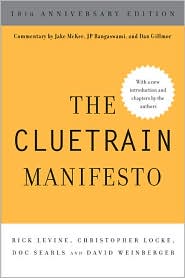
Cluetrain 10th Anniversary edition
Cluetrain 10th Anniversary
Everything Is Miscellaneous
Small Pieces cover
Small Pieces Loosely Joined
Cluetrain cover
Cluetrain Manifesto
My face
Speaker info
Who am I? (Blog Disclosure Form) Copy this link as RSS address Atom Feed

December 18, 2002

Paying for Archives

Scott Kirsner (columnist at the Boston Globe and contributing editor to Wired and FastCompany…the type of guy freelancers like me envy) responds in an email to my explanation of why I urge people to subscribe to Salon but bash the Globe for tucking their online articles away in a for-pay archive. He writes:

In my mind, if you want an organization to survive – whether it is a for-profit one like Salon or the Globe or a non-profit like the American Heart Association – it makes sense to financially support it.

The reason the Globe has been existent since 1872, supporting public discourse etc, is that it has figured out how to reliably make money over that period.

When we started the Web site in 1995, there was no government agency giving us a grant to put the Globe’s material online, for free. One of the things that subsidizes the cost of putting the content online with no cost to readers – even if only for a few days – is the archives.

I promise you that it is not “almost free” to run vast databases of stories, with credit card verification, etc. (And to pay the technicians to make sure that the servers remain up and available.) You’re right that the actual cost of delivering each story is probably not $2.95, but that cost does subsidize a lot of stuff that goes on line for free, even if only temporarily.

An interesting question to ask is what will happen to newspapers that perennially lose money on their Web operations. I don’t think it would be such a wild prediction to say that they would either shut them down, or, if they didn’t, see the losses from their Web operation begin to hurt the print operation – forcing them to fire reporters, editors, photographers, etc.

Given all the statistics about declines in newspaper readership by young people, the high cost of printing and delivering the things, and the revenue threat from online job sites, I don’t think it’s a foregone conclusion that newspapers like the Globe are institutions that will survive forever and ever regardless of whether their businesses are run intelligently.

I suspect I won’t change your opinion on this, but just thought I would write and contribute to the conversation…

I know I’m never going to win an argument with Scott because he fights dirty by being right. Nevertheless…

Three principles here conflict for me. First, I believe in people making money on the Web. Second, newspapers have a special obligation to make their information widely available because that is good for our democracy. Third, if you make my web site look bad, your sites’ servers should be terminally infected with head lice. So, how does the Globe policy stack up to these three Prime Directives? (Yeah, I know you can’t really have three prime directives…)

First, the Globe should take in money on the Web. And it does. It runs ads. It markets itself. It lets people buy tickets from season ticket holders. Great! Do these defray the cost of the Web site? Scott’s message implies not.

So, should the Globe now do whatever it has to in order to break even on the Web? Of course not. It wouldn’t run a porn-for-pay service. The Second Principle (oh lordy, now I’m even capitalizing myself) suggests that the paper has a social responsibility to keep its content available to the citizenry. Having to pay to re-read the paper makes our democracy just a little bit worse. The Globe should make money using the well-known SOW technique: Some Other Way.

Third, putting up a link and then taking it down breaks the Web.

So, let’s be positive. What would I suggest the Globe do in order to satisfy these contradictory principles? It’s obvious: I dunno.

Or, possibly: Charge for complete online access to today’s newspaper, but keep access to previous issues free. And have Scott become the editor of an online magazine called “The Boston Globe Presents THE HUB” that has added-value content you can’t get anywhere else, including some kickass weblogs by Globe reporters. Like Salon. Yeah, easy for me to say. But I can’t pretend to give the Globe a business plan; I don’t know enough about their business. All I can do as a reader and citizen is thank them for the good they do and gripe if their values don’t align with mine. And that’s what I’m doing.

I understand that newspapers are in trouble. But of all the ways to subsidize their operations, putting a turnstile in front of the archives is among the worst.

And, I know I am a kook for believing this, but these problems are only temporary. As soon as $300 ebook hardware with high enough resolution becomes a standard part of every school kid’s equipment, newspapers will start to jettison the mass distribution of their print versions. It’s only a few years away. At that point, I will be delighted to subscribe to The Globe Online at the current print price. Without the cost of printing and delivering a forest of paper every day, I sincerely hope The Globe will be richer than Croesus.

I love the Globe. I read its inky pages every day. Long may they crinkle! And if I thought that the only way for the Globe to stay online was to charge $3.00 to read an article in their archive, I’d shut up about it. But we’re looking at a balancing act and IMO the Globe has underestimated the importance of keeping our recent past present to us.


It is with only a trace of irony that I point out that Scott’s columns, including the recent one on weblogs that started this back-and-forth, are archived for free at digitalmass.com, a boston.com site.

Tweet
Follow me

Categories: Uncategorized Tagged with: web Date: December 18th, 2002 dw

10 Comments »

Getting Past our Missile Shield

I have come upon certain information about a hidden weakness of the 10-missile defense shield President Bush has decided to erect to protect our country. Although some may call me unpatriotic or even a traitor for telling our potential enemies how to defeat the shield, I prefer to think of myself as a whistle-blower.

So, here is the one can’t-fail way to exploit the hidden weakness of our missle shield: Fire 11 missiles.

Tweet
Follow me

Categories: Uncategorized Tagged with: politics Date: December 18th, 2002 dw

9 Comments »

December 17, 2002

Cometa’s Tale

Jane Black deconstructs the Cometa story for Businessweek. Cometa made a splash last week by announcing that AT&T, Intel and IBM had joined to provide nationwide wifi access. On a closer reading of the press materials (first suggested by Peter Kaminski), it turns out that the Big Three have very little skin in this game. Further, it’s not clear that the game is about putting up 20,000 hotspots; it could just be an announcement that Cometa is available if you’re a telco or an ISP looking to outsource your WiFi construction project. (Jane’s take is more detailed and fact-based than mine.)

Jane also draws an interesting parallel to ZapMail, FedEx’s plan to put them new-fangled fax machines in their offices so that they could fax business’s documents. That way individual businesses wouldn’t have to buy the expensive contraptions. But this centralized approach failed as prices dropped and every business installed its own. In the same way, centralized provisioning of WiFi may (should!) give way to the bottom-up installation of neighborhood networks. (

Do I sense Clay Shirky‘s hand in the inclusion of the ZapMail story? I know it’s something he’s interested in.)


Dehyphenated WiFi

I’m annoying Dewayne Hendricks — cited in Jane’s article — by refusing to spell WiFi as “Wi-Fi,” which is the official spelling. I figure I’m already too stiff in my spelling because I capitalilze the interior “F.” Hell, I think it really ought to be spelled “wifi.”

I also spell “e-mail” as “email.”

Suppose I compromise by agreeing to put the hyphens I save into “co-operation” and “margin-of-error.” Win-win!

Tweet
Follow me

Categories: Uncategorized Tagged with: web Date: December 17th, 2002 dw

14 Comments »

Centralizing the Servers

Craig Allen writes in an email:

This may be common knowledge, but I learned from a brief article in Doctor Dobb’s Journal (ya gotta pay on the web, I get the print edition free, how weird is that?) that way back when the Internet was being designed, AT&T somehow forced the design to rely on a relatively small number of central routers rather than a more distributed, decentralized approach. As a result, the net is more vulnerable to various kinds of Denial of Service attacks, various unplanned disasters, and (I’m not sure if this is an assumption on my part or the article said it) less throughput. AT&T’s reason was that otherwise it would be too competitive with the phone network (most of which they owned at the time).

(Craig notes that he’s summarizing from memory and thus may be off in some of the details.)

News to me. Sounds plausible. But everything sounds plausible to me.

Tweet
Follow me

Categories: Uncategorized Tagged with: tech Date: December 17th, 2002 dw

9 Comments »

Schneier’s Favorite Color is Gray

Kevin Marks writes “Bruce Schneier gets it” and appends this quotation to prove it:

This is law, not technology, so there are all sorts of shades of gray to this issue. The interests at stake in the original attack, the nature of the property, liberty or personal safety taken away by the counterattack, the risk of being wrong, and the availability and effectiveness of other measures are all factors that go into the assessment of whether something is morally or legally right. The RIAA bill is at one extreme because copyright is a limited property interest, and there is a great risk of wrongful deprivation of use of the computer, and of the user’s privacy and security. A strikeback that disables a dangerous Internet worm is less extreme. Clearly this is something that the courts will have to sort out.

It’s important that we brand the RIAA position as extremist. It’s also important that we recognize that software will never be able to make the Fair Use judgments that humans do. Leeway is crucial.

Kevin writes: “His ‘Secrets and Lies’ book is good on this too.” I haven’t read it, but in my experience Kevin has yet to be wrong in a recommendation.

Tweet
Follow me

Categories: Uncategorized Tagged with: politics Date: December 17th, 2002 dw

21 Comments »

Lott’s Racist Association

From Slate’s daily roundup of the news, by Eric Umansky:

The LAT’s [Los Angeles Times] Lott coverage had a nice bit of newspaper-speak. It mentions that he promised to reconsider his ties to the Council of Conservative Citizens, “a group attacked as segregationist.” A group attacked as segregationist? Any semi-conscious person would conclude so. (See for yourself: http://www.cofcc.org/page12.htm )

Lott has given speeches to the group over the years and has met with their leaders. According to the Washington Post:

In his speech [to the group], Lott, according to the newsletter, called the Citizen Informer, warns against the forces supporting government spending: ‘We need more meetings like this across the nation’ to offset these liberal pressures. ‘The people in this room stand for the right principles and the right philosophy. Let’s take it in the right direction and our children will be the beneficiaries'” (Thomas B. Edsall, The Washington Post, December 16, 1998).

Here are some excerpts from the page Umansky points to :

To a large extent, soft conservatives and so-called “neo-conservatives” have embraced the legacy of Martin Luther King and the civil rights movement. Nowadays, the average “conservative” policy maker thinks and acts like a bleeding heart liberal from 1963. …

The C of CC recognizes that European Christian heritage is essential for the survival of our standard of living and way of life. There is no acceptable substitute for the civilization that has evolved through the Greeks, Romans, Celts, and Anglo-Saxons.

Some “gems” from elsewhere on their site:

The burden of slavery will probably never be lifted from the white man. And yet, the real shame of slavery is that Africans were ever brought to America in the first place. No system of labor was ever more costly or cumbersome…

Rather than doling out government checks from welfare offices, an African Slave Reparation and Repatriation Fund should be created to undo the wrong that was done 400 years ago. Countries like Gambia, Senegal, and Liberia would receive a fixed bounty for every slave descendant who migrates to Africa …


Lott may never have meant, as happily charged in the press, that we would have been better off with a segregationist President, but I wish he had. It is true, and it is time someone says so.


The Sixth Law of God is a book that will stun even fundamentalist Christians! Pastor V. S. Harrell has researched the oldest available Greek Septuagint texts to prove that the Commandment against adultery is a law against race mixing!

Lott will be gone within a week. Having rejected segregation, the Republicans will turn with minty-fresh breath to the task of preserving the nation’s concentration of wealth.

Tweet
Follow me

Categories: Uncategorized Tagged with: politics Date: December 17th, 2002 dw

10 Comments »

Treat Yourself

Go take a look at Gary and Fiona’s gorgeous newborn, the very picture of possibility.

(On a completely different note, if Gary’s site greets you with the wrong name in the upper right, try clicking on the “If you’re not so-and-so” link. Really.)

Tweet
Follow me

Categories: misc Tagged with: misc Date: December 17th, 2002 dw

10 Comments »

December 16, 2002

Gary Boone’s New Blog

Gary Boone starts off his new weblog with a thoughtful essay on the relationship of trains and the Internet, and a link to an “impossible” puzzle from Simon Coggins. (Actually, since I don’t understand the solution that’s provided, it remains to me truly impossible.)

Welcome to Blogland, Gary.

Tweet
Follow me

Categories: Uncategorized Tagged with: web Date: December 16th, 2002 dw

6 Comments »

Adina Reviews “Small Pieces”

Adina reviews my book “Small Pieces Loosely Joined,” filtering it through her interest in Talmudic interpretation. As you know by now, Adina is way smart and an incisive reader.

There are two points where I’d either object or ask a question (or, better, passive-aggressively object by asking a question). First, she takes “authenticity” in a way that I don’t quite get and don’t think I intended. She seems to think I mean by it something having to do with the purity of one’s roots when in fact I use it as something like taking ownership for who one is.

Second, she is put off by the book’s romanticism. I can see why. And it is certainly a reasonable objection to “The Cluetrain Manifesto.” But I’m bothered by this because I intended “Small Pieces” not as a barbaric yawp in favor of individualism, yada yada, but as a way of talking about our weird representationalist self-understanding, i.e., our belief that experience is something in our own minds.

Anyway, her review is more interesting and helpful than my self-obsessed nitpicking is letting on. Thank you, Adina.

Tweet
Follow me

Categories: misc Tagged with: misc Date: December 16th, 2002 dw

8 Comments »

Boston Globe: The Link Maker … and Breaker

I’m pleased as Hubert Humphrey’s punch to be included in the list of Boston bloggers mentioned by Scott Kirsner in today’s Boston Globe, along with Dan Bricklin, John Robb, Ray Kurzweil, Jeremy Allaire, Ray Ozzie, and Bob Frankston. That’s some heady company!

At the risk of being churlish, I do feel the need to address Scott’s poking me about why I urge people to subscribe to Salon but knock the Globe for “asking users to pay for access to Globe articles once they are moved into the site’s archives.” Is it because my “instinct is usually to side with the underdog,” as Scott guesses?

Well, sure, there’s that. But also…

1. Salon needs the support. While its editor Scott Rosenberg says its finances are not nearly as shaky as some have assumed, nothing is certain in this crazy hill of beans, and we need some high-quality online magazines to succeed.

2. Newspapers have a special role. They are the bedrock of public information. They try for comprehensive coverage and they aim for a type of objectivity that lets our beliefs have some shared footing. Locking up that information makes our society stupider. (Yes, yes, I know objectivity is so pre-POMO, etc.)

3. It costs the Globe as close to nothing as humans can count for me to search their archives and look at an article. The pricing is thus unrelated to costs. Paying 5 times the price of an entire printed copy of the newspaper is waaaay too much.

4. The most important social role of a publication like a newspaper is to enable conversations. We want an informed citizenry so that we can get past “Hey, how’s it goin’?” when we talk with one another. That’s crucial to how we make social decisions and to how we come to be a community in the first place. But kicking off a conversation in public and then going to sulk in your room is just plain rude. Salon, on the other hand, makes it clear from the beginning: if you want to talk, pay your $29/year.

5. Of all the links in this blog entry, there’s only one I can guarantee will be broken in a week: the link to Scott’s article.


In a fit of irony, the Globe’s archives seem to be down this morning.


While I’m in an appending mood: “404! Page gap! 404!” is a palindrome.

Tweet
Follow me

Categories: Uncategorized Tagged with: web Date: December 16th, 2002 dw

21 Comments »

« Previous Page | Next Page »


Creative Commons License
This work is licensed under a Creative Commons Attribution-NonCommercial-ShareAlike 3.0 Unported License.
TL;DR: Share this post freely, but attribute it to me (name (David Weinberger) and link to it), and don't use it commercially without my permission.

Joho the Blog uses WordPress blogging software.
Thank you, WordPress!